 @memeorandum@universeodon.com
2026-05-30 01:10:54
No heavyweights allowed: Troops must meet fitness criteria to attend White House UFC event (NBC News)
https://www.nbcnews.com/politics/white-house/no-heavyweights-allowed-troops-must-meet-fitness-criteria-attend-white-rcna347606
http://www.memeorandum.com/260529/p127#a260529p127
 @azonenberg@ioc.exchange
2026-07-30 03:20:46
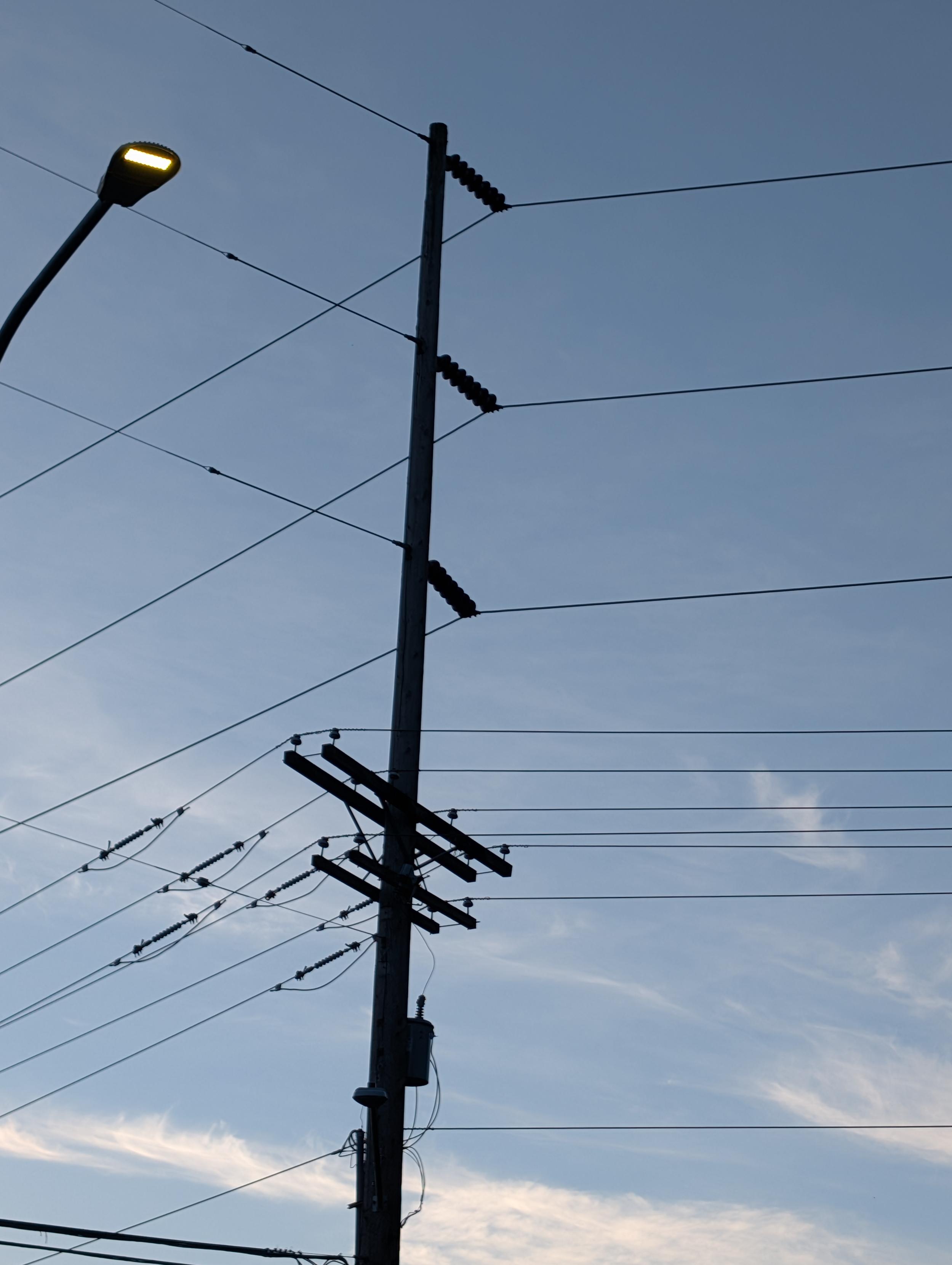
Posting some typical north American power infrastructure in response to a discussion earlier today.
This pole is in a downtown area and is mixed transmission, distribution, and communications.
Top lines with largest spacing are transmission, feeding to a substation the next block over. Probably 100 kV.
The ones on the cross arm are distribution, probably around 10 kV. Both 3 sets are 3 phase.
 @bourgwick@heads.social
2026-05-29 13:34:45
whoever it was who decided that the difference between "signal" & "no signal" on our internet router should be a solid blue light & the same blue light slowwwwwly almost imperceptibly fading on/off, please come to the courtesy phone, i would like to shoot your clown ass from a fucking cannon.
 @aardrian@toot.cafe
2026-07-29 12:01:26
The 2026 State of CSS Survey results are out:
https://2026.stateofcss.com/
Unsurprised color features in CSS are most hated, despite last year’s survey’s odd focus on them.
CSS carousels also fitting given they encode WCAG violations, break Separation of Concerns.

 @heiseonline@social.heise.de
2026-07-21 12:17:03
Garmin Cirqa: Bildschirmloser Fitnesstracker ohne Abo
Garmin hat mit dem Cirqa seinen ersten bildschirmlosen Fitnesstracker vorgestellt. Das Band erfasst Gesundheitsdaten und kommt ohne Abozwang.
https://www.
 @edintone@mastodon.green
2026-06-30 12:51:43
Northampton's Ghosts of Industry project. Capturing fading painted street signs. #GhostSigns
 @carloshr@lile.cl
2026-07-28 18:06:44
Encuesta:
¿Contratarías a un detective privado para averiguar si tu pareja te es infiel?
Como siempre, bienvenidas todas las opiniones y comentarios.
#Encuesta #Fediencuesta
 @hex@kolektiva.social
2026-05-29 22:15:58
I tried to write something up to talk about an idea, but it didn't quite work. I have a lot more I need to put into it. But I want to get an idea out, and, after talking with a person who pointed out some of the flaws in what I wrote, I think I can maybe write down the kernel of the idea here.
An acquaintance of mine did a deep dive on Operational Art and wrote his thesis (which prompted an earlier set of posts and an article I wrote for my professional-ish blog) on the intersection of the OODA loop and critical philosophy. I've been spending a lot of time thinking about Kilcullen's Three Pillars model (after watching Andrewism's wonderful video) and Beer's VSM. The TL;DR of it is that there's a much better insurgency model. Of course, the insurgency model also works for a bunch of other things, because cybernetics lets you do all kinds of cool abstraction like that.
So as I was reading the essay of a comrade the other day, that model popped back into my head and I'm going to try to share what I can of it.
When colonizers came to the Salish region, they saw what they believed to be an untouched wilderness. They failed to see the ways in which Salish people tended the land. Indigenous fire practices were common on the northwest coast, and the suppression of those practices remains a problem. There is an interrelationship between an environment and the systems within it. Systems, like people, animals, and cultures, adapt to the environment. In doing so, those systems will also change the environment.
Social technology was invisible, so colonizers defaulted to either some kind of Rousseauvian or Malthusian model of these people. They were not, for the colonizers, people who had developed advanced social technologies to live in harmony with their world. They were, rather, people in "a state of nature."
The European influenced left continues to draw this Rousseauvian model, which continues through a lot of Anarchist revolutionary thought. European anarchists were heavily influenced by observations and theories around the behavior of indigenous people. The remnants of this thought still exist in the idea that the system must only be destroyed for us to be free.
This is the same obliviousness to social technology, that social technology actually exists, often informs both early colonizers and modern radicals.
It is through this obliviousness that we fail to recognize how capitalism is a social technology that is managed into existence and maintained, and how changes in the environment can threaten institutions that have become over-adapted to a specific version of that environment.
We can extend Kilcullen's metaphor of a "conflict ecosystem" through cybernetics into a much more rich model, populated by viable systems. The ecosystem itself has a fitness function, which drives adaptation within the environment. But all actors in the environment also affect it. Some try to manage the environment. Revolutions are often over who manages a social ecosystem, over who controls the social technology and what it does.
Once we see this dynamic at play, calls of "riot" and "revolution" make a whole lot less sense. Rather, the question becomes, "how do we change the ecosystem in such a way that it cannot be 'managed' at all?"
Graeber/Wengrow talked about Turtle Island indigenous social technologies in Dawn of Everything, such as the system of moieties and clans described in the book. So I have a good reading list as I think through this model, but I hope the "ecosystem" model is helpful (if not completely fleshed out).
I'd be interested in any critiques or thoughts to help develop this idea more.
@memeorandum@universeodon.com2026-06-27 18:10:58
Man Taken into Custody in Somalia for Role in Feeding Our Future Fraud Scheme (US Department of Justice)
https://www.justice.gov/usao-mn/pr/man-taken-custody-somalia-role-feeding-our-future-fraud-scheme
http://www.memeorandum.com/260627/p39#a260627p39
@heiseonline@social.heise.de2026-06-27 06:04:00
