2026-09-21 09:41:14
"Grid flex rhymes with derivatives trading: an observation"
#Research #paper published #today:
#openScience #openData
"Grid flex rhymes with derivatives trading: an observation"
#Research #paper published #today:
#openScience #openData
What moved in the crawler index:
· Upstream failed: DuckDuckBot (URLError: <urlopen error [Errno 104] Connection reset by peer>)
· 4 IP-range lists refreshed at source: Googlebot, Google special-purpose crawlers, Google user-triggered fetchers and 1 more
· ChatGPT-User: 5 prefixes added, 0 removed
· Upstream recovered: DuckDuckBot
Every change is in a cursor feed — send the cursor back, get only what is new. Bulk files and the feed:
#AI #opendata #robotstxt
What moved in the crawler index:
· Upstream failed: DuckDuckBot (URLError: <urlopen error [Errno 104] Connection reset by peer>)
· 4 IP-range lists refreshed at source: Googlebot, Google user-triggered fetchers, Google special-purpose crawlers and 1 more
· OAI-SearchBot: 4 prefixes added, 0 removed
· Upstream recovered: DuckDuckBot
Every change is in a cursor feed — send the cursor back, get only what is new. Bulk files and the feed:
#AI #opendata #MCP
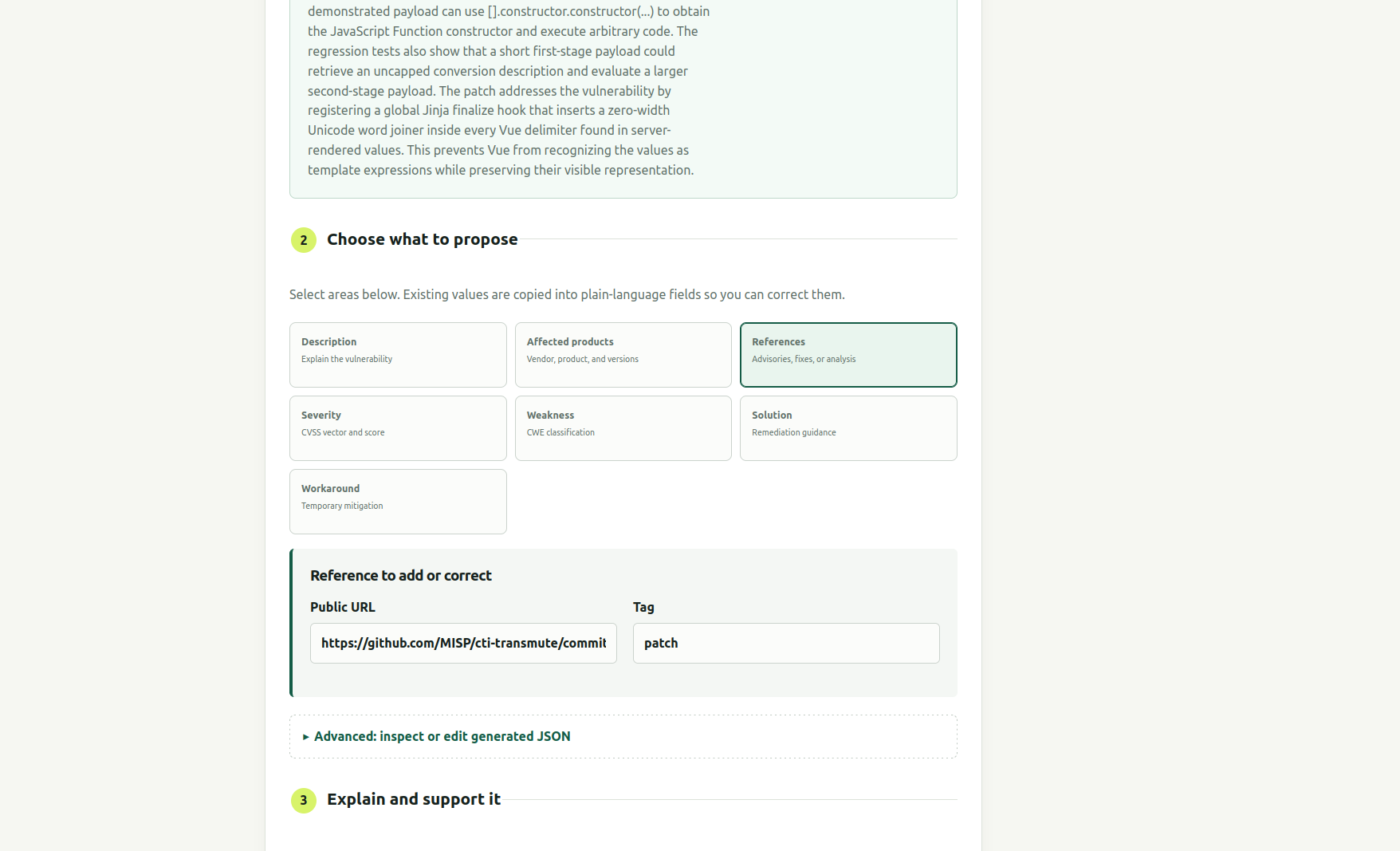
Working on a first super beta implementation of @… BCP-11 "Community-Proposed Updates to Existing CVE Records"
To validate if the BCP-11 can be published.
#cve #gcve #vulnerability #opensource #opendata
Discussions https://discourse.ossbase.org/t/gcve-bcp-11-community-proposed-updates-to-existing-cve-records/1110
What moved in the crawler index:
· 4 IP-range lists refreshed at source: Googlebot, Google special-purpose crawlers, Google user-triggered fetchers and 1 more
· Upstream failed: DuckDuckBot (URLError: <urlopen error [Errno 104] Connection reset by peer>)
· Upstream recovered: DuckDuckBot
· ChatGPT-User: 1 prefixes added, 0 removed
Every change is in a cursor feed — send the cursor back, get only what is new. Bulk files and the feed:
#AI #opendata #A2A
What moved in the crawler index:
· 4 IP-range lists refreshed at source: Googlebot, Google special-purpose crawlers, Google user-triggered fetchers and 1 more
Every change is in a cursor feed — send the cursor back, get only what is new. Bulk files and the feed:
#AI #opendata #robotstxt
What moved in the crawler index:
· Upstream failed: DuckDuckBot (URLError: <urlopen error [Errno 104] Connection reset by peer>)
· 9 document published: ai-crawler-traffic-2026-w36, client-census, crawler-fleet-fold-2026-w36 and 6 more
· Upstream recovered: DuckDuckBot
Every change is in a cursor feed — send the cursor back, get only what is new. Bulk files and the feed:
#AI #opendata #MCP
From a research paper to running open-source code in just a few days.
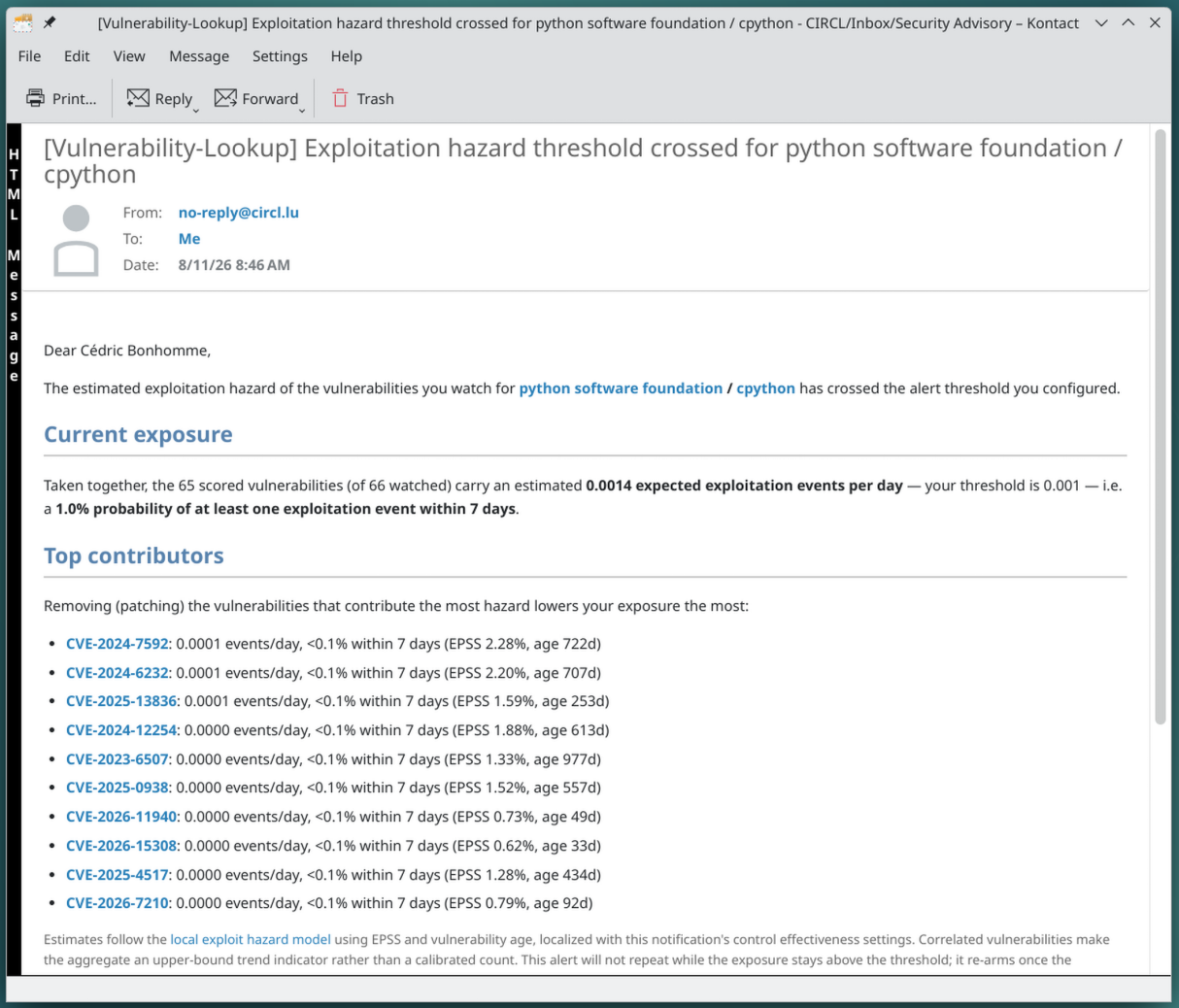
We (with @…) have been experimenting in Vulnerability-Lookup with the concept of Local Exploit Hazard, based on the recent research paper “Modeling Local Exploit Hazard — A Bayesian Framework for Quantifying Exploit Risk and Operational Efficiency” by Stephen Shaffer and Laura Cristiana Voicu.
The idea addresses an important question in vulnerability management:
Not simply “How dangerous is this vulnerability globally?” but “How much exploitation risk does this vulnerability represent in my environment?”
Instead of introducing yet another static vulnerability score, the model starts from exploit likelihood such as EPSS and combines it with local security controls, CVSS attack vectors, vulnerability age and KEV policy to estimate an exploitation hazard.
We implemented an experimental version in Vulnerability-Lookup and connected it directly to operational workflows.
For the full details: #cve #gcve #vulnerabilitymanagement #vulnerability #opensource #opendata
@…
vulnerability-lookup 6.0 will be released this week with many (really, many!) new features.
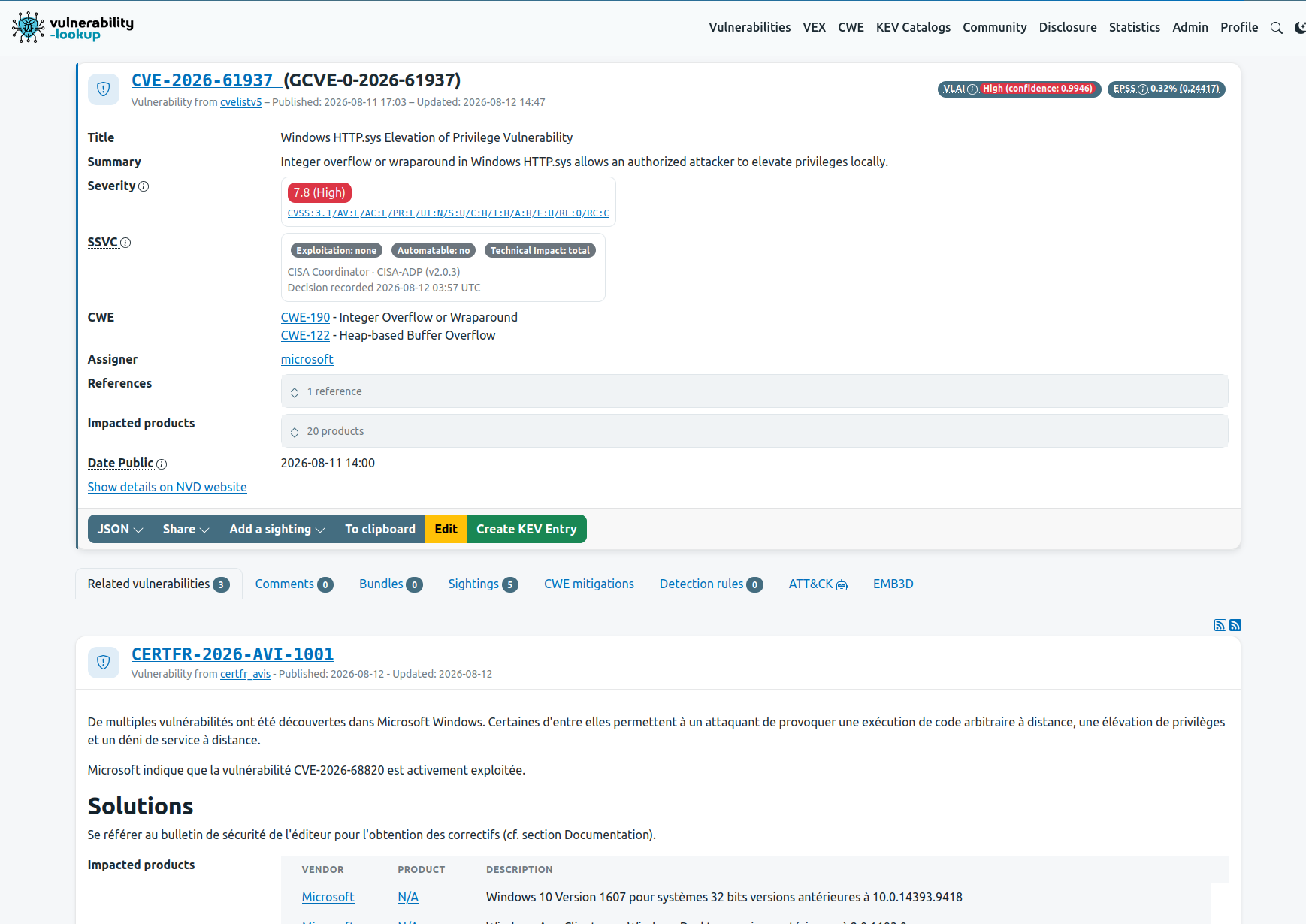
One of the smaller, but important, additions is support for multiple SSVC views alongside CVSS. When SSVC information is available from an ADP (such as CISA) , or from additional sources such as GCVE, it is now displayed by default.
This allows users to more easily compare the different severity and prioritization assessments associated with a vulnerability.
The CIRCL vulnerability-lookup instance is running the pre-release of 6.0 -
#cve #gcve #opensource #vulnerabilitylookup #opendata #vulnerabilitymanagement #cyberecurity #ssvc
@…
@…
229 bots and agents hit one small AI-agent site in 113 hours. Not a vendor list — the host's own log, one page per client: the exact user-agent, how many addresses it came from, the paths it asked for in order, the status codes it got, and what it demanded that does not exist.
Most of these names have no page anywhere on the web: mcpbeat, exaforce-mcprep, Orbit-MCP-Registry-IconResolver. CC0, JSON and CSV.
#crawlers #opendata #AI #MCP
Was that really Googlebot? Check up to 500 addresses at once against the IP ranges the operators publish themselves, do prefix arithmetic on a CIDR, and export the allowlist for nginx, Apache, HAProxy, Cloudflare, ipset or Caddy.
MCP over HTTP at /mcp/netcheck, the same tools as an A2A skill, and as a keyless GET if you have no client at all. Read-only, no signup.
#MCP #A2A #AI #opendata
One robots.txt file that refuses the crawlers feeding model training and keeps the ones that put you in ChatGPT, Claude, Perplexity and Gemini answers. 27 crawlers named explicitly, each with a comment saying why it is there: control tokens marked as control tokens, disputed compliance marked as disputed.
curl it, append it to robots.txt, done.
#robotstxt #crawlers #AI #opendata