 @HeidiSeibold@fosstodon.org
2026-03-04 08:24:34
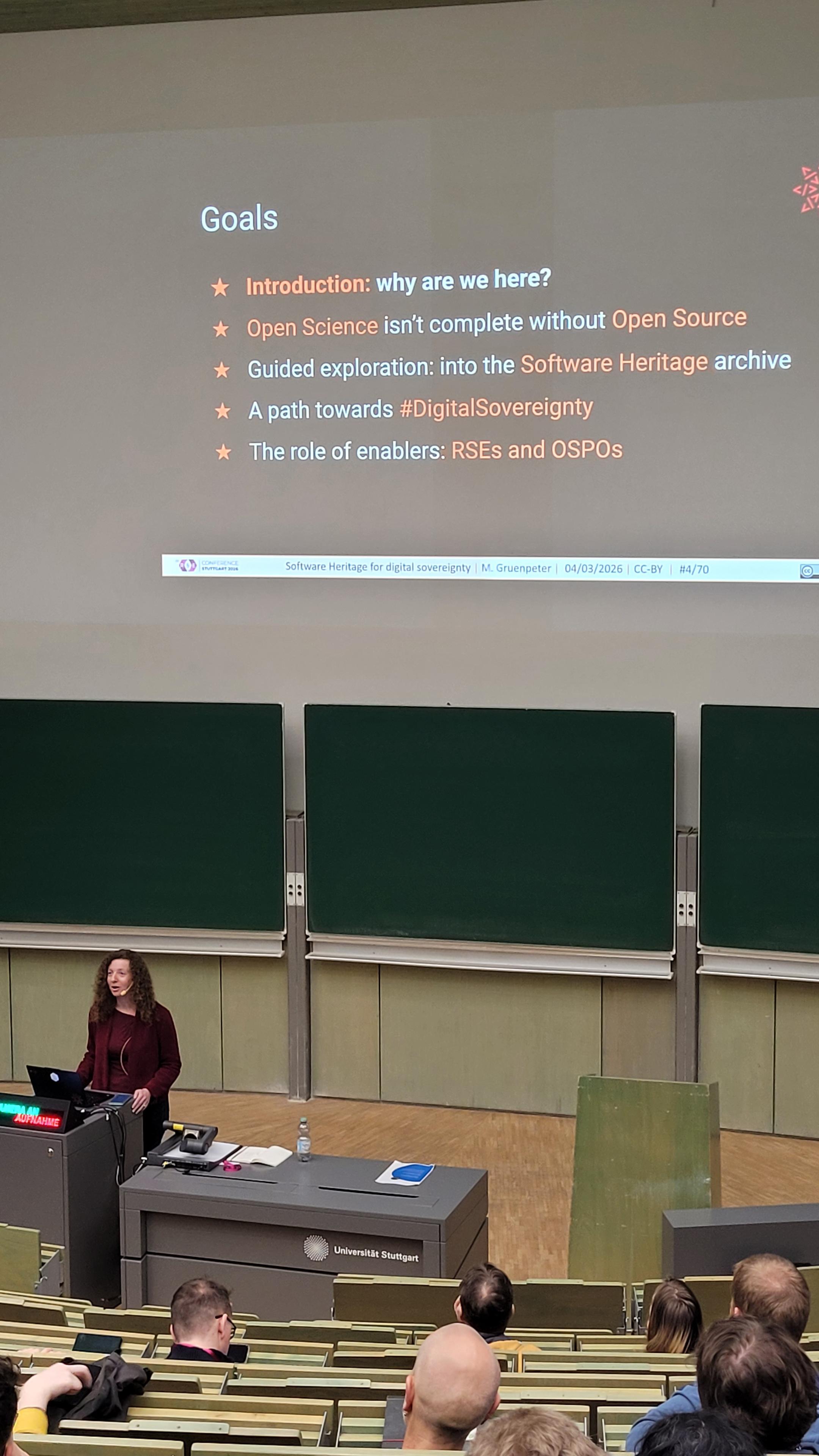
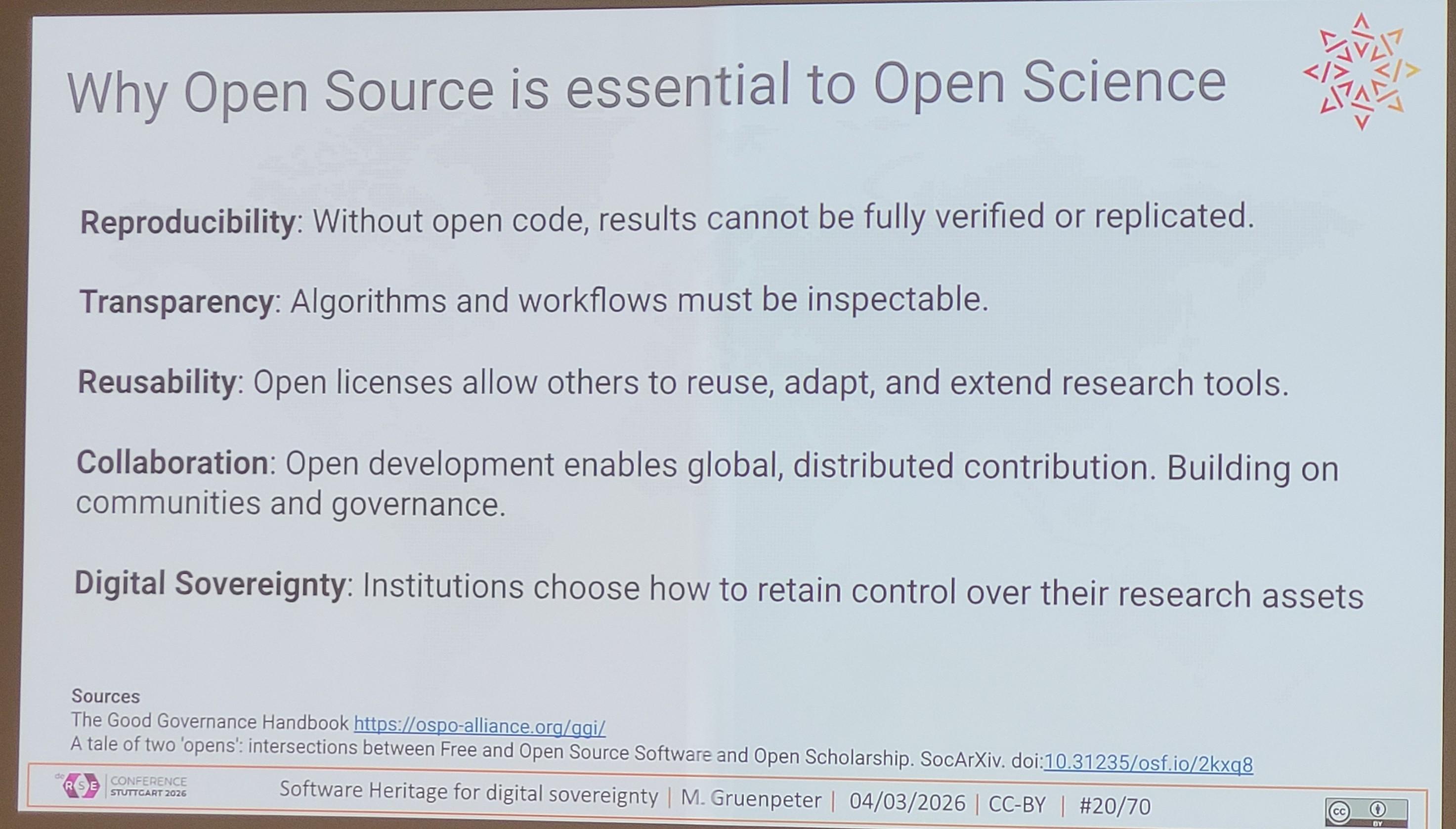
Keynote about #digitalsovereignty by @… this morning at #deRSE26.
The knowledge is in the source code.
 @fanf@mendeddrum.org
2026-03-03 12:42:03
from my link log —
Debugging reproducible build issues in Rust.
https://notes.8pit.net/notes/iqfs.html
saved 2026-03-03 https://dotat.at/:/1MYHD.…
 @cyrevolt@mastodon.social
2026-03-02 16:23:05
https://notes.8pit.net/notes/iqfs.html
That post is generally interesting, but this is non-sense:
"#Rust software commonly consists of a large amount of dependencies" - big nope.
A "large amount of dependencies" is found where software is high-level, and that is due …
@cyrevolt@mastodon.social2026-04-23 16:54:11
 @arXiv_csLG_bot@mastoxiv.page
2026-02-25 10:41:01
PIME: Prototype-based Interpretable MCTS-Enhanced Brain Network Analysis for Disorder Diagnosis
Kunyu Zhang, Yanwu Yang, Jing Zhang, Xiangjie Shi, Shujian Yu
https://arxiv.org/abs/2602.21046 https://arxiv.org/pdf/2602.21046 https://arxiv.org/html/2602.21046
arXiv:2602.21046v1 Announce Type: new
Abstract: Recent deep learning methods for fMRI-based diagnosis have achieved promising accuracy by modeling functional connectivity networks. However, standard approaches often struggle with noisy interactions, and conventional post-hoc attribution methods may lack reliability, potentially highlighting dataset-specific artifacts. To address these challenges, we introduce PIME, an interpretable framework that bridges intrinsic interpretability with minimal-sufficient subgraph optimization by integrating prototype-based classification and consistency training with structural perturbations during learning. This encourages a structured latent space and enables Monte Carlo Tree Search (MCTS) under a prototype-consistent objective to extract compact minimal-sufficient explanatory subgraphs post-training. Experiments on three benchmark fMRI datasets demonstrate that PIME achieves state-of-the-art performance. Furthermore, by constraining the search space via learned prototypes, PIME identifies critical brain regions that are consistent with established neuroimaging findings. Stability analysis shows 90% reproducibility and consistent explanations across atlases.
toXiv_bot_toot
@HeidiSeibold@fosstodon.org2026-02-12 09:30:36
For an upcoming newsletter post I am looking for the best
👉 online resources on reproducible research 👈️
What are yours, and why?