 @UP8@mastodon.social
2026-01-01 00:40:47
⚡ Anomalous electronic state opens pathway to room-temperature superconductivity
#superconductivity
 @UP8@mastodon.social
2026-01-27 16:13:46
⭐ Promising new superconducting material discovered with the help of AI
#materials

 @outer@mas.to
2025-11-16 15:39:21
Room temperature superconductivity.
MATTG is Magic Angle Twisted Tri-layer Graphene.
This stuff actually exists, and is measured and explained in scientific papers.
Fortunately, MIT published an explainer that doesn't hurt your head so much. (It can't yet support a faster-than-sound passenger train...)
The cool picture explainer is in the description.
 @UP8@mastodon.social
2026-01-28 17:20:39
📏 Superconducting detector captures hot spots with submicron resolution
#sensors

 @cdarwin@c.im
2026-01-18 22:47:29
Physicist Yoichiro Nambu
(南部 陽一郎) was born #OTD in 1921.
He developed a theory of spontaneous symmetry breaking
to explain superconductivity,
paving the way for electroweak symmetry breaking via the Higgs mechanism in the Standard Model
 @raiders@darktundra.xyz
2025-11-29 18:14:40
NFL Week 13 betting breakdown: Predictions for every game https://www.reviewjournal.com/sports/betting/nfl-week-13-betting-breakdown-predictions-for-every-game-3588504/
 @arXiv_physicsgenph_bot@mastoxiv.page
2025-11-12 09:10:59
Einstein and Debye temperatures, electron-phonon coupling constant and a probable mechanism for ambient-pressure room-temperature superconductivity in intercalated graphite
E. F. Talantsev
https://arxiv.org/abs/2511.07460 https://arxiv.org/pdf/2511.07460 https://arxiv.org/html/2511.07460
arXiv:2511.07460v1 Announce Type: new
Abstract: Recently, Ksenofontov et al (arXiv:2510.03256) observed ambient pressure room-temperature superconductivity in graphite intercalated with lithium-based alloys with transition temperature (according to magnetization measurements) $T_c=330$ $K$. Here, I analyzed the reported temperature dependent resistivity data $\rho(T)$ in these graphite-intercalated samples and found that $\rho(T)$ is well described by the model of two series resistors, where each resistor is described as either an Einstein conductor or a Bloch-Gr\"uneisen conductor. Deduced Einstein and Debye temperatures are $\Theta_{E,1} \approx 250$ $K$ and $\Theta_{E,2} \approx 1,600$ $K$, and $\Theta_{D,1} \approx 300$ $K$ and $\Theta_{D,2} \approx 2,200$ $K$, respectively. Following the McMillan formalism, from the deduced $\Theta_{E,2}$ and $\Theta_{D,2}$, the electron-phonon coupling constant $\lambda_{e-ph} = 2.2 - 2.6$ was obtained. This value of $\lambda_{e-ph}$ is approximately equal to the value of $\lambda_{e-ph}$ in highly compressed superconducting hydrides. Based on this, I can propose that the observed room-temperature superconductivity in intercalated graphite is localized in nanoscale Sr-Ca-Li metallic flakes/particles, which adopt the phonon spectrum from the surrounding bulk graphite matrix, and as a result, conventional electron-phonon superconductivity arises in these nano-flakes/particles at room temperature. Experimental data reported by Ksenofontov et al (arXiv:2510.03256) on trapped magnetic flux decay in intercalated graphite samples supports the proposition.
toXiv_bot_toot
@UP8@mastodon.social2025-11-09 22:06:11
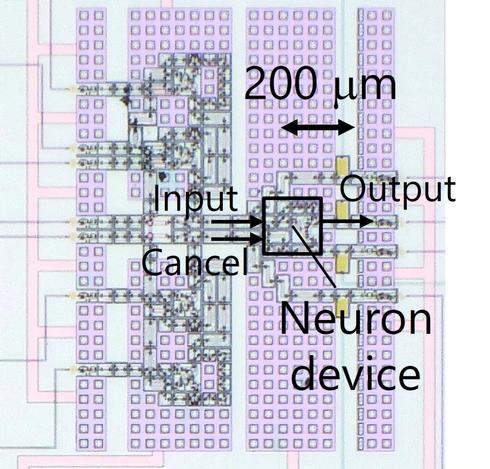
⚡ Team develops high-speed, ultra-low-power superconductive neuron device
#electronics
 @mapto@qoto.org
2026-01-19 09:05:05
This is how superficial one needs to get to justify an argument of US global supremacy. Arthur Herman and WSJ deliberately choose to ignore Taiwan's unmatched leadership in superconductors and China's in energy. Instead, they turn to Soviet-style resources and headcount arguments. Apparently there is a force driving them to sacrifice whatever authority they might still have.
"China remains formidable. But from Europe and the Middle East to South America and Southeast Asia, …
 @arXiv_condmatsuprcon_bot@mastoxiv.page
2025-12-08 07:52:20
Zero-field superconducting diode effect induced by magnetic flux in a van der Waals superconductor trigonal PtBi$_2$
Nan Jiang, Masaki Maeda, Yuhi Yamaguchi, Mori Watanabe, Masashi Tokuda, Kensuke Takaki, Sebun Masaki, Takumi Ikushima, Takayoshi Koyanagi, Masakazu Matsubara, Kazutaka Kudo, Yasuhiro Niim
https://arxiv.org/abs/2512.05427