Tootfinder

Opt-in global Mastodon full text search. Join the index!

No exact results. Similar results found.
@DrPlanktonguy@ecoevo.social
2025-11-29 14:30:16

Weekend #Plankton Factoid 🦠🦐
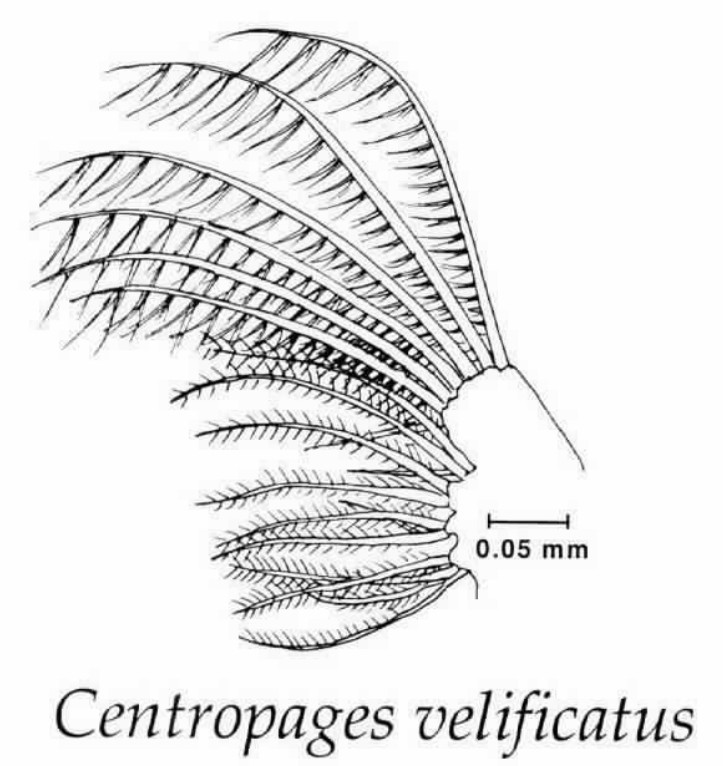
Many aquatic animals are described as "filter feeders" but this is not functionally correct since it would require water forced through a mesh. Instead, most zooplankton, including copepods, are suspension feeders. They create feeding current gyres using appendages, and use spiny modified ones (maxillae) to intercept individual algal particles and move …
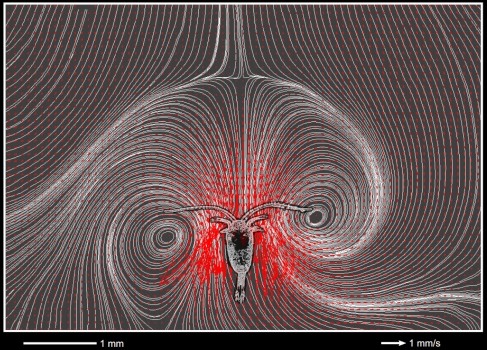
image/jpeg the feeding current of a copepod zooplankton is shown by lines of the path of water. Two circular gyres are formed at the ends of the antennae beside the head which focuses water current into the head of the copepod, highlighted in red. A scale bar indicates the animal is about 1 mm long. 
https://www.oceanlifecentre.dk/news/nyhed?id=ebaa37ec-c19f-482a-a7ea-b02e7553588d
image/jpeg a diagram of a mouthpart (maxillae M2) is shown with long spines on the top and shorter ones on the bottom of one side which have protruding hairs to form a basket-like structure. Caption says Centropages velificatus and the scale bar suggests the entire structure is about 0.4 mm long. Taken from Mimi Koehl. 1998. 11(1), Oceanography.
https://tos.org/oceanography/assets/docs/11-2_koehl.pdf
@DrPlanktonguy@ecoevo.social
2025-10-25 14:16:33

Weekend #Plankton Factoid 🦠🦐
The poles are cold and dark half the year, so you might think these areas were low productivity. Nope. These are some of the highest productivity and efficient food webs on the planet, which is why whales will travel half the globe to feed here. When sunlight returns in spring, long days and nutrients drive intense blooms. There was a question of nutrient sources…
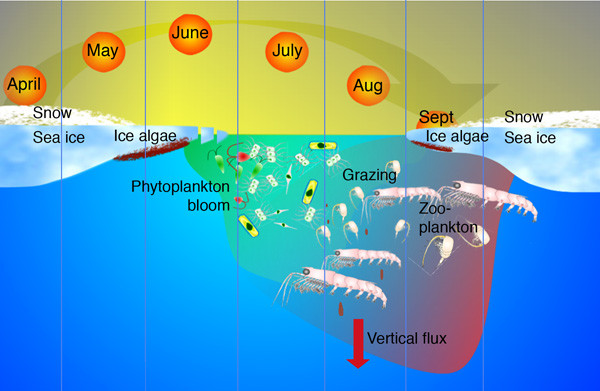
image/jpeg an illustration of the Arctic productivity cycle showing the sun rising higher in April to provide sunlight to support the growth of algae and phytoplankton. The summer sun drives production of dense bloos in June, leading to growth of grazing zooplankton which drives vertical flux of nutrients via fecal matter to the deep waters. Production gradually declines during as the phytoplankton use up nutrients and reduced sunlight.
Illustration: Alexander Keck & Paul Wassmann (1993), modif…