@Techmeme@techhub.social
2026-08-14 16:12:58
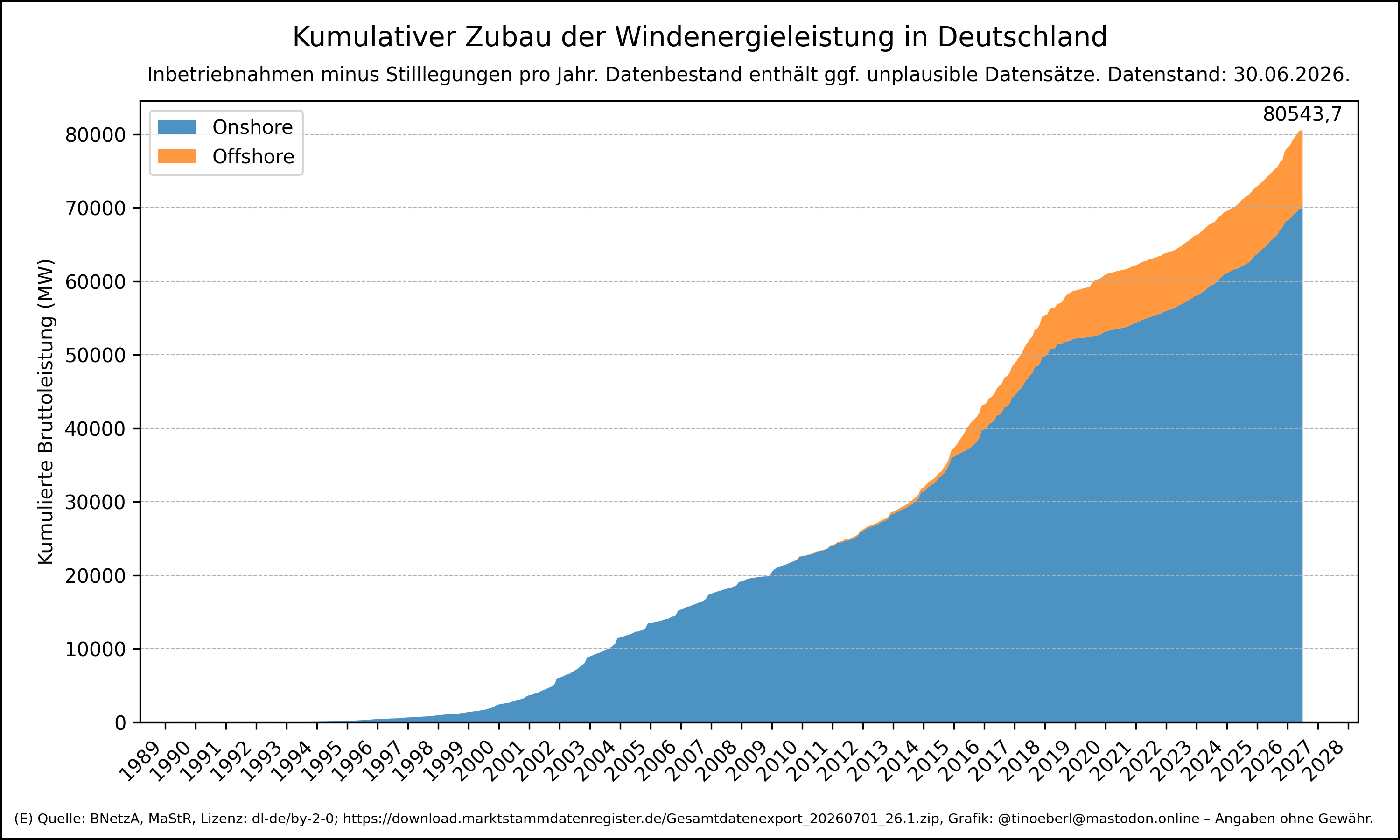
Alibaba releases weights for Qwen3.8 models under Apache 2.0 license, including Qwen3.8-27B, which it says beats Qwen3.7-Plus and excels in real-world coding (@alibaba_qwen)
https://x.com/alibaba_qwen/status/2088280182356611304
 @tinoeberl@mastodon.online
2026-08-09 06:08:02
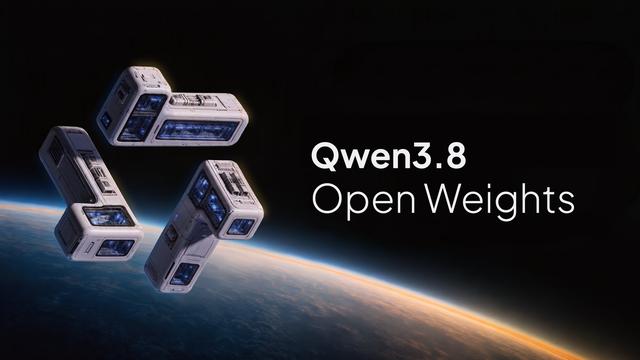
Kumulativer Zubau der #Windenergieleistung in #Deutschland mit Stand vom 31.07.2026.
Summen der Inbetriebnahmen minus Stilllegungen pro Jahr.
Der Datenbestand enthält ggf. unplausible Datensätze.
👉 Zusatzlesestoff: Warum

 @michabbb@social.vivaldi.net
2026-09-05 20:41:25
💻 Binaries available for macOS arm64/x64, Linux arm64/x64 and Windows arm64/x64 for quick local testing. Dashboard runs on localhost:8080.
📊 64.5k stars, 5k forks and 44,095 commits. Licensed under the Sustainable Use License.
https://github.com/nocodb/nocodb
 @toxi@mastodon.thi.ng
2026-07-26 18:50:31
New 10x8" silver gelatin print. This one took a lot of refining, back and forth and test strips to achieve the right balance between brightness, contrast (esp. in the brighter parts of the clouds) and smooth mid-tone transitions. So even though this is a contact print from a digital negative, this was the first time in ages (i.e. decades) that I used some physical dodging to soften the horizon and emphasize the haze in the distance a tiny bit more...


 @arXiv_astrophGA_bot@mastoxiv.page
2026-09-09 09:33:33
Active galactic nucleus activity in brightest cluster galaxies at intermediate redshifts in Sunyaev-Zel'dovich--selected clusters
N. Hatamkhani, R. E. Skelton, J. Delhaize, M. Hilton, S. I. Loubser, N. Gupta, K. M. Mogotsi
https://arxiv.org/abs/2609.09049 https://arxiv.org/pdf/2609.09049 https://arxiv.org/html/2609.09049
arXiv:2609.09049v1 Announce Type: new
Abstract: Context. Brightest cluster galaxies (BCGs) host powerful active galactic nuclei (AGNs) and help regulate the heating--cooling balance of the intracluster medium. While radio-mode feedback is well established locally, its prevalence at intermediate redshifts remains poorly constrained. Aims. We investigate the incidence, accretion state, and host-galaxy properties of AGNs in BCGs in Sunyaev--Zel'dovich (SZ)-selected clusters at $0.3 < z < 0.8$, testing dependences on cosmic epoch, cluster mass, and dynamical state. Methods. We analyse 171 BCGs from the Atacama Cosmology Telescope SZ catalogue, combining Southern African Large Telescope spectroscopy, WISE mid-infrared photometry, and Rapid ASKAP Continuum Survey radio data with \textsc{X-CIGALE} modelling to derive stellar masses, star formation rates, and Eddington-scaled accretion rates. Results. Thirty-eight BCGs (22%) host radio-loud AGNs. Only two ($\sim$5%) are high-excitation radio galaxies; the remainder are low-excitation systems. Most AGNs have low Eddington ratios ($-3 \lesssim \log_{10}\lambda_{\mathrm{Edd}} \lesssim -1$), consistent with radiatively inefficient accretion. Accretion efficiency increases with redshift, while correlations with cluster mass and dynamical state are weak. Radio luminosity is independent of cluster mass. Compared to field radio AGNs, BCG radio-loud AGNs have similar radio powers but are hosted by galaxies $\sim0.8$ dex more massive. Conclusions. BCG radio-loud AGNs at $0.3 < z < 0.8$ are predominantly low-excitation, radiatively inefficient systems, indicating that maintenance-mode accretion was widespread in massive clusters ($M_{500c} \simeq 3.2 \times 10^{14},M_\odot$) by $z \sim 1$. Accretion appears regulated primarily by fuel availability and cosmic evolution rather than global cluster properties, while the cluster environment mainly sets the host-galaxy mass scale.
toXiv_bot_toot
@tinoeberl@mastodon.online2026-07-03 16:18:02
Kumulativer Zubau der #Windenergieleistung in #Deutschland mit Stand vom 30.06.2026.
Summen der Inbetriebnahmen minus Stilllegungen pro Jahr.
Der Datenbestand enthält ggf. unplausible Datensätze.
👉 Zusatzlesestoff: Warum