On Website Technicals (2022-08) - Tech updates: FUELINST glitch, review pros and cons, a11y, fanlife, Save-Data, traffic nadir, JXL. - https://www.earth.org.uk/note-on-site-technicals-63.html
from my link log —
No-one knows the type of char char.
https://blog.knatten.org/2019/05/24/no-one-knows-the-type-of-char-char/
saved 2019-10-17
Bit into a chocolate truffle from a local candy shop that was a kind of hemispherical shape, perhaps made from a flat chocolate base that had a blob of filling put on it and then encapsulated in more chocolate.
And as I'm looking at the seam between the two segments the first thing that comes to mind is... Wouldn't it be cool to freeze one of these in LN2, cross section, polish, maybe ion mill, then do like SEM/EBSD to look at the cocoa butter grain structure around the weld li…
"Durchsage ihres Lokomotivführers: Wegen einer Stellwerkstörung kann diese S11 ab Winterthur nicht weiterfahren. Sie müssen mit einem anderen Zug nach Zürich weiterfahren."
Montag.
#SBB #övlife #Winterthur
Logistics in the technical sense (part of supply chain management) is a subset of logistics in the vernacular sense ("the handling of the details of an operation"). You can explore this second and more general sense, and thereby build an understanding of the first and more technical sense, by iteratively asking the question, "how does one make that happen" and follow questions from there.
A big part of organizing is figuring out the (vernacular) logistics (and helping others figure it out). You want to organize a seed swap? Ok. How does one make that happen? Well, you need seeds, people, a place, and perhaps a time. How does one make that happen? You can forage seeds or you can buy seeds for a garden and swap extras. How do you get people to come? Well, figure out where you want people to come from and choose an accessible place. What's the easiest thing to do? Get people from your neighborhood. How does one make that happen? Well, maybe put up flyers. How does one make that happen? Well, print them on your printer if you have one, or at a library, then go post them up. Etc.
Keep asking questions until you either find a roadblock that you can't find a way around, or you find things you can do yourself (one of those things you can do yourself is asking friends to help).
If you practice the exercise of thinking about how things happen, you can start to find things that you can do yourself. You can start to understand what exists now, and you can imagine what's possible. By thinking about logistics, you can figure out how to replace things when they collapse or are dismantled. You can also identify things that can't easily be replaced, and try to figure out alternatives.
This practice is good for figuring out how to build, but it can also be a valuable practice for figuring out how to resist. Concentration camps and ethnic cleansing also require logistics. Mass displacement means moving people. How does one do that? People are generally going to be moved in planes or buses. How does one do that? Well, people get loaded on to planes or buses in specific places. Planes and buses need fuel. Planes are fueled at their airports, which may well be the same places where people are loaded on to them. There is a fuel depo and a fuel truck that makes flying people out of a specific place possible. How does the fuel get to that fuel depo? Well, that fuel is probably also delivered by truck. Someone drives those trucks. Someone fuels those planes. Someone clears the planes for takeoff. Someone fuels those busses. Someone drives those busses. And so on.
Logistics networks can be highly complex. The more complex the operation, the more possible points of failure and more possible points where pressure can be applied, where operations can be disrupted. Ethnic cleansing is a complicated operation. The logistics of disrupting complicated things tend to be much less complicated than the logistics of the complicated things themselves.
The Right has exploited this fact for a long time. Centralized social services are logistically complex. Public infrastructure is logistically complex. By destroying these things, they can loot public resources by privatizing the infrastructure and functionality.
But the things that support the Right are even more logistically complex. Oil, cars, AI data centers, internal paramilitary, these are extremely complicated and fragile. There are numerous pressure points, all of which can respond to numerous strategies.
If we want to win, we should reduce the influence of politics over the things we care about. We should focus on building distributed mutual aid networks that don't rely on state funding and aren't subject to the whims of politicians. This is also known as "dual power." That is, creating counter-institutions outside of the dominant political system. The Right already does this in the form of churches and corporations.
As we reduce our complexity, we can then press our complexity advantage against the things for which the Right *needs* the state: the apparatus of violence needed to maintain capital and enforce the dominant order.
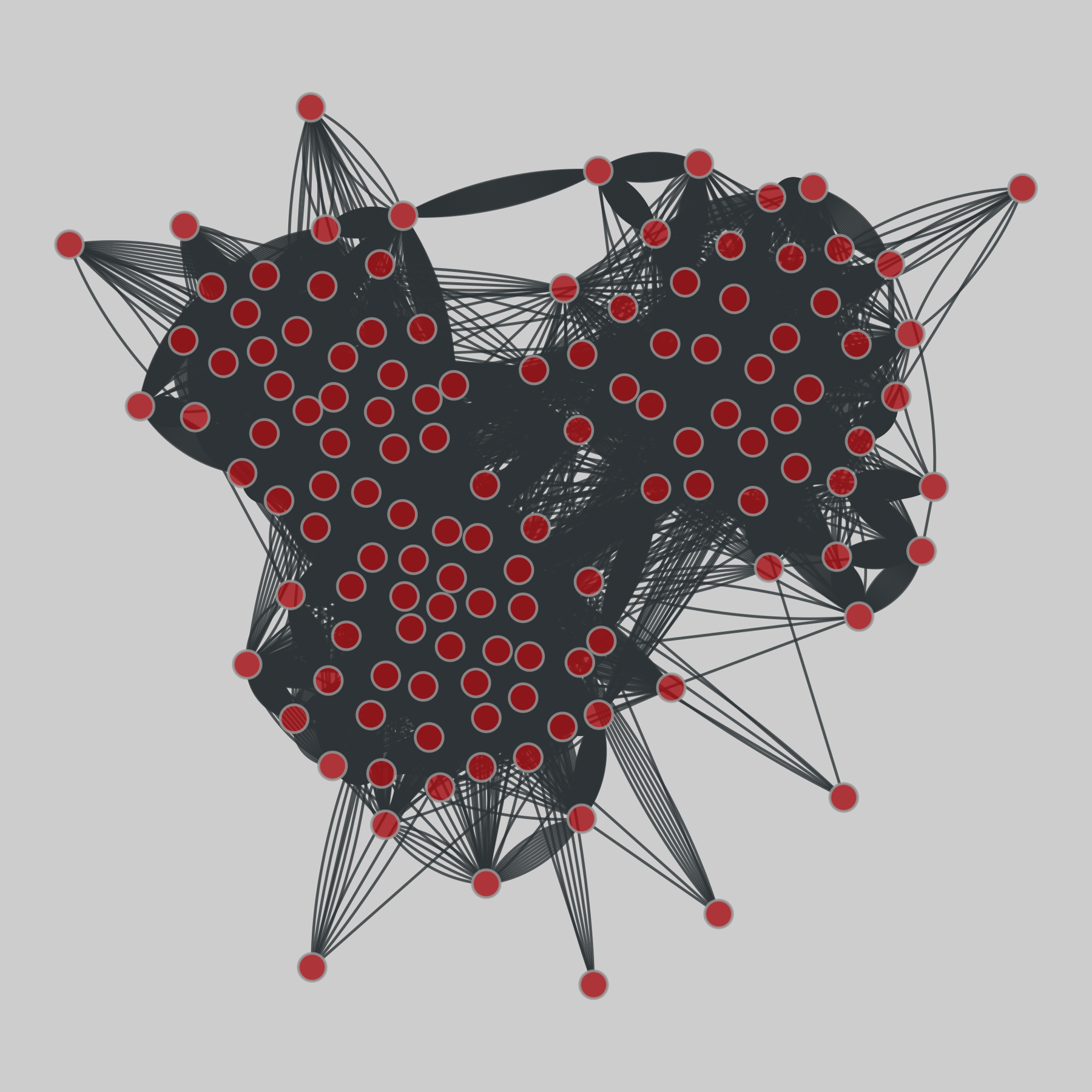
sp_high_school_new: High school dynamic contacts (2011-2012)
These datasets contain the temporal network of contacts between students in a high school in Marseilles, France. The first dataset gives the contacts of the students of three classes during 4 days in Dec. 2011, and the second corresponds to the contacts of the students of 5 classes during 7 days (from a Monday to the Tuesday of the following week) in Nov. 2012.
This network has 180 nodes and 45047 edges.
Tags: Soc…
Solutocapillary instability in slipping falling films
Sanghasri Mukhopadhyay, S\'everine Millet, Bastien Di Pierro, Asim Mukhopadhyay
https://arxiv.org/abs/2605.17519 https://arxiv.org/pdf/2605.17519 https://arxiv.org/html/2605.17519
arXiv:2605.17519v1 Announce Type: new
Abstract: We present a comprehensive framework for gravity-driven, surfactant-laden thin films flowing over slippery substrates, elucidating how wall slip modifies the coupled hydrodynamics and interfacial transport. A long-wave model is formulated with a conservative bulk-surface mass balance and a Navier slip condition. The Orr-Sommerfeld eigenvalue problem governs the linear regime, while a weighted-residual model captures the nonlinear evolution over a range of equilibrium surfactant coverages, Marangoni strengths, and adsorption kinetics. The analysis predicts a non-monotonic variation of the critical Reynolds number with equilibrium coverage, exhibiting a maximum at intermediate $\Gamma_e$, and a slip-induced transition from single- to double-hump solitary structures with increasing Marangoni number, accompanied by attenuated capillary ripples. Under fast adsorption kinetics, the surface field homogenizes, preserving the mean film shape and flux while flattening both the surface concentration $\Gamma$ and the bulk inventory $\chi h\phi$. A spurious interfacial mass growth reported by Pascal et al.(PRF, 2019) and D'Alessio et al.(JFM, 2020) is resolved through a revised surface balance ensuring strict conservation. Wall slip thus emerges as a key control parameter, reducing viscous resistance and mitigating Marangoni back-stress. The slip parameter $\beta$ is a useful control knob for surfactant-laden films. Slip prevents fragile multi-hump bound states, promoting a single broad crest or an almost flat, uniform sheet by carefully bonding $\beta$ to wave selection, ripple damping, and the bulk-surface surfactant balance.
toXiv_bot_toot
"Ideally, that's what you've got in an acting career is an equal number of dramas and comedies and an equal number of small films and big films."
—Jason Bateman
#acting #coaching #inspiration
Happy 5th birthday to #Wordle!
According to Wordle’s stats, I’ve played 1601 times. And because I first started playing on 5 January 2022, I missed playing 26 times.