 @bourgwick@heads.social
2026-03-02 19:16:59
velvet underground researchers have apparently confirmed that this audio from a random youtube user is genuinely the band's long-lost july 8th, 1967 performance from upbeat, a cleveland teen tv show, doing the unreleased "guess i'm falling in love" complete with screaming girls. https://www.youtube.com/watch?v=GU2UNyDoN_M…

 @AprilTeachy@bildung.social
2026-01-03 07:53:00
Seufz...
Explosions and low-flying aircraft reported in Venezuelan capital Caracas
https://www.theguardian.com/world/live/2026/jan/03/caracas-explosions-venezuela-maduro-latest-news-updates-live?CM…
 @netzschleuder@social.skewed.de
2026-01-31 15:00:05
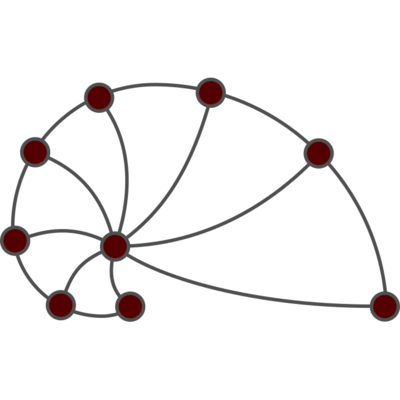
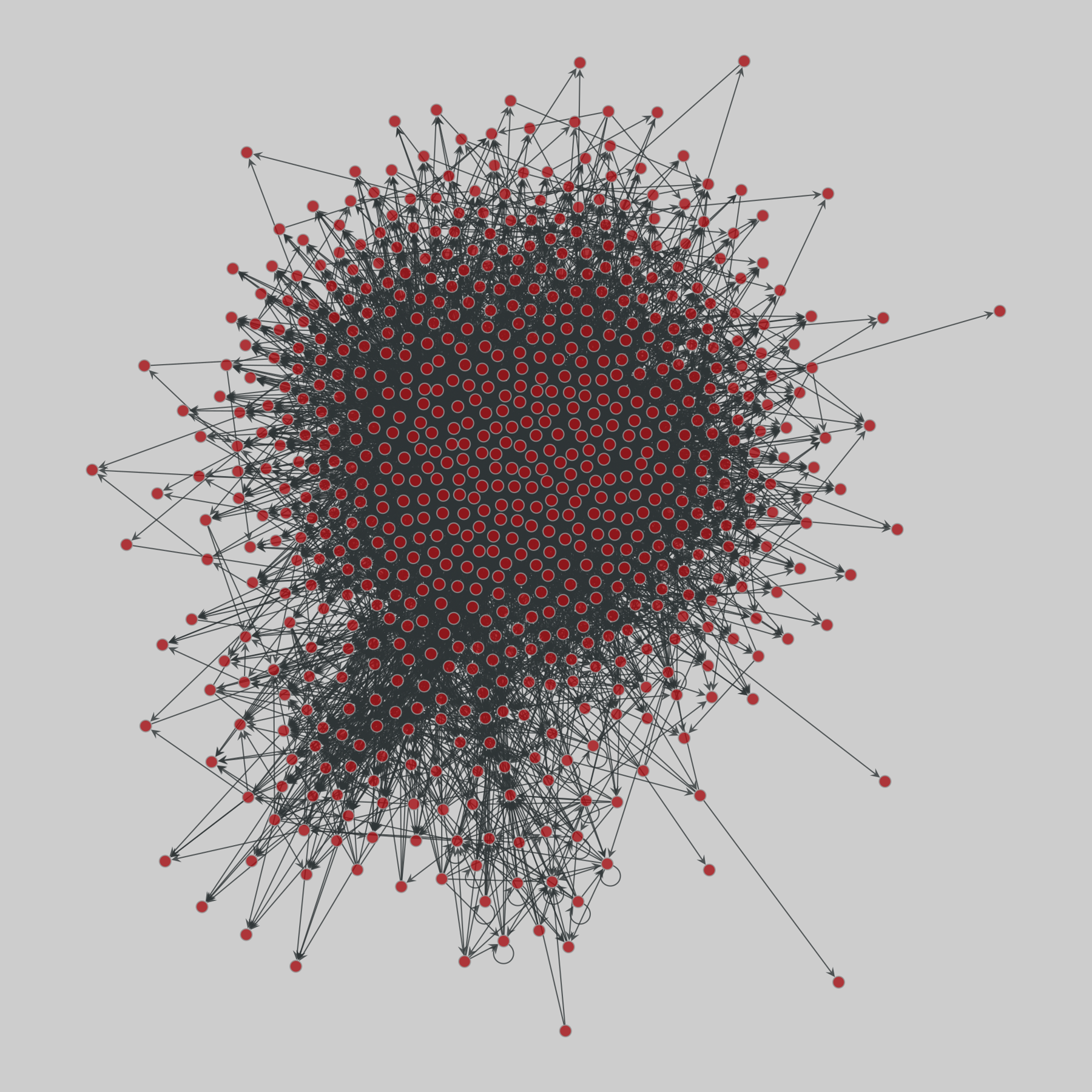
messal_shale: Messel Shale food web (2014)
A network of feeling links among taxa based on the 48 million years old uppermost early Eocene Messel Shale. Edge property 'certainty' denotes the certainty of the edge. Metadata include evidence, habitat, and trophic roles. The edge direction goes from consumer to resource.
This network has 700 nodes and 6444 edges.
Tags: Biological, Food Web, Uncertain, Weighted, Metadata
 @arXiv_physicsinsdet_bot@mastoxiv.page
2026-02-03 09:41:32
Proton Energy Dependence of Radiation Induced Low Gain Avalanche Detector Degradation
Veronika Kraus, Marcos Fernandez Garcia, Luca Menzio, Michael Moll
https://arxiv.org/abs/2602.01800 https://arxiv.org/pdf/2602.01800 https://arxiv.org/html/2602.01800
arXiv:2602.01800v1 Announce Type: new
Abstract: Low Gain Avalanche Detectors (LGADs) are key components for precise timing measurements in high-energy physics experiments, including the High Luminosity upgrades of the current LHC detectors. Their performance is, however, limited by radiation induced degradation of the gain layer, primarily driven by acceptor removal. This study presents a systematic comparison of how the degradation evolves with different incident proton energies, using LGADs from Hamamatsu Photonics (HPK) and The Institute of Microelectronics of Barcelona (IMB-CNM) irradiated with 18 MeV, 24 MeV, 400 MeV and 23 GeV protons and fluences up to 2.5x10^15 p/cm2. Electrical characterization is used to extract the acceptor removal coefficients for different proton energies, whereas IR TCT measurements offer complementary insight into the gain evolution in LGADs after irradiation. Across all devices, lower energy protons induce stronger gain layer degradation, confirming expectations. However, 400 MeV protons consistently appear less damaging than both lower and higher energy protons, an unexpected deviation from a monotonic energy trend. Conversion of proton fluences to 1 MeV neutron-equivalent fluences reduces but does not eliminate these differences, indicating that the standard Non-Ionizing Energy Loss (NIEL) scaling does not fully account for the underlying defect formation mechanisms at different energies and requires revision when considering irradiation fields that contain a broader spectrum of particle types and energies.
toXiv_bot_toot
@AprilTeachy@bildung.social2026-01-03 09:50:04
Ohne Kommentar...
Venezuelan president Maduro captured and flown out of country following ‘large scale’ US attack, Trump says – live
https://www.theguardian.com/world/live/2026/jan/03/caracas-explo…
 @hikingdude@mastodon.social
2026-02-28 15:34:28

 @cdarwin@c.im
2026-03-29 03:15:12
Space Force guardians provided critical support during high-profile U.S. military operations in Iran and Venezuela
— experience that underscores the need for additional resources to prepare the service for future conflicts,
a senior official told DefenseScoop in an exclusive interview Friday.
Operation Midnight Hammer and Operation Absolute Resolve were carried out by the joint force in June 2025 and January 2026, respectively.
Pentagon leadership have touted the rai…

 @Erikmitk@mastodon.gamedev.place
2026-03-31 19:04:00
Happy Birthday, Angus Young!
I listen to Live At River Plate almost every day. This album and his performance all across the board gives me life!
When I’m 71 I want to be able to jump and run around as much as he still does!

 @cosmos4u@scicomm.xyz
2026-02-21 21:04:27
NASA is taking steps to potentially roll back the #ArtemisII rocket and Orion spacecraft to the Vehicle Assembly Building (VAB) at the agency’s Kennedy Space Center in Florida after overnight Feb. 21 observing interrupted flow of helium to the SLS (Space Launch System) rocket’s interim cryogenic propulsion stage: https://www.nasa.gov/blogs/missions/2026/02/21/nasa-troubleshooting-artemis-ii-rocket-upper-stage-issue-preparing-to-roll-back/ - the upper stage uses helium to maintain the proper environmental conditions for the stage’s engine and to pressurize liquid hydrogen and liquid oxygen propellant tanks; the systems worked during NASA’s Artemis II wet dress rehearsals, but teams were not able to properly flow helium during normal operations and reconfigurations following the wet dress rehearsal that concluded Feb. 19.
@hikingdude@mastodon.social2026-01-29 16:51:38
While I'm settling now at home and think about having a walk in the dark to prevent just falling asleep right now - I enjoy the memories from a recent hike.
As you can see at the frosty cross, it was a bit chill. -- Actually .. I'm quite undecicive whether I like summer or winter more? Summer is green and all, but in winter I like the chill and the cold ...
Maybe I don't have to prefer a season? Yes, I guess I just call myself lucky that I can enjoy every season.
