@inthehands@hachyderm.io
2026-02-21 19:55:38
There’s definitely a hopeful feeling in having room to worry about Space Camp fundraising right now, instead of, say, ICE staging at the local Target parking lot yet again (with Target’s tacit blessing, damn them). It’s been quiet in the city these last few days. Fingers crossed.
Hopeful, but also melancholy: even if ICE does in fact draw down to pre-Dec levels, our “after” is not really going to come for a long time — and when it does, it will feel more like a scar than a sunrise.
/end
 @laurentperrinet@neuromatch.social
2026-03-21 09:24:07
Weird feeling as while looking to answer to the question "how do I get the coordinates of the minimal value of a numpy.ndarray ?", found that I already asked that question ten years ago: https://laurentperrinet.github.io/sciblog/p…
 @Dragofix@veganism.social
2026-04-20 01:59:43
Wildfires used to 'go to sleep' at night. Climate change is turning them into prime burning hours https://phys.org/news/2026-04-wildfires-night-climate-prime-hours.html

 @aredridel@kolektiva.social
2026-04-14 14:22:42
So to follow up on this, I've caught it in action. Models, when quantized a bit, just do a bit more poorly with short contexts. Even going from f32 (as trained) to bf16 (as usually run) to q8 tends to do okay for "normal" context windows. And q4 you start feeling like "this model is a little stupid and gets stuck sometimes” (it is! It's just that it's still mostly careening about in the space of "plausible" most of the time. Not good guesswork, but still in the zone). With long contexts, the probability of parameters collapsing to zero are higher, so the more context the more likelihood you are to see brokenness.
And then at Q2 (2 bits per parameter) or Q1, the model falls apart completely. Parameters collapse to zero easily. You start seeing "all work and no play makes jack a dull boy” sorts of behavior, with intense and unscrutinized repetition, followed by a hard stop when it just stops working.
And quantization is a parameter that a model vendor can turn relatively easily. (they have to regenerate the model from the base with more quantization, but it's a data transformation on the order of running a terabyte through a straightforward and fast process, not like training).
If you have 1000 customers and enough equipment to handle the requests of 700, going from bf16 to q8 is a no-brainer. Suddenly you can handle the load and have a little spare capacity. They get worse results, probably pay the same per token (or they're on a subscription that hides the cost anyway so you are even freer to make trade-offs. There's a reason that subscription products are kinda poorly described.)
It's also possible for them to vary this across a day: use models during quieter periods? Maybe you get an instance running a bf16 quantization. If you use it during a high use period? You get a Q4 model.
Or intelligent routing is possible. No idea if anyone is doing this, but if they monitor what you send a bit, and you generally shoot for an expensive model for simple requests? They could totally substitute a highly quantized version of the model to answer the question.
There are •so many tricks• that can be pulled here. Some of them very reasonable to make, some of them treading into outright misleading or fraudulent, and it's weirdly hard to draw the line between them.
@Dragofix@veganism.social2026-02-17 21:57:47
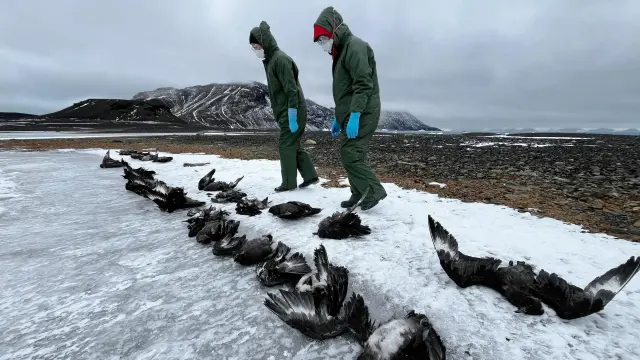
H5N1 bird flu kills more than 50 skuas in first Antarctica wildlife die off #Antarctica
 @seav@en.osm.town
2026-03-11 00:26:48
One fascinating film trivia I learned recently is that Sofia Coppola and Spike Jonze’s marriage from 1999 to 2003 partially inspired Coppola’s 2003 film Lost In Translation and Jonze’s 2013 film Her.
Coincidentally, both films star Scarlett Johansson as the main female protagonist, both films were nominated for the Oscar Best Picture, and both films won the Oscar Best Original Screenplay for Coppola and Jonze.

 @brian_gettler@mas.to
2026-02-12 14:49:34
Following federal cuts to history-focused organizations, the president of the Canadian Historical Association, Colin Coates, sent this letter to Marc Miller, the Minister of Canadian Identity and Culture.
One thing might not be obvious: Coates's reference to Carney's recent Quebec City speech suggests Canadians' need for historical context right now. He doesn't agree with Carney's claims. In fact, most Canadian historians would dispute them.


 @detondev@social.linux.pizza
2026-02-12 21:00:36
choose your character
![Prophet Royal Robertson outside his home (from the documentary Make by Scott Ogden and Malcolm Hearn[1])](https://cdn.social.linux.pizza/system/media_attachments/files/116/059/245/683/869/791/original/4f1167fc9e40fe76.jpg)


 @Dragofix@veganism.social
2026-02-17 23:45:26
Quick course correction needed to avoid 'hothouse Earth' scenario, scientists say #climate
 @Dragofix@veganism.social
2026-03-15 22:45:31
Microplastics may be quietly damaging your brain and fueling Alzheimer’s and Parkinson’s #health