 @hex@kolektiva.social
2025-11-17 08:52:05
The implications are interesting enough when we apply this to systems like capitalism or national governments, but there are other very interesting implications when applied to systems like race or gender.
Like, as a cis man the only way I can be free to express and explore my own masculinity is if the masculinity I participate in is one which allows anyone the freedom to leave. Then I have an obligation to recognize the validity of nom-masculine trans identity as a necessary component of my own. If I fail to do this, then I trap myself in masculinity and allow the system to control me rather than me to be a free participant in the system.
But if it's OK to escape but not enter, that's it's own restriction that constrains the freedom to leave. It creates a barrier that keeps people in by the fear that they cannot return. So in order for me to be free in my cis masculine identity, I must accept non-masculine trans identities as they are and accept detransitioning as also valid.
But I also need to accept trans-masc identities because restricting entry to my masculinity means non-consensually constraining other identities. If every group imposes an exclusion against others coming in, that, by default, makes it impossible to leave every other group. This is just a description of how national borders work to trap people within systems, even if a nation itself allows people to "freely" leave.
So then, a free masculinity is one which recognizes all configurations of trans identities as valid and welcomes, if not celebrates, people who transition as affirmations of the freedom of their own identity (even for those who never feel a reason to exercise that same freedom).
The most irritating type of white person may look at this and say, "oh, so then why can't I be <not white>?" Except that the critique of transratial identities has never been "that's not allowed" and has always been "this person didn't do the work." If that person did the work, they would understand that the question doesn't make sense based on how race is constructed. That person might understand that race, especially whiteness, is more fluid than they at first understood. They might realize that whiteness is often chosen at the exclusion of other racialized identities. They would, perhaps, realize that to actually align with any racialized identity, they would first have to understand the boot of whiteness on their neck, have to recognize the need to destroy this oppressive identity for their own future liberation. The best, perhaps only, way to do this would be to use the privilege afforded by that identity to destroy it, and in doing so would either destroy their own privilege or destroy the system of privilege. The must either become themselves completely ratialized or destroy the system of race itself such being "transracial" wouldn't really make sense anymore.
But that most annoying of white person would, of course, not do any such work. Nevertheless, one hopes that they may recognize the paradox that they are trapped by their white identity, forced forever by it to do the work of maintaining it. And such is true for all privileged identities, where privilege is only maintained through restrictions where these restrictions ultimately become walls that imprison both the privileged and the marginalized in a mutually reinforcing hell that can only be escaped by destroying the system of privilege itself.
 @inthehands@hachyderm.io
2025-12-18 17:03:18
Something that just drives me up the wall about this particular area of Git (merge conflicts) is that, beyond the all-too-typical Git problem of sloppy terminology, this is bad feature design. In most situations, “use ours” and “user theirs” are •both• the wrong answer! There are two doors, and they’re •both• trapdoors.
If you have a merge conflict, that means that you changed something •and• somebody else changed something, and your job is to •synthesize• both changes. To use one is to discard the other, which is usually not what you want!
The thing Git (and every Git GUI) ought to surface is a three-way merge: show me what I changed and what they changed ••relative to the nearest common ancestor••. Yes yes yes, I know it’s possible to finagle that into view with Git. It should be the danged default. It is what I should see first. It is what I should see if I have no idea what I’m doing.
1/ https://hachyderm.io/@jeremydmiller/115741417416659492
 @tiotasram@kolektiva.social
2025-11-18 12:11:51
This is a subtweet...
People who are not anti-capitalist sometimes wonder: "Why is there a monopoly on X life-critical thing?" (E.g., epipens, insulin, web search).
This one is really simple actually: because monopolies are more profitable than competition, and the foundation of capitalism is that capital = power.
Various societies have recognized the necropolitical outcomes of monopolies and have tried to erect barriers to monopoly; we all know that monopolies are bad, death-and-suffering-causing things. But since these societies mostly remain capitalist, they allow these barriers to be eroded by the power of capital (to do otherwise would be to repudiate capitalism because it puts a limit on the power of money). The barriers are ineffective, and the capital = power equation holds, and monopolies result and get to do their killing & maiming thing (remember: even things like social media monopolies that you wouldn't expect to pay for political assassinations like a mining company still profit from inciting genocides). *Sometimes* there are oligopolies instead of monopolies, but instances of really competitive markets are pretty rare for things that are widely sought-after.
The "government will manage the markets to prevent bad outcomes like monopolies" strategy has failed repeatedly, spectacularly, and almost universally. To actually prevent monopolies you need a population that no longer believes that money should equal power, it's that simple. Sadly, it's actually not that simple, since all of the alternatives which equate something else to power, like "the king" or "party loyalty as judged by the supreme leader" have the same problems or worse. The attitude you need to cultivate is "nobody should have power," which is hard because *all* of the power-systems we have constantly propagandize against this attitude in myriad ways. Still, in the future once we've broken free of this age where hierarchy is accepted, people will look back and wonder whether the historical records are even credible given how much needless death and suffering were endured with little resistance.
#anarchy #capitalism
 @pre@boing.world
2025-12-18 09:22:01
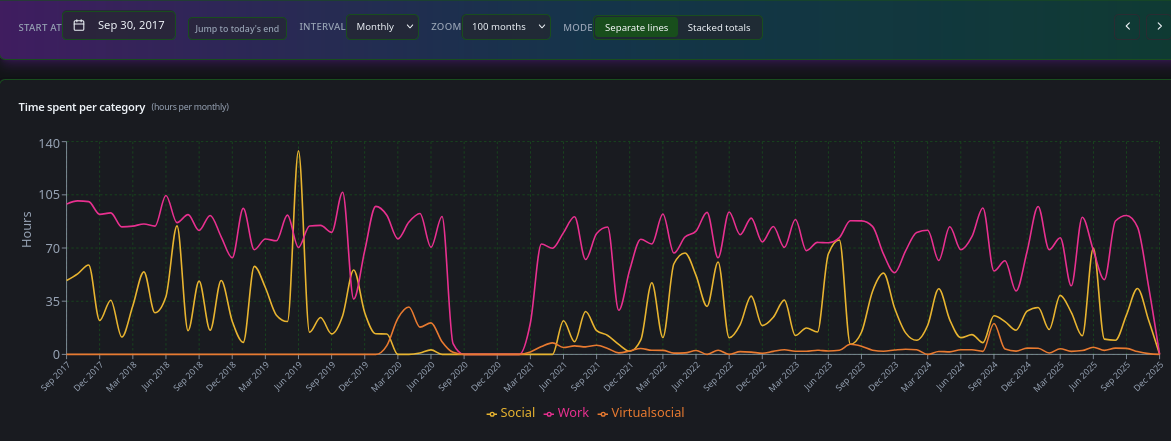
Added a zoom level to the Category page on the Exocortex-Log app. Can make the graphs look a lot cleaner now.
Looking back over the last 100 months here, we can see in general my social life is quite seasonal -- Festivals are a lot of social all weekend long and a couple of them in a month really bumps up the hours from my usual habit of sitting alone in a dark room pressing buttons.
The peak in 2019 is a summer filled with Glasto and Noisily and another festival or camping trip I don’t seem to have recorded the name of.
Then clearly visible is the drop-off in social activity as the COVID pandemic hit. Virtual-Social (IE zoom meetings and the like) picked up quite a bit around there but had died back to almost nothing way before the hours spent with actual people started to tick up.
Annoyingly, I have my biggest gap in data right on top of the pandemic there, where I failed to back up for months and then data became corrupted.
When the data-hole is over we see social life still not really returning until the middle of 2021 and not really getting back into stride until summer 2022.
It remains much lower now on average with lower peaks than before the pandemic too. Multiple reasons.
Work is pretty constant all the way though other than the data-hole. Dipping when I take time off for social mostly.
That data-hole is annoying. Back up your data kids.
#lifeLog #app #exocortexLog
 @cdarwin@c.im
2025-12-17 05:24:24
The privately funded National Trust for Historic Preservation last week asked the U.S. District Court to block Trump’s project.
“No president is legally allowed to tear down portions of the White House without any review whatsoever
— not President Trump, not President Biden, and not anyone else,” the lawsuit states.
“And no president is legally allowed to construct a ballroom on public property without giving the public the opportunity to weigh in.”
Trump had the East W…
 @hex@kolektiva.social
2025-11-17 06:11:16
I think we can actually prove that this constraint is the *only* constraint that can preserve freedom:
1. There will exist actors in a system who will wish to take advantage of others. Evolution drives survival and one strategy for increasing survival in an altruistic society is to become a parasite.
2. Expecting exploitative dynamics, a system needs to have a set of rules to manage exploitation.
3. If the set of rules is static it will lack the requisite variety necessary to manage the infinite possible behavior of humans so the system will fail.
4. If the system is dynamic then it must have a rule set about how it's own rules are updated. This would make the system recursive, which makes the system at least as complex as mathematics. Any system at least as complex as mathematics is necessarily either incomplete or inconsistent (Gödel's incompleteness theorem). If the system is incomplete, then constraints can be evaded which then allow a malicious agent to seize control of the system and update the rules for their own benefit. If constraints are incomplete, then a malicious agent can take advantage of others within the system.
5. Therefore, no social system can possibly protect freedom unless there exists a single metasystemic constraint (that the system must be optional) allowing for the system to be abandoned when compromised.
Oh, you might say, but this just means you have to infinitely abandon systems. Sure, but there's an evolutionary advantage to cooperation so there's evolutionary pressure to *not* be a malicious actor. So a malicious actor being able to compromise the whole system is likely to be a much more rare event. Compromising a system is a lot of work, so the first thing a malicious actor would want to do is preserve that work. They would want to lock you in. The most important objective to a malicious actor compromising a system would be to violate that metasystemic constraint, or all of their work goes out the window when everyone leaves.
And now you understand why borders exist, why fascists are obsessed with maintaining categories like gender, race, ethnicity, etc. This is why even Democrats like Newsom are on board with putting houseless people in concentration camps. And this is why the most important thing anarchists promote is the ability to choose not to be part of any of that.
 @thomasfuchs@hachyderm.io
2025-11-16 19:10:58
PSA about food labeling in the US
We have a gluten detection service dog because many things that should be gluten free/say they’re gluten free are not actually gluten free.
Stuff gets contaminated when growing (e.g. next to wheat field), by shared equipment, in factories, from packaging, during transport and in-store.
Every US consumer should know:
1. The list of ingredients on food isn't exhaustive
2. Allergen labeling:
a) limited to just some allergens
b) manufacturers don't actually have to test
c) "certified" foods are tested—but not continuously
d) testing only works with enough contamination
Some certifications may require batch-testing, but usually they don't.
A "certified gluten free" product may e.g. contain oats which sometimes are contaminated with gluten—but as not every batch is tested it's impossible to know unless you test yourself (hence the service dog).
Even if the product is properly batch-tested, you might get a part of the product that has the allergen in it, whereas the tested part didn't.
Or the threshold was too low (our dog can detect gluten better than any available lab testing equipment; yes, dogs are amazing).
Food products also contain ingredients that do not have to be included on the label when they're "incidental" (included in an another ingredient) or if they're considered part of the manufacturing process but not of the final product (e.g. various coatings on factory equipment).
Don't need to list flavors or specific spices either. ¯\_(ツ)_/¯
As for allergens, only those responsible for ~90% of food allergies* have to be specifically declared, and they're not tested for as it's simply based on the ingredients list.
Good luck if you have other allergies.
*milk, egg, egg, fish, Crustacean shellfish, tree nuts, wheat, peanuts, soybeans
@hex@kolektiva.social2025-10-16 08:24:42
Actually, I do want to come back to masculinity under patriarchy and whiteness under white supremacy because I think it's worth talking more about. The "man" under patriarchy (at least "Western" patriarchy) is represented as power and independence. The man needs nothing and thus owes nothing to anyone. The man controls and is not controlled, which is intimately related to independence as dependence can make someone vulnerable to control. The image of "man" projects power and invulnerability. At the same time "man" is a bumbling fool who can't be held accountable for his inability to control his sexual urges. He must be fed and cared for, as though another child. His worst behaviors must be dismissed with phrases such as "boys will be boys" and "locker room talk." The absurdity of the concept of human "independence" is impossible to understate.
Even if you go all Ted Kaczynski, you have still been raised and taught. This is, perhaps, why it is so much more useful to think in terms of obligations than rights. Rights can be claimed and protected with violence alone, but obligations reveal the true interdependence that sustains us. A "man" may assert his rights. Yet, on some level, we all know that the "man" of patriarchy acts as a child who is not mature enough to recognize his obligations.
White violence and white fragility reflect the same dichotomy. "The master race" somehow always needs brown folks to make all their shit and do all the reproductive labor for them. For those who fully embrace whiteness, the "safe space" is a joke. DEI shows weakness. Yet, when presented with an honest history adults become children who are incapable of differentiating between criticism and simple facts. *They* become the ones who must be kept safe. The expectation to be responsible for one's own words and actions, one of the very core definitions of being an adult, is far too much to expect. Their guilt needs room, needs tending, needs caring. White people cannot simply "grow the fuck up" or, as they may say of slavery, "fucking get over it."
And again, interestingly, it is *rights* that they reference: "Mah Freeze PEACH!" I find it hard to distinguish between such and my own child's assertion that anything she doesn't like is "not fair!" No, these assertions fail to recognize the fundamental fabric of adult society: the obligations we hold to each other.
At the intersection of all privilege is the sovereign, the ultimate god-man-baby. Again, referencing the essay (https://hexmhell.writeas.com/observations-on-domination-and-trump)
> This is where it becomes important to consider the ideology behind the sovereign ritual. Participation within the sovereign ritual denotes to the participants elements of the sovereign. That is, all agents of the sovereign are, essentially, micro dictators. By carrying out the will of the sovereign, these micro dictators can, by extension, act outside of the law.
While law enforcement is the ultimate representative of sovereign violence, privileges allow a gradated approximation of the sovereign. Those who are "closer" in privilege to the sovereign may, for example, be permitted to carry out violence against those who are father away. The gradation of privilege turns the whole society, except for the least privileged, into a cult that protects the privilege system on behalf of the most privileged. (And immediately Malcolm X pops to mind as having already talked about part of this relationship in 1963 https://www.youtube.com/watch?v=jf7rsCAfQCo.)
@hex@kolektiva.social2025-11-17 10:15:14
I feel as though I should illustrate the difference that this one single constraint can make by two examples.
The rules of Simon Says are maximally authoritarian. You must perform any action ordered, with the only restriction that the authority must say "Simon says" first. Were you forced to stay in this system, it would be the most despotic autocracy possible. But it's not. It's a silly game because you can leave at any time.
Let's flip this and imagine a room. During a specific period of time you will have absolute control over everything in this room. In this room you have total freedom. This is not even the limited freedom, the coordinated freedom, the compromising freedom of civil society. You could, without consequence, perform any action you wish in this room. You could say anything, destroy or steal any object, order any individual to perform any action, kill any person in the room with you and take anything they own. This is the sovereign freedom, the absolute freedom, of dictators and kings. The only restriction is that you are not allowed to leave the room while you have this freedom. In fact, you really only have this level of freedom because the room is actually empty other than for you. I am, of course, talking about a form of torture still common in the US: solitary confinement.
@hex@kolektiva.social2025-11-17 10:14:48
I feel as though I should illustrate the difference that this one single constraint can make by two examples.
The rules of Simon Says are maximally authoritarian. You must perform any action ordered, with the only restriction that the authority must say "Simon says" first. Were you forced to stay in this system, it would be the most despotic autocracy possible. But it's not. It's a silly game because you can leave at any time.
Let's flip this and imagine a room. During a specific period of time you will have absolute control over everything in this room. In this room you have total freedom. This is not even the limited freedom, the coordinated freedom, the compromising freedom of civil society. You could, without consequence, perform any action you wish in this room. You could say anything, destroy or steal any object, order any individual to perform any action, kill any person in the room with you and take anything they own. This is the sovereign freedom, the absolute freedom, of dictators and kings. The only restriction is that you are not allowed to leave the room while you have this freedom. In fact, you really only have this level of freedom because the room is actually empty other than for you. I am, of course, talking about a form of torture still common in the US: solitary confinement.