 @arXiv_csLG_bot@mastoxiv.page
2026-02-25 16:08:18
Replaced article(s) found for cs.LG. https://arxiv.org/list/cs.LG/new
[5/6]:
- Watermarking Degrades Alignment in Language Models: Analysis and Mitigation
Apurv Verma, NhatHai Phan, Shubhendu Trivedi
https://arxiv.org/abs/2506.04462 https://mastoxiv.page/@arXiv_csCL_bot/114635190037336859
- Sensory-Motor Control with Large Language Models via Iterative Policy Refinement
J\^onata Tyska Carvalho, Stefano Nolfi
https://arxiv.org/abs/2506.04867 https://mastoxiv.page/@arXiv_csAI_bot/114635187854195641
- ICE-ID: A Novel Historical Census Dataset for Longitudinal Identity Resolution
de Carvalho, Popov, Kaatee, Correia, Th\'orisson, Li, Bj\"ornsson, Sigur{\dh}arson, Dibangoye
https://arxiv.org/abs/2506.13792 https://mastoxiv.page/@arXiv_csAI_bot/114703312162525342
- Feedback-driven recurrent quantum neural network universality
Lukas Gonon, Rodrigo Mart\'inez-Pe\~na, Juan-Pablo Ortega
https://arxiv.org/abs/2506.16332 https://mastoxiv.page/@arXiv_quantph_bot/114732532383196043
- Programming by Backprop: An Instruction is Worth 100 Examples When Finetuning LLMs
Cook, Sapora, Ahmadian, Khan, Rocktaschel, Foerster, Ruis
https://arxiv.org/abs/2506.18777 https://mastoxiv.page/@arXiv_csAI_bot/114738213040759661
- Stochastic Quantum Spiking Neural Networks with Quantum Memory and Local Learning
Jiechen Chen, Bipin Rajendran, Osvaldo Simeone
https://arxiv.org/abs/2506.21324 https://mastoxiv.page/@arXiv_csNE_bot/114754367612728319
- Enjoying Non-linearity in Multinomial Logistic Bandits: A Minimax-Optimal Algorithm
Pierre Boudart (SIERRA), Pierre Gaillard (Thoth), Alessandro Rudi (PSL, DI-ENS, Inria)
https://arxiv.org/abs/2507.05306 https://mastoxiv.page/@arXiv_statML_bot/114822374525501660
- Characterizing State Space Model and Hybrid Language Model Performance with Long Context
Saptarshi Mitra, Rachid Karami, Haocheng Xu, Sitao Huang, Hyoukjun Kwon
https://arxiv.org/abs/2507.12442 https://mastoxiv.page/@arXiv_csAR_bot/114867589638074984
- Is Exchangeability better than I.I.D to handle Data Distribution Shifts while Pooling Data for Da...
Ayush Roy, Samin Enam, Jun Xia, Won Hwa Kim, Vishnu Suresh Lokhande
https://arxiv.org/abs/2507.19575 https://mastoxiv.page/@arXiv_csCV_bot/114935399825741861
- TASER: Table Agents for Schema-guided Extraction and Recommendation
Nicole Cho, Kirsty Fielding, William Watson, Sumitra Ganesh, Manuela Veloso
https://arxiv.org/abs/2508.13404 https://mastoxiv.page/@arXiv_csAI_bot/115060386723032051
- Morphology-Aware Peptide Discovery via Masked Conditional Generative Modeling
Nuno Costa, Julija Zavadlav
https://arxiv.org/abs/2509.02060 https://mastoxiv.page/@arXiv_qbioBM_bot/115139546511384706
- PCPO: Proportionate Credit Policy Optimization for Aligning Image Generation Models
Jeongjae Lee, Jong Chul Ye
https://arxiv.org/abs/2509.25774 https://mastoxiv.page/@arXiv_csCV_bot/115298580419859537
- Multi-hop Deep Joint Source-Channel Coding with Deep Hash Distillation for Semantically Aligned I...
Didrik Bergstr\"om, Deniz G\"und\"uz, Onur G\"unl\"u
https://arxiv.org/abs/2510.06868 https://mastoxiv.page/@arXiv_csIT_bot/115343320768797486
- MoMaGen: Generating Demonstrations under Soft and Hard Constraints for Multi-Step Bimanual Mobile...
Chengshu Li, et al.
https://arxiv.org/abs/2510.18316 https://mastoxiv.page/@arXiv_csRO_bot/115416889485910123
- A Spectral Framework for Graph Neural Operators: Convergence Guarantees and Tradeoffs
Roxanne Holden, Luana Ruiz
https://arxiv.org/abs/2510.20954 https://mastoxiv.page/@arXiv_statML_bot/115445273121677005
- Breaking Agent Backbones: Evaluating the Security of Backbone LLMs in AI Agents
Bazinska, Mathys, Casucci, Rojas-Carulla, Davies, Souly, Pfister
https://arxiv.org/abs/2510.22620 https://mastoxiv.page/@arXiv_csCR_bot/115451397563132982
- Uncertainty Calibration of Multi-Label Bird Sound Classifiers
Raphael Schwinger, Ben McEwen, Vincent S. Kather, Ren\'e Heinrich, Lukas Rauch, Sven Tomforde
https://arxiv.org/abs/2511.08261 https://mastoxiv.page/@arXiv_csSD_bot/115535982708483824
- Two-dimensional RMSD projections for reaction path visualization and validation
Rohit Goswami (Institute IMX and Lab-COSMO, \'Ecole polytechnique f\'ed\'erale de Lausanne)
https://arxiv.org/abs/2512.07329 https://mastoxiv.page/@arXiv_physicschemph_bot/115688910885717951
- Distribution-informed Online Conformal Prediction
Dongjian Hu, Junxi Wu, Shu-Tao Xia, Changliang Zou
https://arxiv.org/abs/2512.07770 https://mastoxiv.page/@arXiv_statML_bot/115689281155541568
- Coupling Experts and Routers in Mixture-of-Experts via an Auxiliary Loss
Ang Lv, Jin Ma, Yiyuan Ma, Siyuan Qiao
https://arxiv.org/abs/2512.23447 https://mastoxiv.page/@arXiv_csCL_bot/115808311310246601
toXiv_bot_toot
 @arXiv_physicsinsdet_bot@mastoxiv.page
2026-02-02 09:14:39
High-bandwidth frequency domain multiplexed readout of transition-edge sensors for neutrinoless double beta decay searches
M. Adami\v{c} (McGill,LBNL), M. Beretta (UCB,INFN), J. Camilleri (LBNL,Virginia Tech), C. Capelli (LBNL,Zurich U.), M. A. Dobbs (McGill), T. Elleflot (LBNL), B. K. Fujikawa (LBNL), Yu. G. Kolomensky (LBNL,UCB), D. Mayer (MIT), J. Montgomery (McGill), V. Novosad (ANL), A. M. Sindhwad (UCB), V. Singh (UCB), G. Smecher (t0.technology), A. Suzuki (LBNL), B. Welliver (UCB)
https://arxiv.org/abs/2601.23106 https://arxiv.org/pdf/2601.23106 https://arxiv.org/html/2601.23106
arXiv:2601.23106v1 Announce Type: new
Abstract: The next-generation of cryogenic neutrinoless double-beta decay experiments require increasingly fast readout in order to improve background discrimination. These experiments, operated as cryogenic calorimeters at $\sim$10 mK, are usually read out by high-impedance neutron transmutation doped (NTD) thermistors, which provide good energy resolution, but are limited by $\sim$1 ms response times. Superconducting detectors, such as transition-edge sensors (TESs) with a time resolution of $\sim$100 $\mu$s, offer superior timing performance over NTD semiconductor bolometers. To make this technology viable for an application to a thousand or more channels, multiplexed readout is necessary in order to minimize the thermal load and radioactive contamination induced by the readout. Frequency-domain multiplexing readout (fMux) for TESs, previously developed at Berkeley Lab and McGill University, is currently in use for mm-wave telescopes with detector sampling rates in the order of 100 Hz. We demonstrate a new readout system, based on the McGill/Berkeley digital fMux readout, to satisfy the higher bandwidth and noise requirements of the next generation of TES-instrumented cryogenic calorimeters. The new readout samples detectors at 156 kHz, three orders of magnitude faster than its cosmology-oriented predecessor. Each multiplexing readout module comprises ten superconducting resonators in the MHz range and a superconducting quantum interference device (SQUID), interfaced to high-bandwidth field programmable gate array (FPGA)-based electronics for digital signal processing and low-latency feedback.
toXiv_bot_toot
 @LillyHerself@Mastodon.social
2026-02-28 19:53:57
Reading a newspaper from the Swedish city I used to live in (which has a large Iranian ex-pat colony) and around a thousand of them are demonstrating downtown, to show support for the US getting rid of the Ayatollah-led regime.
There are many sides to this story.
And as I was typing this, came the notice that the body of the current leader of Iran has been found in the bombed out rubble of his compound.

 @hex@kolektiva.social
2026-02-21 21:10:33
After the whole Adam Something "dating advice for leftist men" thing, I realized I should probably write something about that. I didn't, but I realized I should. Here I am sort of getting around to it.
I had a friend call me an "elder" at one point. I was like 35 at that time, but like... a lot of old leftists are just dead or in prison, so we take what we can get I guess. Being also an elder in the sense that I'm an elder millennial, who is also a parent and married for almost 10 years and all that, I guess I'm technically qualified.
So here it is, dating advice for (straight cis) leftist men:
1. Don't.
That's it, actually. That's the whole thing. Let me explain a bit.
First of all, this is dating advice for neuroatypical folks. We're way overrepresented in both extremes because this system wasn't built for us. And that's who is *the most* confused by all the relationship stuff, and most likely to try to apply all this masculinity/manosphere bullshit. I'm also talking a bit from experience here, as a neruo-spicy trying to "figure out" how to date within a paradigm entirely built around neurotypicals and their relationships. It's garbage. Throw it out. There's nothing worth saving.
His video had some line comparing not having sex to your house being on fire. I'm not gonna bother to quote it because I'm busy with actual life. But like, that's exactly what I'm talking about. I recognize that and it's horribly destructive. Men who buy in to patriarchy actually believe this, because those men value themselves based on (hetro) sex. Yeah, if you think you're worthless because you aren't "getting laid" then yeah, you're gonna feel like that's an emergency.
"Dating" as a paradigm turns humans into roles. It dehumanizes us all, and thus makes human connection much harder. It is a game that, like thermonuclear war, can only be won by not playing.
When you abandon "dating" and just act like a human, everything starts to be easier. There's no such thing as being "friend zoned" because you're just friends. Sometimes friendships become other things, sometimes they don't. It doesn't actually matter, because if you're actually there for friendship then you don't *need* anything else.
My grandma, at 98 I think, gave me some advice. My grandparents always got along well, and were married for enough decades that I listened really closely. She told me I should just do things I loved to do and everything else would work itself out.
And it kind of did.
I understand the fear, the idea that you'll die alone. I get that. I get the loneliness. It all hits a lot harder when you have ADHD emotions and past trauma. I get that. But that fear is self-manifesting. When you build your confidence, when you don't *need* to be "in a relationship," you have more room to actually build relationships. For me, dating was dehumanizing. When I abandoned that, I was able to actually be a good partner, and I was able to find my partner.
I would advise against marriage as well, but we did get married for legal reasons. It can still be hard to maintain that, to see each other as people rather than roles. That becomes extra hard as parents. But the times that we cut through that are the times we're closest. Those are the times when it becomes easier to remember that we're both humans and all human relationships need tending.
Roles don't need to be tended because they are classifications. Classifications are static. But relationships between humans are not. Humans are messy and chaotic. Humans have all kinds of complex needs and desires.
So yeah, don't date. Just be a human and see what happens. Maybe google "relationship anarchy" and see where it takes you.
If you have ADHD, it can be especially useful to understand that relationships with neurotypical folks can be especially difficult. Assume you're incompatible with 90% of the population as your baseline, and you'll start to understand why the standard "dating" thing has made you feel so alienated and miserable.
Neurotypical folks generally have no idea that atypicality exists, much less how it impacts relationships. Having to conform to a neurotypical relationship just adds additional mental strain unless you find someone (really special) who can do at least some of the work.
The ADHD thing was especially important for me. There were so many things I was told to do in specific ways by neurotypicals that never worked for me. Their advice always made me feel like a failure. When I was finally diagnosed, I realized they were just giving advice for the wrong type of brain. It was advice I could never use. Basically all dating advice I ever got fell into this same category.
That's my braindump. Maybe I'll develop it more in the future, but I'm busy so maybe not. I hope it helps someone who is struggling like I was.
 @arXiv_physicsfludyn_bot@mastoxiv.page
2026-02-27 08:14:50
Kelvin wave and soliton propagation in classical viscous vortex filaments
Elio Sterkers, Giorgio Krstulovic
https://arxiv.org/abs/2602.22439 https://arxiv.org/pdf/2602.22439 https://arxiv.org/html/2602.22439
arXiv:2602.22439v1 Announce Type: new
Abstract: Vortex filaments are highly rotating localized structures of fluids that admits several types of excitation. Here, we study them by using numerical simulations of the three-dimensional incompressible Navier-Stokes equations. We first address the propagation of Kelvin waves, helicoidal excitations propagating along the filament, and measure their dispersion relation which turns out to be in good agreement with the original Lord Kelvin predictions. Then, inspired by the connection between vortex line dynamics and an integrable system, we show numerically the existence of solitons propagating along vortex filaments and study the collision of two of such structures. Finally, we show numerically the experimental feasibility of studying vortex solitons in the lab, by proposing an experiment for their generation.
toXiv_bot_toot
 @detondev@social.linux.pizza
2026-03-21 03:47:39
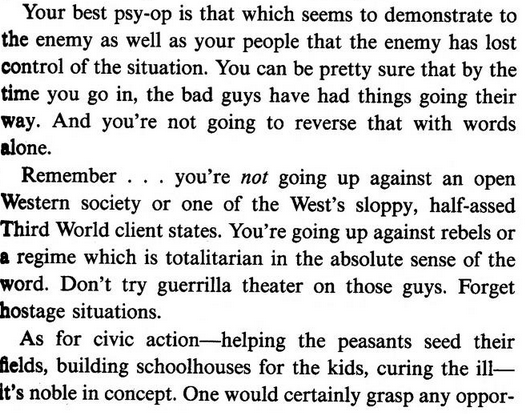
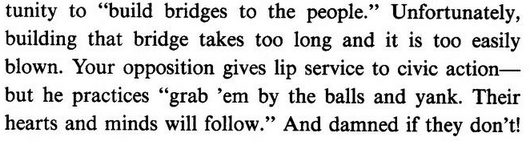
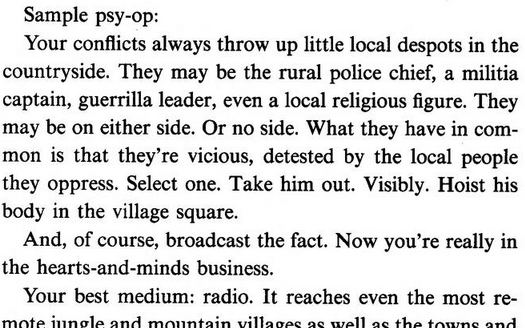
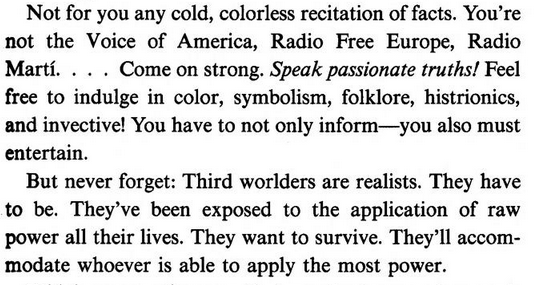
Learning how to psyop Third World populations with Manual of The Mercenary Soldier
https://archive.org/details/PaulBalorManualOfTheMercenarySoldier
 @callunavulgaris@mastodon.scot
2026-04-25 11:48:41
For #Caturday Tails is in disgrace for digging up and crapping in my plant pots. I've just redone them all and covered them with stylish old plastic bags. It's 1-1 at the moment, Tails to move.
