Just 10 months ago, NASA asked three companies if they could do something nobody had done before.
Could they build and launch a satellite to save a $500 million astronomy mission at risk of crashing back to Earth?
What’s more, could they do it in less than a year on a tight budget?
Katalyst Space Technologies, a startup founded in 2020, presented the most compelling solution.
“They came back with a response that was technically and programmatically plausible,
an…
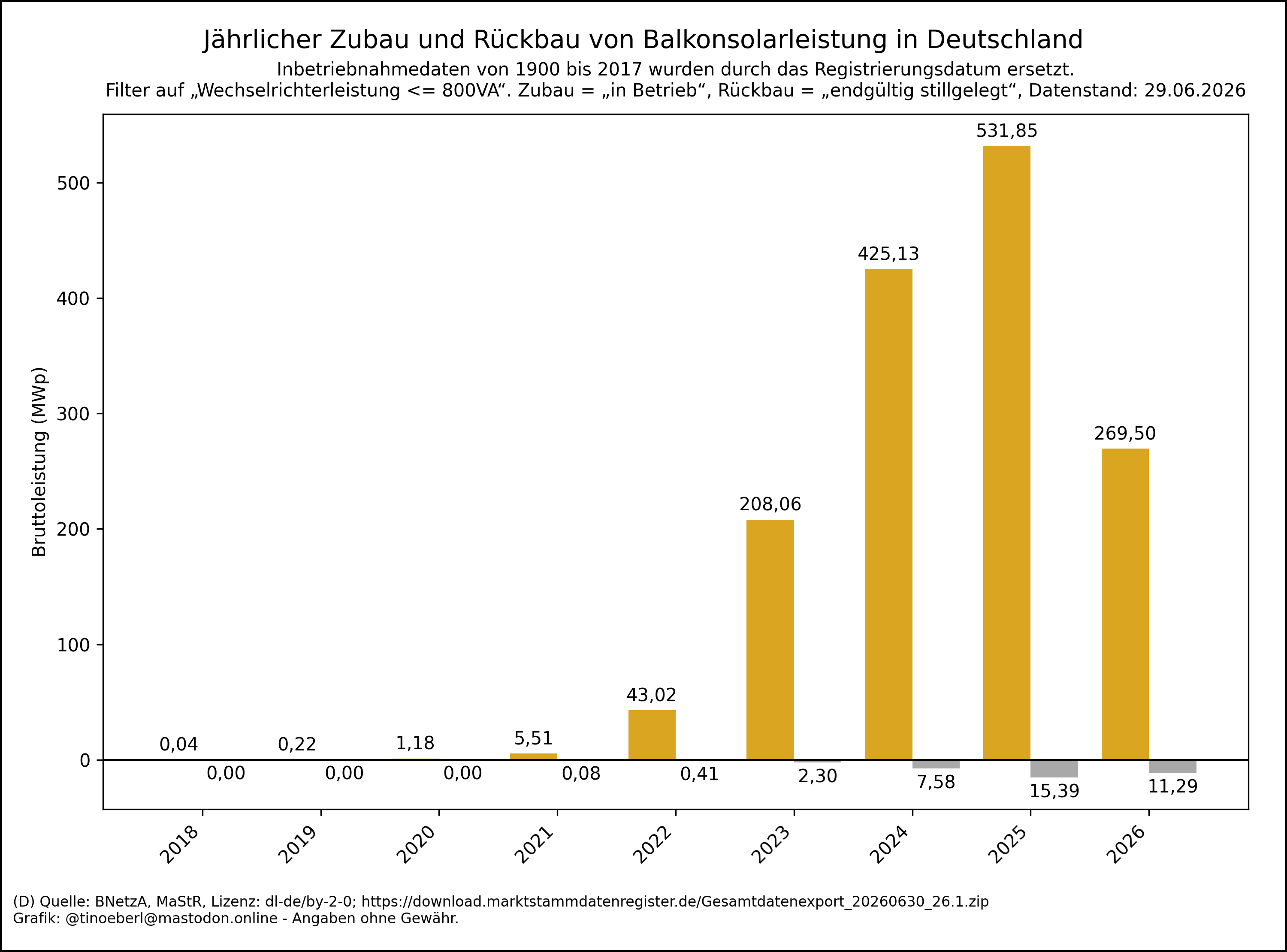
Jährlicher Zubau und Rückbau von #Balkonsolarleistung in Deutschland mit Stand vom 29.06.2026.
Unplausible Inbetriebnahmedaten von 1900 bis 2017 wurden durch das Registrierungsdatum der #Steckersolaranlage ersetzt.
👉 Zusatzlesestoff:
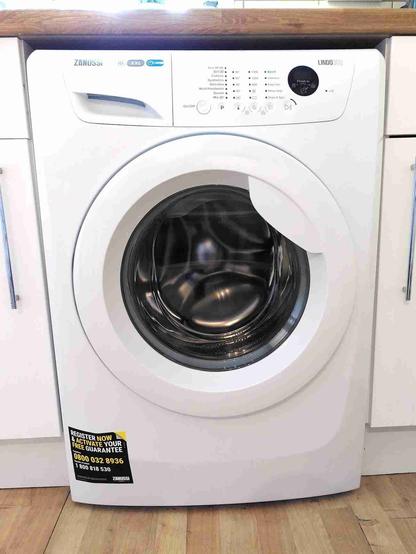
On the Zanussi ZWF01483W washing machine: Review (2020) - Cold washes, 10kg capacity, quick and intensive cycles. - https://www.earth.org.uk/note-on-Zanussi-ZWF01483W-freestanding-washing-machine-REVIEW.html
Improved Approximation Guarantees for Groupwise Maximin Share Fairness
Georgios Amanatidis, Anna Korfiati, Evangelos Markakis, Christodoulos Santorinaios
https://arxiv.org/abs/2606.04731 https://arxiv.org/pdf/2606.04731 https://arxiv.org/html/2606.04731
arXiv:2606.04731v1 Announce Type: new
Abstract: We study the problem of fairly allocating a set of indivisible goods to a set of $n$ agents with additive valuation functions. We focus on the very demanding notion of \textit{groupwise maximin share fairness} (GMMS), which requires that each agent $i$ receives value comparable to their maximin share, where the latter is computed \textit{with respect to any subset of agents that contains $i$}. We show that it is possible to compute $(\phi-1)$-approximate GMMS allocations in polynomial time, where $\phi \approx 1.618$ is the golden ratio). This improves on the previously known guarantee of $4/7$ of Chaudhury et al. [SICOMP; 2021] and Amanatidis et al. [TCS; 2020]. We propose a simple algorithm that maintains the same main properties as the Draft-and-Eliminate algorithm of Amanatidis et al. [TCS, 2020] and we improve on the approximation guarantee analysis by carefully bounding the relevant value within any subinstance induced by the restriction of our allocation to a subset of agents. Our analysis is asymptotically tight for algorithms that share these properties and has the additional benefit of giving improved guarantees for restricted settings; in particular, when the agents agree on the top $n$ goods or when the number of agents is small. To illustrate the challenges of going beyond the guarantees of our algorithm, we also present a variant with an improved approximation of $(\sqrt{10}-1)/3 \approx 0.72$ for the case of three agents. To achieve this improvement we partially characterize the maximin share guarantees of short picking sequences for a small number of goods.
toXiv_bot_toot
Delighted to announce that I'm SCROBBLING once more (first time since 2020)! How could I have lived without that wonderful verb?!
JellyFin (NAS) > Feishin > Turntable > Maloja (NAS)
#SelfHosting #DeSpotify
 @cdarwin@c.im