 @rasterweb@mastodon.social
2026-05-23 04:55:02
➡️ Notes - 3D Printing Tools Part 1
https://jackiepease.zone/weeknotes/2026/02/20/weeknotes.html
(This is a link from my bookmark collection. A new link gets posted each night.)
@rasterweb@mastodon.social➡️ Notes - 3D Printing Tools Part 1
https://jackiepease.zone/weeknotes/2026/02/20/weeknotes.html
(This is a link from my bookmark collection. A new link gets posted each night.)
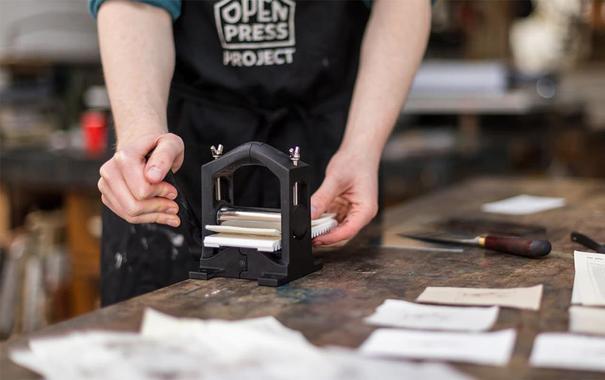
@rasterweb@mastodon.social➡️ Open Press Project – The 3D-printed printing press
#bookmarks
 @alejandrobdn@social.linux.pizza
Setting up remote access to Bambulab 3D printers that are on a different VLAN than yours is a pain in the ass.
Bambulab has chosen the wrong path. It might carve out a niche among users who aren't very tech-savvy when it comes to 3D printing (and who aren’t interested in learning either), but all of us nerds who have used their printers are going to tell them to go to hell.
By the way, if you're trying to set up remote access using pfSense or OPNsense, here's a great …
 @penguin42@mastodon.org.uk
First neat 3d printed concrete thing I've seen; printing spiral staircase:
https://www.youtube.com/watch?v=7v64CP7r4lI
 @daniel@social.telemetrydeck.com
3D printing a little Daniel replacement so I can do even more things at once!
 @fanf@mendeddrum.org
this is neat: 3d printing prototype injection moulds https://youtu.be/9LCIFetDKUA
they don’t work well but they’re good enough to cheaply try out a mould design
the desktop injection moulding machine is pretty swish too: the idea is to use it for plastic recycling
 @elduvelle@neuromatch.social
 @arXiv_physicsfludyn_bot@mastoxiv.page
Designing single-layer PDMS devices for micron to millimeter-scale deformations
Leon Valentin Gebhard, Alexandre S. Avaro, Gabriel Amselem, Charles N. Baroud
https://arxiv.org/abs/2605.17402 https://arxiv.org/pdf/2605.17402 https://arxiv.org/html/2605.17402
arXiv:2605.17402v1 Announce Type: new
Abstract: The elasticity of PDMS has played a central role in advancing important microfluidic technologies, ranging from early valves to sophisticated organ-on-a-chip systems. However, most deformable microfluidic devices are based on geometries that require complex multi-layer PDMS architectures and include thin membranes, leading to difficult microfabrication and poor stability. Recently, Jain, Belkadi et al. (Biofabrication 16.3 (2024): 035010) introduced a single-layer device in which a wide and long microfluidic channel was deformed by controlling the pressure in two independent and adjacent air chambers. While they demonstrated the ability to deform the channel ceiling to compress biological materials, the design parameters remain unexplored. Here, we perform a numerical study on 14,336 variants of this device and identify the height of the PDMS layer, the width of the microchannel and the width of the air chamber as the main features that determine the ceiling deformation. Three deformation modes are observed as the geometrical parameters are varied: A U shape with a central minimum, a W shape with two minima and a central maximum, or an inverse U shape with an upward-bulging single maximum. The numerical results are validated in experiments that reproduce the three shapes for the predicted geometries and demonstrate vertical ceiling deformations ranging from a few microns to the millimeter scale. The generality of this approach is demonstrated for two example applications: A fully closing single-layer microfluidic valve and an optical lens of controllable anisotropy. This work leverages the rapid prototyping enabled by 3D printing or micro-milling to open new perspectives in microfluidic actuation.
toXiv_bot_toot
 @kunstbanause@nrw.social
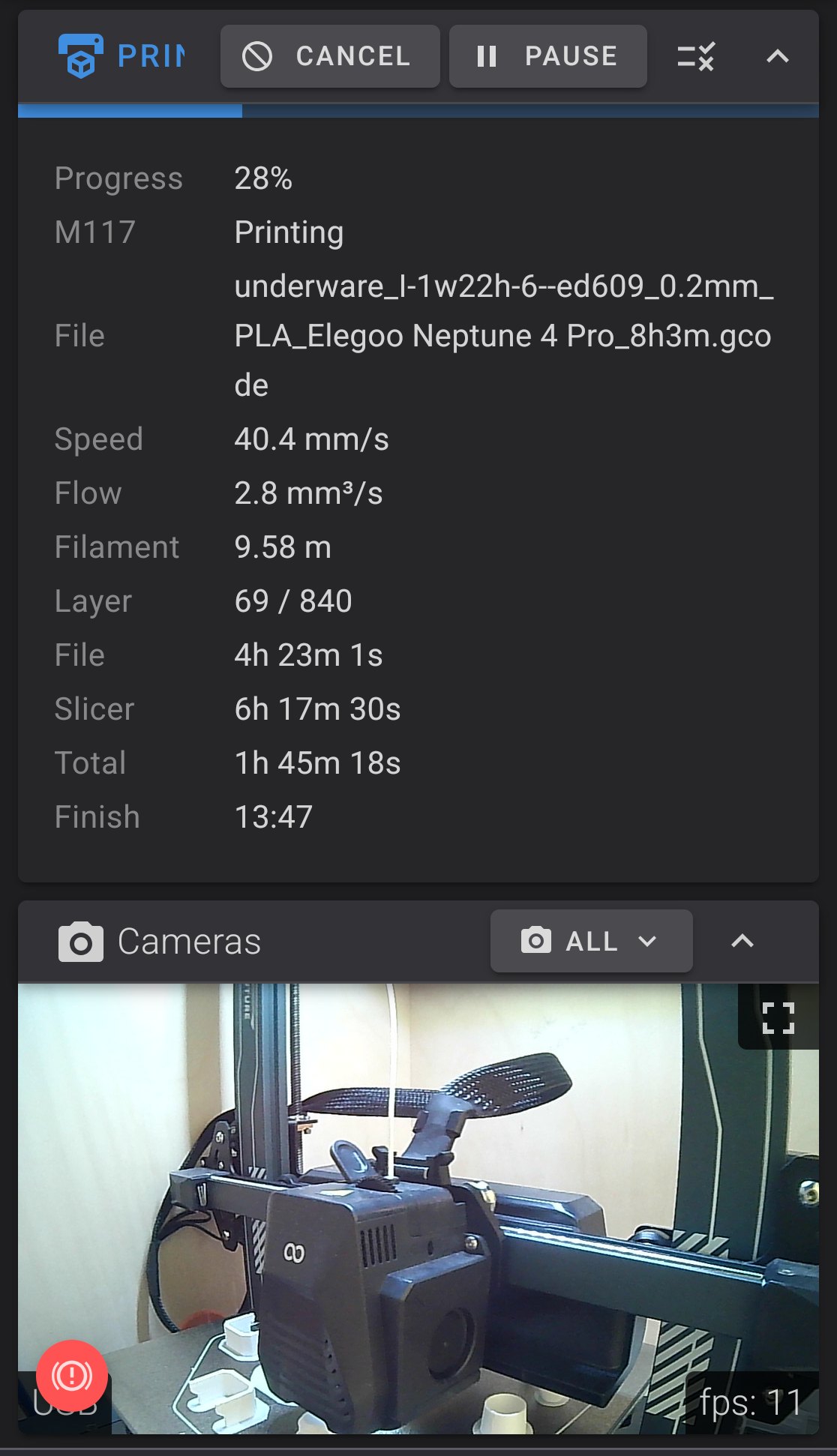
I think my longest print yet, on the Neptune at least. Let's see if it can actually beat the slicer estimation by two hours.
#3dprinting #openNept4une #openNeptune
 @thomasfuchs@hachyderm.io
this is no longer sold (afaik), but there’s 3D printing models