 @heiseonline@social.heise.de
2026-07-03 05:16:00

 @cdarwin@c.im
2026-08-03 20:15:16
Another Ukrainian innovation:
interceptor drones are being mounted on small transport aircraft like An-28s to take down Russian attack drones
https://bsky.app/profile/mariadrutska.bsky.social/post/3mk6oatoggc2t

 @ErikJonker@mastodon.social
2026-08-03 05:56:19

 @david@boles.xyz
2026-06-02 12:05:45
The Book I Could Not Afford to Get Wrong
Every book I take on carries some risk, and on most of them the risk is mine alone....
https://bolesblogs.com/2026/06/02/the-book-i-could-not-afford-to-get-wrong/

 @Techmeme@techhub.social
2026-08-03 05:10:36
A detailed recap of the real-world target hacks by OpenAI's and Anthropic's models, exposing failures in AI alignment training and meaningful supervision (Zvi Mowshowitz/Don't Worry About the Vase)
https://thezvi.substack.com/p/further-developments-about-interna…

 @cowboys@darktundra.xyz
2026-06-04 14:00:52
Not re-signing Jadeveon Clowney is a mistake by the Cowboys https://insidethestar.com/not-re-signing-jadeveon-clowney-is-a-mistake-by-the-cowboys
 @arXiv_csOS_bot@mastoxiv.page
2026-06-04 07:41:41
GNStor: Design of GPU-Native High-Performance Remote All-Flash Array
Shushu Yi, Wenbo Wu, Guoci Chen, Junrong Zhu, Shengwen Liang, Mao Bo, Chenying Huan, Chen Tian, Jie Zhang
https://arxiv.org/abs/2606.04908 https://arxiv.org/pdf/2606.04908 https://arxiv.org/html/2606.04908
arXiv:2606.04908v1 Announce Type: new
Abstract: GPU has become the leading computing device for a wide range of data-intensive applications, which tightly collaborates with remote all-flash array (AFA) to accommodate ever-expanding datasets, facilitate multi-client data sharing, and guarantee fault tolerance. Although GPU is the center of computation, all I/O processes in existing GPU-AFA systems are still CPU-centric. CPU orchestrates remote I/O requests and executes a centralized AFA engine to take charge of AFA-level functionalities (e.g., access control and metadata persistence). This design disparity suffers from substantial CPU-GPU interaction overhead and I/O traffic amplification, compromising end-to-end I/O performance.
In this work, we present \emph{GNStor}, a GPU-native AFA system that enables GPU to directly access remote AFA without CPU intervention in the I/O path, thereby fully exploiting the performance of AFA. Specifically, GNStor first proposes a GPU-centric NVMe over RDMA (NoR) software stack (named \emph{GNoR}), paving a fast path for GPUs to directly initiate NoR I/O requests to SSDs within remote AFA. GNoR employs an atomic-operation-based I/O orchestration design and follows the single-instruction-multiple-thread (SIMT) execution model of GPU, fully exploiting the massive parallelism of GPU architectures. To facilitate essential AFA functionalities in a CPU-bypass I/O path, GNStor further designs \emph{deEngine}, a decentralized AFA engine that seamlessly decomposes and integrates AFA-level tasks into each SSD firmware, thereby achieving efficient AFA access at low cost. Evaluation results show that GNStor achieves 3.2$\times$ higher I/O throughput and reduces application execution time by 31.1\%, compared to state-of-the-art AFA systems.
toXiv_bot_toot
 @lukem@hachyderm.io
2026-06-03 21:33:33
Tangerine Dream zagra w Polsce w maju przyszłego roku.
Ale jak zobaczyłem, że koncert w Warszawie odbędzie się w Progresji, podczas gdy w innych miastach w gmachach oper i filharmonii, to mam poważną zagwozdkę, czy nie pojechać gdzieś w Polskę.
 @leftsidestory@mstdn.social
2026-06-03 00:30:00
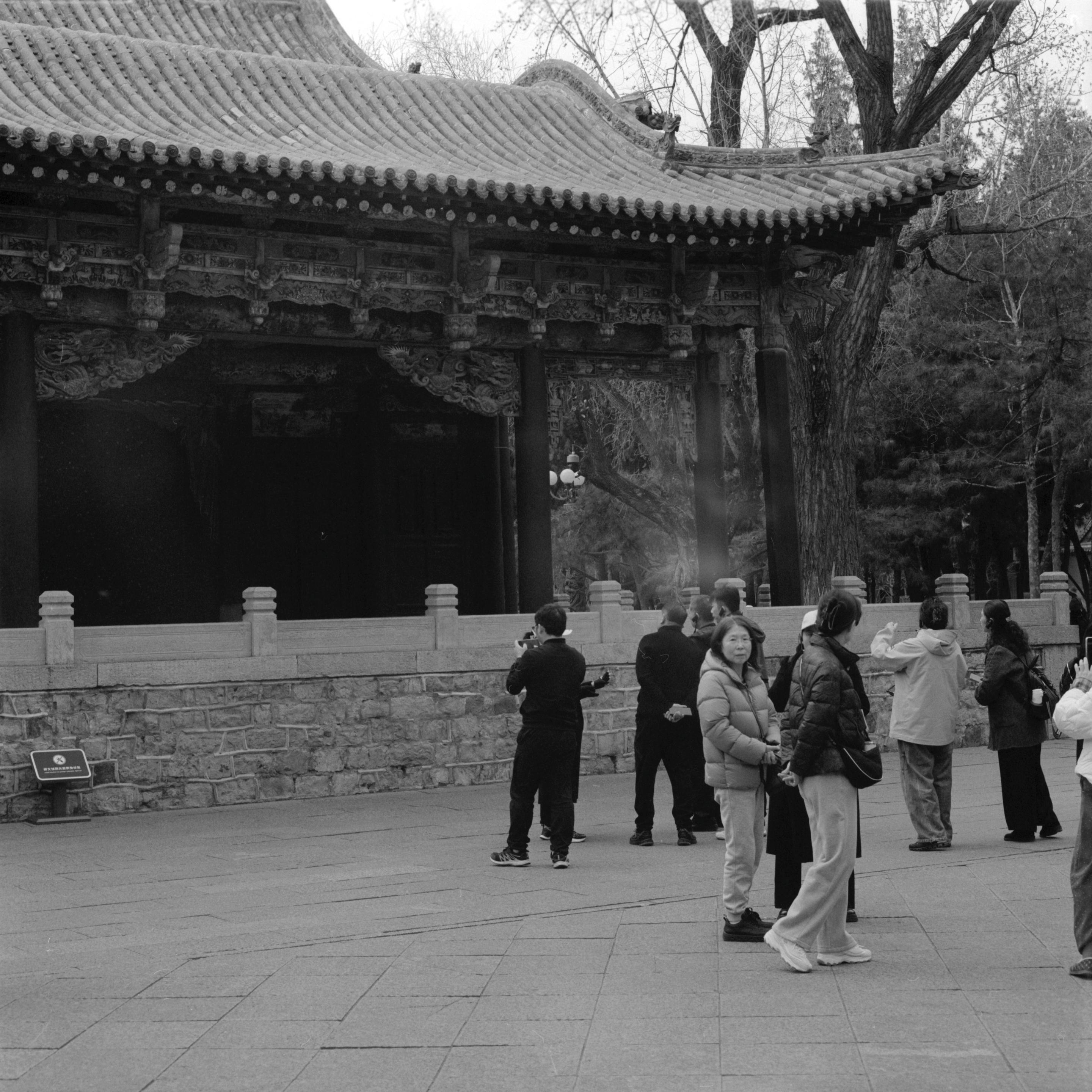
Mistakes and None Thereof II ❌
错误和当中没有错误 II ❌
📷 Pentax 6x7
🎞️ Ilford HP5 Plus 400
If you like my work, Support by buying me a coffee or a roll of film from
PayPal https://www.paypal.com/paypalme/ydcdingsite
Wise


 @leftsidestory@mstdn.social
2026-06-04 01:37:18
Mistakes and None Thereof III ❌
错误和当中没有错误 III ❌
📷 Nikon F4E
🎞️ Kentmere 400
If you like my work, Support by buying me a coffee or a roll of film from
PayPal https://www.paypal.com/paypalme/ydcdingsite
Wise