 @heiseonline@social.heise.de
2026-02-11 08:33:00
 @aardrian@toot.cafe
2025-12-11 13:00:55
“Flutter 3.38.0: How an accessibility upgrade broke Android headings”
https://abra.ai/blog/flutter-3-38-0-how-an-accessibility-upgrade-broke-android-headings
PR that should fix it:
 @Techmeme@techhub.social
2025-12-11 17:40:57
Google DeepMind launches an enhanced Gemini Deep Research agent accessible to developers via its new Interactions API, along with a new DeepSearchQA benchmark (The Keyword)
https://blog.google/technology/developers/deep-research-agent-gemini-api/
 @aardrian@toot.cafe
2025-12-12 22:25:14
The Smashing Magazine comment form is still broken, so I’m memorializing the comment I _wanted_ to leave about CSS carousels:
https://adrianroselli.com/2025/05/my-request-to-google-on-accessibility.html#Update06 (anchor)
Includes quote fr…
 @cdarwin@c.im
2025-12-13 05:35:38
The Biden administration may have shot the serif,
switching from Times New Roman font on the grounds that serif-less fonts such as Calibri are more accessible to readers with disabilities.
That’s all over now.
The State Department Action Request reads:
“To restore decorum and professionalism to the Department’s written work products
and abolish yet another wasteful DEIA [Diversity, Equity, Inclusion, and Accessibility] program,
the Department is return…
 @heiseonline@social.heise.de
2025-12-11 08:10:00
Google: Suche wird personalisierter und "hilfreicher"
Google als Social-Media-Feed? Die Suche soll personalisierter werden. Im AI Mode werden mehr Links ausgespielt.
https://www.he…
@heiseonline@social.heise.de2025-12-11 13:44:00
Warnung vor „wahnhaftem Output“: So sollen KI-Firmen Chatbots sicherer machen
In den USA haben 42 Generalstaatsanwälte eine Warnung wegen versteckter Gefahren an große Tech-Unternehmen wie Apple, Meta und OpenAI ausgesprochen.
@aardrian@toot.cafe2025-12-11 17:25:54
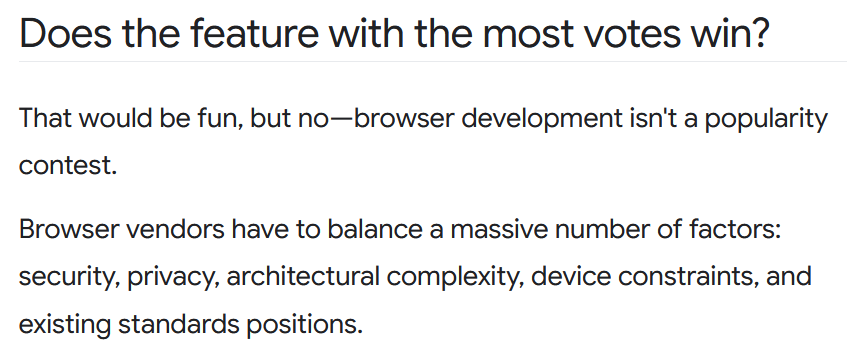
Because #accessibility is out of scope for Baseline, devs may not know how poorly supported a feature is and miss an opportunity to vote for things that are barriers to users and risks to orgs.
“Vote for the web features you want to see”
https://
 @aardrian@toot.cafe
2026-02-08 14:28:03
“The Mistake Of CES’s Accessibility Stage”
https://accessaces.com/the-mistake-of-cess-accessibility-stage/
“Accessibility had not disappeared [from CES], but it was segregated into its own corner with a dedicated ‘Accessibility Stage’.”
@aardrian@toot.cafe2025-12-11 20:55:47
Surveys…
GAAD / WebAIM Global Digital Accessibility Salary Survey #2 (closes 2 Jan 2026):
https://webaim.org/projects/salary2/
Intopia’s Australia / New Zealand Assistive Technology Survey (closes 6 Feb 2026):