 @AimeeMaroux@mastodon.social
2026-05-02 22:14:40
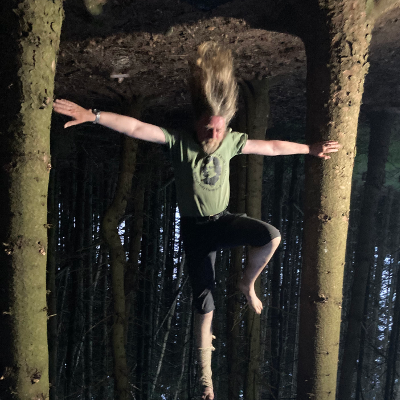
Happy horny #Satyrday, everyone 😈
I'm not entirely certain about the original artist. I think it was Bavarii on Tumblr who is now on BlueSky: https://bsky.app/profile/bavarii.bsky.social

 @simon_brooke@mastodon.scot
2026-05-01 09:09:28
Starting a day with severe depression is a matter of looking at a pile of problems all of which seem insuperable, picking one, breaking it into smaller problems which still seem insuperable, tackling them one by one slowly. In the sure and certain knowledge that the problem probably really was insuperable and sooner or later you will be stopped by a subtask you cannot complete... And that will have to be left as an insuperable problem for the next day. Rinse and repeat.

 @unixviking@social.linux.pizza
2026-04-02 09:24:36
I was bad... so damn bad! I went against my own principles! Out of curiosity, I broke my sacred vow NEVER to use something like artificial intelligence. Especially not for meaningless stuff, like most people use it for.
But then... I was looking for a new profile picture for myself.... and then... I got curious to see if all this artificial intelligence hype had any substance... if this AI is really as good in certain areas as many claim... so I tried out an image AI for the first time…

 @mlawton@mstdn.social
2026-05-03 03:14:33
A friend and I saw Ben Folds play at Harvester Music Center tonight. 🎶 🎹 🎤
Great show.
#Music

 @azonenberg@ioc.exchange
2026-05-01 19:20:18
So it turns out that NSight Systems still runs on my box sans nvidia GPU as long as I uncheck the boxes for GPU metrics.
But it'll give me CPU and NIC side profiling including, critically, all of the NVTX annotations so I know which filters are running concurrently with which others, how long they're taking, etc.
It's certainly not as good as something that integrates properly with the GPU but with careful use of NVTX I can probably at least get dispatch-level run tim…
 @arXiv_csDS_bot@mastoxiv.page
2026-02-03 08:07:36
Fast $k$-means Seeding Under The Manifold Hypothesis
Poojan Shah, Shashwat Agrawal, Ragesh Jaiswal
https://arxiv.org/abs/2602.01104 https://arxiv.org/pdf/2602.01104 https://arxiv.org/html/2602.01104
arXiv:2602.01104v1 Announce Type: new
Abstract: We study beyond worst case analysis for the $k$-means problem where the goal is to model typical instances of $k$-means arising in practice. Existing theoretical approaches provide guarantees under certain assumptions on the optimal solutions to $k$-means, making them difficult to validate in practice. We propose the manifold hypothesis, where data obtained in ambient dimension $D$ concentrates around a low dimensional manifold of intrinsic dimension $d$, as a reasonable assumption to model real world clustering instances. We identify key geometric properties of datasets which have theoretically predictable scaling laws depending on the quantization exponent $\varepsilon = 2/d$ using techniques from optimum quantization theory. We show how to exploit these regularities to design a fast seeding method called $\operatorname{Qkmeans}$ which provides $O(\rho^{-2} \log k)$ approximate solutions to the $k$-means problem in time $O(nD) \widetilde{O}(\varepsilon^{1 \rho}\rho^{-1}k^{1 \gamma})$; where the exponent $\gamma = \varepsilon \rho$ for an input parameter $\rho < 1$. This allows us to obtain new runtime - quality tradeoffs. We perform a large scale empirical study across various domains to validate our theoretical predictions and algorithm performance to bridge theory and practice for beyond worst case data clustering.
toXiv_bot_toot
 @cdarwin@c.im
2026-02-26 00:21:21
JD "they really don't teach law at Yale" Vance
https://bsky.app/profile/atrupar.com/post/3mfpo3gnvyi22

 @arXiv_mathLO_bot@mastoxiv.page
2026-03-31 08:06:12
The Cardinalities of Intervals of Equational Theories and Logics
Juan P. Aguilera, Nick Bezhanishvili, Tenyo Takahashi
https://arxiv.org/abs/2603.27203 https://arxiv.org/pdf/2603.27203 https://arxiv.org/html/2603.27203
arXiv:2603.27203v1 Announce Type: new
Abstract: We study the cardinality of classes of equational theories (varieties) and logics by applying descriptive set theory. We affirmatively solve open problems raised by Jackson and Lee [Trans. Am. Math. Soc. 370 (2018), pp. 4785-4812] regarding the cardinalities of subvariety lattices, and by Bezhanishvili et al. [J. Math. Log. (2025), in press] regarding the degrees of the finite model property (fmp). By coding equations and formulas by natural numbers, and theories and logics by real numbers, we examine their position in the Borel hierarchy. We prove that every interval of equational theories in a countable language corresponds to a $\boldsymbol{\Pi}^0_1$ set, and every fmp span of a normal modal logic to a $\boldsymbol{\Pi}^0_2$ set. It follows that they have cardinality either $\leq \aleph_0$ or $2^{\aleph_0}$, provably in ZFC. In the same manner, we observe that the set of pretabular extensions of a tense logic is a $\boldsymbol{\Pi}^0_2$ set, so its cardinality is either $\leq \aleph_0$ or $2^{\aleph_0}$. We also point out a negative solution to another open problem raised by Jackson and Lee [Trans. Am. Math. Soc. 370 (2018), pp. 4785-4812] regarding the existence of independent systems, which relies on Je\v{z}ek et al. [Bull. Aust. Math. Soc. 42 (1990), pp. 57-70].
toXiv_bot_toot
 @relcfp@mastodon.social
2026-02-03 20:20:22
(Un)Equals in the State? Minority Protestants and Their Recognition by Political Regimes https://networks.h-net.org/group/announcements/20139486/unequals-state-minority-protestants-and-their-recognition-political