Tootfinder

Opt-in global Mastodon full text search. Join the index!

@UP8@mastodon.social
2025-10-31 00:13:17

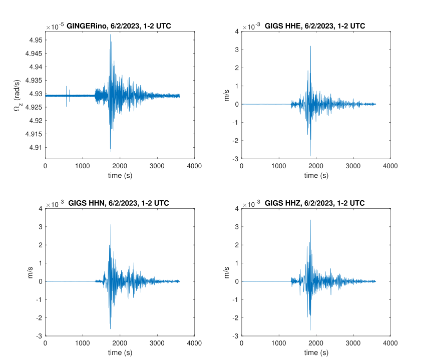
đź’« Fast frequency reconstruction using Deep Learning for event recognition in ring laser data
#laser

Four time series charts showing the horizontal and vertical motion detected by both a conventional seismograph and a ring laser gyroscope that all look just about the same
@arXiv_csLG_bot@mastoxiv.page
2025-10-13 10:41:40

Deep Learning to Identify the Spatio-Temporal Cascading Effects of Train Delays in a High-Density Network
Vu Duc Anh Nguyen, Ziyue Li
arxiv.org/abs/2510.09350

@stefanlaser@social.tchncs.de
2025-10-21 06:53:37

I like to play around as an anonymous commenter in online newspaper columns. If you point out the biases of #AI systems, the comment gets deleted because it is considered too polemical.
The comment was addressing an article about AI in public service and the use in refugee applications 🫣

A quick chat with ChatGPT itself: asked about bias in training and inference, it agrees. It's not traceable; "the exact causal pathways inside a deep neural network remain largely opaque to human understanding." It's never fully decodable. Not that we can trust this very output.
@arXiv_mathOC_bot@mastoxiv.page
2025-10-07 10:40:42

Learning Polynomial Activation Functions for Deep Neural Networks
Linghao Zhang, Jiawang Nie, Tingting Tang
arxiv.org/abs/2510.03682 arxiv.…

@arXiv_eessSP_bot@mastoxiv.page
2025-10-14 11:12:28

WiNPA: Wireless Neural Processing Architecture
Sai Xu, Yanan Du
arxiv.org/abs/2510.11150 arxiv.org/pdf/2510.11150

@arXiv_quantph_bot@mastoxiv.page
2025-10-09 10:48:21

Accelerating Inference for Multilayer Neural Networks with Quantum Computers
Arthur G. Rattew, Po-Wei Huang, Naixu Guo, Lirand\"e Pira, Patrick Rebentrost
arxiv.org/abs/2510.07195

@arXiv_astrophIM_bot@mastoxiv.page
2025-10-14 10:55:48

Slitless Spectroscopy Source Detection Using YOLO Deep Neural Network
Xiaohan Chen, Man I Lam, Yingying Zhou, Hongrui Gu, Jinzhi Lai, Zhou Fan, Jing Li, Xin Zhang, Hao Tian
arxiv.org/abs/2510.10922

@arXiv_mathDS_bot@mastoxiv.page
2025-10-13 08:17:40

Architecture Induces Structural Invariant Manifolds of Neural Network Training Dynamics
Jiajie Zhao, Tao Luo, Yaoyu Zhang
arxiv.org/abs/2510.09564

@arXiv_csCE_bot@mastoxiv.page
2025-10-14 09:05:08

Comparative Evaluation of Neural Network Architectures for Generalizable Human Spatial Preference Prediction in Unseen Built Environments
Maral Doctorarastoo, Katherine A. Flanigan, Mario Berg\'es, Christopher McComb
arxiv.org/abs/2510.10954

@arXiv_physicsinsdet_bot@mastoxiv.page
2025-10-06 08:09:59

Development of Deep Neural Network First-Level Hardware Track Trigger for the Belle II Experiment
Y. -X. Liu, T. Koga, H. Bae, Y. Yang, C. Kiesling, F. Meggendorfer, K. Unger, S. Hiesl, T. Forsthofer, A. Ishikawa, Y. Ahn, T. Ferber, I. Haide, G. Heine, C. -L. Hsu, A. Little, H. Nakazawa, M. Neu, L. Reuter, V. Savinov, Y. Unno, J. Yuan, Z. Xu

@arXiv_csSD_bot@mastoxiv.page
2025-10-06 08:50:59

WavInWav: Time-domain Speech Hiding via Invertible Neural Network
Wei Fan, Kejiang Chen, Xiangkun Wang, Weiming Zhang, Nenghai Yu
arxiv.org/abs/2510.02915

@arXiv_physicsfludyn_bot@mastoxiv.page
2025-10-09 09:33:31

Active Control of Turbulent Airfoil Flows Using Adjoint-based Deep Learning
Xuemin Liu, Tom Hickling, Jonathan F. MacArt
arxiv.org/abs/2510.07106

@arXiv_physicsaoph_bot@mastoxiv.page
2025-10-07 08:07:39

Deep learning the sources of MJO predictability: a spectral view of learned features
Lin Yao, Da Yang, James P. C. Duncan, Ashesh Chattopadhyay, Pedram Hassanzadeh, Wahid Bhimji, Bin Yu
arxiv.org/abs/2510.03582

@arXiv_condmatdisnn_bot@mastoxiv.page
2025-10-09 08:27:41

Application of deep neural networks for computing the renormalization group flow of the two-dimensional phi^4 field theory
Yueqi Zhao, Michael M. Fogler, Yi-Zhuang You
arxiv.org/abs/2510.06508 …

@arXiv_csLG_bot@mastoxiv.page
2025-10-09 10:55:31

GTCN-G: A Residual Graph-Temporal Fusion Network for Imbalanced Intrusion Detection (Preprint)
Tianxiang Xu, Zhichao Wen, Xinyu Zhao, Qi Hu, Yan Li, Chang Liu
arxiv.org/abs/2510.07285

@arXiv_astrophIM_bot@mastoxiv.page
2025-10-13 08:57:00

deep-REMAP: Probabilistic Parameterization of Stellar Spectra Using Regularized Multi-Task Learning
Sankalp Gilda
arxiv.org/abs/2510.09362 …

@UP8@mastodon.social
2025-10-08 16:22:05

đź“· Two-stage framework reconstructs sharp 4D scenes from blurry handheld videos
#imaging

@arXiv_csAR_bot@mastoxiv.page
2025-10-10 07:31:38

A Scalable FPGA Architecture With Adaptive Memory Utilization for GEMM-Based Operations
Anastasios Petropoulos, Theodore Antonakopoulos
arxiv.org/abs/2510.08137

@arXiv_eessSY_bot@mastoxiv.page
2025-10-06 08:22:39

Data-Driven Stochastic Distribution System Hardening Based on Bayesian Online Learning
Wenlong Shi, Hongyi Li, Zhaoyu Wang
arxiv.org/abs/2510.02485

@arXiv_csLG_bot@mastoxiv.page
2025-12-22 10:32:50

Spatially-informed transformers: Injecting geostatistical covariance biases into self-attention for spatio-temporal forecasting
Yuri Calleo
arxiv.org/abs/2512.17696 arxiv.org/pdf/2512.17696 arxiv.org/html/2512.17696
arXiv:2512.17696v1 Announce Type: new
Abstract: The modeling of high-dimensional spatio-temporal processes presents a fundamental dichotomy between the probabilistic rigor of classical geostatistics and the flexible, high-capacity representations of deep learning. While Gaussian processes offer theoretical consistency and exact uncertainty quantification, their prohibitive computational scaling renders them impractical for massive sensor networks. Conversely, modern transformer architectures excel at sequence modeling but inherently lack a geometric inductive bias, treating spatial sensors as permutation-invariant tokens without a native understanding of distance. In this work, we propose a spatially-informed transformer, a hybrid architecture that injects a geostatistical inductive bias directly into the self-attention mechanism via a learnable covariance kernel. By formally decomposing the attention structure into a stationary physical prior and a non-stationary data-driven residual, we impose a soft topological constraint that favors spatially proximal interactions while retaining the capacity to model complex dynamics. We demonstrate the phenomenon of ``Deep Variography'', where the network successfully recovers the true spatial decay parameters of the underlying process end-to-end via backpropagation. Extensive experiments on synthetic Gaussian random fields and real-world traffic benchmarks confirm that our method outperforms state-of-the-art graph neural networks. Furthermore, rigorous statistical validation confirms that the proposed method delivers not only superior predictive accuracy but also well-calibrated probabilistic forecasts, effectively bridging the gap between physics-aware modeling and data-driven learning.
toXiv_bot_toot

@arXiv_csAR_bot@mastoxiv.page
2025-10-09 07:50:41

Hardware-Efficient CNNs: Interleaved Approximate FP32 Multipliers for Kernel Computation
Bindu G Gowda (International Institute of Information Technology Bangalore), Yogesh Goyal (International Institute of Information Technology Bangalore), Yash Gupta (International Institute of Information Technology Bangalore), Madhav Rao (International Institute of Information Technology Bangalore)

@arXiv_csLG_bot@mastoxiv.page
2025-10-13 10:43:50

Cross-Receiver Generalization for RF Fingerprint Identification via Feature Disentanglement and Adversarial Training
Yuhao Pan, Xiucheng Wang, Nan Cheng, Wenchao Xu
arxiv.org/abs/2510.09405

@arXiv_nlincd_bot@mastoxiv.page
2025-10-13 13:09:04

Replaced article(s) found for nlin.CD. arxiv.org/list/nlin.CD/new
[1/1]:
- Network Dynamics-Based Framework for Understanding Deep Neural Networks
Yuchen Lin, Yong Zhang, Sihan Feng, Hong Zhao

@arXiv_csLG_bot@mastoxiv.page
2025-12-22 13:54:35

Replaced article(s) found for cs.LG. arxiv.org/list/cs.LG/new
[2/5]:
- The Diffusion Duality
Sahoo, Deschenaux, Gokaslan, Wang, Chiu, Kuleshov
arxiv.org/abs/2506.10892 mastoxiv.page/@arXiv_csLG_bot/
- Multimodal Representation Learning and Fusion
Jin, Ge, Xie, Luo, Song, Bi, Liang, Guan, Yeong, Song, Hao
arxiv.org/abs/2506.20494 mastoxiv.page/@arXiv_csLG_bot/
- The kernel of graph indices for vector search
Mariano Tepper, Ted Willke
arxiv.org/abs/2506.20584 mastoxiv.page/@arXiv_csLG_bot/
- OptScale: Probabilistic Optimality for Inference-time Scaling
Youkang Wang, Jian Wang, Rubing Chen, Xiao-Yong Wei
arxiv.org/abs/2506.22376 mastoxiv.page/@arXiv_csLG_bot/
- Boosting Revisited: Benchmarking and Advancing LP-Based Ensemble Methods
Fabian Akkerman, Julien Ferry, Christian Artigues, Emmanuel Hebrard, Thibaut Vidal
arxiv.org/abs/2507.18242 mastoxiv.page/@arXiv_csLG_bot/
- MolMark: Safeguarding Molecular Structures through Learnable Atom-Level Watermarking
Runwen Hu, Peilin Chen, Keyan Ding, Shiqi Wang
arxiv.org/abs/2508.17702 mastoxiv.page/@arXiv_csLG_bot/
- Dual-Distilled Heterogeneous Federated Learning with Adaptive Margins for Trainable Global Protot...
Fatema Siddika, Md Anwar Hossen, Wensheng Zhang, Anuj Sharma, Juan Pablo Mu\~noz, Ali Jannesari
arxiv.org/abs/2508.19009 mastoxiv.page/@arXiv_csLG_bot/
- STDiff: A State Transition Diffusion Framework for Time Series Imputation in Industrial Systems
Gary Simethy, Daniel Ortiz-Arroyo, Petar Durdevic
arxiv.org/abs/2508.19011 mastoxiv.page/@arXiv_csLG_bot/
- EEGDM: Learning EEG Representation with Latent Diffusion Model
Shaocong Wang, Tong Liu, Yihan Li, Ming Li, Kairui Wen, Pei Yang, Wenqi Ji, Minjing Yu, Yong-Jin Liu
arxiv.org/abs/2508.20705 mastoxiv.page/@arXiv_csLG_bot/
- Data-Free Continual Learning of Server Models in Model-Heterogeneous Cloud-Device Collaboration
Xiao Zhang, Zengzhe Chen, Yuan Yuan, Yifei Zou, Fuzhen Zhuang, Wenyu Jiao, Yuke Wang, Dongxiao Yu
arxiv.org/abs/2509.25977 mastoxiv.page/@arXiv_csLG_bot/
- Fine-Tuning Masked Diffusion for Provable Self-Correction
Jaeyeon Kim, Seunggeun Kim, Taekyun Lee, David Z. Pan, Hyeji Kim, Sham Kakade, Sitan Chen
arxiv.org/abs/2510.01384 mastoxiv.page/@arXiv_csLG_bot/
- A Generic Machine Learning Framework for Radio Frequency Fingerprinting
Alex Hiles, Bashar I. Ahmad
arxiv.org/abs/2510.09775 mastoxiv.page/@arXiv_csLG_bot/
- ASecond-Order SpikingSSM for Wearables
Kartikay Agrawal, Abhijeet Vikram, Vedant Sharma, Vaishnavi Nagabhushana, Ayon Borthakur
arxiv.org/abs/2510.14386 mastoxiv.page/@arXiv_csLG_bot/
- Utility-Diversity Aware Online Batch Selection for LLM Supervised Fine-tuning
Heming Zou, Yixiu Mao, Yun Qu, Qi Wang, Xiangyang Ji
arxiv.org/abs/2510.16882 mastoxiv.page/@arXiv_csLG_bot/
- Seeing Structural Failure Before it Happens: An Image-Based Physics-Informed Neural Network (PINN...
Omer Jauhar Khan, Sudais Khan, Hafeez Anwar, Shahzeb Khan, Shams Ul Arifeen
arxiv.org/abs/2510.23117 mastoxiv.page/@arXiv_csLG_bot/
- Training Deep Physics-Informed Kolmogorov-Arnold Networks
Spyros Rigas, Fotios Anagnostopoulos, Michalis Papachristou, Georgios Alexandridis
arxiv.org/abs/2510.23501 mastoxiv.page/@arXiv_csLG_bot/
- Semi-Supervised Preference Optimization with Limited Feedback
Seonggyun Lee, Sungjun Lim, Seojin Park, Soeun Cheon, Kyungwoo Song
arxiv.org/abs/2511.00040 mastoxiv.page/@arXiv_csLG_bot/
- Towards Causal Market Simulators
Dennis Thumm, Luis Ontaneda Mijares
arxiv.org/abs/2511.04469 mastoxiv.page/@arXiv_csLG_bot/
- Incremental Generation is Necessary and Sufficient for Universality in Flow-Based Modelling
Hossein Rouhvarzi, Anastasis Kratsios
arxiv.org/abs/2511.09902 mastoxiv.page/@arXiv_csLG_bot/
- Optimizing Mixture of Block Attention
Guangxuan Xiao, Junxian Guo, Kasra Mazaheri, Song Han
arxiv.org/abs/2511.11571 mastoxiv.page/@arXiv_csLG_bot/
- Assessing Automated Fact-Checking for Medical LLM Responses with Knowledge Graphs
Shasha Zhou, Mingyu Huang, Jack Cole, Charles Britton, Ming Yin, Jan Wolber, Ke Li
arxiv.org/abs/2511.12817 mastoxiv.page/@arXiv_csLG_bot/
toXiv_bot_toot