 @blakes7bot@mas.torpidity.net
2026-01-16 07:23:28
#Blakes7 Series B, Episode 09 - Countdown
AVON: I doubt it. [Turns and leaves]
[Blake smiles]
[End of episode. Roll credits.]
https://blake.torpidity.net/m/209/537 B7B1

 @arXiv_csLG_bot@mastoxiv.page
2025-12-22 13:54:24
Replaced article(s) found for cs.LG. https://arxiv.org/list/cs.LG/new
[1/5]:
- Feed Two Birds with One Scone: Exploiting Wild Data for Both Out-of-Distribution Generalization a...
Haoyue Bai, Gregory Canal, Xuefeng Du, Jeongyeol Kwon, Robert Nowak, Yixuan Li
https://arxiv.org/abs/2306.09158
- Sparse, Efficient and Explainable Data Attribution with DualXDA
Galip \"Umit Yolcu, Moritz Weckbecker, Thomas Wiegand, Wojciech Samek, Sebastian Lapuschkin
https://arxiv.org/abs/2402.12118 https://mastoxiv.page/@arXiv_csLG_bot/111962593972369958
- HGQ: High Granularity Quantization for Real-time Neural Networks on FPGAs
Sun, Que, {\AA}rrestad, Loncar, Ngadiuba, Luk, Spiropulu
https://arxiv.org/abs/2405.00645 https://mastoxiv.page/@arXiv_csLG_bot/112370274737558603
- On the Identification of Temporally Causal Representation with Instantaneous Dependence
Li, Shen, Zheng, Cai, Song, Gong, Chen, Zhang
https://arxiv.org/abs/2405.15325 https://mastoxiv.page/@arXiv_csLG_bot/112511890051553111
- Basis Selection: Low-Rank Decomposition of Pretrained Large Language Models for Target Applications
Yang Li, Daniel Agyei Asante, Changsheng Zhao, Ernie Chang, Yangyang Shi, Vikas Chandra
https://arxiv.org/abs/2405.15877 https://mastoxiv.page/@arXiv_csLG_bot/112517547424098076
- Privacy Bias in Language Models: A Contextual Integrity-based Auditing Metric
Yan Shvartzshnaider, Vasisht Duddu
https://arxiv.org/abs/2409.03735 https://mastoxiv.page/@arXiv_csLG_bot/113089789682783135
- Low-Rank Filtering and Smoothing for Sequential Deep Learning
Joanna Sliwa, Frank Schneider, Nathanael Bosch, Agustinus Kristiadi, Philipp Hennig
https://arxiv.org/abs/2410.06800 https://mastoxiv.page/@arXiv_csLG_bot/113283021321510736
- Hierarchical Multimodal LLMs with Semantic Space Alignment for Enhanced Time Series Classification
Xiaoyu Tao, Tingyue Pan, Mingyue Cheng, Yucong Luo, Qi Liu, Enhong Chen
https://arxiv.org/abs/2410.18686 https://mastoxiv.page/@arXiv_csLG_bot/113367101100828901
- Fairness via Independence: A (Conditional) Distance Covariance Framework
Ruifan Huang, Haixia Liu
https://arxiv.org/abs/2412.00720 https://mastoxiv.page/@arXiv_csLG_bot/113587817648503815
- Data for Mathematical Copilots: Better Ways of Presenting Proofs for Machine Learning
Simon Frieder, et al.
https://arxiv.org/abs/2412.15184 https://mastoxiv.page/@arXiv_csLG_bot/113683924322164777
- Pairwise Elimination with Instance-Dependent Guarantees for Bandits with Cost Subsidy
Ishank Juneja, Carlee Joe-Wong, Osman Ya\u{g}an
https://arxiv.org/abs/2501.10290 https://mastoxiv.page/@arXiv_csLG_bot/113859392622871057
- Towards Human-Guided, Data-Centric LLM Co-Pilots
Evgeny Saveliev, Jiashuo Liu, Nabeel Seedat, Anders Boyd, Mihaela van der Schaar
https://arxiv.org/abs/2501.10321 https://mastoxiv.page/@arXiv_csLG_bot/113859392688054204
- Regularized Langevin Dynamics for Combinatorial Optimization
Shengyu Feng, Yiming Yang
https://arxiv.org/abs/2502.00277
- Generating Samples to Probe Trained Models
Eren Mehmet K{\i}ral, Nur\c{s}en Ayd{\i}n, \c{S}. \.Ilker Birbil
https://arxiv.org/abs/2502.06658 https://mastoxiv.page/@arXiv_csLG_bot/113984059089245671
- On Agnostic PAC Learning in the Small Error Regime
Julian Asilis, Mikael M{\o}ller H{\o}gsgaard, Grigoris Velegkas
https://arxiv.org/abs/2502.09496 https://mastoxiv.page/@arXiv_csLG_bot/114000974082372598
- Preconditioned Inexact Stochastic ADMM for Deep Model
Shenglong Zhou, Ouya Wang, Ziyan Luo, Yongxu Zhu, Geoffrey Ye Li
https://arxiv.org/abs/2502.10784 https://mastoxiv.page/@arXiv_csLG_bot/114023667639951005
- On the Effect of Sampling Diversity in Scaling LLM Inference
Wang, Liu, Chen, Light, Liu, Chen, Zhang, Cheng
https://arxiv.org/abs/2502.11027 https://mastoxiv.page/@arXiv_csLG_bot/114023688225233656
- How to use score-based diffusion in earth system science: A satellite nowcasting example
Randy J. Chase, Katherine Haynes, Lander Ver Hoef, Imme Ebert-Uphoff
https://arxiv.org/abs/2505.10432 https://mastoxiv.page/@arXiv_csLG_bot/114516300594057680
- PEAR: Equal Area Weather Forecasting on the Sphere
Hampus Linander, Christoffer Petersson, Daniel Persson, Jan E. Gerken
https://arxiv.org/abs/2505.17720 https://mastoxiv.page/@arXiv_csLG_bot/114572963019603744
- Train Sparse Autoencoders Efficiently by Utilizing Features Correlation
Vadim Kurochkin, Yaroslav Aksenov, Daniil Laptev, Daniil Gavrilov, Nikita Balagansky
https://arxiv.org/abs/2505.22255 https://mastoxiv.page/@arXiv_csLG_bot/114589956040892075
- A Certified Unlearning Approach without Access to Source Data
Umit Yigit Basaran, Sk Miraj Ahmed, Amit Roy-Chowdhury, Basak Guler
https://arxiv.org/abs/2506.06486 https://mastoxiv.page/@arXiv_csLG_bot/114658421178857085
toXiv_bot_toot
@blakes7bot@mas.torpidity.net2026-01-15 13:12:08
Series C, Episode 12 - Death-Watch
VILA: [Pulls Orac's key] They don't write poetry like that anymore. What this electronic pain is trying to say is-
TARRANT: -is that unless we get a break, there's going to be a fatal foul-up.
VILA: Right.
https://blake.torpidity.net/m/312/52

 @servelan@newsie.social
2026-03-04 02:05:06
'Eliminate the impossible, and whatever remains, however improbable, must be the truth'
Trump, Rubio and Hegseth can’t seem to get their stories straight on rationale for Iran war as Mideast explodes | The Independent
https://www.independent.co.uk/news/world/americas/us-politics/trump-rubio-hegseth-iran-war-rationale-explanation-b2931430.html
 @cjust@infosec.exchange
2026-02-04 17:24:47
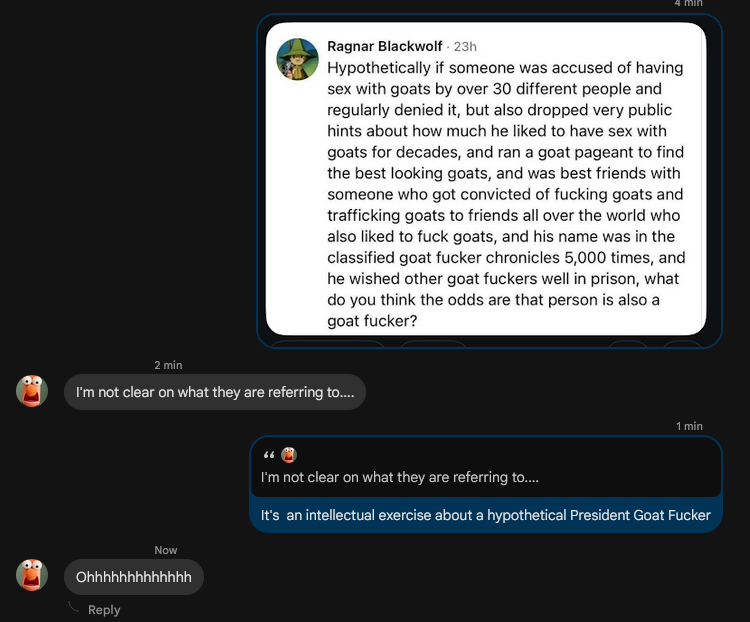
A good friend of mine has the Muppet character "Beaker" as his avatar. For reasons.
He offers me advice. I offer him advice. We chat. These are #ChatsWithBeaker
 @arXiv_csDS_bot@mastoxiv.page
2026-02-10 10:58:06
Approximate Cartesian Tree Matching with Substitutions
Panagiotis Charalampopoulos, Jonas Ellert, Manal Mohamed
https://arxiv.org/abs/2602.08570 https://arxiv.org/pdf/2602.08570 https://arxiv.org/html/2602.08570
arXiv:2602.08570v1 Announce Type: new
Abstract: The Cartesian tree of a sequence captures the relative order of the sequence's elements. In recent years, Cartesian tree matching has attracted considerable attention, particularly due to its applications in time series analysis. Consider a text $T$ of length $n$ and a pattern $P$ of length $m$. In the exact Cartesian tree matching problem, the task is to find all length-$m$ fragments of $T$ whose Cartesian tree coincides with the Cartesian tree $CT(P)$ of the pattern. Although the exact version of the problem can be solved in linear time [Park et al., TCS 2020], it remains rather restrictive; for example, it is not robust to outliers in the pattern.
To overcome this limitation, we consider the approximate setting, where the goal is to identify all fragments of $T$ that are close to some string whose Cartesian tree matches $CT(P)$. In this work, we quantify closeness via the widely used Hamming distance metric. For a given integer parameter $k>0$, we present an algorithm that computes all fragments of $T$ that are at Hamming distance at most $k$ from a string whose Cartesian tree matches $CT(P)$. Our algorithm runs in time $\mathcal O(n \sqrt{m} \cdot k^{2.5})$ for $k \leq m^{1/5}$ and in time $\mathcal O(nk^5)$ for $k \geq m^{1/5}$, thereby improving upon the state-of-the-art $\mathcal O(nmk)$-time algorithm of Kim and Han [TCS 2025] in the regime $k = o(m^{1/4})$.
On the way to our solution, we develop a toolbox of independent interest. First, we introduce a new notion of periodicity in Cartesian trees. Then, we lift multiple well-known combinatorial and algorithmic results for string matching and periodicity in strings to Cartesian tree matching and periodicity in Cartesian trees.
toXiv_bot_toot
 @tante@tldr.nettime.org
2026-03-05 18:00:05
"Regulate outcomes. The tech doesn’t matter. For the person hurt the tool that was used to hurt them isn’t that relevant. We need to make sure that we are reducing, ideally eliminating the hurt."
(Original title: Nothing to Declare)
https://tante.cc/2026/03/05/nothing-to-de…
 @arXiv_physicsinsdet_bot@mastoxiv.page
2026-02-09 08:25:58
CAGE: An Internal Source Scanning Cryostat for HPGe Characterization
G. Othman, C. Wiseman, T. H. Burritt, J. A. Detwiler, M. P. Held, R. Henning, T. Mathew, D. Peterson, W. Pettus, G. Song, T. D. Van Wechel
https://arxiv.org/abs/2602.06289 https://arxiv.org/pdf/2602.06289 https://arxiv.org/html/2602.06289
arXiv:2602.06289v1 Announce Type: new
Abstract: The success of current and future-generation neutrinoless double beta decay experiments relies on the ability to eliminate or reduce extraneous backgrounds. In addition to constructing experiments using radiopure materials and handling in underground laboratories, it is necessary to understand and reduce known backgrounds in data analysis. The Large Enriched Germanium Experiment for Neutrinoless double beta Decay is searching for this decay using 76Ge-enriched high-purity germanium detectors submerged in an active liquid argon veto. A significant background in LEGEND is surface events from shallowly-impinging radiation on detector surfaces. In this paper we introduce the Collimated Alphas, Gammas, and Electrons (CAGE) scanning system, an internal-source scanning vacuum cryostat, designed to perform studies of surface events on sensitive surfaces of HPGe in a surface-lab. CAGE features a collimated radionuclide source inside a movable infrared shield that is able to perform precision scans of detector surfaces by utilizing three independent motor stages for source positioning. This allows detailed studies of pulse shapes as a function of source position and incident angle, where defining features can be extracted and exploited for removing surface backgrounds in data analysis in LEGEND. In this paper, we describe CAGE and demonstrate its performance with a commissioning run with 241Am. The commissioning run was completed with the source at normal incidence, and we estimate a beam spot precision of 3.1 mm, which includes positioning uncertainties and the beam-spot size. Using the 59.5 keV gamma population from 241Am, we show that low-energy photon events near the passivated surface feature risetimes that increase with radial distance from the detector center. We suggest a specific metric that can be used to discriminate low-energy gamma backgrounds in LEGEND with similar characteristics.
toXiv_bot_toot
@blakes7bot@mas.torpidity.net2026-03-09 20:20:56
Series C, Episode 10 - Ultraworld
ULTRA 1: Fine specimen. Categorize as humanoid vertebrate. Subcategory, telepath.
ULTRA 3: Very shortly we can remove her from the sleep cell.
ULTRA 2: And the others?
ULTRA 1: They will be dealt with in due course.
https://blake.torpidity.net/m/310/309
 @blakes7bot@mas.torpidity.net
2026-01-20 13:40:29
Series C, Episode 05 - The Harvest of Kairos
DASTOR: The Liberator, madam. Tele-sentry stations report an approach course for Lypterion. Tarrant is coming here.
SERVALAN: I know that. When will he arrive?
https://blake.torpidity.net/m/305/173 B7B3
