 @cdarwin@c.im
2026-08-11 14:41:50
Lawyers for the Los Angeles Police officer charged with multiple felonies for secretly recording his colleagues’ racist, sexist and homophobic comments
issued a scathing response to Los Angeles County Dist. Atty. Nathan Hochman,
-- accusing the D.A. of making
“a desperate effort to save face”
and attempting to discredit their client ahead of his arraignment Monday.
Officer Daniel Flores has said he heard co-workers refer to Black people as “monkeys” who like gra…

 @acka47@openbiblio.social
2026-08-31 18:10:06
RE: https://glammr.us/@LibraryLoon/117191361596568805
"Even if we can come to a definition of public good, why should we assume that an AI infrastructure will produce it? And even if it can produce good, does the amount of good justify the other effects…
 @aredridel@kolektiva.social
2026-07-19 17:06:31
periodic reminder that Dunning-Kruger effect is mostly statistical error and if you're using it as a part of your worldview, that's maybe a problem.
Doubly so since a naive reflection of it is a belief in a fascist ubermensch who's just smarter than everyone else. You can justify deeply anti-democratic ideals with it. So consider this carefully.
 @arXiv_csPL_bot@mastoxiv.page
2026-07-22 07:43:31
Build-Authorized Evidence for Opaque Calls: A Fail-Closed Rewrite-Authority Boundary
Zhonghua Yi (Toka Language Research Group)
https://arxiv.org/abs/2607.18949 https://arxiv.org/pdf/2607.18949 https://arxiv.org/html/2607.18949
arXiv:2607.18949v1 Announce Type: new
Abstract: Detached semantic facts about opaque native providers do not by themselves justify compiler rewrites: rewrite authority must be confined to the accepted fact, selected provider and build, caller, callback environment, observation, and runtime target. We present a build-authorized path-effect interface that enforces this boundary through fail-closed authorization and link receipts. The design separates receipt closure, callback-environment closure, and projection identity, and passes accepted facts to LLVM through a narrow internal API. We use one-hop topology-load reuse as a minimal observable witness of authority, not as the optimization target.
A conservative LLVM consumer reuses a pointer observation only from a noalias root or one constant nonzero projection. Rocq models prove conditional refinement and authority non-amplification under explicit effect, alias, compiler/ABI, and target-resolution premises. We instantiate checked production with Toka: a source-summary gate emits exact LLVM IR, a separate IR checker accepts only a bounded topology-preserving subset, and only accepted IR is compiled into the receipt-bound provider object. A bounded static Darwin/arm64 profile also checks the final direct branch target.
Across issuer-declared readv, recvmsg, and Cairo boundaries, authorized IR retains each opaque call, reduces the relevant loads from two to one, and preserves observed results; mismatched providers, builds, callbacks, projections, and unsupported IR remain neutral. A libjpeg case is rejected because its callback environment is open, while a bound callback singleton demonstrates the supported closure rule. The contribution is a checked deployment-compiler boundary with an explicit trust and applicability frontier, not a uniquely expressive effect encoding or a new load-elimination algorithm.
toXiv_bot_toot
 @enriquericos@mastoart.social
2026-08-21 18:47:09
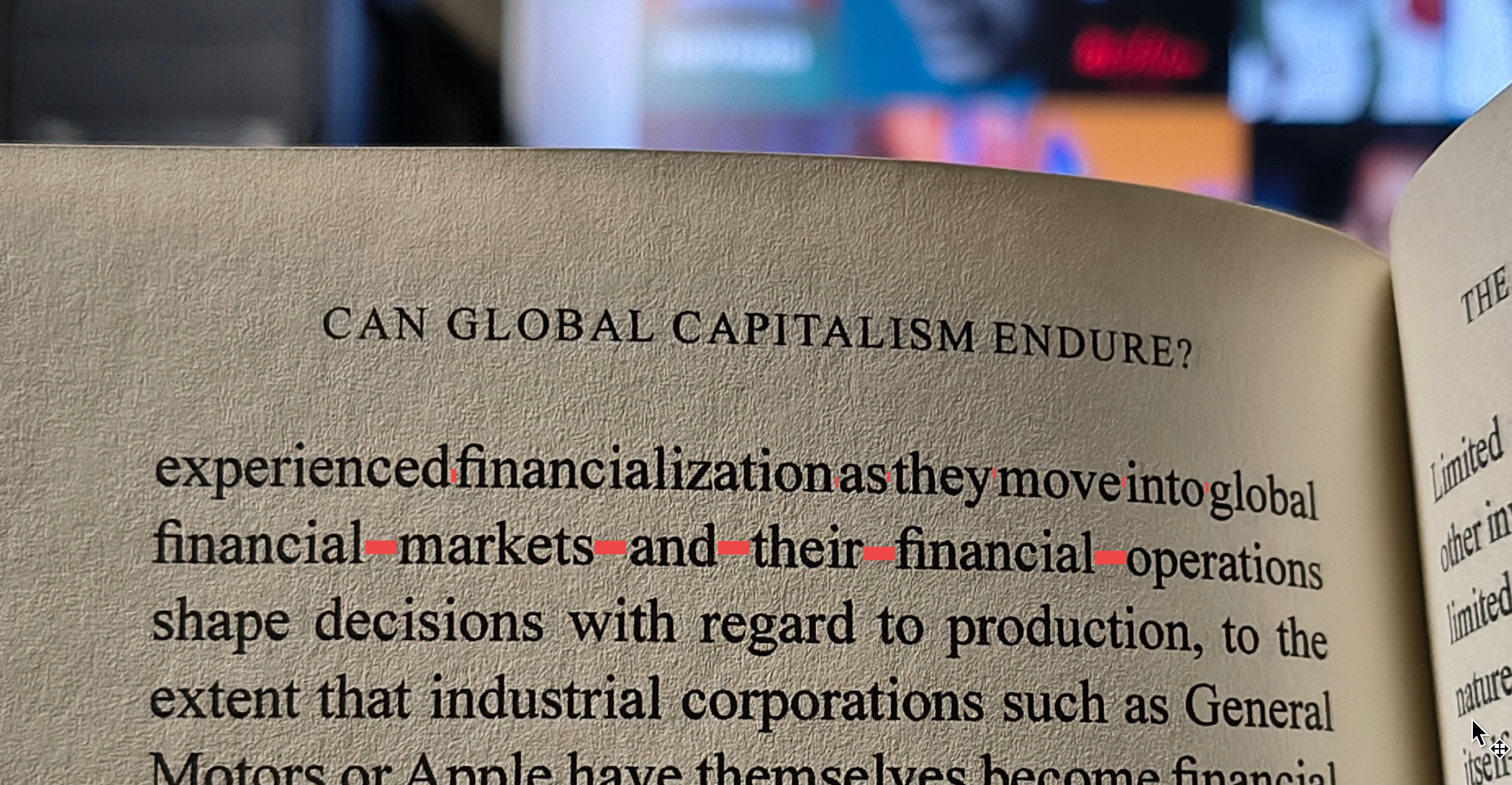
Please, don't justify your texts if you don't know how to adjust the spaces, and, for the love of Satan or whatever deity you fancy, please don't print a book like this.
#GraphicDesign #Unjustified #books #layout