@… it would be much easier without the capitalist counter investments
From the article
But finance is frequently working in the opposite direction. About $7.3tn flows each year to activities that degrade nature, compared with about $220bn for nature-based solutions, according to UN figures cited in the report.
“For every £1 invested in p…
🔐 Logged-in flows use a persistent browser profile locally or Playwright storageState JSON in CI; stepshots patch amends existing bundles with manually captured steps for one-shot flows
🤖 stepshots mcp serves the recording workflow over #MCP on stdio so AI agents can call get_schema, list_tutorials, record, verify and upload
For a while now, the global economy has been beating the odds.
The energy shock prompted by the American and Israeli attacks on Iran in February set off the largest disruption of worldwide energy flows in history. Yet despite jumps in oil prices, widening conflict in the Middle East, fuel shortages and inflation pressures, the feared crash never came and most economies managed to muddle through.
But wiggle room is narrowing at the same time the outlook is darkening. Look at what …
What data do I need to simulate various battery sizes? The measures are in 5 minute intervals.
Total Active Power in W (Measuring Point ID p24) tells me how much energy was harvested at that moment. By dividing it by 12, I get the Wh. I could use Total Yield in Wh (p2) but then I need to subtract the data from the previous time frame.
Next I need to know how much energy the house used. I could look at the Meter Active Power in W (p8018) from the meter, which tells me how much energy flows to or from the grid. Divided by 12 to get Wh.
The difference is how much energy I could send or would need from the battery.
Because there are limits to how fast energy can be stored and returned, I probably should wait with the division until the end to not have to go back and forth multiple times.
The battery has a storage capacity in Wh and a charge/discharge limit in W.
Examples:
p24: 4.000 W
p8018: 2.000 W
-> house uses 6.000 W
Battery with 5.000 W discharge limit needs to provide 2000/12 Wh -> 167 Wh
p24: 4.000 W
p8018: -2.000 W
-> house uses 2.000 W
Battery could charge 2000/12 Wh -> 167 Wh
p24: 1.000 W
p8018: 7.000 W
-> house uses 8.000 W
Battery can only provide 5000/12 Wh -> 417 Wh
2000 W (167 Wh) have to be bought
Fields:
PV W, Meter W, House W, Battery W, Battery Wh, Grid W, Grid sold Wh, Grid bought Wh
RE: https://social.tchncs.de/@stefanlaser/117274760102231892
Knowledge has weight. It accumulates in infrastructures, flows through cables, and settles in data centres that consume land, water, minerals, and energy.
We look at this issue throu…
Sources: Chinese regulators have told banks to back tech companies, but lenders still prefer stable cash flows and profitability over loss-making tech startups (Bloomberg)
https://www.bloomberg.com/news/features/2026-0…
Oil demand is falling more than expected, partly due to record fuel prices. World oil demand will drop by 2.5 million bpd this year, the @iea.org said, more than its previous forecast of a 1.6 million bpd decline.
However, supply is expected to decrease even faster (hence the shortage), and demand is expected to rebound by practically the same amount next year.
🔐 Secure #session defaults: session.use_strict_mode=1, session.cookie_httponly=1 and session.cookie_samesite=Lax. This can break #SSO flows like #SAML POST bindings, payment callbacks and shared sessi…
I get that everyone loves the guillotine imagery right now, but it's probably worth reminding everyone that The Terror wasn't a leftist thing. It was a centrist thing. The French Revolution wasn't a socialist revolution, it was a Liberal revolution. The Jacobins were radical liberals.
There's an ideological rythme and meter that flows through history. Where Robespierre killed those to his right but killed far more to his left, so has the Liberal state always done exactly the same. And where the result of murdering away the left ended with a reactionary dictatorship in France, so has the American Revolution ultimately played out more slowly but with the same results. Not with guillotines but with prisons, not with the Committee of Public Safety but with the FBI and COINTELPRO.
Does anyone know where I can find daily historic #isobar charts for the #UK? I want to study wind flows across #Britain during the three heatwaves we've had so far this year.
From Flows to Maps: Sampling Laws for Attractor Intensity and Bounded-Noise Escape
Jiguang Yu, Louis Shuo Wang
https://arxiv.org/abs/2608.02933 https://arxiv.org/pdf/2608.02933 https://arxiv.org/html/2608.02933
arXiv:2608.02933v1 Announce Type: new
Abstract: Intensity of attraction quantifies the largest amplitude of a persistent bounded disturbance that an attractor can withstand without loss of controlled confinement in its basin. Although intensity has been formulated separately for flows and maps, its behavior under temporal sampling has remained unresolved. We establish an explicit correspondence between the intensity $\mu(A)$ of a continuous-time attractor and the intensity $\mu_h(A)$ of its exact time-$h$ map. For an $L$-Lipschitz vector field, \[ \frac{\mu(A)}{1 Lh} \leq \frac{\mu_h(A)}{h} \leq \mu(A)\frac{e^{Lh}-1}{Lh}, \] and hence $\mu_h(A)/h\to\mu(A)$. The resulting first-order rate is sharp in general, while smooth scalar escape geometries can exhibit second-order convergence. We extend the framework to one-step numerical methods through a stability theory for block intensity and to attracting invariant graphs over compact invertible nonautonomous bases, obtaining uniform sampling convergence over the forcing phase. For bounded-support random perturbations, normalized discrete intensity is identified with the pathwise safety threshold; above it, finite escape follows under an explicit finite-exit condition, while escape probabilities require additional assumptions on the noise law. We also show that the discrete state--normal boundary map converges to the normalized Pontryagin boundary system governing extremal reachable-set boundaries. Exact scalar benchmarks, a grazing resilience model, planar Duffing escape, anisotropic disturbances, periodic and quasiperiodic forcing, and transfer-operator computations illustrate the theory. These results give intensity estimated from discrete observations or simulations a sampling-independent continuous-time meaning.
toXiv_bot_toot
Dolphins cheerleader Kylie Beck reacts as brother Carson Beck experiences "ebbs and flows" in preseason roller coaster vs. Cowboys https://www.sportskeeda.com/nfl/news-dolphins-chee…
It's #WaterfallWednesday and this one came to my mind. You might see a nice waterfall. I spent 3h there. Really! In hindsight I didn't know where all the time went but I enjoyed seeing the #waterfall from all kinds of angles and shutter speeds.
3h very well invested liveti…
"Little lies, stunning shows
People buy, money flows, it just works" 🎶🕺🏼
Three weeks using Wayland & Hyprland on Arch, after switching from i3wm after several years.
The experience has been good, almost everything flows according to my workflow after making many changes to hyprland.lua.
The only thing I’m having trouble with is the initial detection of 2 of 3 three external monitors connected to a docking station. For now, I have to restart my session to enable the other two. I’ll have to keep investigating.
But overall so far so good.
Three-layer water flows: Dirichlet-Neumann operators and approximations
Rossen Ivanov, Calin-Iulian Martin
https://arxiv.org/abs/2608.06314 https://arxiv.o…
"As the economist Mariana Mazzucato told me, 80% of British finance now flows back into finance, insurance and real estate. Western economies became increasingly good at rewarding ownership, but increasingly bad at building the productive foundations on which prosperity depends."
I wonder how how the US compares to that 80% - Pre-AI and post-AI investment absurdity.
The west is in freefall – and the worst part is that we were warned, but chose not to listen
"As the economist Mariana Mazzucato told me, 80% of British finance now flows back into finance, insurance and real estate. Western economies became increasingly good at rewarding ownership, but increasingly bad at building the productive foundations on which prosperity depends."
I wonder how how the US compares to that 80% - Pre-AI and post-AI investment absurdity.
The west is in freefall – and the worst part is that we were warned, but chose not to listen
Most global trade flows through these 27 chokepoints. The economic risks are rising, report says. - CBS News
https://www.cbsnews.com/news/strait-of-hormuz-shipping-chokepoints-global-trade/
Cosmic Velocity Flows: from Theory to Observations
Saee Dhawalikar
https://arxiv.org/abs/2608.03530 https://arxiv.org/pdf/2608.03530 https://arxiv.org/html/2608.03530
arXiv:2608.03530v1 Announce Type: new
Abstract: The Large-Scale Structure (LSS) of the Universe forms a complex network of nodes, filaments, sheets, and voids known as the Cosmic Web. As current and upcoming galaxy surveys increasingly probe the quasi-linear and non-linear regimes of structure formation, understanding its geometry and dynamics is essential for precision cosmology. In particular, cosmic filaments, which channel matter across the web, are central to these dynamical processes.
This thesis develops numerical tools to study the non-linear cosmic web. First, the Sahyadri suite of high-resolution cosmological $N$-body simulations is introduced, providing a framework for precision studies of LSS and its cosmological dependence. A calibration framework for filament reconstruction is then developed using controlled filament realizations, enabling systematic investigation of reconstruction biases. The effects of filament curvature and reconstruction noise on inferred filament properties are quantified, and a novel Fourier-space smoothing approach is introduced to improve profile recovery.
The thesis further presents Skeletor, a Voronoi-based filament finder that identifies filamentary structures directly from discrete tracers while explicitly incorporating the hierarchical nature of the cosmic web. A novel framework for classifying sub-filamentary structure is developed. Applying these tools to cosmological simulations reveals distinct properties of filament substructure and provides a detailed view of filament phase space, including coherent inflows, multistreaming, and caustic-like features.
Together, these developments provide a framework for studying the geometry, hierarchy, and dynamics of the non-linear cosmic web. More broadly, they contribute to the ongoing effort to build a physically motivated understanding of the non-linear cosmic web beyond traditional measures of clustering.
toXiv_bot_toot
Jio Platforms, which owns India's largest carrier and counts Meta and Google as investors, gets regulatory approval to float India's largest-ever IPO of ~$4B (Vallari Sanzgiri/The Hindu BusinessLine)
https://www.thehindubusi…
Komuro Expansivity and Periodic Orbit Growth for Multi-Singular Hyperbolic Flows
Maria Jos\'e Pacifico, Fan Yang, Jiagang Yang, Rusong Zheng
https://arxiv.org/abs/2608.02186 https://arxiv.org/pdf/2608.02186 https://arxiv.org/html/2608.02186
arXiv:2608.02186v1 Announce Type: new
Abstract: In this paper we prove that every multi-singular hyperbolic set of a $C^1$ flow is Komuro expansive. This is the strongest natural form of expansivity for flows with singularities accumulated by regular orbits, allowing arbitrary orientation-preserving time reparametrizations. We then use this to establish a two-sided asymptotic counting bound of the form $e^{ht}/t$ for periodic orbits, and prove that the normalized orbit measures converge to the unique measure of maximal entropy. We also establish the same results for a $C^1$ open and dense subset of star vector fields.
toXiv_bot_toot
From Interfilamentary Gas to Filaments and Hubs - Gas Flows in the Monoceros R2 Hub–Filament System: #StarFormation: https://www.kyushu-u.ac.jp/en/researches/view/407
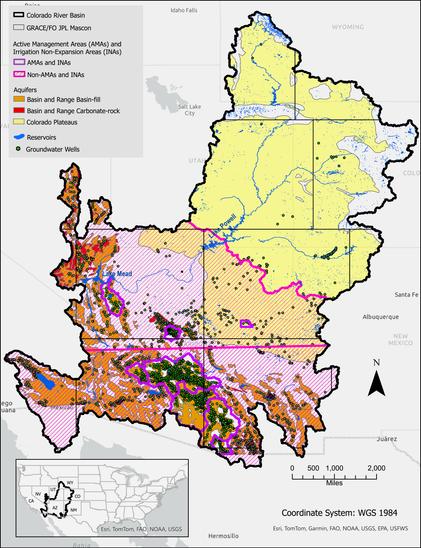
Quitobaquito Springs in south-west Arizona has been called a biological wonderland with few equals.
The springs are an oasis in the vast Sonoran desert along the US-Mexico border, held sacred by the O’odham people, who call it A’al Vaipia.
Here, water flows out of an aquifer at the bottom of a hill, runs along a short concrete channel and collects in a pond.
The pond is home to Sonoyta pupfish, which are small and silvery, with upturned jaws.
In the channel are found …
Replaced article(s) found for hep-th. https://arxiv.org/list/hep-th/new
[2/3]:
- Multicritical points of gravitational solitons and a black hole in four dimensions
Moaathe Belhaj Ahmed, Mois\'es Bravo-Gaete, Robert B. Mann, Constanza Quijada
https://arxiv.org/abs/2605.24783 https://mastoxiv.page/@arXiv_hepth_bot/116639897763402557
- Brane flows
Georgios Papadopoulos, Kostas Skenderis
https://arxiv.org/abs/2605.31181 https://mastoxiv.page/@arXiv_hepth_bot/116673829986872182
- Weyl conformal geometry vs Riemannian geometry of Weyl gauge invariant (dressed) metric
D. M. Ghilencea, V. -M. Mandric
https://arxiv.org/abs/2606.08080 https://mastoxiv.page/@arXiv_hepth_bot/116719153397467346
- Free-Field Construction of Heterotic String Compactified on Calabi-Yau Orbifolds via Corresponden...
Alexander Belavin, Doron Gepner, Grigory Makarov
https://arxiv.org/abs/2606.27490 https://mastoxiv.page/@arXiv_hepth_bot/116832327091097035
- Exact Planar Black Hole in AdS-Einstein-Scalar Gravity with IR-Emergent Nearly Conformal Fluid
Sangheon Yun
https://arxiv.org/abs/2606.31901 https://mastoxiv.page/@arXiv_hepth_bot/116843780286505261
- AdS Black Holes Are Short-Lived inside the Spectral Form Factor
Jos\'e L. F. Barb\'on, Eduardo Velasco-Aja
https://arxiv.org/abs/2607.21704
- Generalized comodule tube algebras for boundary and domain wall defects of (2 1)D topological order
Zhian Jia, Sheng Tan
https://arxiv.org/abs/2608.05071 https://mastoxiv.page/@arXiv_hepth_bot/117047570919781079
- Surviving correlations across a horizon: reflected entropy for bosonic fields in non-inertial fra...
Sayid Mondal
https://arxiv.org/abs/2608.05473 https://mastoxiv.page/@arXiv_hepth_bot/117053235449252443
- Cluster algebras and tilings for the m=4 amplituhedron
Even-Zohar, Lakrec, Parisi, Tessler, Sherman-Bennett, Williams
https://arxiv.org/abs/2310.17727 https://mastoxiv.page/@arXiv_mathCO_bot/111322217178993182
- Weak Correlations as the Underlying Principle for Linearization of Gradient-Based Learning Systems
Ori Shem-Ur, Khen Cohen, Aviv Orly, Yaron Oz
https://arxiv.org/abs/2401.04013
- Gravity and the Hierarchy Problem
Thede de Boer, Jisuke Kubo, Manfred Lindner, Markus Reinig
https://arxiv.org/abs/2510.12882 https://mastoxiv.page/@arXiv_hepph_bot/115382945122925880
toXiv_bot_toot
Extreme flows: where physics meets mathematically rigorous bounds
Bartosz Protas
https://arxiv.org/abs/2608.04859 https://arxiv.org/pdf/2608.04859
I'm not big on the whole Christian "natural/artificial" binary, or the settler-colonialist concept of "wilderness" which erases indigenous stewardship in a bid to claim mid territory (see, e.g., tribes forced out of what are now national parks in the US). But I do enjoy getting out of urban/suburban environments and into places where the human impact on the land is minimal and/or synergistic with non-human flourishing.
I was thinking about why I enjoy this so much today while out on a stroller hike with my younger child, and came to the conclusion that it may be less about being in a "natural" space and more about being in a space whose flourishing is not tied to the capitalist necropolitical "growth" spiral.
Like, there's the baseline intrinsic beauty of flowers, trees, flowing water, etc. Then there's the pleasure of considering how these things fit together into an ecosystem and mutually support each other (and also compete/predate, etc.). But on top of all that, there's the sense that these things are part of a self-sustaining pattern that's capable of continuing without outside inputs and without creating external waste over vast, geologic timescales. The things I see when I look around in a city aren't like that. 100 or 1000 or 10000 years from now they'll be ruins, not necessarily because of human extinction or anything like that, but because the resource flows that create them are inseparable from a fundamentally unsustainable economy built around a paradoxical assumption of infinite exponential growth.
There *are* of course some human-built or -stewarded things in the world that are sustainably maintained, and ruins can have their own kind of beauty. But to me part of the joy of being on a hiking trail is to look around and see beautiful systems that will persist regardless of (most) human political outcomes that I spend a lot of energy worrying about.
Even in the extreme cases of climate change these things will eventually come back, albeit in an altered form. I don't want to ignore the incredibly destructive impact of humans on the environment, of course, but still, it's comforting to me to think about how the problems and brokenness of currently-dominant human cultures might change and scar but will not actually destroy the many systems on this planet that just don't depend on humans for their propagation.
Of the nine “planetary boundaries” that help determine whether life can flourish on Earth,
seven are being breached at their highest ever levels of transgression, according to the latest planetary health check, a process that was established in 2009.
The seven key indicators in the danger zone include climate change,
change in biosphere integrity,
land system change,
freshwater change,
modification of biogeochemical flows,
introduction of novel entit…
Onsager-variational-principle-based Lattice Boltzmann Model For Three-phase Dielectric Fluid Flows
Xinyue Liu, Xu Qian, Fang Xiong, Lei Wang
https://arxiv.org/abs/2608.05787 htt…
Energy Secretary Chris Wright says Trump was "well aware of the risks to energy flows" before launching Iran war (Kaia Hubbard/CBS News)
https://www.cbsnews.com/news/chris-wright-trump-iran-war-aware-energy-flow-risks/
http://www.memeorandum.com/261004/p40#a261004p40
At OSFC this year, I proposed developing functionality for build systems to create secondary artifacts that augment a description of a hardware platform in order to describe full boot flows across multiple processing units and SoCs, so that one could reason about what happens where in the overall system and why:
https://talks.osfc.io/osfc-2026/talk/7788YB/
Mothy et al now showcase a description language to analyze systems for possible bugs:
https://arxiv.org/abs/2510.27485
Funny how things are going. A big puzzle 🧩.
Replaced article(s) found for math.DS. https://arxiv.org/list/math.DS/new
[2/2]:
- Generic-case complexity of Whitehead's algorithm, revisited
Ilya Kapovich
https://arxiv.org/abs/1903.07040
- Exponential mixing for the randomly forced NLS equation
Yuxuan Chen, Shengquan Xiang, Zhifei Zhang, Jia-Cheng Zhao
https://arxiv.org/abs/2506.10318 https://mastoxiv.page/@arXiv_mathAP_bot/114675099940694476
- Machine-Precision Prediction of Low-Dimensional Chaotic Systems from Noise-Free Data
Christof Sch\"otz, Niklas Boers
https://arxiv.org/abs/2507.09652
- Limit theorems for inhomogeneous $\phi$-mixing Markov chains
Yeor Hafouta, Brenden Williams
https://arxiv.org/abs/2510.15323 https://mastoxiv.page/@arXiv_mathPR_bot/115405447591487390
- A kernel method for the learning of Wasserstein geometric flows
Jianyu Hu, Juan-Pablo Ortega, Daiying Yin
https://arxiv.org/abs/2511.06655 https://mastoxiv.page/@arXiv_mathNA_bot/115530572827554967
- Null-Validated Topological Signatures of Financial Market Dynamics
Samuel W. Akingbade
https://arxiv.org/abs/2602.00383 https://mastoxiv.page/@arXiv_qfinST_bot/116006072151481289
- Simple generators of rational function fields
Alexander Demin, Gleb Pogudin
https://arxiv.org/abs/2602.10878 https://mastoxiv.page/@arXiv_csSC_bot/116056681962763734
- Martin Boundary and Invariant Fields of Multiplicative SHE
Hongyi Chen
https://arxiv.org/abs/2602.16126 https://mastoxiv.page/@arXiv_mathPR_bot/116096386900973756
- Counting the number of $1_{m}$-preperiodic $\mathcal{O}_{K}$-points of a discrete dynamical syste...
Brian Kintu
https://arxiv.org/abs/2606.14468 https://mastoxiv.page/@arXiv_mathNT_bot/116753018953819097
- Shadowing and Hyperbolicity for Endomorphisms of Locally Compact Groups
Dekui Peng
https://arxiv.org/abs/2606.27647 https://mastoxiv.page/@arXiv_mathGR_bot/116832321784455128
- Uniform $L^{\infty}$-Boundedness of Global Attractors for Reaction-Diffusion Equations with Neuma...
Antonio L. Pereira
https://arxiv.org/abs/2607.08061 https://mastoxiv.page/@arXiv_mathAP_bot/116894588437564813
- Stability of closed characteristics and invariant sets on star-shaped hypersurfaces
Huagui Duan, Zihao Qi
https://arxiv.org/abs/2607.15546 https://mastoxiv.page/@arXiv_mathSG_bot/116951161229689295
- Vakonomic Fluids
Ritoban Roy-Chowdhury, Mohammad Sina Nabizadeh, Oliver Gross, Anthony Gruber, Albert Chern
https://arxiv.org/abs/2607.18312 https://mastoxiv.page/@arXiv_mathph_bot/116962502170736360
toXiv_bot_toot
Sidewall effects on the onset of interfacial Holmboe waves in stratified exchange flows at high Schmidt number
Guilherme Siqueira de Aquino, Metten M. de Lange, Adrien Lefauve, Matias Duran-Matute
https://arxiv.org/abs/2607.19565 https://arxiv.org/pdf/2607.19565 https://arxiv.org/html/2607.19565
arXiv:2607.19565v1 Announce Type: new
Abstract: Predicting the onset of interfacial instabilities is central to understanding turbulent mixing in natural and engineered stratified shear flows. Here, we study the onset of travelling Holmboe waves in confined exchange flows along a slope. Earlier stratified inclined duct experiments have mapped this transition, and stability analyses based on measured or prescribed profiles have explained their emergence. However, a predictive criterion linking forcing, geometry, base flow, and wave onset was still lacking. We closed this gap with a long-duct, sharp-interface asymptotic theory for the three-dimensional laminar exchange flow, including the effects of sidewall friction. The resulting analytical solution naturally identifies a confinement-adjusted Froude number, $Fr^*$, which unifies the effects of forcing and confinement into a single measure of the effective laminar exchange flow. Using this solution to parameterise sidewall drag in a practical width-averaged model, we perform linear stability analyses and numerical simulations at high Schmidt number. Together, linear stability analysis, direct numerical simulations, and existing experiments across a range of duct widths show that wave onset is accurately predicted by an approximately constant critical value of $Fr^*$. Deviations arise only in very narrow ducts, where sidewalls influence instability not only by modifying the laminar exchange flow but also by directly damping perturbations and delaying wave onset. These findings provide a predictive criterion for wave onset, reconcile long-standing discrepancies among experimental configurations, and establish lateral confinement as a fundamental control on the transition from laminar exchange to wave-driven mixing in stratified shear flows.
toXiv_bot_toot
Replaced article(s) found for nlin.CD. https://arxiv.org/list/nlin.CD/new
[1/1]:
- A Mathematical Framework for Linear Response Theory for Nonautonomous Systems
Stefano Galatolo, Valerio Lucarini
https://arxiv.org/abs/2603.19509 https://mastoxiv.page/@arXiv_mathDS_bot/116277396967537630
- Lagrangian Ellipsoid Diagnostics in Rough Two-Dimensional Synthetic Flows: Aspect-Ratio Saturatio...
Michael Chertkov
https://arxiv.org/abs/2605.27606 https://mastoxiv.page/@arXiv_physicsfludyn_bot/116651135705771524
- Universal self-similar evolution of two-dimensional acoustic turbulence in Bose-Einstein condensates
Guillaume Costa, Sergey Nazarenko, Giorgio Krstulovic
https://arxiv.org/abs/2607.06062 https://mastoxiv.page/@arXiv_condmatquantgas_bot/116883253087715770
toXiv_bot_toot
Trump "refuses to look at the briefing books" and "refuses to have extensive conversations about the issues at hand. He is always saying, 'I'm really good with this.' And then he goes into these meetings, and all it is is flattery. That flattery flows in both directions, with foreign counterparts "very clearly" understanding "what they can get by this."
'Oh my God': White House insiders reveal Trump's dangerous high-stakes habit - Raw Story
https://www.rawstory.com/trump-diplomacy/
Discrete Boltzmann model at Burnett level for compressible multicomponent flows under external forces
Demei Li, Huilin Lai, Chuandong Lin, Suni Chen
https://arxiv.org/abs/2607.20029 https://arxiv.org/pdf/2607.20029 https://arxiv.org/html/2607.20029
arXiv:2607.20029v1 Announce Type: new
Abstract: This work extends the Burnett-level discrete Boltzmann model (DBM) from single-component to multicomponent compressible flows under external forces, building on the fundamental framework of the high-precision discrete kinetic method. A high-isotropy 25-discrete-velocity set is adopted to guarantee numerical stability and spatial symmetry, while a rigorous moment-matching strategy is developed to construct the equilibrium distribution function and external force term. Different from the single-component counterpart, the present model intrinsically incorporates interspecies mass diffusion effects and multi-component thermodynamic nonequilibrium behaviors, which are critical for complex compressible multicomponent systems. The Chapman--Enskog expansion verifies that the proposed model can exactly recover the Burnett-level governing equations for forced multicomponent compressible flows in the continuum limit. Five canonical benchmark cases, including multicomponent mass diffusion, compressible Sod shock tube, thermal Couette flow, Kelvin--Helmholtz instability, and Rayleigh--Taylor instability, are systematically performed. Numerical results demonstrate that the developed Burnett-level multicomponent DBM achieves high accuracy and robustness in capturing both hydrodynamic evolution and multicomponent nonequilibrium characteristics under external forces.
toXiv_bot_toot
RE: https://dair-community.social/@ZekuZelalem/117320888712641893
There's a bit of context behind this that's worth being aware of, and I'll do my best to explain it second (or third) hand. Abiy Ahmed has been the prime minister of Ethiopia since 2019. He was quite popular initially, but has held on to power for quite a while and has been called out for authoritarian tendencies.
His party, the Prosperity Party, is a liberal party that has privatized parts of the economy and is trying to dismantle ethnic federalism. This type of "modernization" is obviously supported by neoliberal forces around the world, especially since he took over from the ethno nationalist ML TPLF.
The TPLF was also authoritarian, brutal, and anti-democratic, as one would expect from an ML organization. Part of Abiy's popularity came from opposition to the TPLF. But more recently, but his forces also carried out genocide in Tigray during that war in 2022 (after his Nobel Peace Prize).
Part of the opposition to his modernization is that ending ethnic federalism would weaken the power of older ethnic structures. This could be seen as similar in some ways to conflicts across Europe in from 1848 through to the early 1900's and in the Balkans after the fall of the Soviet Union.
The connection between ethnicity and nationality has never really stopped causing problems. Liberalism is usually connected to the domination of one ethnic group into a singular national identity. This flows from the French Revolution, through the Russian revolution, and into both the Ethnic ML exported by Communist Russia as part of their attempts to weaken European capitalism and (via both American Colonial Nationalism and the French Revolution) into the Neoliberalism promoted by the US and European powers as a counter.
Ethiopia is a multiethnic country. Unfortunately the logic of the state (liberal or communist) tends to destroy these ethnic identities through a combination of ethnic cleansing, appropriation, and (often forced) integration.
Some of the conflict here is coming out of the tension between a national identity and ethnic identity, especially in relation to Tigray and Amhara, as well as the continued pressure of economic liberalization, and centralization vs federalization.
The point is that it's actually quite a bit more complicated than it may be presented as, especially outside of the religion. European interests may align with Abiy, and present him as a "modernizing force." Addis is one of the centers of the African Union. Meanwhile, other countries have their own interests in stoking this conflict. China, Turkey, the UAE, and Iran all sell drones to the Federal government. Eretria has an interest in creating a buffer zone to keep Ethiopia from seizing a port city from them. Sudan is involved, and I don't have the local political depth to know why.
Various groups will try to point to one group or another as the "good guy/bad guy" but it's definitely not that simple. It's just kind of tragic for everyone. I hope Ethiopian people find peace and freedom.
My hope is that Ethiopia will develop something like Democratic Confederalism that resolves these conflicts and tensions without wiping out the unique identities of the peoples who make up Ethiopia.
Cavitation Acoustic Perturbation Equations: A Computational Framework for Source-Resolved Multiphase Hydroacoustics
Zhi Cheng, Rajeev K. Jaiman
https://arxiv.org/abs/2607.19567 https://arxiv.org/pdf/2607.19567 https://arxiv.org/html/2607.19567
arXiv:2607.19567v1 Announce Type: new
Abstract: This work develops a cavitation-consistent acoustic perturbation framework for predicting sound generation and propagation in cavitating flows. Unlike conventional acoustic perturbation equations for single-phase or weakly compressible flows, the proposed formulation embeds cavitation physics directly into the acoustic equations. The cavitation acoustic perturbation equations (CAPE) incorporate vapor mass transfer, mixture compressibility, and pressure-rate effects within a unified formulation, allowing cavitation-induced noise sources to be resolved in the computational domain. The numerical framework is verified using one-dimensional wave-propagation problems. The solutions become insensitive to further mesh and time-step refinement, the perfectly matched layer suppresses boundary reflections, and the predicted attenuation over a range of source frequencies follows Stokes' sound attenuation law. The framework is then applied to cavitating flow past a circular cylinder and a NACA hydrofoil. The non-cavitating benchmark shows dipole-like radiation associated with unsteady loading, whereas cavitating cases exhibit monopole-like or geometry-modulated radiation caused by volumetric phase change. Source-term analyses identify tonal frequencies associated with vortex shedding, cavity shedding, and collapse-induced excitation. The phase-change terms provide a direct volumetric contribution to the monopole-like source, while localized collapse events appear through amplification of the pressure-rate source. The proposed framework extends acoustic perturbation methods to cavitating multiphase flows and provides an efficient tool for hydroacoustic prediction, source localization, and mechanism analysis in marine and hydraulic applications.
toXiv_bot_toot
Europa erlebte 2026 den drittwärmsten Sommer seit Beginn der Aufzeichnungen.
In Westeuropa war es sogar der wärmste. 52% des Kontinents waren mindestens sehr starkem #Hitzestress ausgesetzt. Gleichzeitig erreichten zahlreiche Flüsse wie Rhein, Donau und Po Rekord- oder nahezu Rekord-Niedrigwasser. Die Folgen betrafen #Wasserversorgung, #Schifffahrt, #Energieerzeugung, #Ökosysteme und Gesundheit.
#Extremwetter #healthcare #climatechange #Klimawandel
Information Transport and Observability in Compressible Aerodynamics
Bo Zhang
https://arxiv.org/abs/2607.20177 https://arxiv.org/pdf/2607.20177 https://arxiv.org/html/2607.20177
arXiv:2607.20177v1 Announce Type: new
Abstract: Pressure measurements provide sparse but direct observations of compressible aerodynamic flows, yet how information about hidden aerodynamic parameters is transported through the flow and encoded in these observations remains poorly understood. Here, we investigate information transport and observability in compressible aerodynamics using a differentiable shock-capturing immersed-boundary solver. By propagating gradients through the full unsteady flow solution, an automatic-differentiation-based observability metric is introduced to quantify the sensitivity of sparse pressure measurements to unknown aerodynamic parameters and identify informative sensing locations for inverse learning. The results reveal that aerodynamic information is transported non-uniformly through the flow field, producing localized regions of high observability. Inverse-learning experiments further demonstrate that observability and learnability are related but distinct concepts: although highly observable probes generally facilitate accurate parameter recovery, the highest-observability probe is not consistently the most effective for parameter inference. Furthermore, both the flow regime and the airfoil geometry substantially influence the distribution of observability and the convergence behavior of inverse learning. These findings establish a quantitative framework for understanding how aerodynamic information is encoded in sparse measurements and demonstrate the potential of automatic differentiation for observability analysis, informative sensor selection, and aerodynamic inverse analysis.
toXiv_bot_toot
A formal log(Re)-cost framework for the engineering turbulence problem
Jiaqi Li, Robert F. Kunz, George Huang, Xiang I. A. Yang
https://arxiv.org/abs/2607.20199 https://arxiv.org/pdf/2607.20199 https://arxiv.org/html/2607.20199
arXiv:2607.20199v1 Announce Type: new
Abstract: In fluid engineering, the turbulence problem is the longstanding challenge of obtaining accurate predictions of engineering quantities at affordable computational cost. Viewed through computational complexity, a practical algorithm requires cost growth no worse than $O(N)$, where $N$ denotes problem size. For turbulent flows, the problem size may be approximated by the number of dynamically relevant scales and hence by the Reynolds number $Re$. We propose a multi-fidelity, physics-constrained, data-driven framework designed to meet this criterion under stated assumptions. We augment the Spalart--Allmaras model through field inversion and machine learning using a constrained formulation that preserves the law of the wall. The model is trained at a low Reynolds number, where high-fidelity data are affordable, and deployed at higher Reynolds numbers. For a mean-flow-aligned grid in a wall-bounded flow, fixed spanwise resolution, and steady-solver cost linear in grid-point count, the low-fidelity RANS prediction scales as $O(\log(Re))$. The high-fidelity calculation and learning stage each contribute $O(Re^0)$ relative to the target Reynolds number, giving an overall formal cost of $O(\log(Re))$. In plane channel flow, a model trained at $Re_\tau=1000$ corrects the wake-layer error of the baseline model and retains the improvement at $Re_\tau=5200$. In the periodic hill, a model trained at $Re_b=5600$ is tested at $Re_b=10595$, $19000$, and $37000$. The constrained formulation preserves separation and recovery behavior as Reynolds number increases, yields the lowest root-mean-square error across all tests, and exhibits nearly Reynolds-number-independent error, indicating robust extrapolation.
toXiv_bot_toot
Replaced article(s) found for physics.flu-dyn. https://arxiv.org/list/physics.flu-dyn/new
[1/1]:
- Exact results for dissipation and steady creeping flow in three-dimensional chiral active fluids
Laura Meissner-Oszer, Bogdan Cichocki, Jeffrey C. Everts
https://arxiv.org/abs/2510.19658 https://mastoxiv.page/@arXiv_physicsfludyn_bot/115422802755500601
- Pressure beneath a periodic travelling water-wave in constant-vorticity flow over a flat bed
Adrian Constantin, Nicolas Gindrier, Otmar Scherzer
https://arxiv.org/abs/2602.21077 https://mastoxiv.page/@arXiv_physicsfludyn_bot/116130402894456942
- A minimal wake-vortex model explains formation flight of flapping birds
Olivia Pomerenk, Kenneth S. Breuer
https://arxiv.org/abs/2602.22043 https://mastoxiv.page/@arXiv_physicsfludyn_bot/116136202119473646
- Lagrangian Ellipsoid Diagnostics in Rough Two-Dimensional Synthetic Flows: Aspect-Ratio Saturatio...
Michael Chertkov
https://arxiv.org/abs/2605.27606 https://mastoxiv.page/@arXiv_physicsfludyn_bot/116651135705771524
- On the Theory of Bulk Viscosity of Cold Plasmas and Thermodynamics of Alkali-Noble Gas Cocktails
Albert M. Varonov, Todor M. Mishonov
https://arxiv.org/abs/2511.14790 https://mastoxiv.page/@arXiv_physicsplasmph_bot/115581169803088580
toXiv_bot_toot
 @mesirii@chaos.social