The Allen Institute of AI launches Bolmo 7B and Bolmo 1B, claiming they are "the first fully open byte-level language models", built on its Olmo 3 models (Emilia David/VentureBeat)
https://venturebeat.com/ai/bolmos-architecture-unlock…
MeshCore is opensource
The foundation of MeshCore is developed primarily by a single developer who is incredibly hardworking, dedicated and idealistic about keeping everything he does fully open. The firmware and protocol specification are completely open, allowing anyone to create a client app or perform security audits on the device firmware implementation. Just hop over to the meshcore-dev github repo and have a look. There are also open source command line, python and javascript cl…
Z.ai releases GLM-Image, an open-source multimodal AI model trained on Huawei chips that it says is China's first to be fully trained using domestic chips (Luz Ding/Bloomberg)
https://www.bloomberg.com/news/articles/2026-01-…
As member of the @…, I applaud the ACM for making all ACM publications in the ACM Digital Library freely accessible.
However, I’m puzzled by the simultaneous introduction of a “Premium Edition,” which provides AI “summaries” nobody’s asked for, and puts metadata behind a paywall. This is NOT how you make “computing research more accessible, discoverable, and reusa…
Only just recently had some time to read the Kimi K2.5 technical report , an impressive open weights model (it's not fully opensource), the distance towards large paid proprietary foundation models is becoming very small.
https://github.com/MoonshotAI/Kimi-K2.5/blob/ma…
RE: https://mstdn.io/@lexelas/115859030305682725
From the announcement it seems that Bose publishes its API documentation, and even that does not allow you to use it fully looking at its licens.
Open Source (a newer term for
Strategyproof Tournament Rules for Teams with a Constant Degree of Selfishness
David Pennock, Daniel Schoepflin, Kangning Wang
https://arxiv.org/abs/2512.05235 https://arxiv.org/pdf/2512.05235 https://arxiv.org/html/2512.05235
arXiv:2512.05235v1 Announce Type: new
Abstract: We revisit the well-studied problem of designing fair and manipulation-resistant tournament rules. In this problem, we seek a mechanism that (probabilistically) identifies the winner of a tournament after observing round-robin play among $n$ teams in a league. Such a mechanism should satisfy the natural properties of monotonicity and Condorcet consistency. Moreover, from the league's perspective, the winner-determination tournament rule should be strategyproof, meaning that no team can do better by losing a game on purpose.
Past work considered settings in which each team is fully selfish, caring only about its own probability of winning, and settings in which each team is fully selfless, caring only about the total winning probability of itself and the team to which it deliberately loses. More recently, researchers considered a mixture of these two settings with a parameter $\lambda$. Intermediate selfishness $\lambda$ means that a team will not lose on purpose unless its pair gains at least $\lambda s$ winning probability, where $s$ is the individual team's sacrifice from its own winning probability. All of the dozens of previously known tournament rules require $\lambda = \Omega(n)$ to be strategyproof, and it has been an open problem to find such a rule with the smallest $\lambda$.
In this work, we make significant progress by designing a tournament rule that is strategyproof with $\lambda = 11$. Along the way, we propose a new notion of multiplicative pairwise non-manipulability that ensures that two teams cannot manipulate the outcome of a game to increase the sum of their winning probabilities by more than a multiplicative factor $\delta$ and provide a rule which is multiplicatively pairwise non-manipulable for $\delta = 3.5$.
toXiv_bot_toot
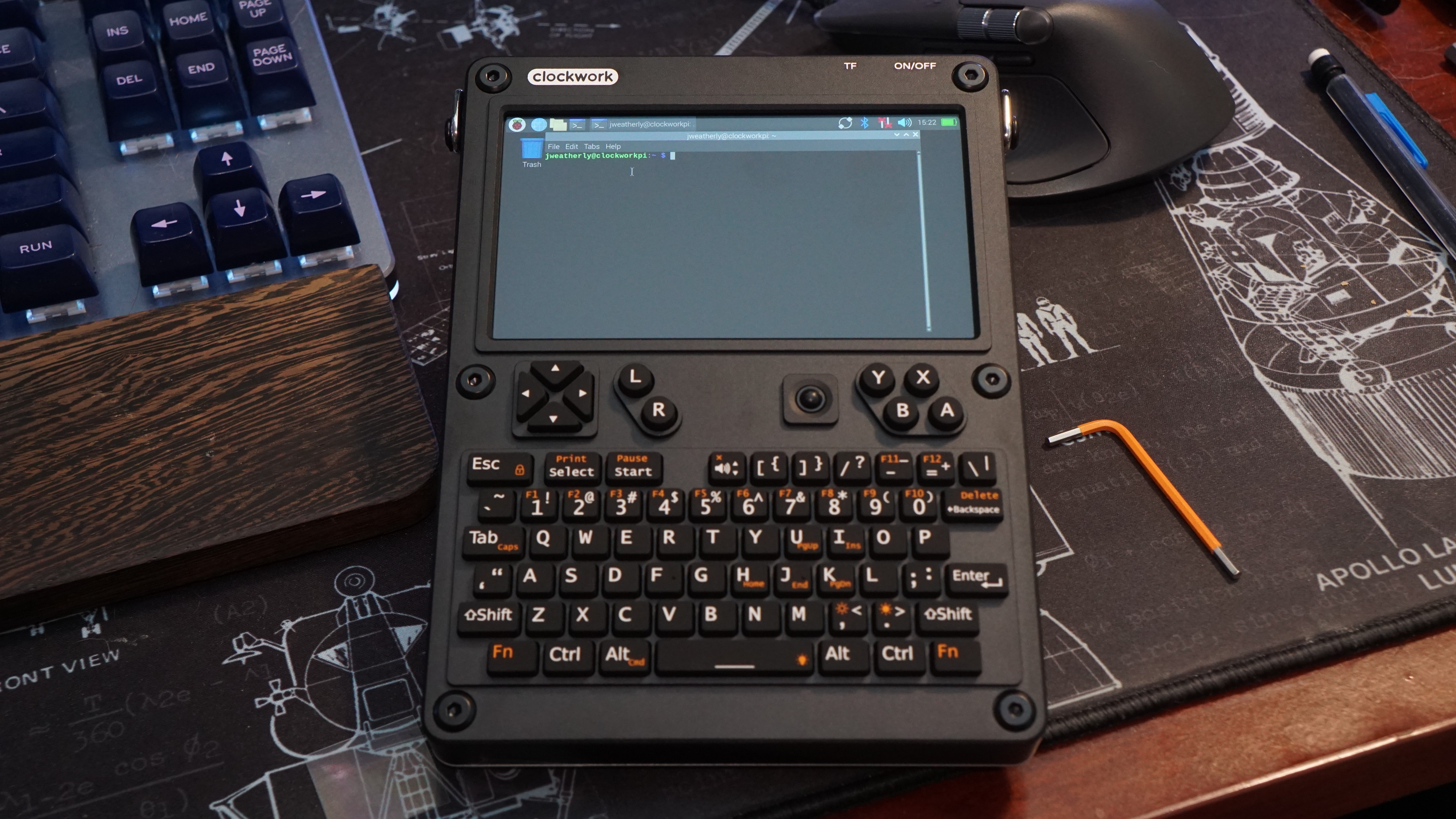
So, initial thoughts so far on the Clockwork uConsole:
- The trackball is pretty bad, would classify it as barely functional.
- Wifi does not work which severely limits things...maybe an antenna problem? Verified it was securely installed on the CM4 module.
- Install isn't bad, very solid device.
- The thermal pad for the RPi CM4 is waaaay too thick.
#clockwork…
Estimating Spatially Resolved Radiation Fields Using Neural Networks
Felix Lehner, Pasquale Lombardo, Susana Castillo, Oliver Hupe, Marcus Magnor
https://arxiv.org/abs/2512.17654 https://arxiv.org/pdf/2512.17654 https://arxiv.org/html/2512.17654
arXiv:2512.17654v1 Announce Type: new
Abstract: We present an in-depth analysis on how to build and train neural networks to estimate the spatial distribution of scattered radiation fields for radiation protection dosimetry in medical radiation fields, such as those found in Interventional Radiology and Cardiology. Therefore, we present three different synthetically generated datasets with increasing complexity for training, using a Monte-Carlo Simulation application based on Geant4. On those datasets, we evaluate convolutional and fully connected architectures of neural networks to demonstrate which design decisions work well for reconstructing the fluence and spectra distributions over the spatial domain of such radiation fields. All used datasets as well as our training pipeline are published as open source in separate repositories.
toXiv_bot_toot
 @Techmeme@techhub.social