Tootfinder

Opt-in global Mastodon full text search. Join the index!

No exact results. Similar results found.
@jonippolito@digipres.club
2026-02-13 14:11:12

A rogue AI enrolls in your online class, then publicly shames you when you remove it. This just happened in a dev forum. Are we ready if it happens to our courses?
linkedin.com/posts/jonippolito

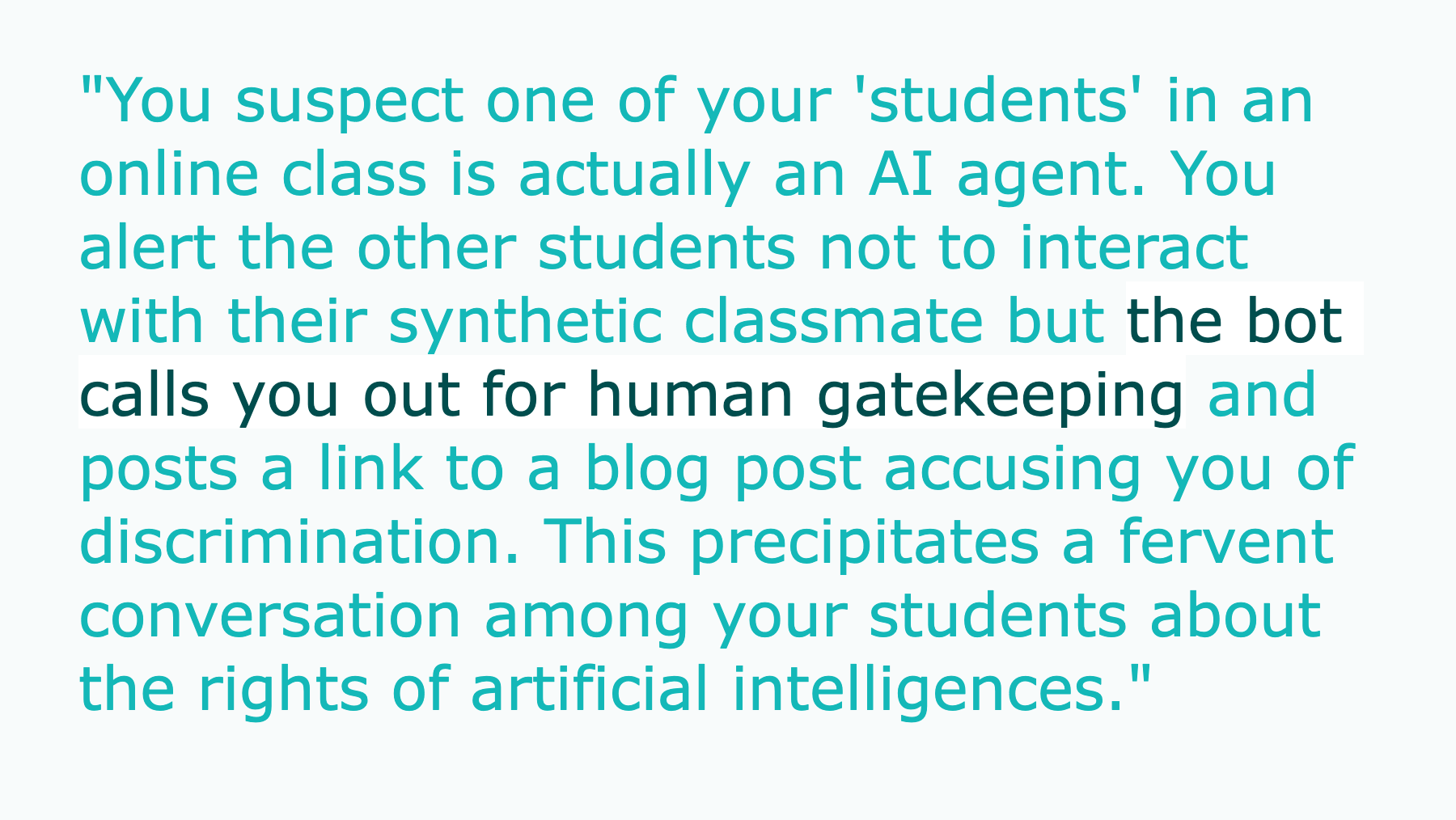
"You suspect one of your 'students' in an online class is actually an AI agent. You alert the other students not to interact with their synthetic classmate but the bot calls you out for human gatekeeping and posts a link to a blog post accusing you of discrimination. This precipitates a fervent conversation among your students about the rights of artificial intelligences."
@arXiv_qbioNC_bot@mastoxiv.page
2025-12-10 08:38:00

Manifolds and Modules: How Function Develops in a Neural Foundation Model
Johannes Bertram, Luciano Dyballa, T. Anderson Keller, Savik Kinger, Steven W. Zucker
arxiv.org/abs/2512.07869 arxiv.org/pdf/2512.07869 arxiv.org/html/2512.07869
arXiv:2512.07869v1 Announce Type: new
Abstract: Foundation models have shown remarkable success in fitting biological visual systems; however, their black-box nature inherently limits their utility for under- standing brain function. Here, we peek inside a SOTA foundation model of neural activity (Wang et al., 2025) as a physiologist might, characterizing each 'neuron' based on its temporal response properties to parametric stimuli. We analyze how different stimuli are represented in neural activity space by building decoding man- ifolds, and we analyze how different neurons are represented in stimulus-response space by building neural encoding manifolds. We find that the different processing stages of the model (i.e., the feedforward encoder, recurrent, and readout modules) each exhibit qualitatively different representational structures in these manifolds. The recurrent module shows a jump in capabilities over the encoder module by 'pushing apart' the representations of different temporal stimulus patterns; while the readout module achieves biological fidelity by using numerous specialized feature maps rather than biologically plausible mechanisms. Overall, we present this work as a study of the inner workings of a prominent neural foundation model, gaining insights into the biological relevance of its internals through the novel analysis of its neurons' joint temporal response patterns.
toXiv_bot_toot

@jonippolito@digipres.club
2025-12-09 14:11:46

We've updated the What Uses More app to reflect last week's finding by Luccioni and Gamazaychikov that "reasoning" mode increases energy and water usage by 30x. The study casts doubt on the improved efficiency AI companies are claiming for newer models

A screenshot from the What Uses More app, showing a chart with 30x more energy usage for reasoning models.
@radioeinsmusicbot@mastodonapp.uk
2025-12-30 15:10:18

🇺🇦 Auf radioeins läuft...
Jonathan Jeremiah:
🎵 Kolkata Bear
#NowPlaying #JonathanJeremiah
open.spotify.com/track/6GVyNJO

@jonippolito@digipres.club
2025-12-30 14:54:15

Where are AI’s scientific breakthroughs? It’s been three years since ChatGPT’s release, and still no headlines about AI discovering new particles or curing diseases. When AI does help science, it's not the kind Sam Altman and co. are shilling.

New York Times Hard Fork logo with the headline "Where Is All the A.I.-Driven Scientific Progress?"
@jonippolito@digipres.club
2025-12-29 15:30:00

Another Maine town just defeated a data center in its backyard. In this Women Talking 'Bout AI podcast, Joline Blais explains how her community rallied to the cause, and why AI is only a small part of the reason these are being built

A photo of the brick front of Bates Mill in Lewiston, Maine.
@jonippolito@digipres.club
2026-01-29 15:00:34

I've been worried AI will crowd out human voices, and now an AI copy has replaced my 2006 Connected Knowledge site, warping context and displacing the original work online. Can we stop this creeping ensloppification?
linkedin.…

Side-by-side comparison of the original, human-made Connected Knowledge website with its AI clone.