 @davidaugust@mastodon.online
2026-05-03 21:31:07
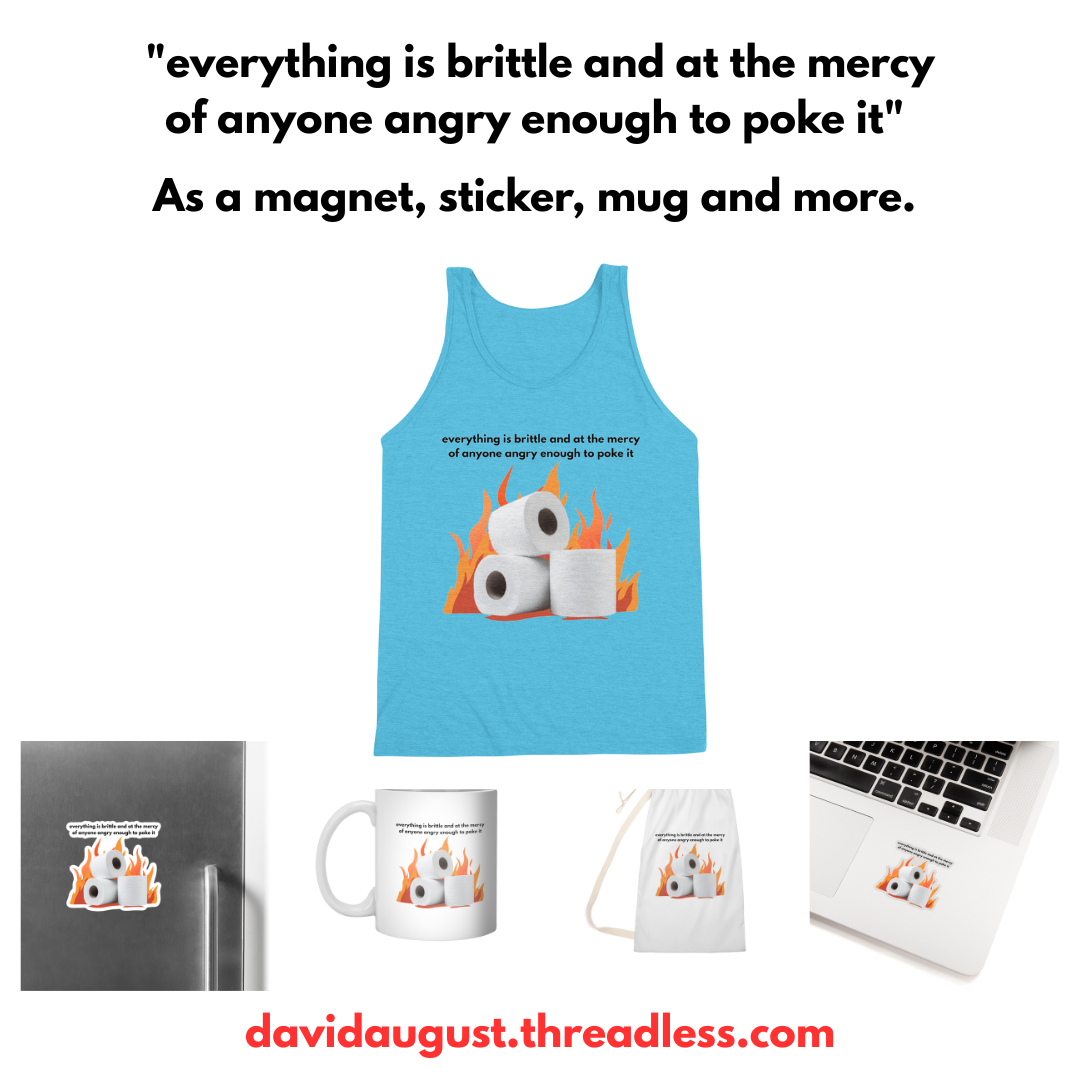
"everything is brittle and at the mercy of anyone angry enough to poke it"
As a magnet, sticker, mug or more.
Get yours: https://davidaugust.threadless.com/designs/warehouse-fire/accessories/sticker
h/t @…
 @Techmeme@techhub.social
2026-04-02 16:36:37
Flipboard launches Surf, an app for creating custom feeds from Mastodon, Threads, Bluesky, RSS, podcasts, and YouTube, after over a year in beta (David Pierce/The Verge)
https://www.theverge.com/tech/905929/flipboard-surf-fediverse-launch

 @Mediagazer@mstdn.social
2026-04-02 17:01:32
Flipboard launches Surf, an app for creating custom feeds from Mastodon, Threads, Bluesky, RSS, podcasts, and YouTube, after over a year in beta (David Pierce/The Verge)
https://www.theverge.com/tech/905929/flipboard-surf-fediverse-launch

 @cdarwin@c.im
2026-05-29 21:20:55
History repeats itself more than it should.
If you think we cannot get out from under these ghouls, then all I can say is we did it several times before.
We should be getting good at it by now.
The closest Trump's gonna get to heaven is on an airplane.
Go figure, cause I can't
Keep protests peaceful.
Don't kill anyone.
They DO make a difference.
Here are some resistance related guides from around the world:
🇺🇸 Fundamentals …

 @raiders@darktundra.xyz
2026-05-20 17:16:31
Predicting when Fernando Mendoza will make his Raiders debut is anyone’s guess https://raiderramble.com/2026/05/20/predicting-when-fernando-mendoza-will-make-his-raiders-debut-is-anyones-guess/
 @usul@piaille.fr
2026-05-29 14:04:35
Tables du monde #2 : La Mongolie Š Toulouse, avec Baasansuren Berthomes et Zolzaya Hirlimann - Le 24-7 - Club des Ambassadeurs de Toulouse
https://le-24-7.fr/tables-du-monde-2-la-mongolie-a-toulouse-avec-baasansuren-berthomes-et-zo…

 @aredridel@kolektiva.social
2026-05-19 15:01:11
Some of these are pretty reasonable! If you allow them for anyone, you probably make it so to compete at all requires everyone to follow suit. That's bad when those things have life-altering health implications.
But all of these things ultimately shape who is allowed to compete at the peak levels.
it's not always good! Honestly baseball is way less interesting to watch in the majors because everyone's great, all the plays are maximal capability, and it's kinda predictable. You don't end up with many of those "holy shit what just happened? that was awesome!" plays that are so much fun to watch. So as a spectator, these rules aren't always great. Sometimes you want to nerf the peak performance until the game is interesting. Sometimes you don't.
In F1, a huge part of the game is the nerding out about the rules and how to evade them cleverly to get peak performance. And the inside baseball on that is way more fun to watch than the race. The race is just cars going zoom and occasionally crashing, interrupted by amazing choreography in the pits.
There's a reason women's soccer is so much more fun for me to watch than men's. It's not been optimized so hard that the game isn't predictable in kind if not outcome. Plus the camaraderie shown is great.
But looking at all this, we gotta ask, what's sport's function in our societies? Why do we do this?
 @hex@kolektiva.social
2026-05-22 05:10:51
The security industry is somewhat unique. It's probably the only industry created by the worker as a threat. If you talk to hackers who were in the scene before Operation Sundevil, you'll realize that it's always been a Bullshit Job.
Folks in L0ft and cDc were hacking companies and basically blackmailing them into paying for their services. Operation Sundevil "straightened up" the industry. Some people went to prison, some people build security services companies. Pretty much anyone who actually believed in the manifesto was locked up or edged out.
Using the Graeber framework here, hackers are partially duct tapers and partially goons. The critical thing here is that the industry was basically created to give money to people who would otherwise destroy the system.
Neuroatypical folks have always been forced to the margins of society, but computers gave us a super power. Now we were extremely dangerous. Tech, especially hackers, have always been paid a lot to minimize the risk of developing a class consciousness.
Graeber talked about this. Kings and nobles would often find some job or title that they could bestow on potential enemies in order to keep them close, to defang them. What better role than sheriff, a type of goon, for a rebel?
We turned it in to a whole thing. Not only did hackers make their own industry and force everyone else to accept it, we even created a whole parallel box ticker industry of "compliance" as a side effect.
The Hacker's Manifesto was decontectualized and made a fun artifact of the past. We were sold a story of "good hackers" who "protected grandma from the bad hackers." But the whole industry always existed to keep us on a leash. The funny thing is that it was a leash that we made ourselves.
But now we're seeing massive layoffs in tech, even in security. Now that we're this far in, everyone has forgotten the history. Leadership doesn't understand what security people do, so they think that LLMs can replace us. But the people in the industry now, the ones who came to it as a career, don't understand the history.
There was always a split for these weird outsiders, these people who couldn't fit in to the system but now had power over it. Some wanted in and they were willing to use extortion to get in, and others wanted to destroy the system to set everyone free.
Operation Sundevil, and the industry that evolved out of it, existed to neutralize those revolutionary elements by offering extortionists a safe entry. Extortionists trusted the capitalists to not stab them in the back the same way capitalists have stabbed everyone in the back through all of history. Now my LinkedIn feed is full of Meta layoffs, and I wonder if that class consciousness is starting to click for anyone yet.
 @kctipton@mas.to
2026-04-14 22:29:31
Thomson Reuters Fired Worker For Speaking Out About ICE, Former Employee Says https://www.404media.co/thomson-reuters-fired-worker-for-speaking-out-about-ice-former-employee-says/
 @aredridel@kolektiva.social
2026-04-14 14:22:42
So to follow up on this, I've caught it in action. Models, when quantized a bit, just do a bit more poorly with short contexts. Even going from f32 (as trained) to bf16 (as usually run) to q8 tends to do okay for "normal" context windows. And q4 you start feeling like "this model is a little stupid and gets stuck sometimes” (it is! It's just that it's still mostly careening about in the space of "plausible" most of the time. Not good guesswork, but still in the zone). With long contexts, the probability of parameters collapsing to zero are higher, so the more context the more likelihood you are to see brokenness.
And then at Q2 (2 bits per parameter) or Q1, the model falls apart completely. Parameters collapse to zero easily. You start seeing "all work and no play makes jack a dull boy” sorts of behavior, with intense and unscrutinized repetition, followed by a hard stop when it just stops working.
And quantization is a parameter that a model vendor can turn relatively easily. (they have to regenerate the model from the base with more quantization, but it's a data transformation on the order of running a terabyte through a straightforward and fast process, not like training).
If you have 1000 customers and enough equipment to handle the requests of 700, going from bf16 to q8 is a no-brainer. Suddenly you can handle the load and have a little spare capacity. They get worse results, probably pay the same per token (or they're on a subscription that hides the cost anyway so you are even freer to make trade-offs. There's a reason that subscription products are kinda poorly described.)
It's also possible for them to vary this across a day: use models during quieter periods? Maybe you get an instance running a bf16 quantization. If you use it during a high use period? You get a Q4 model.
Or intelligent routing is possible. No idea if anyone is doing this, but if they monitor what you send a bit, and you generally shoot for an expensive model for simple requests? They could totally substitute a highly quantized version of the model to answer the question.
There are •so many tricks• that can be pulled here. Some of them very reasonable to make, some of them treading into outright misleading or fraudulent, and it's weirdly hard to draw the line between them.