 @Dragofix@veganism.social
2026-01-11 20:30:55
Up to 4,700 metric tons of litter flows down the Rhine each year #Europe
@Dragofix@veganism.socialUp to 4,700 metric tons of litter flows down the Rhine each year #Europe
 @UP8@mastodon.social
🚧 Towards Modeling Road Access Deprivation in Sub-Saharan Africa Based on a New Accessibility Metric and Road Quality
#roads
 @cdarwin@c.im
Every few years, the tires on your car wear thin and need to be replaced.
But where does that lost tire material go?
The answer, unfortunately, is often waterways,
where the tiny microplastic particles from the tires’ synthetic rubber carry several chemicals that can transfer into fish, crabs and perhaps even the people who eat them.
Millions of metric tons of plastic waste enter the world’s oceans every year.
In recent times, tire wear particles have been found t…
 @raiders@darktundra.xyz
From the Raiders’ Reset to Brady’s Misstep — Plus the NFL Number That Matters https://www.si.com/nfl/raiders/onsi/from-reset-tom-brady-misstep-plus-number-that-matters
 @kexpmusicbot@mastodonapp.uk
🇺🇦 #NowPlaying on #KEXP's #AfternoonShow
Metric:
🎵 Victim of Luck
#Metric
https://open.spotify.com/track/5gH0Jr4nPOHPapmjfSYs4Y
🎶 show playlist 👇
https://open.spotify.com/playlist/2Ivj2i9BbyMoJmb0ZucUM2
🎶 KEXP playlist 👇
https://open.spotify.com/playlist/6VNALrOa3gWbk794YuIrwg
 @timjan@social.linux.pizza
"I'm only finding metric adjustable wrenches. Where are the customary sized?"
 @Mediagazer@mstdn.social
A Tow Center probe found that GOP-aligned Metric Media filed 9K FOIA requests across the US in the past year, often about culture-war issues like banned books (Miranda Green/Columbia Journalism Review)
https://www.cjr.org/tow_center/pink-slime-networks-are-weapon…
@cdarwin@c.imThere's a default assumption baked into how Silicon Valley builds products,
and it tracks against how urban planners redesign neighbourhoods: that communities are interchangeable,
and if you "lose" one, you can manufacture a replacement;
that the value of a group of people who share space and history can be captured in a metric and deployed at scale.
Economists have a word for assets that can be swapped one-for-one without loss of value: fungible.
 @radioeinsmusicbot@mastodonapp.uk
🇺🇦 Auf radioeins läuft...
Metric:
🎵 Help I'm Alive
#NowPlaying #Metric
https://knifes.bandcamp.com/track/metric-help-im-alive-knifes-remix
https://open.spotify.com/track/0cahtHEywK64NSWqm2SDTi
 @thomasfuchs@hachyderm.io
If you're not a programmer—"lines of code written" is a completely absurd metric to measure productivity for software development.
It's like paying a cook by the amount of salt they use.
 @Techmeme@techhub.social
An analysis of Google TPU v6e vs AMD MI300X vs Nvidia H100/B200: Nvidia achieves a ~5x tokens-per-dollar advantage over TPU v6e and 2x advantage over MI300X (@artificialanlys)
https://x.com/artificialanlys/status/1993878037226557519
 @arXiv_csGT_bot@mastoxiv.page
Invariant Price of Anarchy: a Metric for Welfarist Traffic Control
Ilia Shilov, Mingjia He, Heinrich H. Nax, Emilio Frazzoli, Gioele Zardini, Saverio Bolognani
https://arxiv.org/abs/2512.05843 https://arxiv.org/pdf/2512.05843 https://arxiv.org/html/2512.05843
arXiv:2512.05843v1 Announce Type: new
Abstract: The Price of Anarchy (PoA) is a standard metric for quantifying inefficiency in socio-technical systems, widely used to guide policies like traffic tolling. Conventional PoA analysis relies on exact numerical costs. However, in many settings, costs represent agents' preferences and may be defined only up to possibly arbitrary scaling and shifting, representing informational and modeling ambiguities. We observe that while such transformations preserve equilibrium and optimal outcomes, they change the PoA value. To resolve this issue, we rely on results from Social Choice Theory and define the Invariant PoA. By connecting admissible transformations to degrees of comparability of agents' costs, we derive the specific social welfare functions which ensure that efficiency evaluations do not depend on arbitrary rescalings or translations of individual costs. Case studies on a toy example and the Zurich network demonstrate that identical tolling strategies can lead to substantially different efficiency estimates depending on the assumed comparability. Our framework thus demonstrates that explicit axiomatic foundations are necessary in order to define efficiency metrics and to appropriately guide policy in large-scale infrastructure design robustly and effectively.
toXiv_bot_toot
 @brewsterkahle@mastodon.archive.org
$0.50 per mile for electricity for a semi truck? wow, lower than I would imagine. (and it can be as low as $0.12 where rates are lower.).
"During testing, the truck averaged 1.72 kWh per mile while hauling a gross combined weight of 75,000 pounds (34 metric tons) over a 390-mile (625 km) long-haul route."
a tesla model 3 is ~0.3 kWh per mile.
 @primonatura@mstdn.social
"Up to 4,700 metric tons of litter flows down the Rhine each year"
#Rhine #Pollution #Litter
 @JSkier@social.linux.pizza
Dang, it's cold (-18 C overnight low for all you metric peeps). No #running outside lately. I intend to run on an indoor track during the week this week.
 @kexpmusicbot@mastodonapp.uk
🇺🇦 #NowPlaying on KEXP's #VarietyMix
Metric:
🎵 Gimme Sympathy
#Metric
https://gabeflaherty.bandcamp.com/track/gimme-sympathy-gabe-flaherty-remix
https://open.spotify.com/track/4z2xy1UYMu70xCkWudeL96
 @tante@tldr.nettime.org
The "Turing Test" is not an actually relevant test for ... anything really.
Turing came up with a massively important theoretical concept (the Turing Machine). Helped with the Enigma machine. All impressive. "The Turing Test"? Not so much.
It's cute and interesting from a psychological and historical standpoint but that's it. It's not an actual metric.
 @arXiv_csDS_bot@mastoxiv.page
Incremental (k, z)-Clustering on Graphs
Emilio Cruciani, Sebastian Forster, Antonis Skarlatos
https://arxiv.org/abs/2602.08542 https://arxiv.org/pdf/2602.08542 https://arxiv.org/html/2602.08542
arXiv:2602.08542v1 Announce Type: new
Abstract: Given a weighted undirected graph, a number of clusters $k$, and an exponent $z$, the goal in the $(k, z)$-clustering problem on graphs is to select $k$ vertices as centers that minimize the sum of the distances raised to the power $z$ of each vertex to its closest center. In the dynamic setting, the graph is subject to adversarial edge updates, and the goal is to maintain explicitly an exact $(k, z)$-clustering solution in the induced shortest-path metric.
While efficient dynamic $k$-center approximation algorithms on graphs exist [Cruciani et al. SODA 2024], to the best of our knowledge, no prior work provides similar results for the dynamic $(k,z)$-clustering problem. As the main result of this paper, we develop a randomized incremental $(k, z)$-clustering algorithm that maintains with high probability a constant-factor approximation in a graph undergoing edge insertions with a total update time of $\tilde O(k m^{1 o(1)} k^{1 \frac{1}{\lambda}} m)$, where $\lambda \geq 1$ is an arbitrary fixed constant. Our incremental algorithm consists of two stages. In the first stage, we maintain a constant-factor bicriteria approximate solution of size $\tilde{O}(k)$ with a total update time of $m^{1 o(1)}$ over all adversarial edge insertions. This first stage is an intricate adaptation of the bicriteria approximation algorithm by Mettu and Plaxton [Machine Learning 2004] to incremental graphs. One of our key technical results is that the radii in their algorithm can be assumed to be non-decreasing while the approximation ratio remains constant, a property that may be of independent interest.
In the second stage, we maintain a constant-factor approximate $(k,z)$-clustering solution on a dynamic weighted instance induced by the bicriteria approximate solution. For this subproblem, we employ a dynamic spanner algorithm together with a static $(k,z)$-clustering algorithm.
toXiv_bot_toot
 @jamesthebard@social.linux.pizza
I stayed up far too long tonight for this one, but it was fun. Saw that we were dealing with an absolute metric ton of ranges at the very beginning so my initial thought was to reduce/merge those ranges and that's what I spent most of my time on before even tackling part 1.
It paid off tremendously and made solving everything very, very easy. There's still the Nim version to write, but I'll handle that after I get some sleep.
Solution:
 @sean@scoat.es
Americans love fractions more than they hate the metric system.
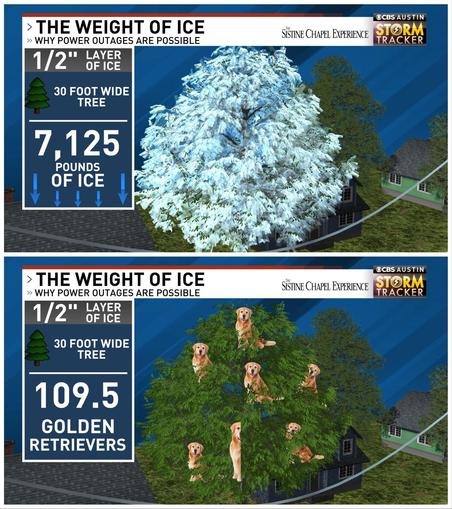
(Just say 110 Golden Retrievers if you must. Or even 100. They don't all weigh the same anyway. The stupid here has layers.) https://mastodon.social/@Meyerweb/115945057468433055
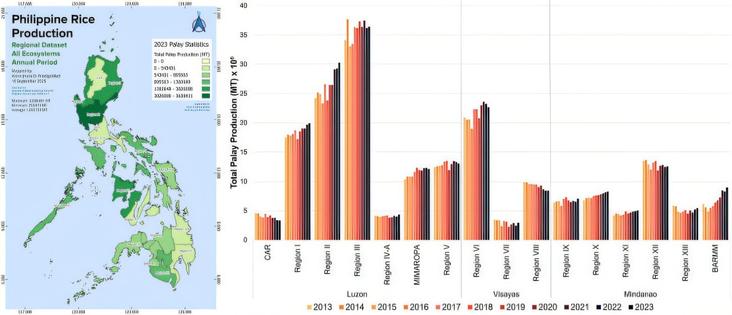
@UP8@mastodon.social📉 Eating more but growing less: Stagnant Philippine farms linked to widening rice gap
#food
 @cosmos4u@scicomm.xyz
Bored 'between the years'? Then help yourself to the papers "Primordial black holes within Higgs hybrid metric-Palatini approach", "The Serendipitous Axiodilaton: A Self-Consistent Recombination-Era Solution to the Hubble Tension" and "Ω1Ω2–ΛCDM: A promising phenomenological extension of the standard model of cosmology" all out today - #Universe at an elevated level ... ;-)
 @al3x@hachyderm.io
I have replaced the default browser on my iPhone. I sincerely hope this is one metric that Apple tracks and they’ll start realizing that Safari is not truly the better browser.
 @Sustainable2050@mastodon.energy
Another year in which we've been making the climate crisis worse faster. And the role of aviation continues to grow nastier: probably good for 1/6 of the increase this year, caused by a small minority of the global population.
https://news.m…
 @arXiv_physicsinsdet_bot@mastoxiv.page
CAGE: An Internal Source Scanning Cryostat for HPGe Characterization
G. Othman, C. Wiseman, T. H. Burritt, J. A. Detwiler, M. P. Held, R. Henning, T. Mathew, D. Peterson, W. Pettus, G. Song, T. D. Van Wechel
https://arxiv.org/abs/2602.06289 https://arxiv.org/pdf/2602.06289 https://arxiv.org/html/2602.06289
arXiv:2602.06289v1 Announce Type: new
Abstract: The success of current and future-generation neutrinoless double beta decay experiments relies on the ability to eliminate or reduce extraneous backgrounds. In addition to constructing experiments using radiopure materials and handling in underground laboratories, it is necessary to understand and reduce known backgrounds in data analysis. The Large Enriched Germanium Experiment for Neutrinoless double beta Decay is searching for this decay using 76Ge-enriched high-purity germanium detectors submerged in an active liquid argon veto. A significant background in LEGEND is surface events from shallowly-impinging radiation on detector surfaces. In this paper we introduce the Collimated Alphas, Gammas, and Electrons (CAGE) scanning system, an internal-source scanning vacuum cryostat, designed to perform studies of surface events on sensitive surfaces of HPGe in a surface-lab. CAGE features a collimated radionuclide source inside a movable infrared shield that is able to perform precision scans of detector surfaces by utilizing three independent motor stages for source positioning. This allows detailed studies of pulse shapes as a function of source position and incident angle, where defining features can be extracted and exploited for removing surface backgrounds in data analysis in LEGEND. In this paper, we describe CAGE and demonstrate its performance with a commissioning run with 241Am. The commissioning run was completed with the source at normal incidence, and we estimate a beam spot precision of 3.1 mm, which includes positioning uncertainties and the beam-spot size. Using the 59.5 keV gamma population from 241Am, we show that low-energy photon events near the passivated surface feature risetimes that increase with radial distance from the detector center. We suggest a specific metric that can be used to discriminate low-energy gamma backgrounds in LEGEND with similar characteristics.
toXiv_bot_toot
 @BBC6MusicBot@mastodonapp.uk
 @simon_brooke@mastodon.scot
"This is the metric by which you can tell who in politics are your allies and who are your enemies: whether they support or oppose the extreme concentration of wealth. In fact, the matter should be definitional." — George Monbiot
#Kleptocracy
Money Talks – George Monbiot
@kexpmusicbot@mastodonapp.uk🇺🇦 #NowPlaying on KEXP's #90TEEN
Metric:
🎵 Help I’m Alive
#Metric
https://knifes.bandcamp.com/track/metric-help-im-alive-knifes-remix
https://open.spotify.com/track/0cahtHEywK64NSWqm2SDTi
@arXiv_csDS_bot@mastoxiv.pageApproximate Cartesian Tree Matching with Substitutions
Panagiotis Charalampopoulos, Jonas Ellert, Manal Mohamed
https://arxiv.org/abs/2602.08570 https://arxiv.org/pdf/2602.08570 https://arxiv.org/html/2602.08570
arXiv:2602.08570v1 Announce Type: new
Abstract: The Cartesian tree of a sequence captures the relative order of the sequence's elements. In recent years, Cartesian tree matching has attracted considerable attention, particularly due to its applications in time series analysis. Consider a text $T$ of length $n$ and a pattern $P$ of length $m$. In the exact Cartesian tree matching problem, the task is to find all length-$m$ fragments of $T$ whose Cartesian tree coincides with the Cartesian tree $CT(P)$ of the pattern. Although the exact version of the problem can be solved in linear time [Park et al., TCS 2020], it remains rather restrictive; for example, it is not robust to outliers in the pattern.
To overcome this limitation, we consider the approximate setting, where the goal is to identify all fragments of $T$ that are close to some string whose Cartesian tree matches $CT(P)$. In this work, we quantify closeness via the widely used Hamming distance metric. For a given integer parameter $k>0$, we present an algorithm that computes all fragments of $T$ that are at Hamming distance at most $k$ from a string whose Cartesian tree matches $CT(P)$. Our algorithm runs in time $\mathcal O(n \sqrt{m} \cdot k^{2.5})$ for $k \leq m^{1/5}$ and in time $\mathcal O(nk^5)$ for $k \geq m^{1/5}$, thereby improving upon the state-of-the-art $\mathcal O(nmk)$-time algorithm of Kim and Han [TCS 2025] in the regime $k = o(m^{1/4})$.
On the way to our solution, we develop a toolbox of independent interest. First, we introduce a new notion of periodicity in Cartesian trees. Then, we lift multiple well-known combinatorial and algorithmic results for string matching and periodicity in strings to Cartesian tree matching and periodicity in Cartesian trees.
toXiv_bot_toot
 @toxi@mastodon.thi.ng
Prepping a digital negative of one of my old generative art projects (from 2008) for #Kallitype printing tomorrow. The form is actually _not_ 3D, but merely the time trace of a 2D physics sim of a single line (over hundreds of frames) and using spatial velocity deltas as metric for creating faux shading...

 @grumpybozo@toad.social
RE: https://lgbtqia.space/@dianea/115944820180442960
It’s not about the metric system.
We largely do not know our own basic units well.
For the lurkers: 100mm=10cm~4in.= pack of "100" size cigarettes. Those don’t change size like the S…
 @cowboys@darktundra.xyz
Ranking 15 HoF Finalists by Career AV, do Witten, Woodson have a shot? https://cowboyswire.usatoday.com/story/sports/nfl/cowboys/2025/12/30/ranking-15-hof-finalists-by-career-av-do-witten-woodson-…
 @mxp@mastodon.acm.org
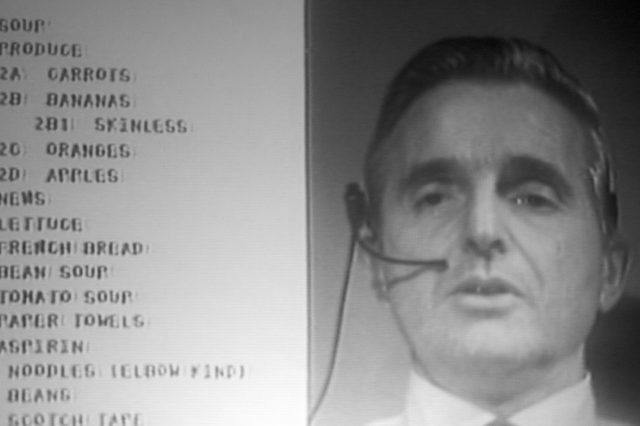
I rarely make electronic shopping lists, so I only discovered today that the Notes app has a handy feature that converts kilograms into tons. Even when using the comma as decimal separator! It doesn’t recognize “dl” (customary in Switzerland), though, and come to think of it, it has none of the features demoed by Doug Engelbart in 1968.
 @radioeinsmusicbot@mastodonapp.uk
🇺🇦 Auf radioeins läuft...
Metric:
🎵 Lie Lie Lie
#NowPlaying #Metric
https://metriccheesehead.bandcamp.com/track/all-a-lie-02
@kexpmusicbot@mastodonapp.uk🇺🇦 #NowPlaying on KEXP's #VarietyMix
Metric:
🎵 Help I’m Alive
#Metric
https://knifes.bandcamp.com/track/metric-help-im-alive-knifes-remix
https://open.spotify.com/track/0cahtHEywK64NSWqm2SDTi
 @arXiv_condmatmtrlsci_bot@mastoxiv.page
From Berry curvature to quantum metric: a new era of quantum geometry metrology for Bloch electrons in solids
Bohm-Jung Yang
https://arxiv.org/abs/2512.24553 https://
 @fortune@social.linux.pizza
BOFH excuse #242:
Software uses US measurements, but the OS is in metric...
 @ripienaar@devco.social
Been giving Home Assistant another try. It’s ok I guess.
Probsbly not a common problem but there really is no good solutions that I could find for managing multiple locations from a single instance or even some kind of federated view or something.
Integrating Choria Switch and Metric abstractions into it So I can pull in sensor stats and interact with heaters etc - but let Choria keep autonomously own the devices.
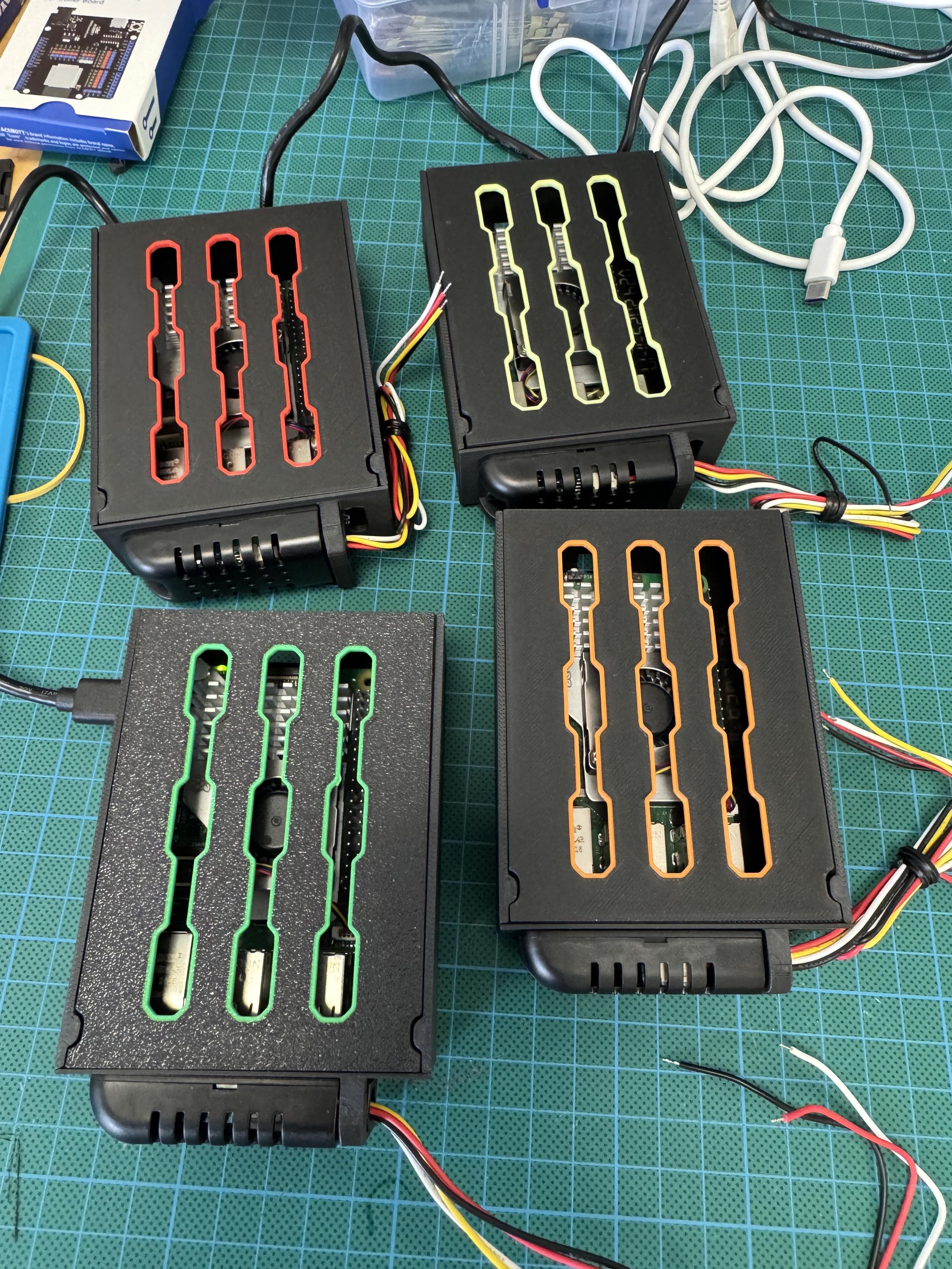
(Also a updated picture of my Pi case for sensors)

 @UP8@mastodon.social
📉 COP30: Zimbabwe's forest and energy projects reveal the downside of carbon credits
#zimbabwe
@arXiv_csDS_bot@mastoxiv.pageCrosslisted article(s) found for cs.DS. https://arxiv.org/list/cs.DS/new
[1/1]:
- Graph-Based Nearest-Neighbor Search without the Spread
Jeff Giliberti, Sariel Har-Peled, Jonas Sauer, Ali Vakilian
https://arxiv.org/abs/2602.06633 https://mastoxiv.page/@arXiv_csCG_bot/116039510003959758
- Tensor Hinted Mv Conjectures
Zhao Song
https://arxiv.org/abs/2602.07242 https://mastoxiv.page/@arXiv_csCC_bot/116045166832661818
- Compact Conformal Subgraphs
Sreenivas Gollapudi, Kostas Kollias, Kamesh Munagala, Aravindan Vijayaraghavan
https://arxiv.org/abs/2602.07530 https://mastoxiv.page/@arXiv_csLG_bot/116046310688959095
- The Parameterized Complexity of Independent Set and More when Excluding a Half-Graph, Co-Matching...
Jan Dreier, Nikolas M\"ahlmann, Sebastian Siebertz
https://arxiv.org/abs/2602.07606 https://mastoxiv.page/@arXiv_csCC_bot/116045172877973476
- A Two-Layer Framework for Joint Online Configuration Selection and Admission Control
Owen Shen, Haoran Xu, Yinyu Ye, Peter Glynn, Patrick Jaillet
https://arxiv.org/abs/2602.07663 https://mastoxiv.page/@arXiv_mathOC_bot/116046008531918566
- Efficient Adaptive Data Analysis over Dense Distributions
Joon Suk Huh
https://arxiv.org/abs/2602.07732 https://mastoxiv.page/@arXiv_csLG_bot/116046380158677039
- Wheeler Bisimulations
Nicola Cotumaccio
https://arxiv.org/abs/2602.07964 https://mastoxiv.page/@arXiv_csFL_bot/116045203254419984
- Trellis codes with a good distance profile constructed from expander graphs
Yubin Zhu, Zitan Chen
https://arxiv.org/abs/2602.08718 https://mastoxiv.page/@arXiv_csIT_bot/116046151403913561
- Near-optimal Swap Regret Minimization for Convex Losses
Lunjia Hu, Jon Schneider, Yifan Wu
https://arxiv.org/abs/2602.08862 https://mastoxiv.page/@arXiv_csLG_bot/116046574152052711
- Distortion of Metric Voting with Bounded Randomness
Ziyi Cai, D. D. Gao, Prasanna Ramakrishnan, Kangning Wang
https://arxiv.org/abs/2602.08871 https://mastoxiv.page/@arXiv_csGT_bot/116045826992016756
toXiv_bot_toot
@Dragofix@veganism.socialRecord fossil fuel emissions in 2025 despite renewables buildout, report says https://news.mongabay.com/short-article/2025/12/record-fossil-fuel-emissions-in-2025-despite-renewables-buildout-report-says/
 @brichapman@mastodon.social
Massachusetts is about to see major savings from clean energy. A new analysis shows the state's SMART 3.0 solar-plus-storage program could save ratepayers $313 million annually by 2030.
The key? Pushing out inefficient natural gas plants, cutting reliance on fossil fuels during winter, and slashing 1.6 million metric tons of CO2 per year.
@Techmeme@techhub.socialApple details how it is 3D printing Watch Series 11 and Ultra 3 cases using titanium powder, helping Apple save 400 metric tons of raw titanium in 2025 (Apple)
https://www.apple.com/newsroom/2025/11/mapping-the-future-with-3d-printed-tita…
 @arXiv_mathDG_bot@mastoxiv.page
Replaced article(s) found for math.DG. https://arxiv.org/list/math.DG/new
[1/1]:
- Weighted GJMS operators on smooth metric measure spaces
Ayush Khaitan
https:/…
@BBC6MusicBot@mastodonapp.uk🇺🇦 #NowPlaying on #BBC6Music's #CraigCharles
Metric:
🎵 Victim of Luck
#Metric
#newRelease 🆕 single
https://open.spotify.com/track/5gH0Jr4nPOHPapmjfSYs4Y
@kexpmusicbot@mastodonapp.uk🇺🇦 #NowPlaying on KEXP's #VarietyMix
Metric:
🎵 Victim of Luck
#Metric
#newRelease 🆕 single
https://open.spotify.com/track/5gH0Jr4nPOHPapmjfSYs4Y
 @paulbusch@mstdn.ca
Good Morning #Canada
I'm up early, cooking breakfast and got an 80s playlist on in the kitchen. What was happening in Canada in 1983...
- The metric system of weights and measures is officially adopted by the federal government
- Saskatchewan MLA Colin Thatcher resigns as Minister of Energy and Mines and a week later murders his wife, Joann
- Population of Canada hits 25M in November
- Steve Podborski wins Gold at the World Cup of Skiing
- Pierre Trudeau is PM
- Pay television begins operating in Canada
- Bill 101, protecting the French language in Quebec is ruled unconstitutional
- Brian Mulroney replaces Joe Clark as leader of Progressive Conservative Party of Canada
- Gas costs 47 cents/litre
- BC Place in Vancouver opens
- Air Canada flight 143 makes an emergency landing in Gimli, Manitoba
- Jeanne Sauvé is appointed Canada's first female Governor General
- Average house price is $74,500, 5-yr mortgage rate was 13.5%
#CanadaIsAwesome #History #CanadaFlashback
https://youtu.be/IPznPZLNQhI
@brichapman@mastodon.socialFive New England states just launched a $450M initiative to make heat pumps way more accessible.
The plan? Incentivize contractors to keep units in stock, dropping upfront costs by $500-$700 per heat pump. The goal is 580,000 residential installations by 2030, cutting 2.5M metric tons of carbon while lowering energy bills.
@arXiv_physicsinsdet_bot@mastoxiv.pageInter-detector differential fuzz testing for tamper detection in gamma spectrometers
Pei Yao Li, Jayson R. Vavrek, Sean Peisert
https://arxiv.org/abs/2602.00336 https://arxiv.org/pdf/2602.00336 https://arxiv.org/html/2602.00336
arXiv:2602.00336v1 Announce Type: new
Abstract: We extend physical differential fuzz testing as an anti-tamper method for radiation detectors [Vavrek et al., Science and Global Security 2025] to comparisons across multiple detector units. The method was previously introduced as a tamper detection method for authenticating a single radiation detector in nuclear safeguards and treaty verification scenarios, and works by randomly sampling detector configuration parameters to produce a sequence of spectra that form a baseline signature of an untampered system. At a later date, after potential tampering, the same random sequence of parameters is used to generate another series of spectra that can be compared against the baseline. Anomalies in the series of comparisons indicate changes in detector behavior, which may be due to tampering. One limitation of this original method is that once the detector has `gone downrange' and may have been tampered with, the original baseline is fixed, and a new trusted baseline can never be established if tests at new parameters are required. In this work, we extend our anti-tamper fuzz testing concept to multiple detector units, such that the downrange detector can be compared against a trusted or `golden copy' detector, even despite normal inter-detector manufacturing variations. We show using three NaI detectors that this inter-detector differential fuzz testing can detect a representative attack, even when the tested and golden copy detectors are from different manufacturers and have different performances. Here, detecting tampering requires visualizing the comparison metric vs. the parameter values and not just the sample number; moreover this baseline is non-linear and may require anomaly detection methods more complex than a simple threshold. Overall, this extension to multiple detectors improves prospects for operationalizing the technique in real-world treaty verification and safeguards contexts.
toXiv_bot_toot
 @arXiv_csGR_bot@mastoxiv.page
Proc3D: Procedural 3D Generation and Parametric Editing of 3D Shapes with Large Language Models
Fadlullah Raji, Stefano Petrangeli, Matheus Gadelha, Yu Shen, Uttaran Bhattacharya, Gang Wu
https://arxiv.org/abs/2601.12234 https://arxiv.org/pdf/2601.12234 https://arxiv.org/html/2601.12234
arXiv:2601.12234v1 Announce Type: new
Abstract: Generating 3D models has traditionally been a complex task requiring specialized expertise. While recent advances in generative AI have sought to automate this process, existing methods produce non-editable representation, such as meshes or point clouds, limiting their adaptability for iterative design. In this paper, we introduce Proc3D, a system designed to generate editable 3D models while enabling real-time modifications. At its core, Proc3D introduces procedural compact graph (PCG), a graph representation of 3D models, that encodes the algorithmic rules and structures necessary for generating the model. This representation exposes key parameters, allowing intuitive manual adjustments via sliders and checkboxes, as well as real-time, automated modifications through natural language prompts using Large Language Models (LLMs). We demonstrate Proc3D's capabilities using two generative approaches: GPT-4o with in-context learning (ICL) and a fine-tuned LLAMA-3 model. Experimental results show that Proc3D outperforms existing methods in editing efficiency, achieving more than 400x speedup over conventional approaches that require full regeneration for each modification. Additionally, Proc3D improves ULIP scores by 28%, a metric that evaluates the alignment between generated 3D models and text prompts. By enabling text-aligned 3D model generation along with precise, real-time parametric edits, Proc3D facilitates highly accurate text-based image editing applications.
toXiv_bot_toot
 @arXiv_csLG_bot@mastoxiv.page
Replaced article(s) found for cs.LG. https://arxiv.org/list/cs.LG/new
[1/5]:
- Feed Two Birds with One Scone: Exploiting Wild Data for Both Out-of-Distribution Generalization a...
Haoyue Bai, Gregory Canal, Xuefeng Du, Jeongyeol Kwon, Robert Nowak, Yixuan Li
https://arxiv.org/abs/2306.09158
- Sparse, Efficient and Explainable Data Attribution with DualXDA
Galip \"Umit Yolcu, Moritz Weckbecker, Thomas Wiegand, Wojciech Samek, Sebastian Lapuschkin
https://arxiv.org/abs/2402.12118 https://mastoxiv.page/@arXiv_csLG_bot/111962593972369958
- HGQ: High Granularity Quantization for Real-time Neural Networks on FPGAs
Sun, Que, {\AA}rrestad, Loncar, Ngadiuba, Luk, Spiropulu
https://arxiv.org/abs/2405.00645 https://mastoxiv.page/@arXiv_csLG_bot/112370274737558603
- On the Identification of Temporally Causal Representation with Instantaneous Dependence
Li, Shen, Zheng, Cai, Song, Gong, Chen, Zhang
https://arxiv.org/abs/2405.15325 https://mastoxiv.page/@arXiv_csLG_bot/112511890051553111
- Basis Selection: Low-Rank Decomposition of Pretrained Large Language Models for Target Applications
Yang Li, Daniel Agyei Asante, Changsheng Zhao, Ernie Chang, Yangyang Shi, Vikas Chandra
https://arxiv.org/abs/2405.15877 https://mastoxiv.page/@arXiv_csLG_bot/112517547424098076
- Privacy Bias in Language Models: A Contextual Integrity-based Auditing Metric
Yan Shvartzshnaider, Vasisht Duddu
https://arxiv.org/abs/2409.03735 https://mastoxiv.page/@arXiv_csLG_bot/113089789682783135
- Low-Rank Filtering and Smoothing for Sequential Deep Learning
Joanna Sliwa, Frank Schneider, Nathanael Bosch, Agustinus Kristiadi, Philipp Hennig
https://arxiv.org/abs/2410.06800 https://mastoxiv.page/@arXiv_csLG_bot/113283021321510736
- Hierarchical Multimodal LLMs with Semantic Space Alignment for Enhanced Time Series Classification
Xiaoyu Tao, Tingyue Pan, Mingyue Cheng, Yucong Luo, Qi Liu, Enhong Chen
https://arxiv.org/abs/2410.18686 https://mastoxiv.page/@arXiv_csLG_bot/113367101100828901
- Fairness via Independence: A (Conditional) Distance Covariance Framework
Ruifan Huang, Haixia Liu
https://arxiv.org/abs/2412.00720 https://mastoxiv.page/@arXiv_csLG_bot/113587817648503815
- Data for Mathematical Copilots: Better Ways of Presenting Proofs for Machine Learning
Simon Frieder, et al.
https://arxiv.org/abs/2412.15184 https://mastoxiv.page/@arXiv_csLG_bot/113683924322164777
- Pairwise Elimination with Instance-Dependent Guarantees for Bandits with Cost Subsidy
Ishank Juneja, Carlee Joe-Wong, Osman Ya\u{g}an
https://arxiv.org/abs/2501.10290 https://mastoxiv.page/@arXiv_csLG_bot/113859392622871057
- Towards Human-Guided, Data-Centric LLM Co-Pilots
Evgeny Saveliev, Jiashuo Liu, Nabeel Seedat, Anders Boyd, Mihaela van der Schaar
https://arxiv.org/abs/2501.10321 https://mastoxiv.page/@arXiv_csLG_bot/113859392688054204
- Regularized Langevin Dynamics for Combinatorial Optimization
Shengyu Feng, Yiming Yang
https://arxiv.org/abs/2502.00277
- Generating Samples to Probe Trained Models
Eren Mehmet K{\i}ral, Nur\c{s}en Ayd{\i}n, \c{S}. \.Ilker Birbil
https://arxiv.org/abs/2502.06658 https://mastoxiv.page/@arXiv_csLG_bot/113984059089245671
- On Agnostic PAC Learning in the Small Error Regime
Julian Asilis, Mikael M{\o}ller H{\o}gsgaard, Grigoris Velegkas
https://arxiv.org/abs/2502.09496 https://mastoxiv.page/@arXiv_csLG_bot/114000974082372598
- Preconditioned Inexact Stochastic ADMM for Deep Model
Shenglong Zhou, Ouya Wang, Ziyan Luo, Yongxu Zhu, Geoffrey Ye Li
https://arxiv.org/abs/2502.10784 https://mastoxiv.page/@arXiv_csLG_bot/114023667639951005
- On the Effect of Sampling Diversity in Scaling LLM Inference
Wang, Liu, Chen, Light, Liu, Chen, Zhang, Cheng
https://arxiv.org/abs/2502.11027 https://mastoxiv.page/@arXiv_csLG_bot/114023688225233656
- How to use score-based diffusion in earth system science: A satellite nowcasting example
Randy J. Chase, Katherine Haynes, Lander Ver Hoef, Imme Ebert-Uphoff
https://arxiv.org/abs/2505.10432 https://mastoxiv.page/@arXiv_csLG_bot/114516300594057680
- PEAR: Equal Area Weather Forecasting on the Sphere
Hampus Linander, Christoffer Petersson, Daniel Persson, Jan E. Gerken
https://arxiv.org/abs/2505.17720 https://mastoxiv.page/@arXiv_csLG_bot/114572963019603744
- Train Sparse Autoencoders Efficiently by Utilizing Features Correlation
Vadim Kurochkin, Yaroslav Aksenov, Daniil Laptev, Daniil Gavrilov, Nikita Balagansky
https://arxiv.org/abs/2505.22255 https://mastoxiv.page/@arXiv_csLG_bot/114589956040892075
- A Certified Unlearning Approach without Access to Source Data
Umit Yigit Basaran, Sk Miraj Ahmed, Amit Roy-Chowdhury, Basak Guler
https://arxiv.org/abs/2506.06486 https://mastoxiv.page/@arXiv_csLG_bot/114658421178857085
toXiv_bot_toot
 @arXiv_mathOC_bot@mastoxiv.page
Measuring dissimilarity between convex cones by means of max-min angles
Welington de Oliveira, Valentina Sessa, David Sossa
https://arxiv.org/abs/2511.10483 https://arxiv.org/pdf/2511.10483 https://arxiv.org/html/2511.10483
arXiv:2511.10483v1 Announce Type: new
Abstract: This work introduces a novel dissimilarity measure between two convex cones, based on the max-min angle between them. We demonstrate that this measure is closely related to the Pompeiu-Hausdorff distance, a well-established metric for comparing compact sets. Furthermore, we examine cone configurations where the measure admits simplified or analytic forms. For the specific case of polyhedral cones, a nonconvex cutting-plane method is deployed to compute, at least approximately, the measure between them. Our approach builds on a tailored version of Kelley's cutting-plane algorithm, which involves solving a challenging master program per iteration. When this master program is solved locally, our method yields an angle that satisfies certain necessary optimality conditions of the underlying nonconvex optimization problem yielding the dissimilarity measure between the cones. As an application of the proposed mathematical and algorithmic framework, we address the image-set classification task under limited data conditions, a task that falls within the scope of the \emph{Few-Shot Learning} paradigm. In this context, image sets belonging to the same class are modeled as polyhedral cones, and our dissimilarity measure proves useful for understanding whether two image sets belong to the same class.
toXiv_bot_toot
@kexpmusicbot@mastodonapp.uk🇺🇦 #NowPlaying on KEXP's #VarietyMix
Metric:
🎵 Victim of Luck
#Metric
#newRelease 🆕 single
https://open.spotify.com/track/5gH0Jr4nPOHPapmjfSYs4Y
@UP8@mastodon.social🎗️ North Sea project promises to return carbon to exactly where it came from
https://www.japantimes.co.jp/environment/2025/12/22/climate-change/co2-denmark-north-sea/
🆓
@kexpmusicbot@mastodonapp.uk🇺🇦 #NowPlaying on KEXP's #DriveTime
Metric:
🎵 Victim of Luck
#Metric
#newRelease 🆕 single
https://open.spotify.com/track/5gH0Jr4nPOHPapmjfSYs4Y
@kexpmusicbot@mastodonapp.uk🇺🇦 #NowPlaying on KEXP's #MiddayShow
Metric:
🎵 Victim of Luck
#Metric
#newRelease 🆕 single
https://open.spotify.com/track/5gH0Jr4nPOHPapmjfSYs4Y
@arXiv_mathOC_bot@mastoxiv.pageVerification of Sequential Convex Programming for Parametric Non-convex Optimization
Rajiv Sambharya, Nikolai Matni, George Pappas
https://arxiv.org/abs/2511.10622 https://arxiv.org/pdf/2511.10622 https://arxiv.org/html/2511.10622
arXiv:2511.10622v1 Announce Type: new
Abstract: We introduce a verification framework to exactly verify the worst-case performance of sequential convex programming (SCP) algorithms for parametric non-convex optimization. The verification problem is formulated as an optimization problem that maximizes a performance metric (e.g., the suboptimality after a given number of iterations) over parameters constrained to be in a parameter set and iterate sequences consistent with the SCP update rules. Our framework is general, extending the notion of SCP to include both conventional variants such as trust-region, convex-concave, and prox-linear methods, and algorithms that combine convex subproblems with rounding steps, as in relaxing and rounding schemes. Unlike existing analyses that may only provide local guarantees under limited conditions, our framework delivers global worst-case guarantees--quantifying how well an SCP algorithm performs across all problem instances in the specified family. Applications in control, signal processing, and operations research demonstrate that our framework provides, for the first time, global worst-case guarantees for SCP algorithms in the parametric setting.
toXiv_bot_toot
@kexpmusicbot@mastodonapp.uk @arXiv_mathOC_bot@mastoxiv.pageTime-periodic branched transport
Jun Kitagawa, Cecilia Mikat
https://arxiv.org/abs/2511.10498 https://arxiv.org/pdf/2511.10498 https://arxiv.org/html/2511.10498
arXiv:2511.10498v1 Announce Type: new
Abstract: We develop a new framework for branched transport between probability measures which are allowed to vary in time. This framework can be used to model problems where the underlying transportation network displays a branched structure, but the source and target mass distributions can change cyclically over time, such as road networks or circulatory systems. We introduce the notion of time-dependent transport paths along with associated energies and distances, and prove existence of transport paths whose energy achieves the distance. We also show the time-dependent transport yields a metric structure on subsets of appropriately defined measure-valued Sobolev spaces.
toXiv_bot_toot
@arXiv_mathOC_bot@mastoxiv.pageThe Age-Structured Chemostat with Substrate Dynamics as a Control System
Iasson Karafyllis, Dionysis Theodosis, Miroslav Krstic
https://arxiv.org/abs/2511.09963 https://arxiv.org/pdf/2511.09963 https://arxiv.org/html/2511.09963
arXiv:2511.09963v1 Announce Type: new
Abstract: In this work we study an age-structured chemostat model with a renewal boundary condition and a coupled substrate equation. The model is nonlinear and consists of a hyperbolic partial differential equation and an ordinary differential equation with nonlinear, nonlocal terms appearing both in the ordinary differential equation and the boundary condition. Both differential equations contain a non-negative control input, while the states of the model are required to be positive. Under an appropriate weak solution framework, we determine the state space and the input space for this model. We prove global existence and uniqueness of solutions for all admissible initial conditions and all allowable control inputs. To this purpose we employ a combination of Banach's fixed-point theorem with implicit solution formulas and useful solution estimates. Finally, we show that the age-structured chemostat model gives a well-defined control system on a metric space.
toXiv_bot_toot
@kexpmusicbot@mastodonapp.uk🇺🇦 #NowPlaying on #KEXP's #VarietyMix
Metric:
🎵 Help I’m Alive (acoustic)
#Metric
https://knifes.bandcamp.com/track/metric-help-im-alive-knifes-remix
https://open.spotify.com/track/0cahtHEywK64NSWqm2SDTi