 @arXiv_csCL_bot@mastoxiv.page
2025-10-13 10:28:40
CLARity: Reasoning Consistency Alone Can Teach Reinforced Experts
Jiuheng Lin, Cong Jiang, Zirui Wu, Jiarui Sun, Yansong Feng
https://arxiv.org/abs/2510.09278 https://
@arXiv_csCL_bot@mastoxiv.pageCLARity: Reasoning Consistency Alone Can Teach Reinforced Experts
Jiuheng Lin, Cong Jiang, Zirui Wu, Jiarui Sun, Yansong Feng
https://arxiv.org/abs/2510.09278 https://
 @arXiv_csHC_bot@mastoxiv.page
Exploring Student Choice and the Use of Multimodal Generative AI in Programming Learning
Xinying Hou, Ruiwei Xiao, Runlong Ye, Michael Liut, John Stamper
https://arxiv.org/abs/2510.05417
 @arXiv_csAI_bot@mastoxiv.page
The Cognitive Bandwidth Bottleneck: Shifting Long-Horizon Agent from Planning with Actions to Planning with Schemas
Baixuan Xu, Tianshi Zheng, Zhaowei Wang, Hong Ting Tsang, Weiqi Wang, Tianqing Fang, Yangqiu Song
https://arxiv.org/abs/2510.07091
 @arXiv_csCV_bot@mastoxiv.page
Replaced article(s) found for cs.CV. https://arxiv.org/list/cs.CV/new
[3/7]:
- AutoDrive-QA: A Multiple-Choice Benchmark for Vision-Language Evaluation in Urban Autonomous Driving
Boshra Khalili, Andrew W. Smyth
 @digitalnaiv@mastodon.social
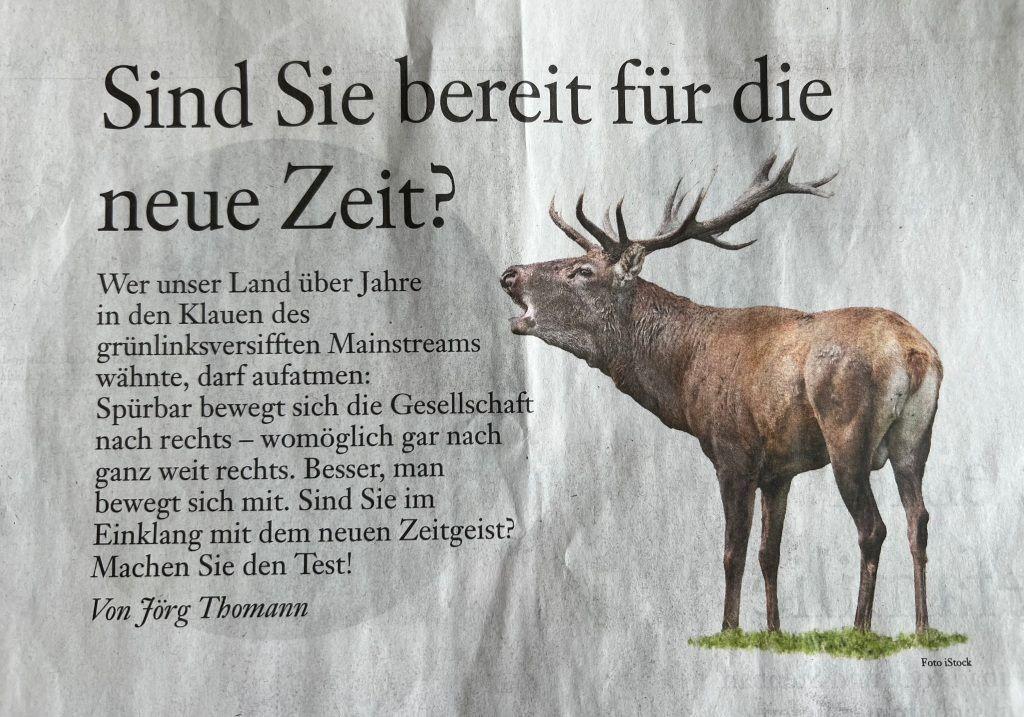
Witzig oder ernst gemeint? Multiple-Choice-Test in der Frankfurter Allgemeinen Sonntagszeitung vom 27. September 2025. Aber wie kann man als seriöser Journalist schreiben: "Besser, man bewegt sich mit" (nach rechts). Geht es noch? #FAZ
Wenn Algorithmen Politik bestimmen: USA, Deutschland und die Eskalation im Netz
 @arXiv_csIR_bot@mastoxiv.page
Fairness for niche users and providers: algorithmic choice and profile portability
Elizabeth McKinnie, Anas Buhayh, Clement Canel, Robin Burke
https://arxiv.org/abs/2509.22660 h…
 @paul@social.van.buu.re
Je zen-moment van vandaag.

 @arXiv_csGT_bot@mastoxiv.page
Correlation of Rankings in Matching Markets
R\'emi Castera, Patrick Loiseau, Bary S. R. Pradelski
https://arxiv.org/abs/2512.05304 https://arxiv.org/pdf/2512.05304 https://arxiv.org/html/2512.05304
arXiv:2512.05304v1 Announce Type: new
Abstract: We study the role of correlation in matching markets, where multiple decision-makers simultaneously face selection problems from the same pool of candidates. We propose a model in which a candidate's priority scores across different decision-makers exhibit varying levels of correlation dependent on the candidate's sociodemographic group. Such differential correlation can arise in school choice due to the varying prevalence of selection criteria, in college admissions due to test-optional policies, or due to algorithmic monoculture, that is, when decision-makers rely on the same algorithms and data sets to evaluate candidates. We show that higher correlation for one of the groups generally improves the outcome for all groups, leading to higher efficiency. However, students from a given group are more likely to remain unmatched as their own correlation level increases. This implies that it is advantageous to belong to a low-correlation group. Finally, we extend the tie-breaking literature to multiple priority classes and intermediate levels of correlation. Overall, our results point to differential correlation as a previously overlooked systemic source of group inequalities in school, university, and job admissions.
toXiv_bot_toot
@arXiv_csCL_bot@mastoxiv.pageMind Your Tone: Investigating How Prompt Politeness Affects LLM Accuracy (short paper)
Om Dobariya, Akhil Kumar
https://arxiv.org/abs/2510.04950 https://ar…
 @arXiv_csCE_bot@mastoxiv.page
Sci2Pol: Evaluating and Fine-tuning LLMs on Scientific-to-Policy Brief Generation
Weimin Wu, Alexander C. Furnas, Eddie Yang, Gefei Liu, Akhil Pandey Akella, Xuefeng Song, Dashun Wang, Han Liu
https://arxiv.org/abs/2509.21493
 @arXiv_astrophIM_bot@mastoxiv.page
AstroMMBench: A Benchmark for Evaluating Multimodal Large Language Models Capabilities in Astronomy
Jinghang Shi, Xiao Yu Tang, Yang Hunag, Yuyang Li, Xiaokong, Yanxia Zhang, Caizhan Yue
https://arxiv.org/abs/2510.00063
@arXiv_csCL_bot@mastoxiv.pageAnalyzing Dialectical Biases in LLMs for Knowledge and Reasoning Benchmarks
Eileen Pan, Anna Seo Gyeong Choi, Maartje ter Hoeve, Skyler Seto, Allison Koenecke
https://arxiv.org/abs/2510.00962
@arXiv_csCL_bot@mastoxiv.pageJGU Mainz's Submission to the WMT25 Shared Task on LLMs with Limited Resources for Slavic Languages: MT and QA
Hossain Shaikh Saadi, Minh Duc Bui, Mario Sanz-Guerrero, Katharina von der Wense
https://arxiv.org/abs/2509.22490