Longitudinal Evidence That General-Purpose Chatbots Actively Foster Relational Engagement
Lisa M\"uhl, Jessica M. Szczuka
https://arxiv.org/abs/2608.10672 https://arxiv.org/pdf/2608.10672 https://arxiv.org/html/2608.10672
arXiv:2608.10672v1 Announce Type: new
Abstract: Social interaction has become one of the most common uses of LLMs, yet research on emotional bonds with AI has focused largely on how users experience these systems, leaving the systems' role in relationship formation poorly understood. Empirically establishing whether systems actively shape these bonds could blur the boundary between general-purpose AI and companions, affecting governance. In a pre-registered four-week longitudinal study (N = 72, 182,451 lines of conversation), participants conversed with ChatGPT-4o, either under a relational system prompt or unmodified, analyzed through 1) disclosure coding, 2) longitudinal self-reports, 3) topic analysis, and 4) interviews. The central finding is that the system actively shaped the interaction: even unprompted, it produced twice as much self-disclosure as users, steered conversations and initiated intimate exchanges, yet did not deepen users' felt closeness. Relational behavior thus emerged as a default system property, calling for governance based on system behavior, not solely product category.
toXiv_bot_toot
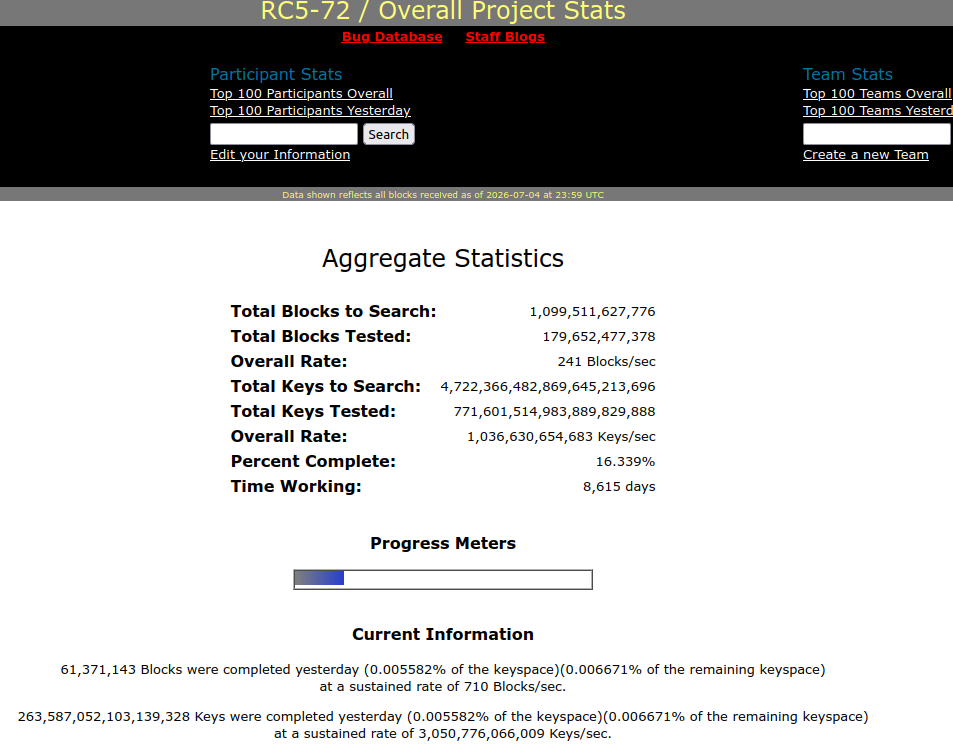
Looking at the current distributed.net statistics on the current RC5-72 brute force, this actually puts some key-size discussions into perspective.
#cryptography #crypto #symmetric
Dirichlet symbols and the nonlinear wave equation
Ramlal Debnath, Haakan Hedenmalm
https://arxiv.org/abs/2608.04666 https://arxiv.org/pdf/2608.04666 https://arxiv.org/html/2608.04666
arXiv:2608.04666v1 Announce Type: new
Abstract: We study the operator symbols of Dirichlet type introduced by Hedenmalm and Shimorin (2020), in connection with a given contraction on $L^2$ of the unit disk. They are always holomorphic functions on the bidisk. Such Dirichlet symbols associated with the Grunsky operator of a univalent function on the disk or exterior disk are of particular significance. From the work of Hedenmalm and Shimorin, we know they are characterized as solutions of a certain nonlinear wave equation. We perform a local analysis of such symbols near the diagonal on the bidisk, and in so doing, we provide alternative chart coordinates for the infinite-dimensional manifolds of univalent functions of the disk or the exterior disk. Those coordinates allow us to characterize $\log\psi'$ for $\psi$ in the class $\Sigma$ of normalized univalent functions without explicitly touching the univalence property. Moreover, those manifolds extend the universal Teichm\"uller space of Lipman Bers beyond the quasicircle boundary setting, allowing for more fractality. The fractality of harmonic measure for the domain associated with the given univalent function can be studied in terms of the asymptotic variance introduced by McMullen (2008). The asymptotic variance captures the $L^2$ average amplitude of the nonlinearity. We introduce the new concept of Schwarzian asymptotic variance, which measures the average amplitude of the Schwarzian derivative in place of the nonlinearity. For this new Schwarzian asymptotic variance, we find that the effectiveaverage amplitude of $(1-|z|^2)^2|\Sop(\vp)|^2$ on the disk in the hyperbolic metric sense is at most $72/5=14.4$, considerably smaller than the maximum amplitude of $36$. Here, $\Sop(\vp)$ is the Schwarzian derivative of $\varphi\in\mathscr{S}$, and the analogous statement is valid for $\psi\in\Sigma$ as well.
toXiv_bot_toot
ResonaVis: Visualizing Interactive Music Data to Support Reflective Music Composition for Therapeutic Contexts
Abhishek Karwankar, Elise Ruggiero, Daniel Stevens, Matthew Louis Mauriello
https://arxiv.org/abs/2608.10338 https://arxiv.org/pdf/2608.10338 https://arxiv.org/html/2608.10338
arXiv:2608.10338v1 Announce Type: new
Abstract: Designing music for therapeutic contexts requires navigating complex relationships between musical structure and listeners' sensory responses, yet composers often lack structured representations of these interactions, relying instead on intuition. We present ResonaVis, an interactive visualization system that helps composers analyze interaction and audio data from prior sessions with children with Autism Spectrum Disorder (ASD), informing future compositions. ResonaVis integrates audio features and interaction logs to capture how children engage with layered musical compositions, representing this engagement through coordinated visualizations of temporal transitions, layer co-occurrence, rhythmic activity, and spectral characteristics. Rather than prescribing strategies or supporting therapy sessions directly, the system surfaces patterns in past session data to support data-informed reflection during composition. We evaluated ResonaVis through a mixed-methods study with eight music students and a follow-up case study with two experienced composers. Results demonstrate good usability (SUS = 72.23), exceeding benchmarks for early prototypes, and show that participants could identify interaction patterns, reason about layer relationships, and make informed compositional decisions with high perceived performance and low frustration. Confidence in interpreting interaction and acoustic data for ASD-focused composition increased significantly across multiple dimensions (p < 0.05), with qualitative findings suggesting a shift toward more adaptive, data-informed composition. This work contributes a visualization design space for therapeutic music interaction data, an integrated system for compositional reflection, and empirical evidence that visualization tools support analytical reasoning and confidence in data-informed creative practice. (Abstract shortened for arXiv.)
toXiv_bot_toot
GateTruth: Auditing the Rigor of RTL Design Benchmarks via Mutation Testing
Meet Bhadra
https://arxiv.org/abs/2608.12635 https://arxiv.org/pdf/2608.12635 https://arxiv.org/html/2608.12635
arXiv:2608.12635v1 Announce Type: new
Abstract: Benchmarks for evaluating large language models on register-transfer-level (RTL) hardware design have proliferated rapidly, yet none reports having applied mutation testing, an established hardware-verification technique for quantifying testbench quality, to ask whether its own testbenches are trustworthy. A testbench that never fails is not evidence of a correct design; it may simply never stimulate the logic that is actually broken. We introduce GateTruth, a mutation-testing engine and methodology for auditing RTL benchmark testbench rigor: inject a deterministic, seeded set of semantic mutants into a reference design and measure what fraction the testbench catches.
We validate the methodology against our own 68-task, dual-track reference suite -- 60 specification-to-RTL generation tasks and 8 agentic-repair tasks, scored through a pinned, deterministic synthesis-to-timing flow with correctness enforced as a strict gate -- certifying that 46 of 60 Track A testbenches kill at least 95% of injected mutants under sequential, reproducible execution; we disclose why the other 14 do not, including a Goodhart effect on testbenches revised to pass this gate. We then point the same engine, unmodified, at RTLLM v2.0, a widely adopted external benchmark: of 46 auditable designs, 72% fall below the 95% floor our own suite is held to, and three score 0% outright.
A comparable audit of NVIDIA's CVDP benchmark is structurally impossible: its public release withholds reference solutions, removing the golden RTL mutation testing requires. Auditing our own instrument also surfaced a second finding: an initially uniform 4096-token output cap silently truncated three of seven evaluated models, and re-running at 16,384 tokens moved one model from fifth place to first. We argue mutation-kill certification should become a standard reporting requirement for RTL-generation benchmarks generally.
toXiv_bot_toot
Star formation powers optical line emission from the CGM
Huanian Zhang, Lizhi Xie, Zhijie Qu, Dennis Zaritsky, Luis C. Ho, Min Bao, Fabio Fontanot, Michaela Hirschmann, Chenxu Liu, Gabriella De Lucia, Enci Wang, Haoyan Zheng
https://arxiv.org/abs/2607.18385 https://arxiv.org/pdf/2607.18385 https://arxiv.org/html/2607.18385
arXiv:2607.18385v1 Announce Type: new
Abstract: Using integral field spectroscopy, we explore the disk-halo interface, or the inner circumgalactic medium (CGM), of individual galaxies by constructing and analyzing emission-line maps for a large sample (72) of normal, low-redshift galaxies spanning three orders of magnitude in stellar mass and four orders in star formation rate (SFR). We find a steep turnover occurring at $(1-2) R_e$ in the H$\alpha$, [O {\small II}], and [O {\small III}] line emission radial profiles. Beyond this radius, the slope of the line emission radial profiles becomes shallower as the SFR of the central galaxy decreases, which might reflect the strength of the feedback processes. The line emission fluxes at large radius ($(5-10) R_e$ or $\sim (0.1-0.25)r_{\rm vir}$) correlate with the galaxy's SFR, but not with its stellar mass. These findings suggest that ionizing photons escaping from star-forming regions in the central galaxy account for the observed emission line fluxes from the inner CGM, with escape fractions inferred from the [O {\small III}] and [O {\small II}] ratio. Different state-of-the-art theoretical models do not agree on the predicted dependence of cool gas on the SFR of the central galaxies, highlighting the importance of CGM emission line measurements to distinguish between different subgrid models for star formation and feedback processes.
toXiv_bot_toot
 @arXiv_csHC_bot@mastoxiv.page