 @raiders@darktundra.xyz
2025-11-26 23:23:30
Raiders Mailbag: How can rookies see more playing time down the stretch? https://www.raiders.com/news/mailbag/raiders-mailbag-how-can-rookies-see-more-playing-time-down-the-stretch
@raiders@darktundra.xyzRaiders Mailbag: How can rookies see more playing time down the stretch? https://www.raiders.com/news/mailbag/raiders-mailbag-how-can-rookies-see-more-playing-time-down-the-stretch
 @Techmeme@techhub.social
Cerrion, which develops AI video agents that detect and resolve production line issues in real time, raised an $18M Series A led by Creandum (Tamara Djurickovic/Tech.eu)
https://tech.eu/2025/11/25/cerrion-raises-18m-to-reduce-factory-downtime-wi…
@raiders@darktundra.xyzRaiders Mailbag: How can rookies see more playing time down the stretch? https://www.raiders.com/news/mailbag/raiders-mailbag-how-can-rookies-see-more-playing-time-down-the-stretch
 @brichapman@mastodon.social
What happens when you pair solar panels with mini nuclear reactors? Chinese researchers just cracked the code.
Their new microgrid framework combines photovoltaics with small modular reactors, using AI to balance both in real time. The results are striking: 18.7% lower costs, 37.1% fewer emissions, and 98% reliability.
The secret? Smart coordination between battery storage and hydrogen production that adapts on the fly.
 @blakes7bot@mas.torpidity.net
#Blakes7 Series A, Episode 09 - Project Avalon
SERVALAN: [To Travis] Project Avalon has failed totally. There will be a full inquiry. Until that time you are relieved of your command.
TRAVIS: [To himself] If it takes all my life, I will destroy you, Blake. I will destroy you. I will destroy you.

 @markhburton@mstdn.social
Harjeet Singh of the Satat Sampada Climate Foundation, said: “Cop30 will go down in history as the deadliest talkshow ever produced.”
https://thenextrecession.wordpress.com/2025/11/23/cop-30-its-no-joke/
 @arXiv_statML_bot@mastoxiv.page
Contraction and entropy production in continuous-time Sinkhorn dynamics
Anand Srinivasan, Jean-Jacques Slotine
https://arxiv.org/abs/2510.12639 https://arx…
@blakes7bot@mas.torpidity.netSeries C, Episode 05 - The Harvest of Kairos
AVON: Cally. [Grasps her by the arms]
TARRANT: [Enters] Is this the time or the place? That thing has warped your reason, Avon. It's even warped your notorious instinct for looking after number one. We are in danger, can't you understand that?
https://blake.torpidity.net/m/3…

 @Sustainable2050@mastodon.energy
Big news for the energy transition!
And a nice little 'told you so' moment for yours truly :)
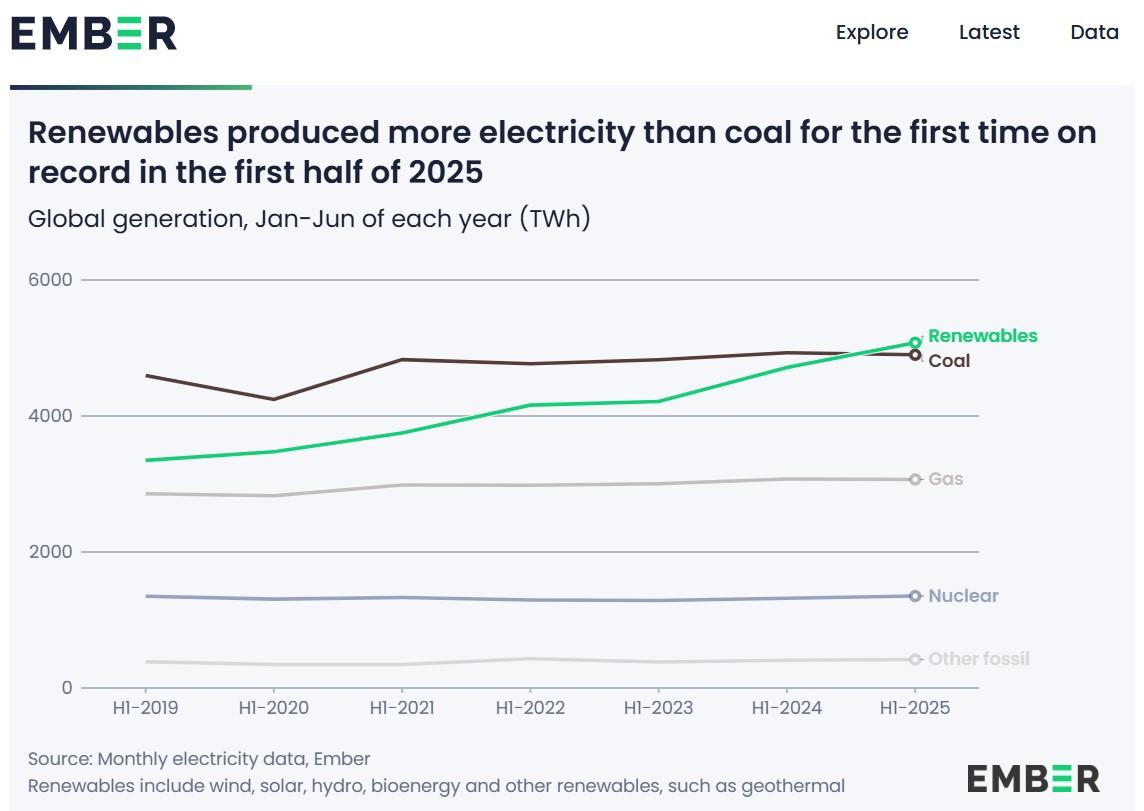
In the first half of this year, renewables produced more electricity globally than coal, for the first time.
And 2025 is the date I predicted for this to happen, back in 2016, in a blog post for Ecofys! The score was 23%-40% at the time, with most of the renewables share still coming from hydro, and the prediction was less than obvious.

 @arXiv_csSE_bot@mastoxiv.page
HotBugs.jar: A Benchmark of Hot Fixes for Time-Critical Bugs
Carol Hanna, Federica Sarro, Mark Harman, Justyna Petke
https://arxiv.org/abs/2510.07529 https://
 @arXiv_hepex_bot@mastoxiv.page
Search for dark matter production in association with bottom quarks and a lepton pair in proton-proton collisions at $\sqrt{s}$ = 13 TeV
CMS Collaboration
https://arxiv.org/abs/2510.12396
 @mgorny@social.treehouse.systems
"""
[…] Paradoxically, the more a population grew, the more precious it became, as it offered a supply of cheap labour, and by lowering costs allowed a greater expansion of production and trade. In this infinitely open labour market, the ‘fundamental price’, which for Turgot meant a subsistence level for workers, and the price determined by supply and demand ended up as the same thing. A country was all the more commercially competitive for having at its disposal the virtual wealth that a large population represented.
Confinement was therefore a clumsy error, and an economic one at that: there was no sense in trying to suppress poverty by taking it out of the economic circuit and providing for a poor population by charitable means. To do that was merely to hide poverty, and suppress an important section of the population, which was always a given wealth. Rather than helping the poor escape their provisionally indigent situation, charity condemned them to it, and dangerously so, by putting a brake on the labour market in a period of crisis. What was required was to palliate the high cost of products with cheaper labour, and to make up for their scarcity by a new industrial and agricultural effort. The only reasonable remedy was to reinsert the population in the circuit of production, being sure to place labour in areas where manpower was most scarce. The use of paupers, vagabonds, exiles and émigrés of any description was one of the secrets of wealth in the competition between nations. […]
Confinement was to be criticised because of the effects it had on the labour market, but also because like all other traditional forms of charity, it constituted a dangerous form of finance. As had been the case in the Middle Ages, the classical era had constantly attempted to look after the needs of the poor by a system of foundations. This implied that a section of the land capital and revenues were out of circulation. In a definitive manner too, as the concern was to avoid the commercialisation of assistance to the poor, so judicial measures had been taken to ensure that this wealth never went back into circulation. But as time passed, their usefulness diminished: the economic situation changed, and so did the nature of poverty.
«Society does not always have the same needs. The nature and distribution of property, the divisions between the different orders of the people, opinions, customs, the occupations of the majority of the population, the climate itself, diseases and all the other accidents of human life are in constant change. New needs come into being, and old ones disappear.» [Turgot, Encyclopédie]
The definitive character of a foundation was in contradiction with the variable and changing nature of the accidental needs to which it was designed to respond. The wealth that it immobilised was never put back into circulation, but more wealth was to be created as new needs appeared. The result was that the proportion of funds and revenues removed from circulation constantly increased, while that of production fell in consequence. The only possible result was increased poverty, and a need for more foundations. The process could continue indefinitely, and the fear was that one day ‘the ever increasing number of foundations might absorb all private funds and all private property’. When closely examined, classical forms of assistance were a cause of poverty, bringing a progressive immobilisation that was like the slow death of productive wealth:
«If all the men who have ever lived had been given a tomb, sooner or later some of those sterile monuments would have been dug up in order to find land to cultivate, and it would have become necessary to stir the ashes of the dead in order to feed the living.» [Turgot, Lettre Š Trudaine sur le Limousin]
"""
(Michel Foucault, History of Madness)
@blakes7bot@mas.torpidity.netSeries A, Episode 04 - Time Squad
BLAKE: [Laughs slightly] More interesting is where it was going and why. Let's see if Avon's got any ideas.
[Interior. Alien projectile]
BLAKE: [To Avon] What do you Think?
https://blake.torpidity.net/m/104/227 B7B5

 @deprogrammaticaipsum@mas.to
"What has not changed in 50 years is the fact we are still using centralized architectures, prone to government intrusion and privacy leaks. Maybe it is time to think about a “Post Cloud” era where information is distributed instead of centralized. Of course this raises questions of trust, cryptography, security and collaboration, but the technology to build such systems already exists. It is more of a question of policy and education than of technology."
 @lpryszcz@genomic.social
imagine spinning a little jet engine capable of supersonic flight next time you prompt your favorite LLM / genAI...
naturally, there are companies producing gas turbines for data centers, but like with RAM memory and SSD, the unexpected growth of data centers caused shortages, hence repurposing of jet engines for energy production...
 @fanf@mendeddrum.org
i talked about this demo in the pub on weds and this toot just reappeared in my feed :-)
https://bsky.brid.gy/r/https://bsky.app/profile/did:plc:tbo4hkau3p2itkar2vsnb3gp/post/3lihqadxsu225
 @arXiv_hepph_bot@mastoxiv.page
Space-time geometry of small and large collision systems at LHC energies
Thomas A. Trainor
https://arxiv.org/abs/2510.05314 https://arxiv.org/pdf/2510.0531…
 @thomastraynor@social.linux.pizza
Panicked message from the boss. Looks like one of the documentation files is corrupted. We haven't had the time to cross train that process. Too many manual steps to extract the information from the repository, download to the network work folder, import into Word format, locate specific items and run the macro to format those, export to PDF and then reindex the production doc folder with the change.
 @compfu@mograph.social
Clapshot: open source browser-based media review like frame.io
https://cinelinux.com/en/2025/10/04/clapshot-a-alternativa-open-source-ao-frame-io-para-revisao-de-videos/
Haven't tested it yet, but the review seem…
@arXiv_csSE_bot@mastoxiv.pageAdaptive Reinforcement Learning for Dynamic Configuration Allocation in Pre-Production Testing
Yu Zhu
https://arxiv.org/abs/2510.05147 https://arxiv.org/pd…
 @arXiv_csHC_bot@mastoxiv.page
A Multimodal GUI Architecture for Interfacing with LLM-Based Conversational Assistants
Hans G. W. van Dam
https://arxiv.org/abs/2510.06223 https://arxiv.or…
 @arXiv_csAI_bot@mastoxiv.page
Thinkquel: A Model Dedicated to Text-to-dbt Using Synthetic Data and a Span-Aware Objective
Anni Li, Aria Attar, Paul Dong
https://arxiv.org/abs/2510.00186 https://
@blakes7bot@mas.torpidity.netSeries A, Episode 04 - Time Squad
BLAKE: Has anyone been down to see our guests lately?
JENNA: Vila went down a little while ago.
BLAKE: And?
VILA: Thawing nicely. Couple of hours, we should be able to talk to them.
https://blake.torpidity.net/m/104/250 B7B3

 @arXiv_csCV_bot@mastoxiv.page
Multi-View Camera System for Variant-Aware Autonomous Vehicle Inspection and Defect Detection
Yash Kulkarni, Raman Jha, Renu Kachhoria
https://arxiv.org/abs/2509.26454 https://
 @arXiv_astrophCO_bot@mastoxiv.page
Constraining Inflationary Particle Production with CMB Polarization
Luca H. Abu El-Haj, Oliver H. E. Philcox, J. Colin Hill
https://arxiv.org/abs/2509.23123 https://
 @arXiv_econTH_bot@mastoxiv.page
An analysis of government subsidy policies in vaccine supply chain: Innovation, Production, or Consumption?
Ran Gu, Enhui Ding, Shigui Ma
https://arxiv.org/abs/2510.03661 https:…
 @arXiv_astrophHE_bot@mastoxiv.page
High-energy variability of the gravitationally lensed blazar PKS 1830-211
Sarah M. Wagner, Jeffrey D. Scargle, Greg Madejski, Andrea Gokus, Krzysztof Nalewajko, Patrick G\"unther, Karl Mannheim
https://arxiv.org/abs/2510.07220
@mgorny@social.treehouse.systems"""
Traditional politics of assistance and the repression of unemployment were now called into question. The need for reform became urgent.
Poverty was gradually separated from the old moral confusions. Economic crises had shown that unemployment could not be confused with indolence, as indigence and enforced idleness spread throughout the countryside, to precisely the places that had previously been considered home to the purest and most immediate forms of moral life. This demonstrated that poverty did not solely fall under the order of the fault: ‘Begging is the fruit of poverty, which in turn is the consequence of accidents in the production of the earth or in the output of factories, of a rise in the price of basic foodstuffs, or of growth of the population, etc.’ Indigence became a matter of economics.
But it was not contingent, nor was it destined to be suppressed forever. There would always be a certain quantity of poverty that could never be effaced, a sort of fatal indigence that would accompany all forms of society until the end of time, even in places where all the idle were employed: ‘The only paupers in a well governed state must be those born in indigence, or those who fall into it by accident.’ This backdrop of poverty was somehow inalienable: whether by birth or accident, it formed an inevitable part of society. The state of lack was so firmly entrenched in the destiny of man and the structure of society that for a long time the idea of a state without paupers remained inconceivable: in the thought of philosophers, property, work and indigence were terms linked right up until the nineteenth century.
This portion of poverty was necessary because it could not be suppressed; but it was equally necessary in that it made wealth possible. Because they worked but consumed little, a class of people in need allowed a nation to become rich, to release the value of its fields, colonies and mines, making products that could be sold throughout the world. An impoverished people, in short, was a people that had no poor. Indigence became an indispensable element in the state. It hid the secret but most real life of society. The poor were the seat and the glory of nations. And their noble misery, for which there was no cure, was to be exalted:
«My intention is solely to invite the authorities to turn part of their vigilant attention to considering the portion of the People who suffer … the assistance that we owe them is linked to the honour and prosperity of the Empire, of which the Poor are the firmest bulwark, for no sovereign can maintain and extend his domain without favouring the population, and cultivating the Land, Commerce and the Arts; and the Poor are the necessary agents for the great powers that reveal the true force of a People.»
What we see here is a moral rehabilitation of the figure of the Pauper, bringing about the fundamental economic and social reintegration of his person. Paupers had no place in a mercantilist economy, as they were neither producers nor consumers, and they were idle, vagabond or unemployed, deserving nothing better than confinement, a measure that extracted and exiled them from society. But with the arrival of the industrial economy and its thirst for manpower, paupers were once again a part of the body of the nation.
"""
(Michel Foucault, History of Madness)
 @arXiv_heplat_bot@mastoxiv.page
Nevanlinna-Pick interpolation from uncertain data
Sarah Fields, Norman Christ
https://arxiv.org/abs/2510.12136 https://arxiv.org/pdf/2510.12136
 @gwire@mastodon.social
Amazon have a comedy movie about an armed hostage situation at a wedding, "Bride Hard". And I thought "oh, was this one of those instances where two movies with the same premise somehow went into production at the same time?".
But no, this was announced after the release of "Shotgun Wedding" like they expect it to become a genre.
 @arXiv_condmatstatmech_bot@mastoxiv.page
Optimal Computation from Fluctuation Responses
Jinghao Lyu, Kyle J. Ray, James P. Crutchfield
https://arxiv.org/abs/2510.03900 https://arxiv.org/pdf/2510.0…
 @arXiv_physicsplasmph_bot@mastoxiv.page
GyroSwin: 5D Surrogates for Gyrokinetic Plasma Turbulence Simulations
Fabian Paischer, Gianluca Galletti, William Hornsby, Paul Setinek, Lorenzo Zanisi, Naomi Carey, Stanislas Pamela, Johannes Brandstetter
https://arxiv.org/abs/2510.07314
 @arXiv_physicssocph_bot@mastoxiv.page
Integrating Weather and Land Cover Data into Geospatial Impact Evaluations
Elinor Benami, Mike Cecil, Anna Josephson, Gina Maskell, Jeffrey D. Michler
https://arxiv.org/abs/2510.05108
@blakes7bot@mas.torpidity.netSeries A, Episode 04 - Time Squad
BLAKE: How long has it been registering?
JENNA: Couple of minutes. Signal's getting stronger.
BLAKE: Zen, visual detector scan and computer analysis on grid one one five, please.
https://blake.torpidity.net/m/104/48 B7B2

 @arXiv_csSD_bot@mastoxiv.page
Temporal-Aware Iterative Speech Model for Dementia Detection
Chukwuemeka Ugwu, Oluwafemi Oyeleke
https://arxiv.org/abs/2510.00030 https://arxiv.org/pdf/251…
@arXiv_hepph_bot@mastoxiv.pageGluon splitting at small $x$: a unified derivation for the JIMWLK, DGLAP and CSS equations
Paul Caucal, Edmond Iancu, Farid Salazar, Feng Yuan
https://arxiv.org/abs/2510.08454 h…
 @arXiv_nuclex_bot@mastoxiv.page
Status and future directions for direct cross-section measurements of the 13C(a,n)16O reaction for astrophysics
L. Csedreki, Gy. Gy\"urky, D. Rapagnani, G. F. Ciani, M. Aliotta, C. Anannad, L. Barbieri, F. Barile, D. Bemmerer, A. Best, A. Boeltzig, C. Broggini, C. G. Bruno, A. Caciolli, F. Casaburom, F. Cavannak, P. Colombetti, A. Compagnucci, P. Corvisiero, T. Davinson, R. Depalo, A. Di Leva, Z. Elekes, F. Ferraro, A. Formicola, Zs. F\"ul\"opa, G. Gervino, A. Guglielmet…
@blakes7bot@mas.torpidity.netSeries B, Episode 10 - Voice from the Past
JENNA: Zen, abort course for asteroid PK One One Eight and resume course for planet Del Ten. Confirm with arrival time.
ZEN: Arrival at planet Del Ten at zero four five plus one.
[Liberator turns in space]
https://blake.torpidity.net/m/210/164

 @BBC6MusicBot@mastodonapp.uk
🇺🇦 #NowPlaying on #BBC6Music's #DonLettsCultureClashRadio
Bim One Production:
🎵 Hard Time
#BimOneProduction
https://open.spotify.com/track/0iVaHOfDhHDEUyb3TYJFKz
@arXiv_condmatstatmech_bot@mastoxiv.pageA variational formulation of stochastic thermodynamics. Part I: Finite-dimensional systems
H\'ector Vaquero del Pino, Fran\c{c}ois Gay-Balmaz, Hiroaki Yoshimura, Lock Yue Chew
https://arxiv.org/abs/2510.01787
@blakes7bot@mas.torpidity.netSeries B, Episode 08 - Hostage
MUTOID: Yes, Supreme Commander. Time distort ten.
SERVALAN: Mutoids. Don't you ever question anything?
https://blake.torpidity.net/m/208/384 B7B4
 @arXiv_hepex_bot@mastoxiv.page
P371 Experiment at CERN -- quest for polarized antiprotons
M. Zielinski, D. Grzonka, G. Khatri, P. Kulessa, J. Ritman, T. Sefzick, J. Smyrski, V. Verhoeven, H. Xu
https://arxiv.org/abs/2510.00825
@blakes7bot@mas.torpidity.netSeries A, Episode 04 - Time Squad
VILA: A limiter?
GAN: Something that stops him from helping us too much. Or maybe it's someone who stops him.
VILA: Gan, if you're trying to scare me, you're succeeding.
[Exterior. Liberator approaches the alien craft.]
https://blake.torpidity.net/m/104/91
 @arXiv_nuclex_bot@mastoxiv.page
Experimental overview of electromagnetic radiation in heavy-ion collisions
Sebastian Scheid
https://arxiv.org/abs/2509.26456 https://arxiv.org/pdf/2509.264…
@blakes7bot@mas.torpidity.netSeries B, Episode 07 - Killer
JENNA: Obviously not.
BLAKE: I hope we got that through to him in time.
[A-line room]
AVON: Keep an eye on the corridor.
https://blake.torpidity.net/m/207/537 B7B3
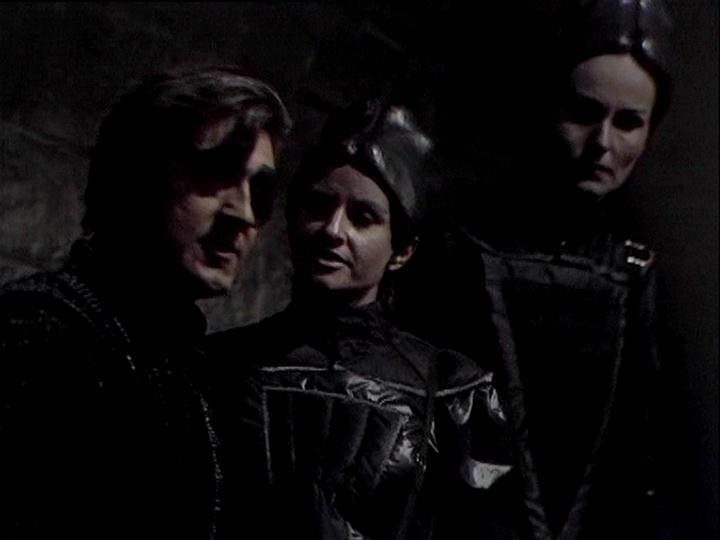
 @blakes7bot@mas.torpidity.net
Series B, Episode 05 - Pressure Point
MUTOID: They have not had time to get far.
TRAVIS: Couple of miles at the most, and without their teleport they're earthbound now.
MUTOID: I will call security.
TRAVIS: No!
https://blake.torpidity.net/m/205/416 B7B3
 @arXiv_hepex_bot@mastoxiv.page
Advancing the CMS Level-1 Trigger: Jet Tagging with DeepSets at the HL-LHC
Stella Schaefer, Christopher Brown, Duc Hoang, Sioni Summers, Sebastian Wuchterl
https://arxiv.org/abs/2509.24371
@blakes7bot@mas.torpidity.netSeries A, Episode 04 - Time Squad
JENNA: Gan, the aliens have linked their ship to our power source. I'm getting a very heavy power loss. I'll have to disconnect. You'll be all right, won't you?
GAN: [Nods] Yes.
https://blake.torpidity.net/m/104/454 B7B6
 @blakes7bot@mas.torpidity.net
Series D, Episode 11 - Orbit
VILA: You really think things through, don't you, Avon? If we do need it, we won't have time to get it.
AVON: Well then, let's hope we don't need it. [Smiles]
[Scene: Scorpio]
https://blake.torpidity.net/m/411/84 B7B2
 @blakes7bot@mas.torpidity.net
Series D, Episode 08 - Games
GERREN: Told you, there was no time. Besides, from what I've heard, she might be more than a match for you.
AVON: Well now. Just who are they sending?
https://blake.torpidity.net/m/408/87 B7B3