Key lessons I learned in the last ~year: 💡
- Give to causes/uses that (can) last long.
- Giving that lasts can also give you back a lot of satisfaction.
Wish I'd learned that sooner. 😳
#lesson #giving #satisfaction
Skellow (adj.)
Descriptive of the satisfaction experienced when looking at a really good dry-stone wall.
Douglas Adams & John Lloyd, The Meaning of Liff https://tmoliff.blogspot.com/2012/09/skellow-adj.html
from my link log —
MiniZinc high-level solver-independent constraint satisfaction and optimization modelling language.
https://www.minizinc.org/index.html
saved 2019-09-30
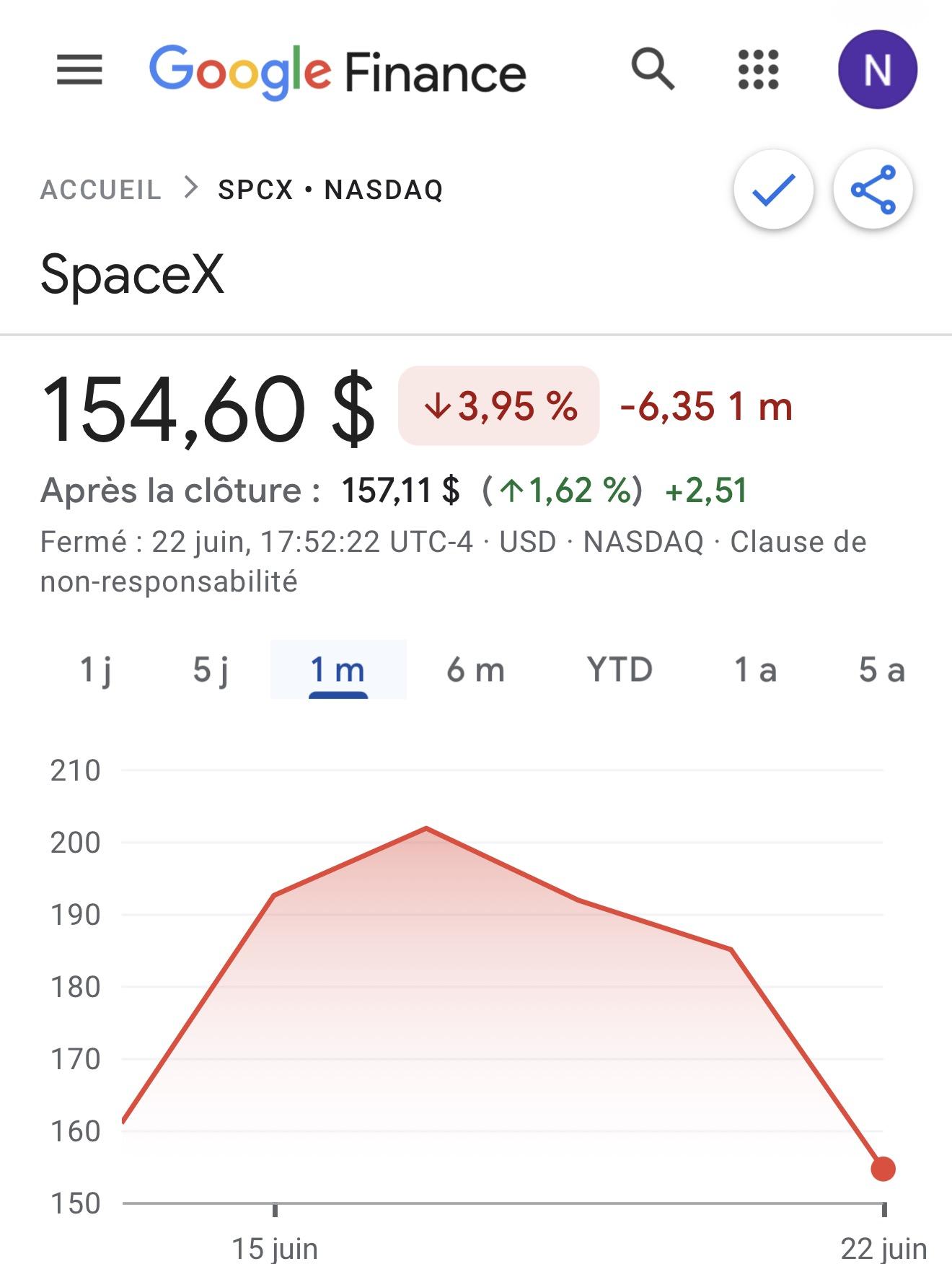
On peut avoir une satisfaction, c’est que l’ouverture en bourse de #SpaceX, après être monté en flèche, finit par s’effondrer plus bas qu’Š l’ouverture.
16,48% de perte quand même aujourd’hui !
Spoke with an #acting #coaching client about artistic satisfaction. One can act for a brief period without any, but sort of like gas in a tank, if it's lacking enough, long enough, it gets very tough to keep doing this. Valid to find it, even outside of formal jobs.
"Several of my peers now “AI-wash” their work, meaning that even when they can perfectly competently execute on their jobs to the satisfaction of their management teams, said managers are unhappy if the engineers haven’t used AI in the work… so now they’re lying about using LLMs even in contexts where their professional judgement is that they aren’t the appropriate tool. They just do the work, the same way they have for decades, and say Claude did it. "
Felt a lot of satisfaction yesterday at the grocery to pick an item in my hands and then… oops, US made. Good bye, back on the shelf
Keep it up, every $ diverted is a win.
#buycanadian
Toward cryptographically verifiable authorization for autonomous AI agents: A security hypothesis, preliminary formal model, and proof-of-concept implementation
M. Llamb\'i-Morillas, D. Fern\'andez-Fern\'andez
https://arxiv.org/abs/2607.21325 https://arxiv.org/pdf/2607.21325 https://arxiv.org/html/2607.21325
arXiv:2607.21325v1 Announce Type: new
Abstract: Autonomous AI agents increasingly execute actions, invoke tools, and operate on protected resources with limited human oversight. Existing authentication and authorization mechanisms establish identity and delegate authority, but do not inherently provide cryptographic evidence that a concrete request issued by a specific agent satisfies the applicable policy in a specific execution context. This paper hypothesizes that agent authorization can be formalized as a cryptographically verifiable relation, denoted $R_{CVA}$, that jointly binds an agent principal, a concrete authorization request, an execution context, and the satisfaction of an applicable policy, while selectively preserving the confidentiality of private authorization attributes. We introduce a preliminary formal abstraction for Cryptographically Verifiable Agent Authorization (CVA), define a compact set of candidate security properties including authorization soundness, principal binding, request binding, policy binding, and replay resistance, and provide an executable zero-knowledge proof of concept that instantiates selected elements of the model over a Groth16 zk-SNARK construction. We further identify and formalize the structural separation among identity binding, authorization-request binding, and runtime execution binding as a central open problem in the design of secure agentic systems (a distinction {not explicitly addressed by} current agentic security frameworks) and present a falsifiable research agenda for its resolution.
toXiv_bot_toot
I've been talking before why money won't solve the burnout problem. But let's for a minute assume that you really wanted to help people maintaining #FreeSoftware by paying them. The problem is that:
1. You have to pay them a living wage.
While all monetary help is appreciated by developers, they need a living wage. Not "that should prevent you from starving to death" but the kind of money that can support a honest (but not lavish) lifestyle: pay the bills, feed your family, cover other living costs such as repairs, clothes, appliances, and let you save enough for future emergencies.
It's simple as that. If you can't do that, they're going to need a dayjob. If they're lucky, it won't collide with their #FLOSS work. If they're not, it will kill them. Or they'll fall somewhere in the middle, slowly burning out until they can neither maintain their projects, nor work.
2. You need to guarantee that the payouts will continue.
People need security. They're not going to stay unemployed, let alone quit their job or turn down a job offer, unless they either have good guaranties or substantial savings (or they're in a really bad shape and wouldn't be able to handle the job anyway). The job market is hell, and people just know that when the payments stop, they may not be able to find a job soon, let alone a good job. Even "passively" looking for a job can burn you out.
So yeah, one-off payments and pinky swears won't do. And it isn't even a matter of whether we can trust you; it's a matter if you'll actually be able to continue paying us. And honestly, I don't really know how to solve that. Perhaps by paying up front, but for how long? Finding a job may take more than a year, finding a good job may be once-in-a-lifetime opportunity.
3. It can't end up being a job.
Perhaps most difficult of all, these payments can't really come with explicit obligations. I mean, that's the whole point: you want to support FLOSS, not turn it into a corporate project. You want the maintainer to remain free and enjoy the work. That is unlikely to happen if their livelihood is now dependent on your satisfaction. And even if it isn't, I for example would still feel indebted to whoever's paying me to do FLOSS, even if they really didn't expect anything in return, and would fall into a spiral of guilt-inflicted burnout if I failed to maintain the software satisfactorily.
#OpenSource
from my link log —
MiniZinc high-level solver-independent constraint satisfaction and optimization modelling language.
https://www.minizinc.org/index.html
saved 2019-09-30
Wrt to Codeberg kicking out slop:
“How may the compulsive programmer be distinguished from a merely dedicated, hard-working professional programmer? First, by the fact that the ordinary professional programmer addresses himself to the problem to be solved, whereas the compulsive programmer sees the problem mainly as an opportunity to interact with the computer.
The ordinary computer programmer will usually discuss both his substantive and his technical programming problem with others. He will generally do lengthy preparatory work, [...] He develops his program slowly and systematically. When something doesn't work, he may spend considerable time away from the computer, framing careful hypotheses to account for the malfunction and designing crucial experiments to test them.
[...]
When he has finally composed the program he set out to produce, he is able to complete a sensible description of it and to turn his attention to other things.
The professional regards programming as a means toward an end, not as an end in itself. His satisfaction comes from having solved a substantive problem, not from having bent a computer to his.”
—Joseph Weizenbaum, Computer Power and Human Reason, 1976
Weakly Non-Negative Supermartingales for Omega-Regular Verification
Toru Takisaka, Hongjie Qing, Libo Zhang
https://arxiv.org/abs/2607.17798 https://arxiv.org/pdf/2607.17798 https://arxiv.org/html/2607.17798
arXiv:2607.17798v1 Announce Type: new
Abstract: Martingale-based methods are central to probabilistic program verification, but strong global non-negativity requirements can exclude simple certificates from tractable template classes. Relaxing this requirement enlarges the search space for automated synthesis, but naive relaxations are unsound in the probabilistic setting. We introduce lazy Streett supermartingales and their lexicographic extension, showing that weak non-negativity can nevertheless be used soundly to certify almost-sure satisfaction of $\omega$-regular properties with polynomial templates under a broad class of sampling distributions, including all bounded-support distributions. This extends prior weakly non-negative methods from termination to general $\omega$-regular verification. We further give a compositional account of lexicographic certificates in terms of one-dimensional ones. Experiments on 170 polynomial probabilistic-program benchmarks show increases of 20.0-23.5 percentage points in verification success over the strongly non-negative baseline.
toXiv_bot_toot
Over breakfast, my wife and I had a wonderful conversation about the #Sanskrit word "kushaloapari" (कुशलोपरि), its decomposition, etymology, usage, and relationship to other words. We concluded writing it all up would mean a blog post.
#intellectual #satisfaction #languages #vocabulary
 @smurthys@hachyderm.io