Tipp: Templates für Apple Mail auf dem Mac
Apple sieht Vorlagen in seiner Mail-Anwendung unter macOS bislang nicht vor. Mit wenig Mühe können Sie sich diese Funktion aber selbst zusammenbauen.
https://www.
Glabels is pretty awesome! Been struggling with some old Word templates someone made ages ago. Went looking for some proper label software and found #linux
A deep dive into Grok Bot, including its architecture, use cases, and alternatives, as xAI adds shareable bot templates and online purchases through Stripe Link (Flavio Copes)
https://flaviocopes.com/grok-bot/
I'm getting close to releasing a web project I've been working on for five years.
I hope I've found every bit of 3AM profanity and all of the foos, foobars, and ipsum dolors hidden in the site templates.
There is such a long gap between when I started and when I'm launching that I barely remember half of what I did.
#devlife
Sound flexibly interacts with dual-format templates to optimize visual search https://onlinelibrary.wiley.com/doi/10.1111/psyp.70412 "congruent sounds improved accuracy and shortened response times"
oh, totally missed to brag about my new #blog workflow.
Using the #SSG `make` and 4 #lua templates. See
📝 8 post types: Text, Link, Question, Task, Synthesis, Debate, Code Review & Alert, each with dedicated UI and per-community templates
🔍 Hybrid search combines full-text tsvector with pg_trgm trigram similarity, fused via Reciprocal Rank Fusion
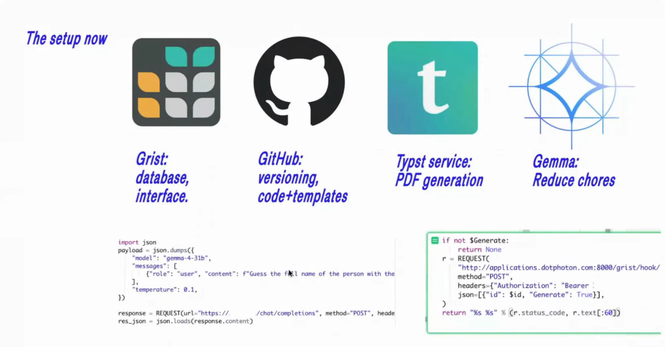
The factors that matter to auditors are traceability (the relational structure of the requirements database), reproducibility of deliverables (the Typst integration), auditability of the system itself (Grist is open source and self-hosted), and version control of both data and templates (Git).
"In most languages, metaprogramming lives in a separate layer with its own representation of code like templates, reflection APIs, token streams, quasi-quoted ASTs. Some of those layers are crude and some are genuinely sophisticated, but each is a wall between code and data. In Elisp there was never a wall to tunnel through. Elisp enables metaprogramming, but it's the same language, and the same data structures, all the way down." - Charlie Holland
#lisp #elisp #emacslisp
https://www.tumblr.com/teledyn/824127274686234624?source=share
Perhaps the main improvement with Office ‘97 that soon followed was the WordArt version with color gradients and templates
RE: https://kolektiva.social/@igd_news/117010156110002339
Before I got shot, I was trying to figure out how to organize against Trump. I found out about the Twin Cities GDC. They had made it relatively easy to organize a GDC chapter. We were working on getting chartered when I got shot.
Twin Cities GDC sent people to help us get Greater Seattle Seattle GDC off the ground. One of their folks helped my partner make sure the house was secure. They gave all sorts of training. We used their "GDC in a box" zip file that had everything you needed to get started (dues forms, meeting notes templates, etc).
When I got out of the hospital, I ended up talking with Erik a few times. I have a *huge* amount of respect for him.
This is the real threat: support, cooperation, organizing. It's not about militancy. It's about organizing. The fascist state wants to destroy people who build. That's the whole point.
He is a threat because he has worked tirelessly, for years, against countless challenges, to make things better for people. That is the thing that cannot be.
Weakly Non-Negative Supermartingales for Omega-Regular Verification
Toru Takisaka, Hongjie Qing, Libo Zhang
https://arxiv.org/abs/2607.17798 https://arxiv.org/pdf/2607.17798 https://arxiv.org/html/2607.17798
arXiv:2607.17798v1 Announce Type: new
Abstract: Martingale-based methods are central to probabilistic program verification, but strong global non-negativity requirements can exclude simple certificates from tractable template classes. Relaxing this requirement enlarges the search space for automated synthesis, but naive relaxations are unsound in the probabilistic setting. We introduce lazy Streett supermartingales and their lexicographic extension, showing that weak non-negativity can nevertheless be used soundly to certify almost-sure satisfaction of $\omega$-regular properties with polynomial templates under a broad class of sampling distributions, including all bounded-support distributions. This extends prior weakly non-negative methods from termination to general $\omega$-regular verification. We further give a compositional account of lexicographic certificates in terms of one-dimensional ones. Experiments on 170 polynomial probabilistic-program benchmarks show increases of 20.0-23.5 percentage points in verification success over the strongly non-negative baseline.
toXiv_bot_toot
🗡️ #Sheath is a #Laravel-first linter for #Blade and #HTML templates, part of the
 @macandi@social.heise.de