 @hex@kolektiva.social
2025-10-30 10:05:59
The fracturing of the Dutch far-right, after Wilder's reminded everyone that bigots are bad at compromise, is definitely a relief. Dutch folks I've talked to definitely see D66 as progressive, <strike>so there's no question this is a hard turn to the left (even if it's not a total flip to the far-left)</strike> a lot of folks don't agree. I'm going to let the comments speak rather than editorialize myself..
While this is a useful example of how a democracy can be far more resilient to fascism than the US, that is, perhaps, not the most interesting thing about Dutch politics. The most interesting thing is something Dutch folks take for granted and never think of as such: there are two "governments."
The election was for the Tweede Kamer. This is a house of representatives. The Dutch use proportional representation, so people can (more or less) vote for the parties they actually want. Parties <strike>rarely</strike> never actually get a ruling majority, so they have to form coalition governments. This forces compromise, which is something Wilders was extremely bad at. He was actually responsible for collapsing the coalition his party put together, which triggered this election... and a massive loss of seats for his party.
Dutch folks do still vote strategically, since a larger party has an easier time building the governing coalition and the PM tends to come from the largest party. This will likely be D66, which is really good for the EU. D66 has a pretty radical plan to solve the housing crisis, and it will be really interesting to see if they can pull it off. But that's not the government I want to talk about right now.
In the Netherlands, failure to control water can destroy entire towns. A good chunk of the country is below sea level. Both floods and land reclamation have been critical parts of Dutch history. So in the 1200's or so, the Dutch realized that some things are too important to mix with normal politics.
You see, if there's an incompetent government that isn't able to actually *do* anything (see Dick Schoof and the PVV/VVD/NSC/BBB coalition) you don't want your dikes to collapse and poulders to flood. So the Dutch created a parallel "government" that exists only to manage water: waterschap or heemraadschap (roughly "Water Board" in English). These are regional bureaucracies that exist only to manage water. They exist completely outside the thing we usually talk about as a "government" but they have some of the same properties as a government. They can, for example, levy taxes. The central government contributes funds to them, but lacks authority over them. Water boards are democratically elected and can operate more-or-less independent of the central government.
Controlling water is a common problem, so water boards were created to fulfill the role of commons management. Meanwhile, so many other things in politics run into the very same "Tragedy of the Commons" problems. The right wing solution to commons management is to let corporations ruin everything. The left-state solution is to move everything into the government so it can be undermined and destroyed by the right. The Dutch solution to this specific problem has been to move commons management out of the domain of the central government into something else.
And when I say "government" here, I'm speaking more to the liberal definition of the term than to an anarchist definition. A democratically controlled authority that facilitates resource management lacks the capacity for coercive violence that anarchists define as "government." (Though I assume they might leverage police or something if folks refuse to pay their taxes, but I can't imagine anyone choosing not to.)
As the US federal government destroys the social fabric of the US, as Trump guts programs critical to people's survival, it might be worth thinking about this model. These authorities weren't created by any central authority, they evolved from the people. Nothing stops Americans from building similar institutions that are both democratic and outside of the authority of a government that could choose to defund and abolish them... nothing but the realization that yes, you actually can.
#USPol #NLPol
 @adulau@infosec.exchange
2026-01-01 10:36:21
Someone asked me, “Have you read the latest Dan Brown?” There’s actually a mention of MISP in The Secret of Secrets. And yes, it fits surprisingly well within the story. Alex Conan (who assists Jonas Faukman in the investigation) mentions that he detected the activity using FTK, and that the indicators were later reused by the threat actor (having a hit on a MISP instance).
“But before I could build the algorithm, my FTK scan returned a hit. One of
the IoCs from th…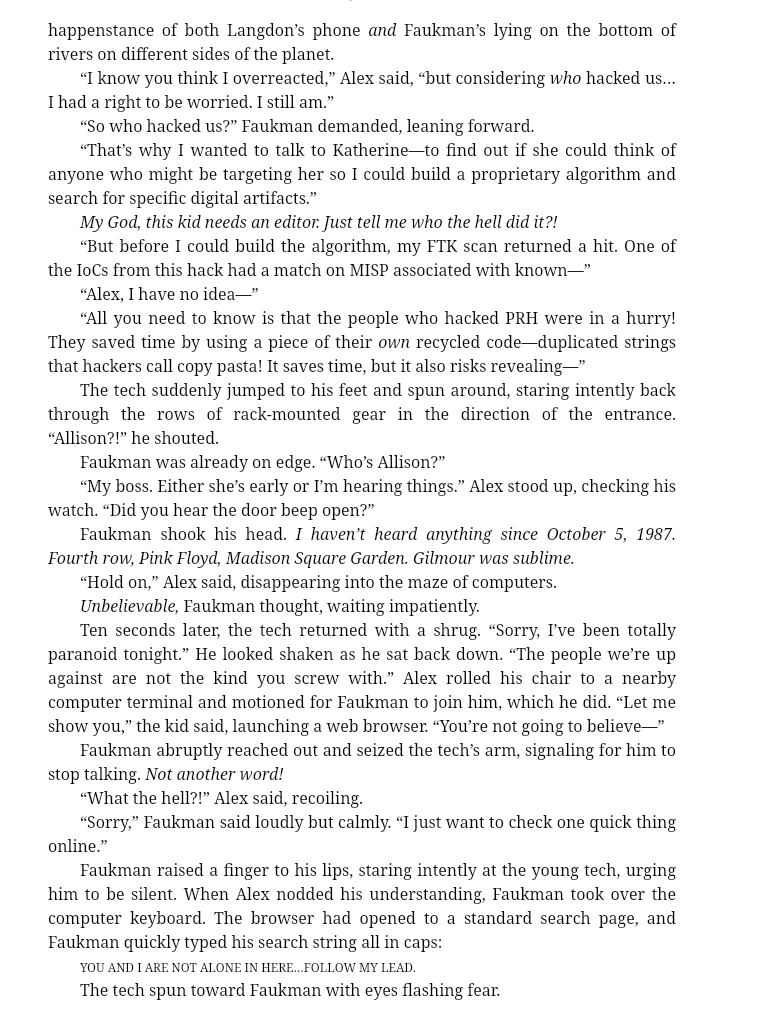

 @mgorny@social.treehouse.systems
2026-01-02 04:23:29
Yeah, why not neglect all the good recommendations in the #Python ecosystem, and instead fork your own C extension package, force people to build it with #ZigLang (it's still C), add unconditional dependency on that, and on top of that, refuse to publish wheels, "allowing for optimised compilation according to your machine's specific architecture and capabilities, instead of some (low performance) common denominator."
Fortunately, looks like #Gentoo can just ignore all the fancy crap and compile it with GCC.
https://pypi.org/project/ruamel.yaml.clibz/
[UPDATE: didn't last long: https://sourceforge.net/p/ruamel-yaml/code/ci/6846cf136e775ed0052cdef6ff02330269c86011/]
@hex@kolektiva.social2025-11-21 18:54:12
Any sufficiently advanced disaster preparedness is indistinguishable from revolutionary dual power. This essay is a bit of a transition between the theory I've written earlier, and more concrete plans.
Even though I only touched on my life on the commune, it was hard not to write more. These are such weird spaces, with so much invisible opportunity. But they're also just so unique and special. For all the stress and uncertainty of making sure you stayed on Lorean's (the head priestess), there were also those long summer nights with the whole community (except the old lady) gathered around a fire, talking and drinking. There was almost a child-like play to the whole time.
There were so Fridays I'd come home with a couple of gallons of beer from the real world, folks would bring things from the garden, someone would grill a steak, everyone who didn't cook would clean up, and we'd just hang out and have fun. So many evenings I'd go over to Miles place with a guitar, or with his guitar, and we'd pass it around over a few beers, talking about philosophy, Star Wars, or some book or other. It's hard not to write about the strange magic of that space.
My partner and I bonded over similar experiences, mine on a weird little religious commune in California and theirs as a temporary worker at Omega Institute. Both had exploitation, people on weird power trips, frustrating dynamics, but also a strange magic and freedom. Both were sort of fantasy worlds, but places that let us see through this one, let us imagine something that something else is possible behind the veil.
There are many such veils.
Perhaps it's fitting that this is more meandering, as a good wander can help the transition between lots of hard thinking and lots of hard working.
https://anarchoccultism.org/building-zion/evaluating-options
Editing feedback (especially typos, spelling, grammar) is always welcome, as are questions and even wider structural advice. I've been adding the handles of folks who provide feedback to the intro in a "thank you" section. If you do help and wouldn't like to be added, please let me know.
 @robpike@hachyderm.io
2025-10-21 21:34:19
Just posted this reply on Reddit because it saddens me to think that someone might not understand the beauty of the Fourier transform:
https://old.reddit.com/r/golang/comments/1obz3sz/gofft_a_pretty_performant_fastfourier_transform/nko8lot/
Another way I like to think of it: A lens does it in 2D, converting an incoming light beam into an image, or an image into a light beam. Plane wave <-> delta function.