 @relcfp@mastodon.social
2026-02-10 16:28:34
Opening Sequences: The Narrative Architecture of TV Titles https://call-for-papers.sas.upenn.edu/cfp/2026/02/09/opening-sequences-the-narrative-architecture-of-tv-titles
@relcfp@mastodon.socialOpening Sequences: The Narrative Architecture of TV Titles https://call-for-papers.sas.upenn.edu/cfp/2026/02/09/opening-sequences-the-narrative-architecture-of-tv-titles
 @jamesthebard@social.linux.pizza
This one took a smidge more thought as I can't abuse `zip` to rotate 2D sequences. However, just rewrote the rotation as a proc and used that. Instead of `reduce`, it was all `foldl`, and I fought with `char` vs `string` due to some of the processing operations between the normal and cephalopod problem processing.
Overall, definitely a fun solve.
Solution:
 @Sustainable2050@mastodon.energy
A century of glaciers melting, condensed into a few seconds. Impressive video: https://www.instagram.com/reel/DQWfDRejcPw/?igsh=Zm51d2Qzb2xtNHM4
@relcfp@mastodon.socialOpening Sequences: The Narrative Architecture of TV Titles
https://ift.tt/VZcfqQX
updated: Monday, February 9, 2026 - 2:10pmfull name / name of organization: José Duarte (ULICES,…
via Input 4 RELCFP
 @arXiv_csGR_bot@mastoxiv.page
Learning to Build Shapes by Extrusion
Thor Vestergaard Christiansen, Karran Pandey, Alba Reinders, Karan Singh, Morten Rieger Hannemose, J. Andreas B{\ae}rentzen
https://arxiv.org/abs/2601.22858 https://arxiv.org/pdf/2601.22858 https://arxiv.org/html/2601.22858
arXiv:2601.22858v1 Announce Type: new
Abstract: We introduce Text Encoded Extrusion (TEE), a text-based representation that expresses mesh construction as sequences of face extrusions rather than polygon lists, and a method for generating 3D meshes from TEE using a large language model (LLM). By learning extrusion sequences that assemble a mesh, similar to the way artists create meshes, our approach naturally supports arbitrary output face counts and produces manifold meshes by design, in contrast to recent transformer-based models. The learnt extrusion sequences can also be applied to existing meshes - enabling editing in addition to generation. To train our model, we decompose a library of quadrilateral meshes with non-self-intersecting face loops into constituent loops, which can be viewed as their building blocks, and finetune an LLM on the steps for reassembling the meshes by performing a sequence of extrusions. We demonstrate that our representation enables reconstruction, novel shape synthesis, and the addition of new features to existing meshes.
toXiv_bot_toot
 @jby@ecoevo.social
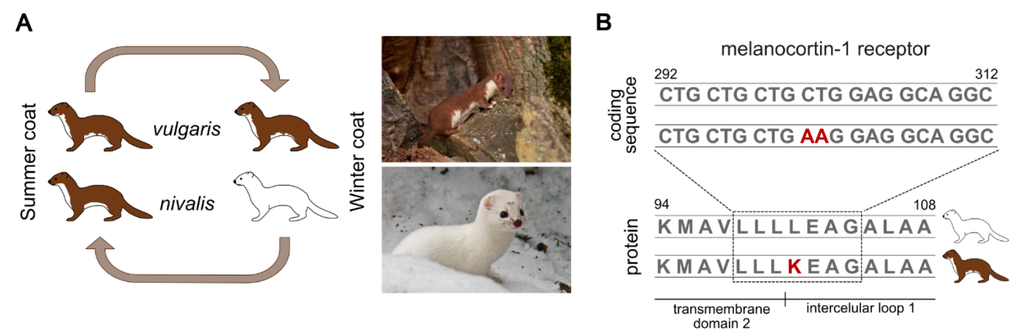
These weasels have locally adapted their winter coats to varying snow cover thanks to a million-year-old mutation
#naturalist
 @veit@mastodon.social
I took a look at the changes coming with Python 3.15 – and I can’t wait to put them to productive use. I’ve already updated our tutorials:
• utf-8 as the default encoding: https://python-basics-tutorial.readthedocs.io/en/latest/types/stri…
 @arXiv_mathOC_bot@mastoxiv.page
Convergence analysis of inexact MBA method for constrained upper-$\mathcal{C}^2$ optimization problems
Ruyu Liu, Shaohua Pan
https://arxiv.org/abs/2511.09940 https://arxiv.org/pdf/2511.09940 https://arxiv.org/html/2511.09940
arXiv:2511.09940v1 Announce Type: new
Abstract: This paper concerns a class of constrained optimization problems in which, the objective and constraint functions are both upper-$\mathcal{C}^2$. For such nonconvex and nonsmooth optimization problems, we develop an inexact moving balls approximation (MBA) method by a workable inexactness criterion for the solving of subproblems. By leveraging a global error bound for the strongly convex program associated with parametric optimization problems, we establish the full convergence of the iterate sequence under the partial bounded multiplier property (BMP) and the Kurdyka-{\L}ojasiewicz (KL) property of the constructed potential function, and achieve the local convergence rate of the iterate and objective value sequences if the potential function satisfies the KL property of exponent $q\in[1/2,1)$. A verifiable condition is also provided to check whether the potential function satisfies the KL property of exponent $q\in[1/2,1)$ at the given critical point. To the best of our knowledge, this is the first implementable inexact MBA method with a full convergence certificate for the constrained nonconvex and nonsmooth optimization problem.
toXiv_bot_toot
 @inthehands@hachyderm.io
Dang it, PostgreSQL is so good.
I did a data export thing. The options I needed were there. Then I needed more options, and then they were also there. They worked the way I guessed. It was fast. It was reliable. Then I thought “oh, what about sequences?!?”, but they already had that covered. My seemingly easy task turned out to be…easy.
@arXiv_csGR_bot@mastoxiv.pageScreen, Match, and Cache: A Training-Free Causality-Consistent Reference Frame Framework for Human Animation
Jianan Wang, Nailei Hei, Li He, Huanzhen Wang, Aoxing Li, Haofen Wang, Yan Wang, Wenqiang Zhang
https://arxiv.org/abs/2601.22160 https://arxiv.org/pdf/2601.22160 https://arxiv.org/html/2601.22160
arXiv:2601.22160v1 Announce Type: new
Abstract: Human animation aims to generate temporally coherent and visually consistent videos over long sequences, yet modeling long-range dependencies while preserving frame quality remains challenging. Inspired by the human ability to leverage past observations for interpreting ongoing actions, we propose FrameCache, a training-free three-stage framework consisting of Screen, Cache, and Match. In the Screen stage, a multi-dimensional, quality-aware mechanism with adaptive thresholds dynamically selects informative frames; the Cache stage maintains a reference pool using a dynamic replacement-hit strategy, preserving both diversity and relevance; and the Match stage extracts behavioral features to perform motion-consistent reference matching for coherent animation guidance. Extensive experiments on standard benchmarks demonstrate that FrameCache consistently improves temporal coherence and visual stability while integrating seamlessly with diverse baselines. Despite these encouraging results, further analysis reveals that its effectiveness depends on baseline temporal reasoning and real-synthetic consistency, motivating future work on compatibility conditions and adaptive cache mechanisms. Code will be made publicly available.
toXiv_bot_toot
 @raiders@darktundra.xyz
Raiders report: Pete Carroll defiant when asked if team has quit on him https://www.reviewjournal.com/sports/raiders/raiders-report-pete-carroll-defiant-when-asked-if-team-has-quit-on-him-3595605/
@arXiv_mathOC_bot@mastoxiv.pageVerification of Sequential Convex Programming for Parametric Non-convex Optimization
Rajiv Sambharya, Nikolai Matni, George Pappas
https://arxiv.org/abs/2511.10622 https://arxiv.org/pdf/2511.10622 https://arxiv.org/html/2511.10622
arXiv:2511.10622v1 Announce Type: new
Abstract: We introduce a verification framework to exactly verify the worst-case performance of sequential convex programming (SCP) algorithms for parametric non-convex optimization. The verification problem is formulated as an optimization problem that maximizes a performance metric (e.g., the suboptimality after a given number of iterations) over parameters constrained to be in a parameter set and iterate sequences consistent with the SCP update rules. Our framework is general, extending the notion of SCP to include both conventional variants such as trust-region, convex-concave, and prox-linear methods, and algorithms that combine convex subproblems with rounding steps, as in relaxing and rounding schemes. Unlike existing analyses that may only provide local guarantees under limited conditions, our framework delivers global worst-case guarantees--quantifying how well an SCP algorithm performs across all problem instances in the specified family. Applications in control, signal processing, and operations research demonstrate that our framework provides, for the first time, global worst-case guarantees for SCP algorithms in the parametric setting.
toXiv_bot_toot
 @buercher@tooting.ch
To do: the representative image of an image sequence is the image where it’s pixel vector has the biggest cosine similarity to the average pixel vector of all images of the sequences. O(n)