 @Techmeme@techhub.social
2026-10-08 00:05:58
Letter: three fired OpenAI researchers urge AI labs to halt work that could impair AI monitoring and say their firings are "chilling those who remain at OpenAI" (Maxwell Zeff/Wall Street Journal)
https://www.
 @aral@mastodon.ar.al
2026-09-21 13:22:29
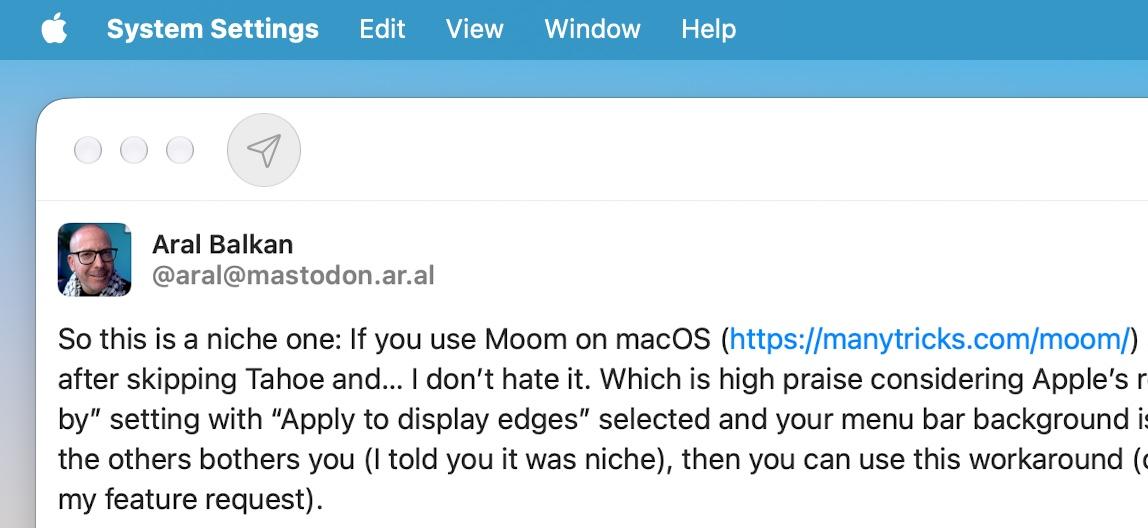
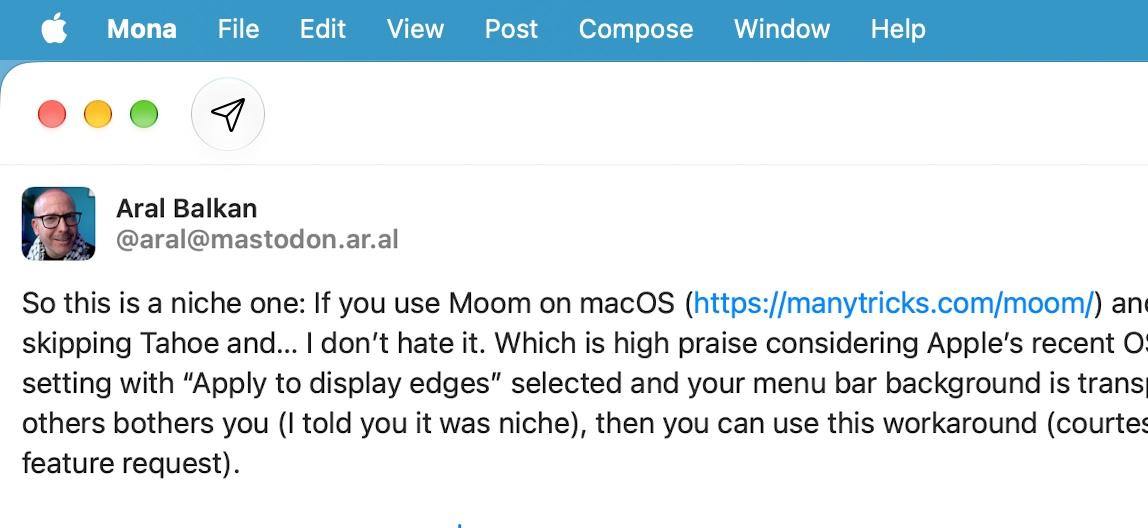
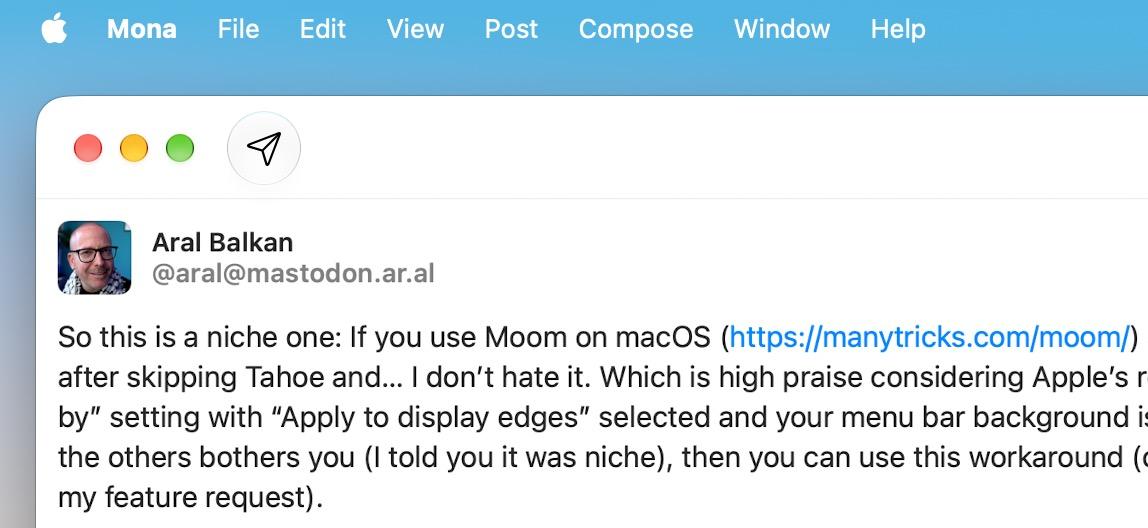
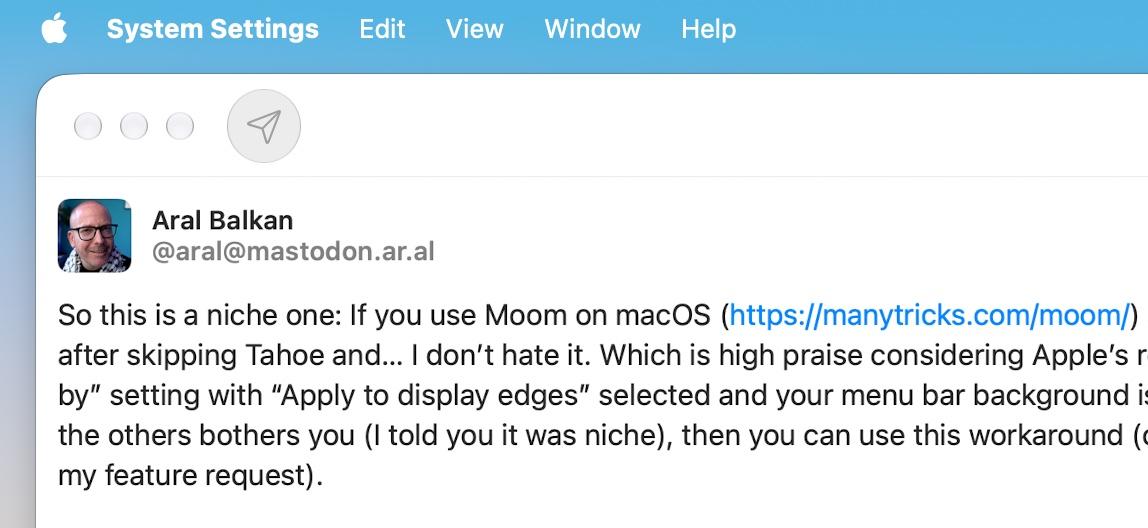
So this is a niche one: If you use Moom on macOS (https://manytricks.com/moom/) and you’re on Golden Gate (yeah, I finally upgraded after skipping Tahoe and… I don’t hate it. Which is high praise considering Apple’s recent OS blunders) and you use the “Separate windows by” setting with “Apply to display edges” se…
 @elduvelle@neuromatch.social
2026-10-01 14:10:32
#Windows11update24h2 question:
Has anyone applied this update and did you manage to toggle off or remove all the genAI stuff in it? Any specific things that worked?
I have to use #Win11 for work and am wondering if I should delay this update for as long as possible or if I …

 @kubikpixel@chaos.social
2026-07-26 05:50:04
NASA: Providing Active Fire Data for Near-Real Time Monitoring and Applications
The Fire Information for Resource Management System (FIRMS) distributes Near Real-Time (NRT) active fire data from the Moderate Resolution Imaging Spectroradiometer (MODIS) aboard the Aqua and Terra satellites, and the Visible Infrared Imaging Radiometer Suite (VIIRS) aboard S-NPP, NOAA 20 and NOAA 21 (formally known as JPSS-1 and JPSS-2).
🔥

 @totientfunction@mathstodon.xyz
2026-07-26 12:16:46




 @hikingdude@mastodon.social
2026-07-24 19:13:34
'Farbe: Blau (kein Himmel)' #FotoVorschlag
Color blue (no sky)
Wow thanks to #immich search, I found a photo that I didn't know I took.. A lot of years ago.
#FlowersOfMastodon

 @holger_moller@bildung.social
2026-07-22 07:06:46
"Es ist #Wirtschaftsliberalismus pur. #Deregulierung für eine reiche Minderheit, mehr Bürokratie und Kontrolle für die große Mehrheit. Dass hier mit zweierlei Maß gemessen wird, empört viele Menschen und treibt sie der AfD in die Arme. Mit sozialer Gerechtigkeit, die nötig w…
 @arXiv_csPL_bot@mastoxiv.page
2026-07-21 07:45:34
ETAS: An Effect-Typed Language for Agent Systems
Huiri Tan, Yikun Wang, Puyang Zhang, Shangyu Li, Jiasi Shen
https://arxiv.org/abs/2607.17780 https://arxiv.org/pdf/2607.17780 https://arxiv.org/html/2607.17780
arXiv:2607.17780v1 Announce Type: new
Abstract: ETAS is a programming language for agent systems that treats model-backed agents, tool calls, prompts, typed memory, human approvals, policies, and execution traces as semantic program elements rather than library conventions. It separates deterministic computation from agentic nondeterminism and externally visible actions while preserving a direct programming style.
We present the core design of ETAS. Its static semantics assigns ordinary types through spec conformance and tracks each computation with two behavioral indices: an escaping effect row and a persistent abstraction of the typed action trace it may request. Specs form a terminating compile-time constraint calculus: type specs provide evidence for polymorphism and resource facts, callable specs constrain function and stage shapes, and trace specs express allow, deny, and temporal constraints. Typing checks requested traces against compiled monitors and emits residual obligations when dynamic resources preclude a complete static proof. The dynamic semantics distinguish requested, handled, denied, and committed events; handlers interpret typed actions without making their requests invisible to authorization or audit.
We formalize a core calculus and state preservation, progress, type/effect soundness, handler trace-transparency, and policy safety. We also implement ETAS in Rust with a command-line interface, typed HIR checks, effect and policy diagnostics, handler checks, and trace-aware execution hooks. ETAS provides a programming-language foundation for reasoning about authorization, nondeterminism, recovery, and audit evidence before and during agent execution.
toXiv_bot_toot