Tootfinder

Opt-in global Mastodon full text search. Join the index!

No exact results. Similar results found.
@elduvelle@neuromatch.social
2026-06-22 15:46:43

Pour ceux qui ont accès...
"La recherche française déstabilisée par une crise multiforme"
lemonde.fr/sciences/article/20

@45names@mastodon.social
2026-06-22 02:20:03

Collusion Contusion
bot by @…
No laws were broken in the making of this bot: don't make me go to gulag.
#satire #potus45

@arXiv_physicsaoph_bot@mastoxiv.page
2026-05-22 07:54:20

From Licensing to Open Access: Designing a Sustainable Transition in Operational Weather Data
Emma Pidduck, Umberto Modigliani, Victoria L. Bennett, Fabio Venuti, Florian Pappenberger, Florence Rabier
arxiv.org/abs/2605.21673 arxiv.org/pdf/2605.21673 arxiv.org/html/2605.21673
arXiv:2605.21673v1 Announce Type: new
Abstract: This translational article documents the European Centre for Medium-Range Weather Forecasts (ECMWF) transition from a restricted data licensing model to open access under CC BY 4.0, completed in October 2025. The policy context included EU open data requirements and alignment with international data exchange frameworks. The transition was implemented through a tiered service model that kept core forecast data open while offering operationally supported delivery as a cost-recovered service. Between 2020 and 2025, ECMWF executed an iterative planning cycle: setting an annual target for revenue reduction, specifying additions to the open tier under that target, provisioning infrastructure, and assessing outcomes to update assumptions. Drawing on internal administrative records (2014 - 2025), we describe design choices, operational constraints, and early outcomes. In the six months following the end of the transition, more than 93% of previously paying organisations retained a Service Agreement, while open endpoint download volumes increased substantially. We discuss trade-offs in defining the open tier (resolution, parameters, schedule), the reduction of compliance overheads formerly associated with redistribution restrictions, and the scalability implications of global distribution. We note an emerging sustainability question as AI-based forecast products become freely available. The early evidence is consistent with the view that a tiered service model can be designed to reconcile open-access obligations with operational sustainability, subject to monitoring over longer contract renewal cycles (typically annual).
toXiv_bot_toot

@lpryszcz@genomic.social
2026-07-21 16:02:37

"Several of my peers now “AI-wash” their work, meaning that even when they can perfectly competently execute on their jobs to the satisfaction of their management teams, said managers are unhappy if the engineers haven’t used AI in the work… so now they’re lying about using LLMs even in contexts where their professional judgement is that they aren’t the appropriate tool. They just do the work, the same way they have for decades, and say Claude did it. "

@thomasfuchs@hachyderm.io
2026-05-20 16:15:08

RE: hachyderm.io/@thomasfuchs/1166
I really want social media to save the context of when you block someone so that you can later know what the asshole did when you’re no longer sure when you blocked them.
E.g. “you blocked this account on this specific reply”
Ideally let me add a private note.

@penguin42@mastodon.org.uk
2026-07-21 14:11:03

Damn; I went to debug why Model B wouldn't write to floppies and...it worked. Yesterday when I got a scope on the write-data line on the drive end it didn't budge at all. By the time I'd got the beeb open today, moved the keyboard and stuffed a scope probe on the gate between the 8271 and the drive it all got nice friendly data there. Hmm.
Took the IC80 out, gave the legs a rub and a bit of contact cleaner, and hmm ok.

@UP8@mastodon.social
2026-07-20 21:36:28

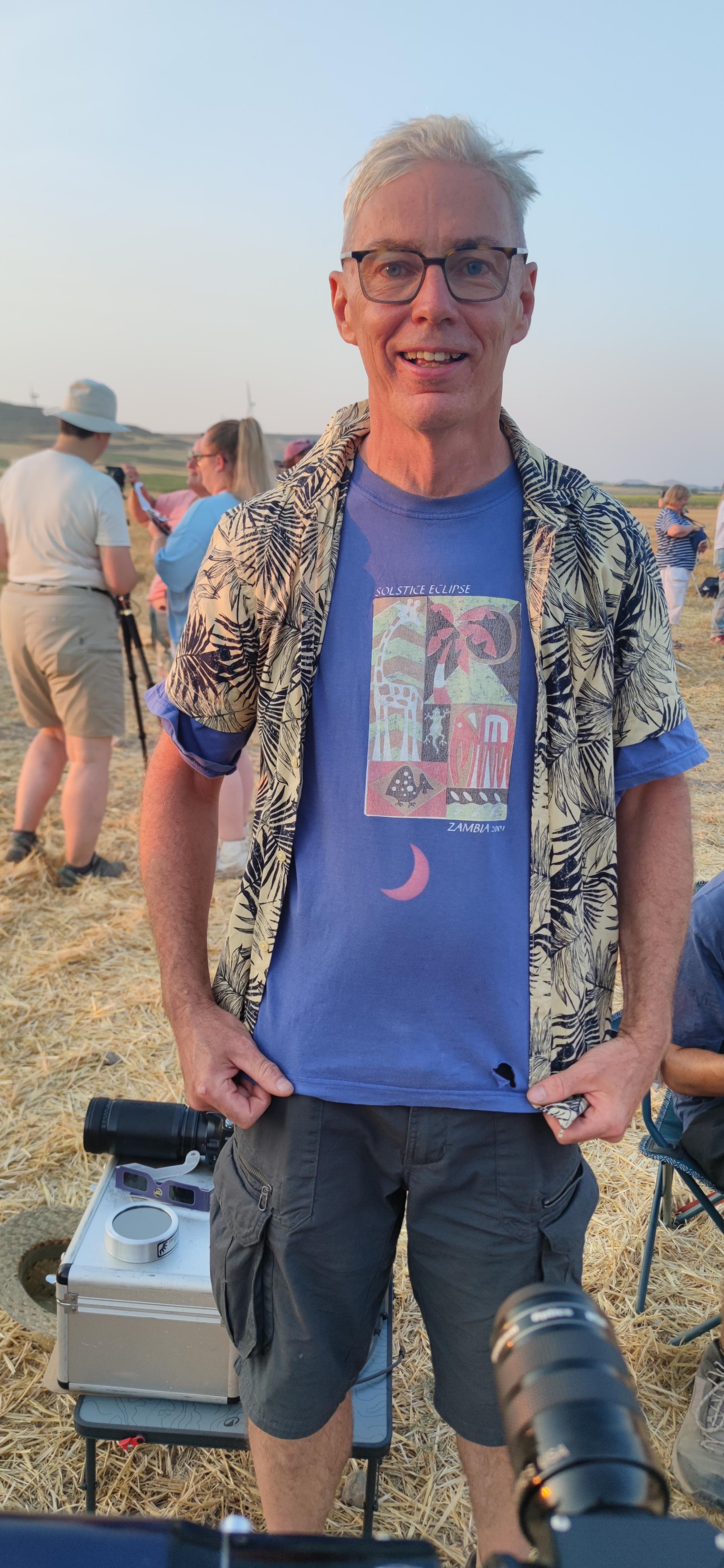
Billy Golicki of Iconic Rock i100 and Billy and the Therapists gets up close and personal at Dio Day
#photo #photography #billy

Man with white hair holding microphone makes eye contact at close range and fills most of the frame

The Pentagon has not formally briefed the press on the war since May,
reversing a series of triumphalist press conferences that Hegseth conducted earlier in the conflict.
Details of hidden American injuries come after a weekend of intense fighting between the U.S. and Iran.
The U.S. conducted strikes after an American service member was killed in Iraq during the “controlled detonation” of an Iranian drone, according to the Pentagon.

@matematico314@social.linux.pizza
2026-07-22 21:24:51

Agora vou fazer contas de dinheiro. Se eu não aparecer mais aqui hoje, provavelmente é porque os números foram tão ruins que passei o resto da noite chorando na minha cama em posição fetal rs.

@arXiv_astrophGA_bot@mastoxiv.page
2026-07-22 08:02:08

The Next Generation Virgo Cluster Survey (NGVS). II. A Catalog of Galaxies in the Virgo Cluster
Laura Ferrarese, Patrick Cote, Lauren A. MacArthur, Joel C. Roediger, John P. Blakeslee, Michele Cantiello, Jean-Charles Cuillandre, Puragra Guhathakurta, Stephen Gwyn, Max M. Kurzner, Eric W. Peng, Matthew Santos, Eleanore B. Todd, Elisa Toloba, Pierre-Alain Duc, Patrick R. Durrell, Nicholas Fantin, Yuting Feng, Ariane Lancon, Sungsoon Lim, Chengze Liu, Deborah Lokhorst, Alessia Longobardi, Simona Mei, J. Christopher Mihos, Sanjaya Paudel, Thomas H. Puzia, Anand Raichoor, Ruben Sanchez-Janssen, Kaixiang Wang, Hongxin Zhang, Alessandro Boselli, Michael L. Balogh, Samuel Boissier, Eric Emsellem, J. J. Kavelaars, Alan W. McConnachie, Cameron R. Morgan, Chelsea Spengler, James E. Taylor, Matthew A. Taylor, Toby Brown, Sebastien Fabbro, Raphael Gavazzi, Hendrik Hildebrandt, Rashi Jain, Andres Jordan, Rory Smith, Solveig Thompson, Haruka Yoshino, Wim van Driel, Ludovic van Waerbeke, Tyrone E. Woods, Jade Yeung
arxiv.org/abs/2607.18414 arxiv.org/pdf/2607.18414 arxiv.org/html/2607.18414
arXiv:2607.18414v1 Announce Type: new
Abstract: The Next Generation Virgo Cluster Survey (NGVS) is a deep, high resolution imaging campaign that used the 1 deg$^2$ MegaCam instrument on the Canada-France-Hawaii Telescope to carry out a comprehensive optical survey of the Virgo cluster, from its core to its virial radius. The NGVS covers a contiguous area of 104 deg$^2$ (8.63 Mpc$^2$ at the 16.5 Mpc distance of Virgo) in the $u^*$-,$g$-,$i$-, and $z$-band, with additional limited coverage in $r$. In this paper, we present the final catalog of Virgo galaxies across the entire NGVS area. The catalog includes 3680 galaxies considered to be $bona~fide$ members of the cluster, spanning a factor of 2.5 million in luminosity, from $g = 8.42$ mag to $g = 24.41$ mag ($M_g = -22.67$ mag to $M_g = -6.68$ mag). With 2100 previously uncataloged galaxies, the NGVS catalog augments the number of known Virgo members by a factor 2.3. The catalog is complete down to $g = 18.6$ mag ($M_g=-12.5$ mag, corresponding to a stellar mass $M_* \sim 1.6\times10^7~M_{\odot}$ for an old stellar population) and 50% complete at $g = 22.0$ mag ($M_g=-9.1$ mag, $M_* \sim 6.2\times10^5~M_{\odot}$), three magnitudes deeper than the venerable Virgo Cluster Catalog (VCC), which for over 40 years has served as the reference standard for Virgo. Photometric and structural parameters are derived for all NGVS galaxies and presented in a series of tables, alongside nuclear and morphological classification, as well as stellar masses and, when available, radial velocities.
toXiv_bot_toot