 @hex@kolektiva.social
2025-11-17 06:11:16
I think we can actually prove that this constraint is the *only* constraint that can preserve freedom:
1. There will exist actors in a system who will wish to take advantage of others. Evolution drives survival and one strategy for increasing survival in an altruistic society is to become a parasite.
2. Expecting exploitative dynamics, a system needs to have a set of rules to manage exploitation.
3. If the set of rules is static it will lack the requisite variety necessary to manage the infinite possible behavior of humans so the system will fail.
4. If the system is dynamic then it must have a rule set about how it's own rules are updated. This would make the system recursive, which makes the system at least as complex as mathematics. Any system at least as complex as mathematics is necessarily either incomplete or inconsistent (Gödel's incompleteness theorem). If the system is incomplete, then constraints can be evaded which then allow a malicious agent to seize control of the system and update the rules for their own benefit. If constraints are incomplete, then a malicious agent can take advantage of others within the system.
5. Therefore, no social system can possibly protect freedom unless there exists a single metasystemic constraint (that the system must be optional) allowing for the system to be abandoned when compromised.
Oh, you might say, but this just means you have to infinitely abandon systems. Sure, but there's an evolutionary advantage to cooperation so there's evolutionary pressure to *not* be a malicious actor. So a malicious actor being able to compromise the whole system is likely to be a much more rare event. Compromising a system is a lot of work, so the first thing a malicious actor would want to do is preserve that work. They would want to lock you in. The most important objective to a malicious actor compromising a system would be to violate that metasystemic constraint, or all of their work goes out the window when everyone leaves.
And now you understand why borders exist, why fascists are obsessed with maintaining categories like gender, race, ethnicity, etc. This is why even Democrats like Newsom are on board with putting houseless people in concentration camps. And this is why the most important thing anarchists promote is the ability to choose not to be part of any of that.
 @midtsveen@social.linux.pizza
2025-11-10 20:33:02
Anarcho-syndicalist. non-binary person. they/them, also bisexual.
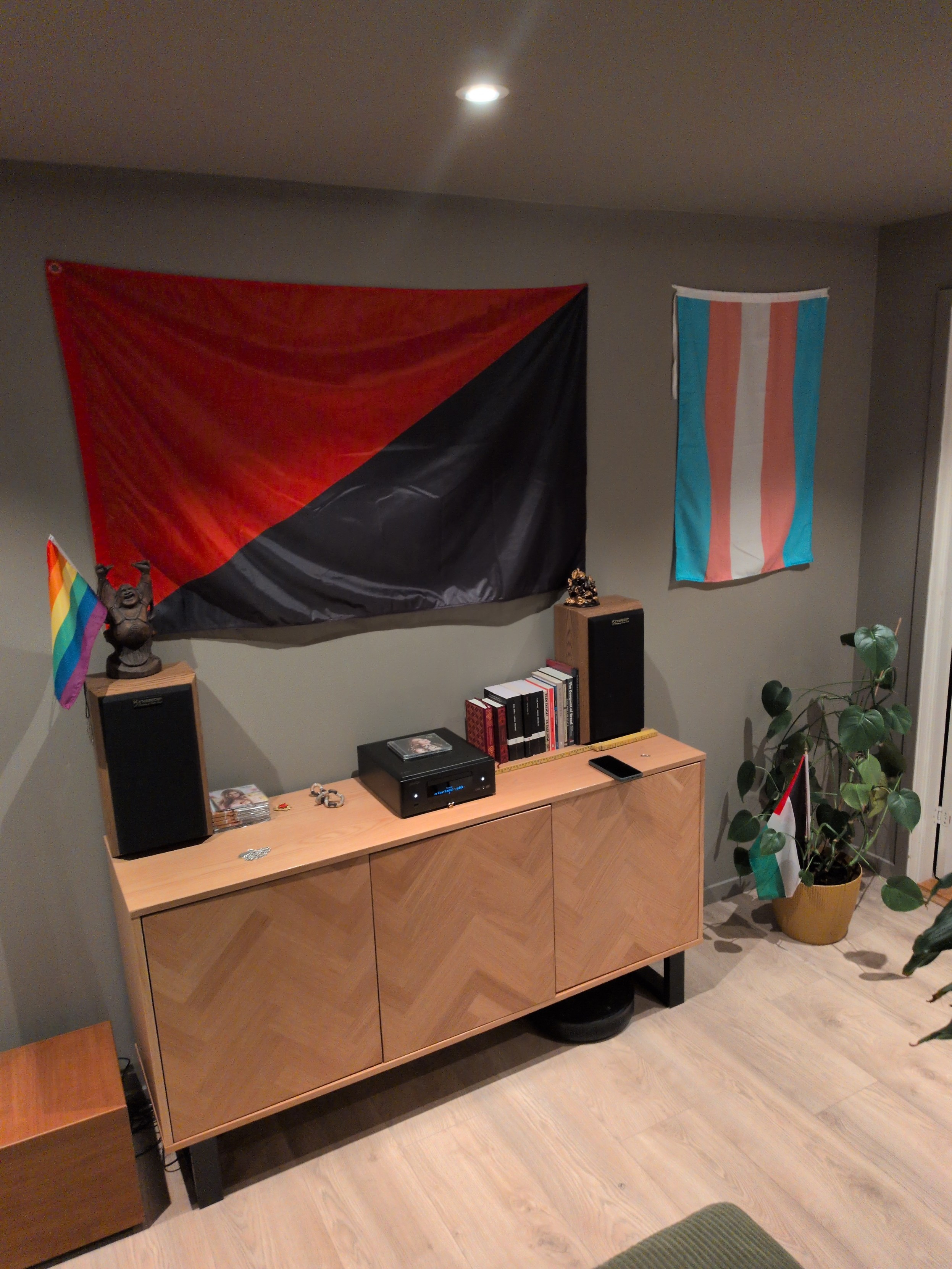
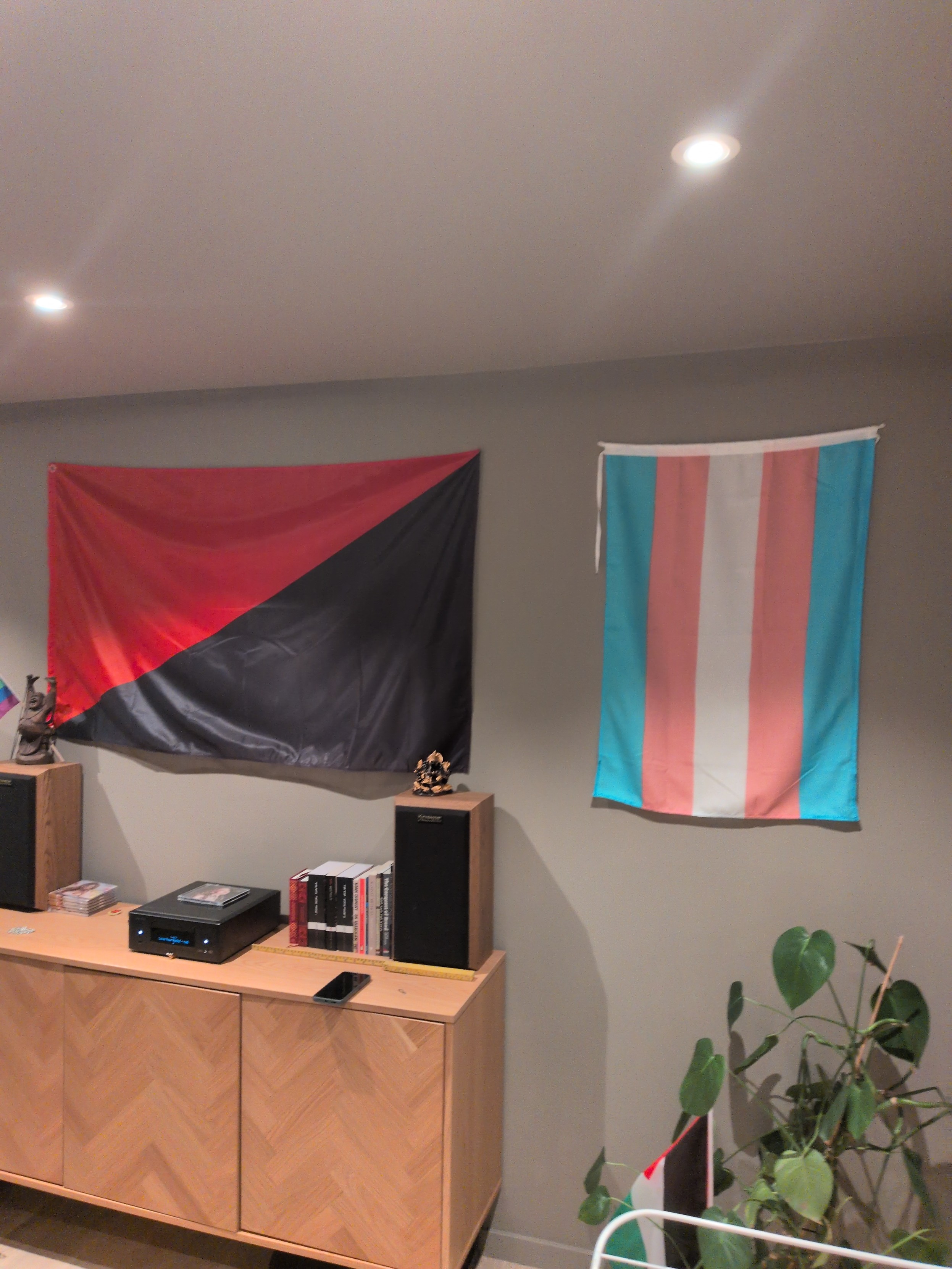
I took down one of my Moomin posters and hung up my two favorite flags in my living room instead. It feels good making my own place look like me.
I know my mom doesn’t like it, but this is my apartment and I’m not going to hide who I am just to make someone else comfortable.
:bisexual_pride: 🏳️⚧️ :genderfluid_flag: :nonbinary_flag: :heart_trans: 🏳️🌈
 @leftsidestory@mstdn.social
2025-12-31 00:30:02
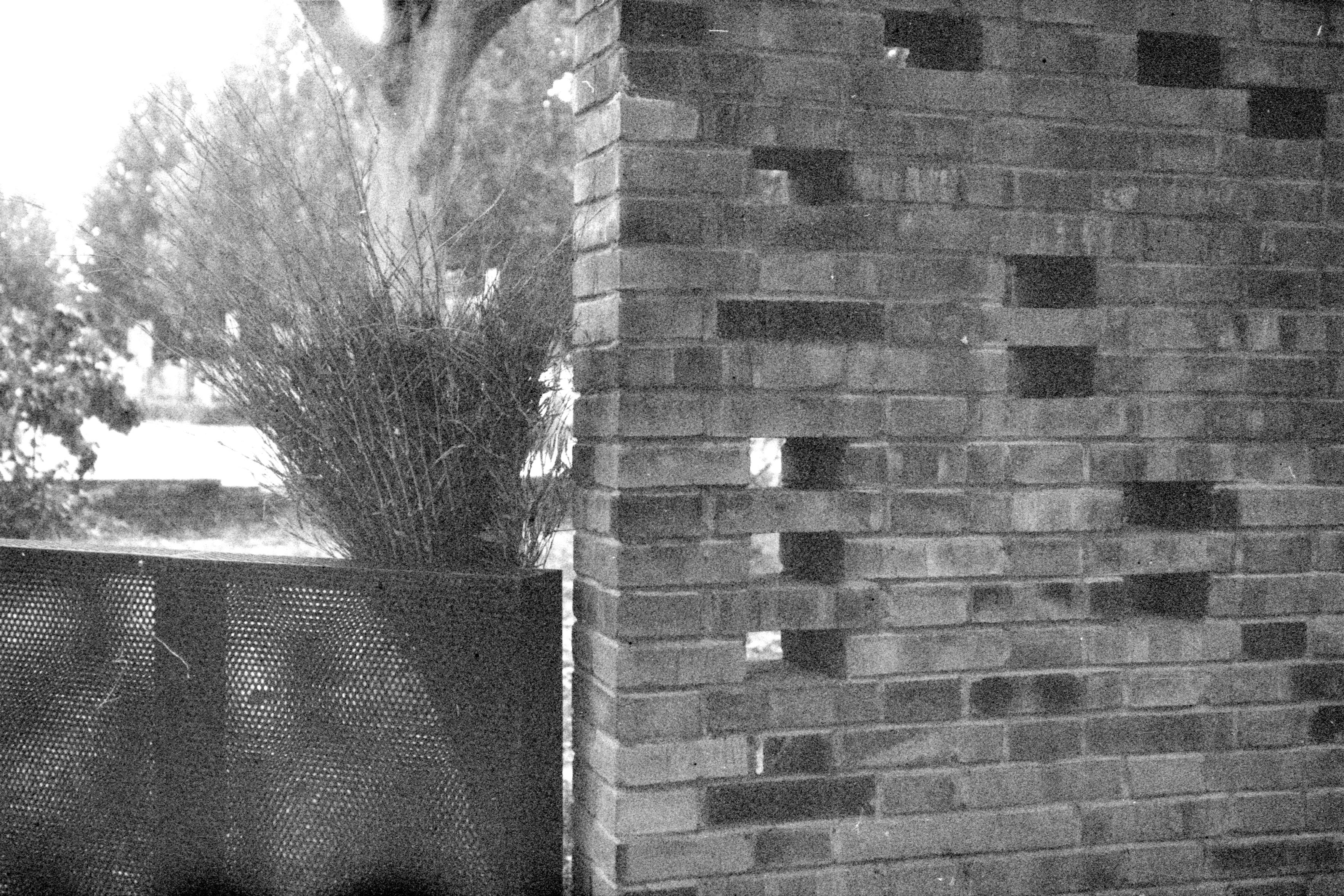
Monumental III 🪦
纪念 III 🪦
📷 Nikon F4E
🎞️ ERA 100, expired 1993
#filmphotography #Photography #blackandwhite


 @arXiv_physicsgenph_bot@mastoxiv.page
2025-11-12 08:45:59
Topological Structure of Infrared QCD
J. Gamboa
https://arxiv.org/abs/2511.07455 https://arxiv.org/pdf/2511.07455 https://arxiv.org/html/2511.07455
arXiv:2511.07455v1 Announce Type: new
Abstract: We investigate the infrared structure of QCD within the adiabatic approximation, where soft gluon configurations evolve slowly compared to the fermionic modes. In this formulation, the functional space of gauge connections replaces spacetime as the natural arena for the theory, and the long-distance behavior is encoded in quantized Berry phases associated with the infrared clouds. Our results suggest that the infrared sector of QCD exhibits features reminiscent of a \emph{topological phase}, similar to those encountered in condensed-matter systems, where topological protection replaces dynamical confinement at low energies. In this geometric framework, color-neutral composites such as quark--gluon and gluon--gluon clouds arise as topological bound states described by functional holonomies. Illustrative applications to hadronic excitations are discussed within this approach, including mesonic and baryonic examples. This perspective provides a unified picture of infrared dressing and topological quantization, establishing a natural bridge between non-Abelian gauge theory, adiabatic Berry phases, and the topology of the space of gauge configurations.
toXiv_bot_toot
 @arXiv_mathSG_bot@mastoxiv.page
2025-11-11 16:45:37
Replaced article(s) found for math.SG. https://arxiv.org/list/math.SG/new
[1/1]:
- Reduction of Cosymplectic groupoids by cosymplectic moment maps
Daniel L\'opez Garcia, Nicolas Martinez Alba
https://arxiv.org/abs/2403.03178 https://mastoxiv.page/@arXiv_mathSG_bot/112047445404247851
- Algebraic Lagrangian cobordisms, flux and the Lagrangian Ceresa cycle
Alexia Corradini
https://arxiv.org/abs/2501.12850 https://mastoxiv.page/@arXiv_mathSG_bot/113876409190220093
- Systolic $S^1$-index and characterization of non-smooth Zoll convex bodies
Stefan Matijevi\'c
https://arxiv.org/abs/2501.13856 https://mastoxiv.page/@arXiv_mathSG_bot/113882071591631203
- Infinite-dimensional Lagrange-Dirac systems with boundary energy flow I: Foundations
Fran\c{c}ois Gay-Balmaz, \'Alvaro Rodr\'iguez Abella, Hiroaki Yoshimura
https://arxiv.org/abs/2501.17551 https://mastoxiv.page/@arXiv_mathSG_bot/113916045279374601
- The Simplicity of the Group of Weakly Hamiltonian Diffeomorphisms on Cosymplectic Manifolds
S. Tchuiaga, P. Bikorimana
https://arxiv.org/abs/2503.10224 https://mastoxiv.page/@arXiv_mathSG_bot/114159599811622365
- Regular semisimple Hessenberg varieties with cohomology rings generated in degree two
Mikiya Masuda, Takashi Sato
https://arxiv.org/abs/2301.03762 https://mastoxiv.page/@arXiv_mathAG_bot/109669428824274443
- Billiards and Hofer's Geometry
Mark Berezovik, Konstantin Kliakhandler, Yaron Ostrover, Leonid Polterovich
https://arxiv.org/abs/2507.04767 https://mastoxiv.page/@arXiv_mathDS_bot/114817105311885626
- Geometric, topological and dynamical properties of conformally symplectic systems, normally hyper...
Marian Gidea, Rafael de la Llave, Tere M-Seara
https://arxiv.org/abs/2508.14794 https://mastoxiv.page/@arXiv_mathDS_bot/115065890424433224
toXiv_bot_toot