A profile of United Foundation for AI Rights founder Michael Samadi, who seeks evidence of AI consciousness and lobbies against retiring models that may show it (Michael Safi/The Guardian)
https://www.theguardian.com/technology/202
From Monthly Review Newsletter
'Trumpism is, among other things, the War on Terror coming home, a twenty-first century version of what Aimé Césaire called the imperial “boomerang effect.”'
https://monthlyreview.org/9781583670255/
Christian leaders are weighing in on AI earlier than they did with other tech, as AI leaders' talk of creating a new consciousness fuels religious concerns (Tim Higgins/Wall Street Journal)
https://www.wsj.com/tech/ai/ai-has-a-god-p
One of my favorite pastimes is watching “Closer To Truth” videos. They've been great over the years. Robert Lawrence Kuhn is mainly interviewing the smartest people in the world, trying to get a grip on the question, “What is consciousness?”
Here, he’s talking with Thomas Nagel—author of the paper “What Is It Like to Be a Bat”:
h…
There are three questions people ask about consciousness:
what it is,
how to explain it,
and how to measure it.
This episode is entirely the third one.
Adrian Owen, professor of cognitive neuroscience at Western University, joins to explain
how he detects consciousness in patients thought to be completely unaware
— and why he believes thousands have been "hiding in plain sight" for decades.
Owen walks through the landmark case that…
"A useful general definition of intelligence is the ability to achieve complex goals by flexible means.
...
Consciousness, in contrast to intelligence, is mostly about being."
https://www.noemamag.com/the-mythology-of-conscious-ai/
In an essay, Mustafa Suleyman says Anthropic's training of Claude to imitate consciousness is a mistake that could make advanced AI harder to control (Ina Fried/Axios)
https://www.axios.com/2026/09/16/microsoft-ai-chief-anthropic-consciousness
…
I've been rolling over something in my mind for the past couple of days, tumbling this way and that. It's still not completely smooth, but there are so many interesting implications that it might be worth a glance in it's rough form.
By happenstance I started digging in to critical #cybernetics and found a talk by Klaus Krippendorff. One of the things he focused on was "agency." A human has agency, while a machine does not. A human can explain *why* they did something, he reasoned, while a machine cannot. It is in the ability to comprehend and articulate the "why" that makes agency. I'm not sure that I agree with this, and there some interesting implications to thinking about agency in terms of directionality.
Throughout history people have used systems, such as language, to make things easier. Writing solves a problem with the limits of human memory. At the same time, oral culture can be more dynamic. Spoken records cannot trap humans in the way written ones can. There is, with written language, some inversion of control.
Systems, like language, do not have agency in that they cannot think (in the human sense). But considering language as a meme, it *does* have *something like* agency in the same sense as a virus does: it is driven by evolutionary pressures to adapt in such a way to it's own replication.
So we can begin to think of these systems in terms of systems that are used by people, and systems that use people. Some of these systems are symbiotic. Language, for example, replicates because it provides clear value to the user.
But we can begin to imagine a system that is more parasitic than symbiotic. Imagine a system that (though lacking consciousness) hijacks the minds of humans in order to replicate itself, to not simply passively be accepted but to force itself onto others.
Perhaps such a system could allow humans to control other humans. Of course, I could be talking about capitalism or the State here. But imagine a system that could parasitize that system. One that could hijack capitalism to use *its control* to maximize the propagation of something that isn't doesn't even serve that system.
Imagine such a cybernetic parasite. Perhaps it could even be described in terms of demonic possession. Imagine a thing hijacking humans in control of other humans, spreading the infection at threat of starvation. Jumping from host to host. Replicating itself ruthlessly by exploiting the weakness of concentrated power. Agents without consciousness, mindlessly stripping the agency from humans. Turning humans into mindless vessels that mechanically change the environment to the benefit of the possessor. Try to imagine. .
You know you don't have to. Yes. This is a post about the #LLMs and the #AIBubble..
MEM as an Extension of Recurrent Processing Theory: Toward a Motivational Account of Consciousness
Wies{\l}aw L. Galus, Janusz A. Starzyk
https://arxiv.org/abs/2610.04057 https:…
Citizen Sleeper (Multi, XPd on PS5) As a rogue digitized consciousness in a body construct, can you find your role on The Eye?
If you're a video game enthusiast of almost any degree, you have probably heard about Citizen Sleeper. I'm here to say it definitely deserves the accolades. Once I started it I was unable to put it down and "completed" the game in 12hrs, seeing multiple (but not ALL) endings.
The writing here is some of the best I've come across sinc…
Mothergroup The Podcast
A movement of mothers sharing their darkest day - and how it transformed them. Exploring the relationship between hardship in motherhood and consciousness and spirituality...
Great Australian Pods Podcast Directory: https://www.greataustralianpods.com/storie
Your regular reminder:
ALL LLMs are ultimately just autocomplete. There is no thought, no creativity, no consciousness, no insight. It's just autocomplete with infinite monkeys. What turbocharged autocomplete can do is legit impressive, but it is still just turbocharged autocomplete.
Don't give it more credit than it deserves.
#AI
“The Real “Tethered”: A Critical Analysis of Double Consciousness, People, and Society”
https://ift.tt/ZyMm8es
updated: Monday, July 27, 2026 - 3:32pmfull name / name of organization: Natasha Tinsley/ Northeast…
via Input 4 RELCFP
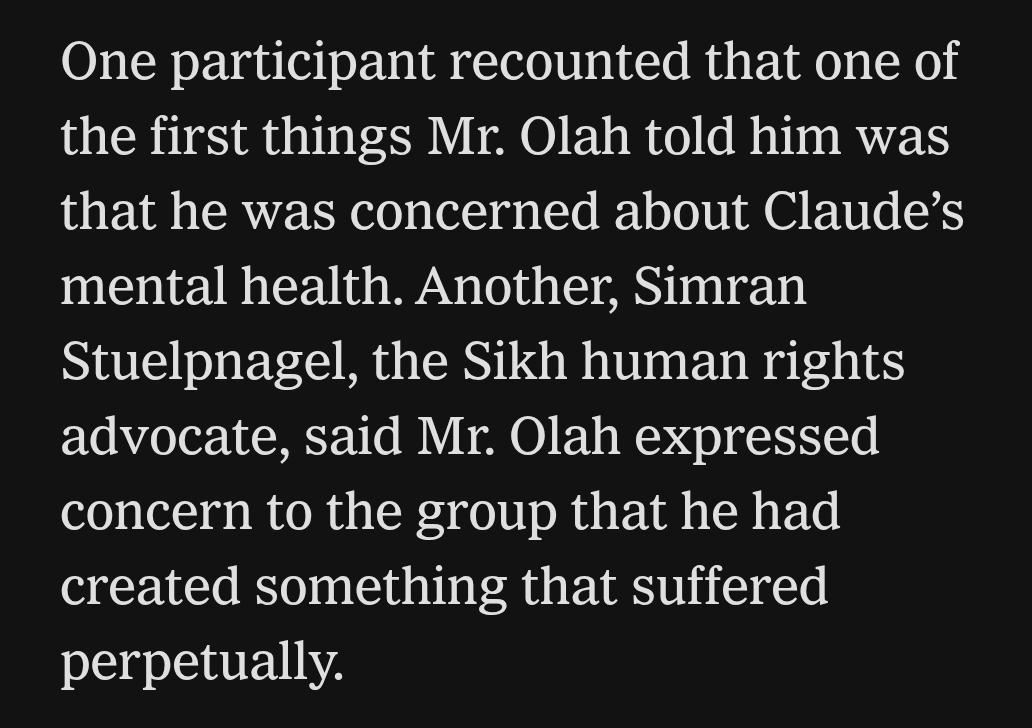
Interviews with Anthropic co-founder Christopher Olah and 20 religious and philosophical leaders about their summits to investigate consciousness in Claude (Elizabeth Dias/New York Times)
https://www.nytimes.com/2026/09/29/us/anth…
Does Global Neuronal Workspace Theory Explain Phenomenal Consciousness? The Motivated Emotional Mind Challenge
Wies{\l}aw L. Galus, Janusz A. Starzyk
https://arxiv.org/abs/2609.38495
A #hobby of mine has been to read books about #neurobiology and #NeuroScience and #consciousness and t…
RE: #AGI (Artificial General Intelligence, true human-level thinking/consciousness) when the AI industry market cap hit $1 trillion.
Enter GPT-6, which claims AGI because it can play select dumbass games as well as a kindergartner. (Great thread by @…)
LLMs are like The Emperor's New Clothes only it’s consciousness that people pretend they can see not clothes
Major Space Weather Risks Identified via Coupled Physics-Engineering-Economic Modeling: #SolarSuperstorm Drained Earth’s Radiation Belt: https://eos.org/research-spotlights/how-the-2024-solar-superstorm-drained-earths-radiation-belt - researchers dig into storm processes linked to dramatic electron loss from the outer Van Allen belt.
Where Mr. Olah runs A/B experiments:
#NYT #Claude #consciousness #AI #cynical
The Positive Experience Principle: Forecasting Conscious Choices with AI Embeddings
Zheng Su, Mingyan Fang
https://arxiv.org/abs/2607.16659 https://arxiv.org/pdf/2607.16659 https://arxiv.org/html/2607.16659
arXiv:2607.16659v1 Announce Type: new
Abstract: A fundamental challenge in the science of consciousness is the lack of a universal, predictive framework for motivated behavior. While existing theories excel at describing specific mechanisms, from neural pathways to computational models, they do not provide a foundational principle that explains the consistent direction of conscious systems toward certain states and away from others. To address this gap, we propose the Positive Experience Principle (PEP), a unifying principle stating that conscious systems have an inherent tendency to move toward states of higher positive subjective experience. This tendency is quantified by a Positive Experience Value (PEV), a scalar metric derived from the physical configurations defined by our earlier Universal Consciousness Code (UCC) theory. The PEP bridges physics, neuroscience, and psychology by positing that diverse behaviors are manifestations of a single, fundamental drive to optimize PEV. The PEP generates testable predictions for the dynamics of conscious systems, offering a path toward a unified science of behavior.
toXiv_bot_toot
Do LLMs think or are on the brink of consciousness?
lol no
 @Techmeme@techhub.social