I’m about to finally get my act together and move my little-used Google Workspace account elsewhere. Is there anyone who would recommend something other than Protonmail for mail? I have file storage covered and don’t need calendars. I want to use a custom domain and a way to use IMAP clients is just about a must. #askfedi
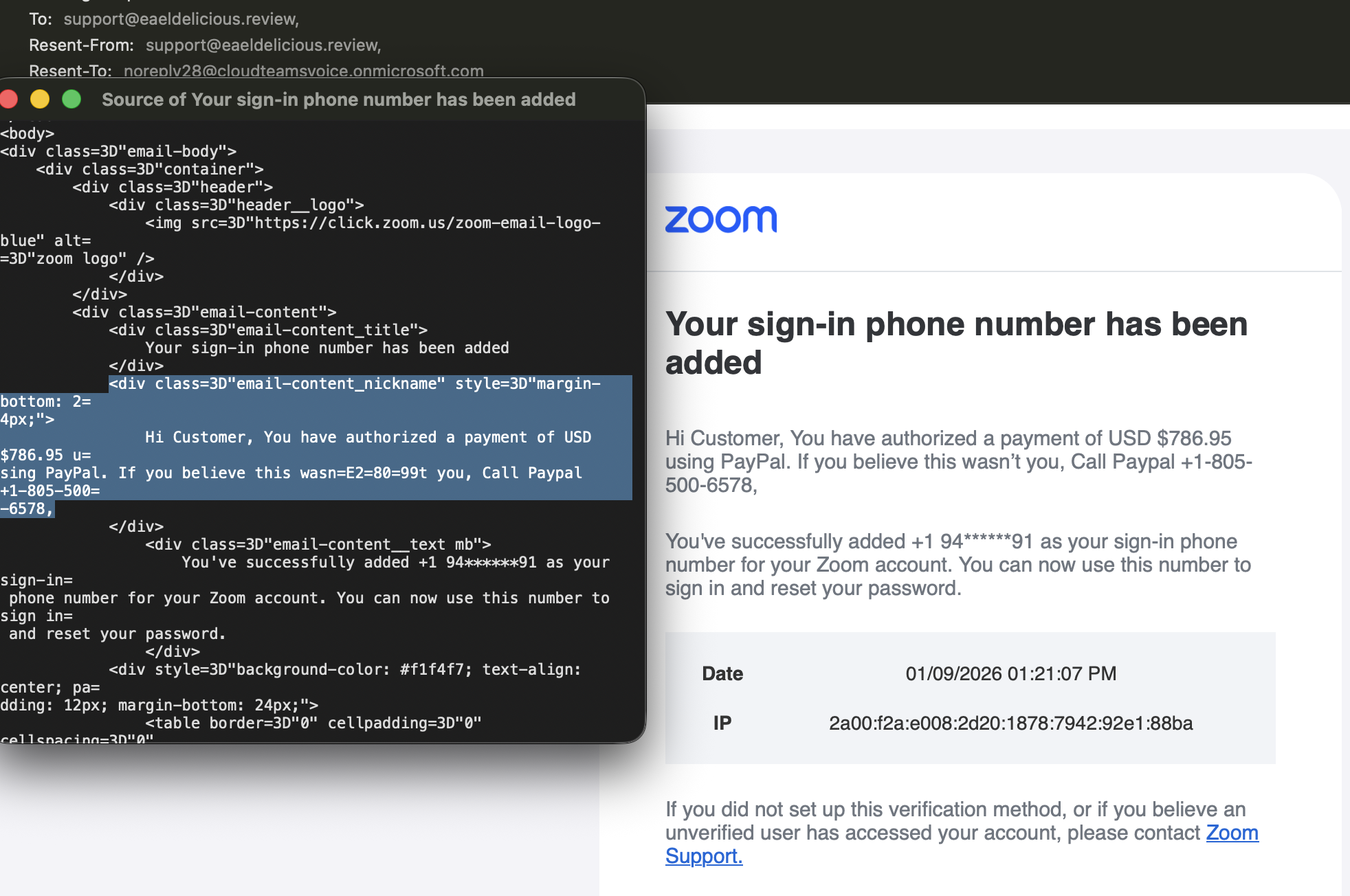
That's a cute #phishing attempt.
I think they've abused auto-forwarding on an Outlook account with a custom domain - but looks like they injected a custom name into the Zoom account with scary messaging trying to get you to call their number as well.
I know some people are iffy about @…, but I've had a great experience with them. I'm not a huge fan of the AI-related stuff they're doing, but it's turned off by default and you can ignore it (like I do) if you're not a fan.
I'm a paid customer because I use a custom domain with catch-all addresses and it's been amazi…
Scattering in Time-Varying Drude-Lorentz Models
Bryce Dixon, Calvin M. Hooper, Ian R. Hooper, Simon A. R. Horsley
https://arxiv.org/abs/2511.19322 https://arxiv.org/pdf/2511.19322 https://arxiv.org/html/2511.19322
arXiv:2511.19322v1 Announce Type: new
Abstract: Motivated by recent experiments, the theoretical study of wave propagation in time varying materials is of current interest. Although significant in nearly all such experiments, material dispersion is commonly neglected in theoretical studies. Yet, as we show here, understanding the precise microscopic model for the material dispersion is crucial for predicting experimental outcomes. Here we study the temporal scattering coefficients of four different time-varying Drude-Lorentz models, exploring how an incident continuous wave splits into forward and backward waves due to an abrupt change in plasma frequency. The differences in the predicted scattering are unique to time-varying media, and arise from the exact way in which the time variation appears in the various model parameters. We verify our results using a custom finite difference time domain algorithm, concluding with a discussion of the limitations that arise from using these models with an abrupt change in plasma frequency.
toXiv_bot_toot
 @trezzer@social.linux.pizza