Tootfinder

Opt-in global Mastodon full text search. Join the index!

@denkbeteiligung@digitalcourage.social
2026-02-02 06:42:30

Das Kabinett will die Reform des #EEG achnell angehen. Das ist grundsätzlich gut und allerhöchste Eisenbahn, aber ich hoffe, dass die #Bürgerenergie projekte die bereits in Entwickkung sind nicht abgewürgt werden indem die Bedingungen maßgeblich verschlechtert werden.

@tinoeberl@mastodon.online
2026-02-08 19:20:12

Die Debatte um das #EEG2027 dreht sich um Kosten, #Förderung und den Umbau der #Energienetze.
Diskutiert werden flexiblere Modelle, mehr Systemdienlichkeit und eine stärkere Marktinteg…

@arXiv_qbioNC_bot@mastoxiv.page
2025-12-08 08:50:00

SSDLabeler: Realistic semi-synthetic data generation for multi-label artifact classification in EEG
Taketo Akama, Akima Connelly, Shun Minamikawa, Natalia Polouliakh
arxiv.org/abs/2512.05500

@seeingwithsound@mas.to
2025-11-21 22:33:24

A low-latency neural inference framework for real-time handwriting recognition from #EEG signals on an edge device nature.com/articles/s41598-025

@tinoeberl@mastodon.online
2025-12-05 16:17:01

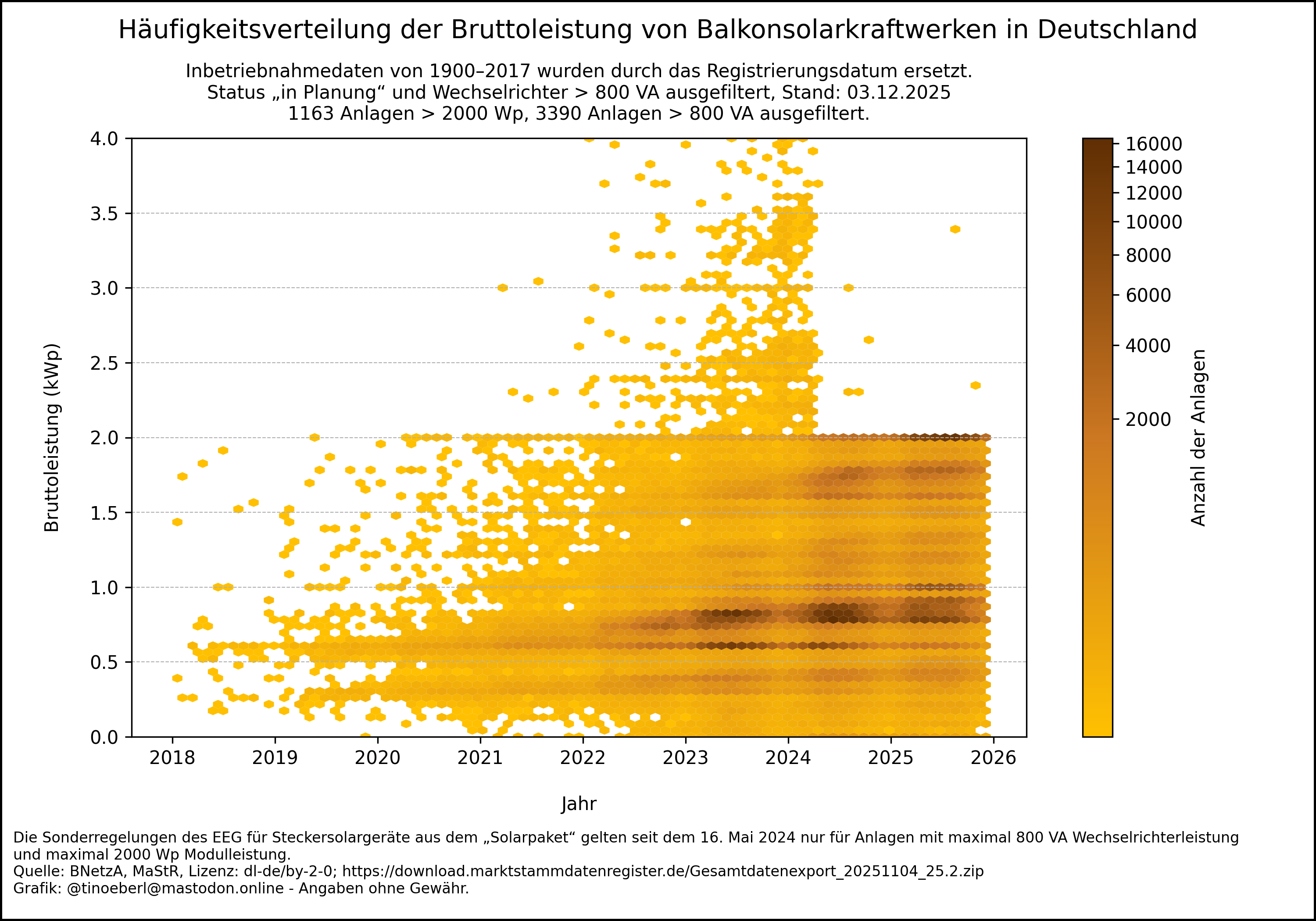
Häufigkeitsverteilung der Bruttoleistung von #Balkonkraftwerk​en in #Deutschland mit Stand vom 03.12.2025.
Unplausible Inbetriebnahmedaten ersetzt, Sonderregelungen nach #Solarpaket

Häufungspunkte-Diagramm der Bruttoleistung von Balkonkraftwerken in Deutschland. Das Diagramm zeigt die zeitliche Verteilung der Bruttoleistung (kWp) für über eine Million Anlagen – die meisten liegen unter 2 kWp, konzentriert ab 2022. Inbetriebnahmedaten von 1900–2017 wurden durch das Registrierungsdatum ersetzt. Anlagen mit Status „in Planung“ und Wechselrichter > 800 VA wurden ausgefiltert. Die Sonderregelungen des EEG für Steckersolargeräte aus dem „Solarpaket“ gelten seit dem 16. Mai 2024 …
@daehne@muenster.im
2026-01-28 15:39:31

In Brandenburg müssen Betreiber von Windanlagen umliegende Gemeinden an ihren Gewinnen beteiligen. Mit dem Geld sollen Infrastruktur, kulturelle und soziale Angebote oder Aufklärung über Windenergie finanziert werden. Aber ob und in welchem Rahmen diese Zahlungen Gemeinden wirklich erreichen – und wofür diese verwendet werden – ist intransparent.
Ich habe mit #IFG eine Anfrage gestellt:

@tinoeberl@mastodon.online
2025-11-16 15:16:52

#Artikelupdate
Ich habe einen sehr alten Artikel überarbeitet. #Solarpaket I ist z.B. neu.
Von der #Direktvermarktung habe ich wenig vernommen. Gibt es dafür inzwischen bew…

@seeingwithsound@mas.to
2026-01-14 08:24:53

EEG changes associated with hallucinations caused by Charles Bonnet Syndrome frontiersin.org/journals/neuro "reduced α power in occipital electrodes at the onset of the hallucinations&q…

@arXiv_csLG_bot@mastoxiv.page
2025-12-22 13:54:35

Replaced article(s) found for cs.LG. arxiv.org/list/cs.LG/new
[2/5]:
- The Diffusion Duality
Sahoo, Deschenaux, Gokaslan, Wang, Chiu, Kuleshov
arxiv.org/abs/2506.10892 mastoxiv.page/@arXiv_csLG_bot/
- Multimodal Representation Learning and Fusion
Jin, Ge, Xie, Luo, Song, Bi, Liang, Guan, Yeong, Song, Hao
arxiv.org/abs/2506.20494 mastoxiv.page/@arXiv_csLG_bot/
- The kernel of graph indices for vector search
Mariano Tepper, Ted Willke
arxiv.org/abs/2506.20584 mastoxiv.page/@arXiv_csLG_bot/
- OptScale: Probabilistic Optimality for Inference-time Scaling
Youkang Wang, Jian Wang, Rubing Chen, Xiao-Yong Wei
arxiv.org/abs/2506.22376 mastoxiv.page/@arXiv_csLG_bot/
- Boosting Revisited: Benchmarking and Advancing LP-Based Ensemble Methods
Fabian Akkerman, Julien Ferry, Christian Artigues, Emmanuel Hebrard, Thibaut Vidal
arxiv.org/abs/2507.18242 mastoxiv.page/@arXiv_csLG_bot/
- MolMark: Safeguarding Molecular Structures through Learnable Atom-Level Watermarking
Runwen Hu, Peilin Chen, Keyan Ding, Shiqi Wang
arxiv.org/abs/2508.17702 mastoxiv.page/@arXiv_csLG_bot/
- Dual-Distilled Heterogeneous Federated Learning with Adaptive Margins for Trainable Global Protot...
Fatema Siddika, Md Anwar Hossen, Wensheng Zhang, Anuj Sharma, Juan Pablo Mu\~noz, Ali Jannesari
arxiv.org/abs/2508.19009 mastoxiv.page/@arXiv_csLG_bot/
- STDiff: A State Transition Diffusion Framework for Time Series Imputation in Industrial Systems
Gary Simethy, Daniel Ortiz-Arroyo, Petar Durdevic
arxiv.org/abs/2508.19011 mastoxiv.page/@arXiv_csLG_bot/
- EEGDM: Learning EEG Representation with Latent Diffusion Model
Shaocong Wang, Tong Liu, Yihan Li, Ming Li, Kairui Wen, Pei Yang, Wenqi Ji, Minjing Yu, Yong-Jin Liu
arxiv.org/abs/2508.20705 mastoxiv.page/@arXiv_csLG_bot/
- Data-Free Continual Learning of Server Models in Model-Heterogeneous Cloud-Device Collaboration
Xiao Zhang, Zengzhe Chen, Yuan Yuan, Yifei Zou, Fuzhen Zhuang, Wenyu Jiao, Yuke Wang, Dongxiao Yu
arxiv.org/abs/2509.25977 mastoxiv.page/@arXiv_csLG_bot/
- Fine-Tuning Masked Diffusion for Provable Self-Correction
Jaeyeon Kim, Seunggeun Kim, Taekyun Lee, David Z. Pan, Hyeji Kim, Sham Kakade, Sitan Chen
arxiv.org/abs/2510.01384 mastoxiv.page/@arXiv_csLG_bot/
- A Generic Machine Learning Framework for Radio Frequency Fingerprinting
Alex Hiles, Bashar I. Ahmad
arxiv.org/abs/2510.09775 mastoxiv.page/@arXiv_csLG_bot/
- ASecond-Order SpikingSSM for Wearables
Kartikay Agrawal, Abhijeet Vikram, Vedant Sharma, Vaishnavi Nagabhushana, Ayon Borthakur
arxiv.org/abs/2510.14386 mastoxiv.page/@arXiv_csLG_bot/
- Utility-Diversity Aware Online Batch Selection for LLM Supervised Fine-tuning
Heming Zou, Yixiu Mao, Yun Qu, Qi Wang, Xiangyang Ji
arxiv.org/abs/2510.16882 mastoxiv.page/@arXiv_csLG_bot/
- Seeing Structural Failure Before it Happens: An Image-Based Physics-Informed Neural Network (PINN...
Omer Jauhar Khan, Sudais Khan, Hafeez Anwar, Shahzeb Khan, Shams Ul Arifeen
arxiv.org/abs/2510.23117 mastoxiv.page/@arXiv_csLG_bot/
- Training Deep Physics-Informed Kolmogorov-Arnold Networks
Spyros Rigas, Fotios Anagnostopoulos, Michalis Papachristou, Georgios Alexandridis
arxiv.org/abs/2510.23501 mastoxiv.page/@arXiv_csLG_bot/
- Semi-Supervised Preference Optimization with Limited Feedback
Seonggyun Lee, Sungjun Lim, Seojin Park, Soeun Cheon, Kyungwoo Song
arxiv.org/abs/2511.00040 mastoxiv.page/@arXiv_csLG_bot/
- Towards Causal Market Simulators
Dennis Thumm, Luis Ontaneda Mijares
arxiv.org/abs/2511.04469 mastoxiv.page/@arXiv_csLG_bot/
- Incremental Generation is Necessary and Sufficient for Universality in Flow-Based Modelling
Hossein Rouhvarzi, Anastasis Kratsios
arxiv.org/abs/2511.09902 mastoxiv.page/@arXiv_csLG_bot/
- Optimizing Mixture of Block Attention
Guangxuan Xiao, Junxian Guo, Kasra Mazaheri, Song Han
arxiv.org/abs/2511.11571 mastoxiv.page/@arXiv_csLG_bot/
- Assessing Automated Fact-Checking for Medical LLM Responses with Knowledge Graphs
Shasha Zhou, Mingyu Huang, Jack Cole, Charles Britton, Ming Yin, Jan Wolber, Ke Li
arxiv.org/abs/2511.12817 mastoxiv.page/@arXiv_csLG_bot/
toXiv_bot_toot

@tinoeberl@mastodon.online
2026-01-25 14:15:03

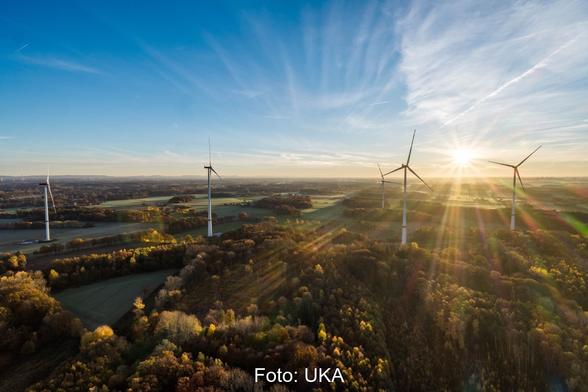
Die UKA‑Gruppe will künftig jährlich #Windenergieanlagen mit einer Gesamtleistung von 1 GW an Land ans Netz bringen.
2025 erreichte das Unternehmen mit 350 MW ein Rekordergebnis. Aktuell befinden sich über 1,5 GW in Bau, weitere Projekte sind durch EEG-Zuschläge gesichert. UKA setzt auf Kooperation, um Projektrechte zuzukaufen und die Umsetzung trotz wachsendem Wettbewerb zu bes…

@seeingwithsound@mas.to
2026-01-19 14:46:13

Functional plasticity in auditory and visual discrimination processing in patients with single-sided deafness: An EEG Study journals.sagepub.com/doi/10.11

@tinoeberl@mastodon.online
2026-01-25 13:14:33

#Windräder in der #Rureifel bringen den umliegenden #Kommunen über 450.000 Euro ein.
Der Projektierer REA aus Düren profitiert von einer EEG-Regelung, nach der bis zu 0,2 Cent pro erzeugt…

@arXiv_qbioNC_bot@mastoxiv.page
2025-12-12 08:16:59

Modeling, Segmenting and Statistics of Transient Spindles via Two-Dimensional Ornstein-Uhlenbeck Dynamics
C. Sun, D. Fettahoglu, D. Holcman
arxiv.org/abs/2512.10844 arxiv.org/pdf/2512.10844 arxiv.org/html/2512.10844
arXiv:2512.10844v1 Announce Type: new
Abstract: We develop here a stochastic framework for modeling and segmenting transient spindle- like oscillatory bursts in electroencephalogram (EEG) signals. At the modeling level, individ- ual spindles are represented as path realizations of a two-dimensional Ornstein{Uhlenbeck (OU) process with a stable focus, providing a low-dimensional stochastic dynamical sys- tem whose trajectories reproduce key morphological features of spindles, including their characteristic rise{decay amplitude envelopes. On the signal processing side, we propose a segmentation procedure based on Empirical Mode Decomposition (EMD) combined with the detection of a central extremum, which isolates single spindle events and yields a collection of oscillatory atoms. This construction enables a systematic statistical analysis of spindle features: we derive empirical laws for the distributions of amplitudes, inter-spindle intervals, and rise/decay durations, and show that these exhibit exponential tails consistent with the underlying OU dynamics. We further extend the model to a pair of weakly coupled OU processes with distinct natural frequencies, generating a stochastic mixture of slow, fast, and mixed spindles in random temporal order. The resulting framework provides a data- driven framework for the analysis of transient oscillations in EEG and, more generally, in nonstationary time series.
toXiv_bot_toot

@tinoeberl@mastodon.online
2025-12-25 16:17:02

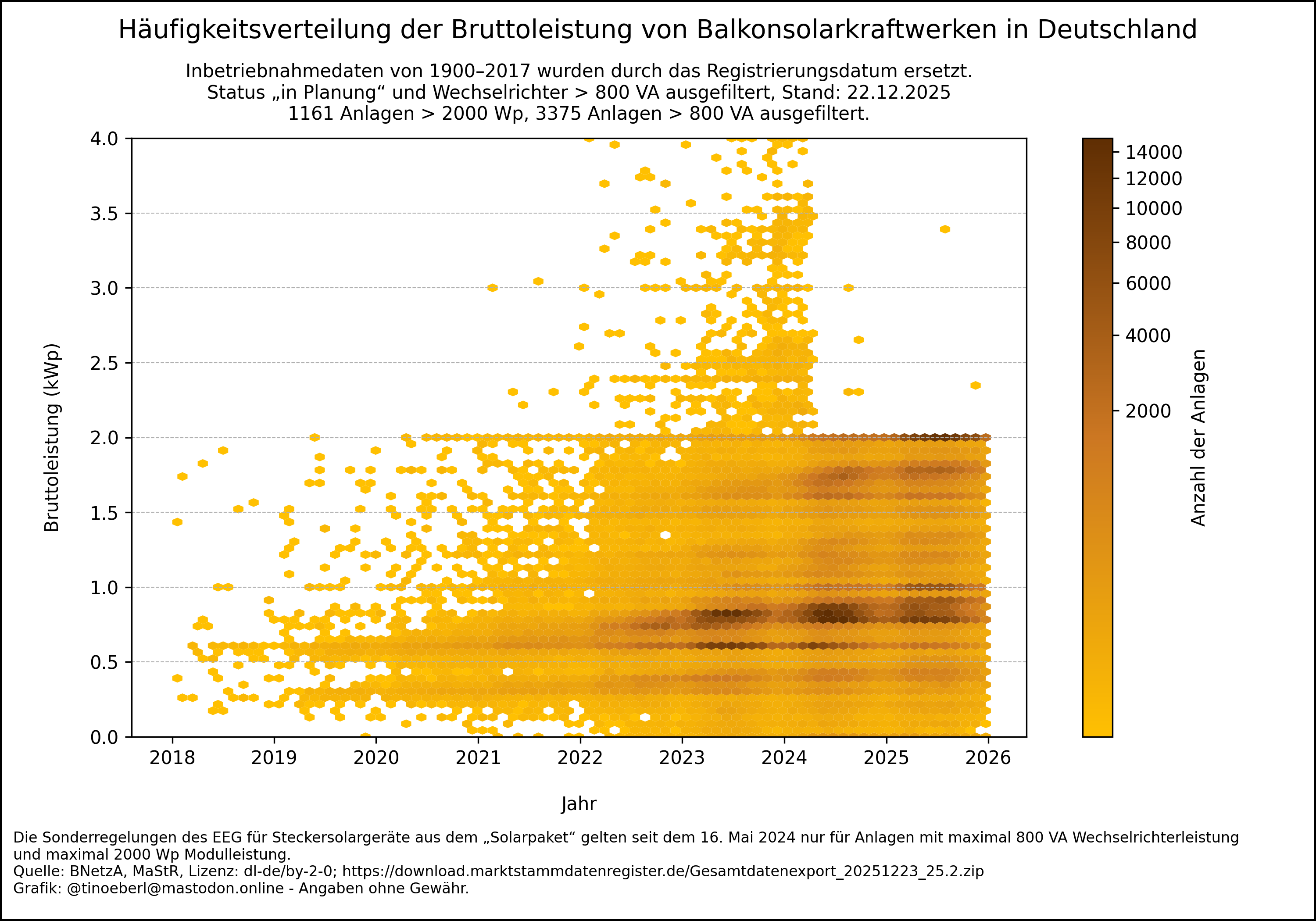
Häufigkeitsverteilung der Bruttoleistung von #Balkonkraftwerk​en in #Deutschland mit Stand vom 22.12.2025.
Unplausible Inbetriebnahmedaten ersetzt, Sonderregelungen nach #Solarpaket

Häufungspunkte-Diagramm der Bruttoleistung von Balkonkraftwerken in Deutschland. Das Diagramm zeigt die zeitliche Verteilung der Bruttoleistung (kWp) für über eine Million Anlagen – die meisten liegen unter 2 kWp, konzentriert ab 2022. Inbetriebnahmedaten von 1900–2017 wurden durch das Registrierungsdatum ersetzt. Anlagen mit Status „in Planung“ und Wechselrichter > 800 VA wurden ausgefiltert. Die Sonderregelungen des EEG für Steckersolargeräte aus dem „Solarpaket“ gelten seit dem 16. Mai 2024 …
@tinoeberl@mastodon.online
2026-01-11 22:23:02

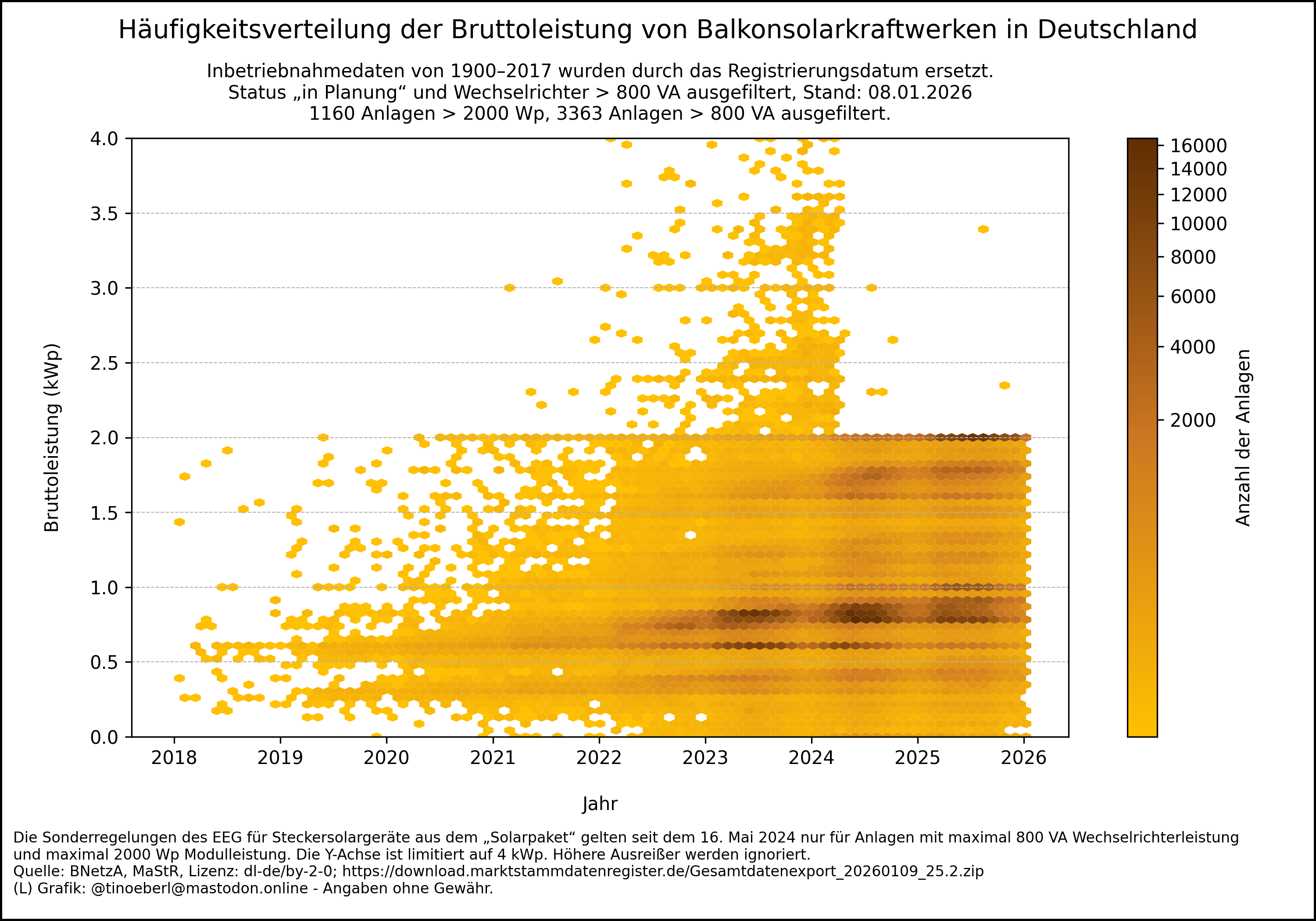
Häufigkeitsverteilung der Bruttoleistung von #Balkonkraftwerk​en in #Deutschland mit Stand vom 08.01.2026.
Unplausible Inbetriebnahmedaten ersetzt, Sonderregelungen nach #Solarpaket

Häufungspunkte-Diagramm der Bruttoleistung von Balkonkraftwerken in Deutschland. Das Diagramm zeigt die zeitliche Verteilung der Bruttoleistung (kWp) für über eine Million Anlagen – die meisten liegen unter 2 kWp, konzentriert ab 2022. Inbetriebnahmedaten von 1900–2017 wurden durch das Registrierungsdatum ersetzt. Anlagen mit Status „in Planung“ und Wechselrichter > 800 VA wurden ausgefiltert. Die Sonderregelungen des EEG für Steckersolargeräte aus dem „Solarpaket“ gelten seit dem 16. Mai 2024 …
@arXiv_qbioNC_bot@mastoxiv.page
2025-12-11 08:29:01

NeuroSketch: An Effective Framework for Neural Decoding via Systematic Architectural Optimization
Gaorui Zhang, Zhizhang Yuan, Jialan Yang, Junru Chen, Li Meng, Yang Yang
arxiv.org/abs/2512.09524 arxiv.org/pdf/2512.09524 arxiv.org/html/2512.09524
arXiv:2512.09524v1 Announce Type: new
Abstract: Neural decoding, a critical component of Brain-Computer Interface (BCI), has recently attracted increasing research interest. Previous research has focused on leveraging signal processing and deep learning methods to enhance neural decoding performance. However, the in-depth exploration of model architectures remains underexplored, despite its proven effectiveness in other tasks such as energy forecasting and image classification. In this study, we propose NeuroSketch, an effective framework for neural decoding via systematic architecture optimization. Starting with the basic architecture study, we find that CNN-2D outperforms other architectures in neural decoding tasks and explore its effectiveness from temporal and spatial perspectives. Building on this, we optimize the architecture from macro- to micro-level, achieving improvements in performance at each step. The exploration process and model validations take over 5,000 experiments spanning three distinct modalities (visual, auditory, and speech), three types of brain signals (EEG, SEEG, and ECoG), and eight diverse decoding tasks. Experimental results indicate that NeuroSketch achieves state-of-the-art (SOTA) performance across all evaluated datasets, positioning it as a powerful tool for neural decoding. Our code and scripts are available at github.com/Galaxy-Dawn/NeuroSk.
toXiv_bot_toot