 @Techmeme@techhub.social
2025-11-16 04:31:39
Dealogic: 51 US tech IPOs raised $16.8B in 2025, driven by AI and crypto, above the past three-year average but far below 2021's 127 IPOs raising $74.4B (Valida Pau/The Information)
https://www.theinformation.com/articles/ai-crypto-companies-dominat…
 @Techmeme@techhub.social
2025-11-17 04:45:39
Tokyo-based Turing, which is developing an AI model for self-driving vehicles, raised a $99M Series A, sources say at a ~$388M valuation (Min-Jeong Lee/Bloomberg)
https://www.bloomberg.com/news/articles/2025-11-17/ai-startup-t…
 @tiotasram@kolektiva.social
2025-12-10 17:19:22
When "self-driving" cars were first getting some hype back in ~2015 or so, I told people who asked me that I didn't think they'd be safe, and that I wished the same money were being invested in driver-assistance systems instead.
At the time, advocates were claiming that self-driving cars would be safer than human drivers.
We now have both self-driving cars and some nifty new driver assistance things, and it turns out that the self-driving cars are in fact being developed by corporations whose attention to the bottom line results in danger to others on the road pretty regularly. I don't actually have stats here for whether they're "safer than human drivers" or not, but the opportunity for one bad software update to make *all* self-driving cars dangerous at once kinda makes me doubt that.
Here's an example of Waymo cars getting "more aggressive" as they try to balance between being too timid and obstructing traffic (including emergency vehicles) and being too dangerous:
https://archive.ph/JJuGv
Here's another example of passing stopped schoolbusses leading to a software recall:
https://abcnews.go.com/GMA/News/waymo-issue-voluntary-software-recall-after-close-calls/story?id=128207776
In the first article, Waymo claims 91% fewer serious accidents per mile. Obviously an independent audit would be actually trustworthy, but even if we take that claim at face value, it's meaningless if an update tomorrow causes 100,000 accidents.
Note that they could be using better engineering practices, and the fact that they aren't shows that they don't care enough about the risks. They could be deploying new software versions incrementally and slowly, letting new versions rack up lots of miles only on a few vehicles before pushing them to a fleet. The should also have the equivalent of a simulation unit test for "schoolbus is stopped, what do?" and if a software version fails that test, it doesn't make it to the fleet. Clearly they don't have that.
I feel pretty vindicated in my earlier prediction that this tech is a bad idea in the hands of the current advocates.
 @tinoeberl@mastodon.online
2026-01-05 15:16:45
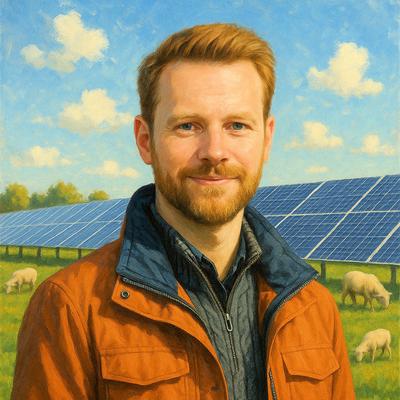
In #Dorfen wurde ein neuer #Solarpark mit #Stromspeicher feierlich in Betrieb genommen.
Die Anlage versorgt rund 1.200 Haushalte und stabilisiert durch gezielte Einspeisung das
 @arXiv_qbioNC_bot@mastoxiv.page
2025-12-12 08:16:59
Modeling, Segmenting and Statistics of Transient Spindles via Two-Dimensional Ornstein-Uhlenbeck Dynamics
C. Sun, D. Fettahoglu, D. Holcman
https://arxiv.org/abs/2512.10844 https://arxiv.org/pdf/2512.10844 https://arxiv.org/html/2512.10844
arXiv:2512.10844v1 Announce Type: new
Abstract: We develop here a stochastic framework for modeling and segmenting transient spindle- like oscillatory bursts in electroencephalogram (EEG) signals. At the modeling level, individ- ual spindles are represented as path realizations of a two-dimensional Ornstein{Uhlenbeck (OU) process with a stable focus, providing a low-dimensional stochastic dynamical sys- tem whose trajectories reproduce key morphological features of spindles, including their characteristic rise{decay amplitude envelopes. On the signal processing side, we propose a segmentation procedure based on Empirical Mode Decomposition (EMD) combined with the detection of a central extremum, which isolates single spindle events and yields a collection of oscillatory atoms. This construction enables a systematic statistical analysis of spindle features: we derive empirical laws for the distributions of amplitudes, inter-spindle intervals, and rise/decay durations, and show that these exhibit exponential tails consistent with the underlying OU dynamics. We further extend the model to a pair of weakly coupled OU processes with distinct natural frequencies, generating a stochastic mixture of slow, fast, and mixed spindles in random temporal order. The resulting framework provides a data- driven framework for the analysis of transient oscillations in EEG and, more generally, in nonstationary time series.
toXiv_bot_toot
 @maxime@social.linux.pizza
2025-12-29 14:25:08
It's crazy omg
Libgodc: Write Go Programs for Sega Dreamcast drpaneas - Hacker News: Front Page (drpaneas) https://github.com/drpaneas/libgodc
 @lysander07@sigmoid.social
2025-11-06 01:02:56
 @Techmeme@techhub.social
2025-12-09 10:35:48
Mercedes partners with Chinese software developer Momenta to deploy Level 4 self-driving cars for Lumo Mobility in Abu Dhabi, its first foray into robotaxis (William Wilkes/Bloomberg)
https://www.bloomberg.com/news/articles/20
@Techmeme@techhub.social2026-01-05 11:15:28
CES 2026: self-driving truck company Kodiak partners with Bosch to develop a hardware and software system to turn standard semi-trucks into autonomous vehicles (Kirsten Korosec/TechCrunch)
https://techcrunch.com/2026/01/05/kodiak-taps-bosch-to-scale-…
 @Techmeme@techhub.social
2025-11-05 07:10:59
VW says it's developing an AI chip for advanced driving in China via a JV between its Cariad unit and Horizon Robotics, with deliveries in three to five years (Edward White/Financial Times)
https://www.ft.com/content/62434bb6-e6bf-4a82-911d-2826f212eee0