 @fanf@mendeddrum.org
2026-09-23 20:42:04
from my link log —
SAML: A fractal of bad design.
https://blog.trailofbits.com/2026/09/21/saml-a-fractal-of-bad-design/
saved 2026-09-23
@fanf@mendeddrum.orgfrom my link log —
SAML: A fractal of bad design.
https://blog.trailofbits.com/2026/09/21/saml-a-fractal-of-bad-design/
saved 2026-09-23
 @arXiv_astrophGA_bot@mastoxiv.page
The fading hierarchy of Galactic open clusters
Guimei Liu, Jo\~ao Alves, Yu Zhang, Emily L. Hunt, Ruqiu Lin, Josefa E. Gro{\ss}schedl, Efrem Maconi, Nora Wagner, Lilly Kormann, Cameren Swiggum
https://arxiv.org/abs/2609.09122 https://arxiv.org/pdf/2609.09122 https://arxiv.org/html/2609.09122
arXiv:2609.09122v1 Announce Type: new
Abstract: Galactic open clusters provide a record of both hierarchical star formation and the subsequent dynamical evolution of the Milky Way disk. We use the two-point correlation function to characterize the spatial and kinematic clustering of open clusters in the solar neighborhood, considering their three-dimensional (3D) distributions and their projections onto the Galactic plane, as well as subsamples divided by age, mass, and survey volume. We quantify the clustering through fractal dimensions and characteristic correlation scales. We find that the youngest clusters have fractal dimensions comparable to those measured in the interstellar medium, suggesting that they retain part of the hierarchical structure of their natal molecular clouds. The clustering strength then decreases systematically with age and becomes weak on a characteristic timescale of order 100 Myr. This evolution is scale dependent: the excess correlation at tens of parsecs fades more rapidly than the weaker correlation at hundreds of parsecs. By contrast, we find only a weak dependence of the clustering properties on cluster mass and volume. Using the same cluster sample, we derive an empirical mapping between projected and 3D fractal dimensions, providing an observational calibration for comparing the Milky Way with studies of external galaxies, where only projected measurements are available. The open-cluster population exhibits characteristic spatial and kinematic clustering scales of approximately 370 pc and 11 km/s, respectively. These results support a picture in which young open clusters inherit a spatial hierarchy from star formation and progressively lose their spatial correlations through subsequent evolution.
toXiv_bot_toot
 @arXiv_astrophCO_bot@mastoxiv.page
Fractal properties of the cosmic web
Jaan Einasto
https://arxiv.org/abs/2608.04694 https://arxiv.org/pdf/2608.04694 https://arxiv.org/html/2608.04694
arXiv:2608.04694v1 Announce Type: new
Abstract: The cosmic web is one of the most complex systems in nature, consisting of galaxies and clusters of galaxies connected by filaments and walls, and separated by large empty regions known as cosmic voids. The most common method for describing the web is the correlation function and its derivative, the structure function and fractal dimension function. In this paper I review the fractal properties of the cosmic web within the concordance {\Lambda}CDM framework. I describe how the fractal function is derived from the angular and spatial distributions of galaxies and discuss the relations between these approaches.
toXiv_bot_toot
 @penguin42@mastodon.org.uk
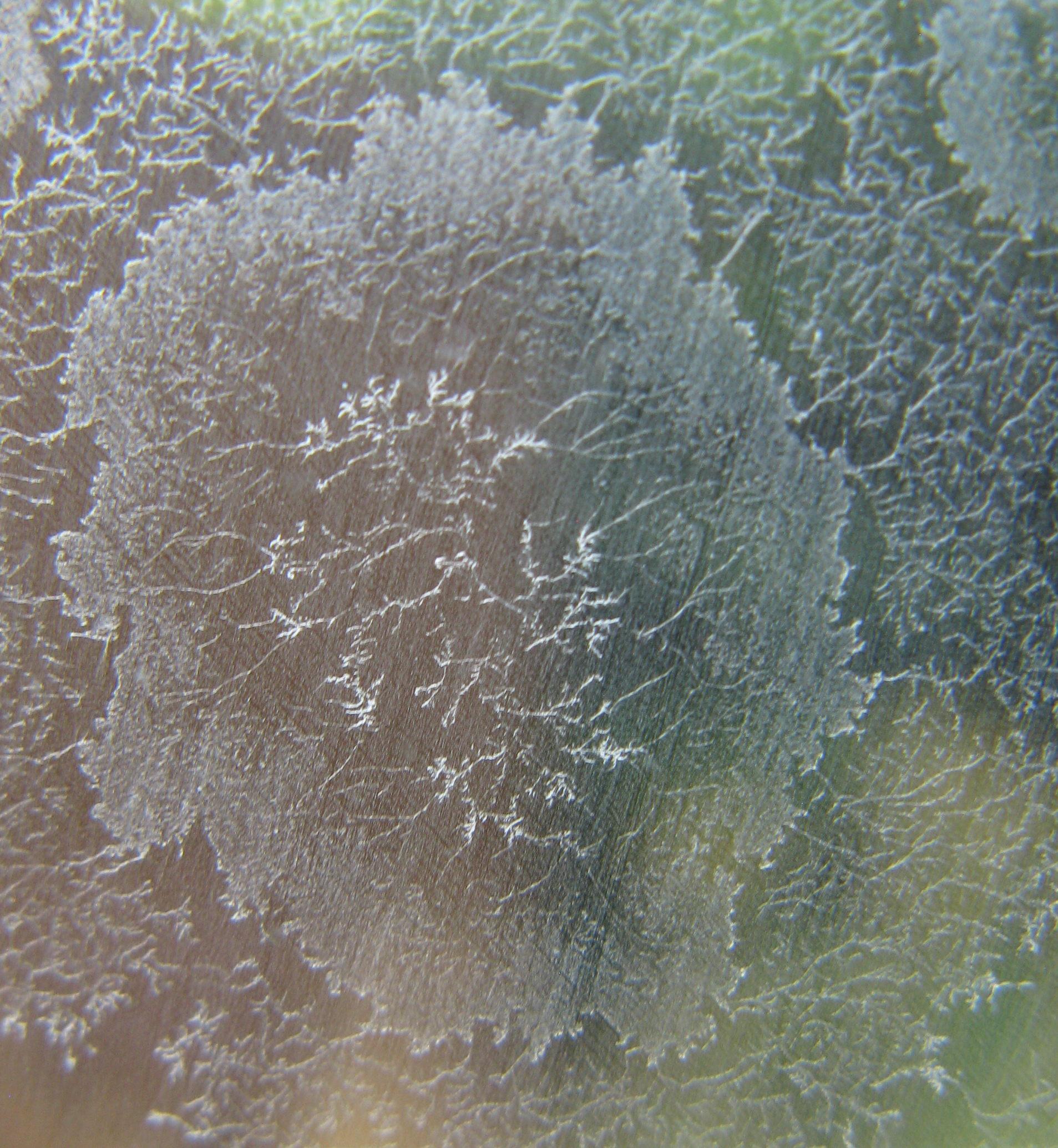
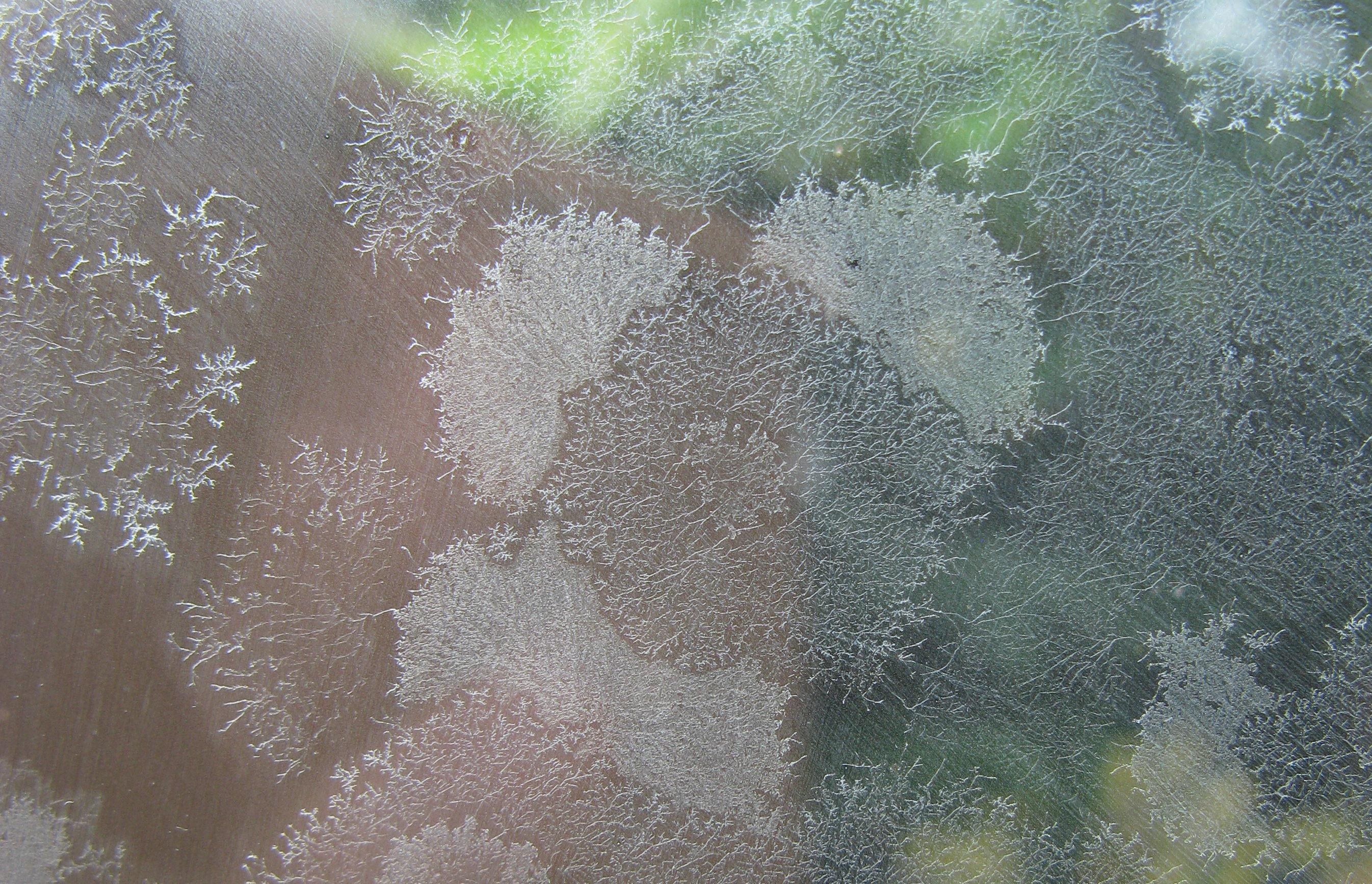
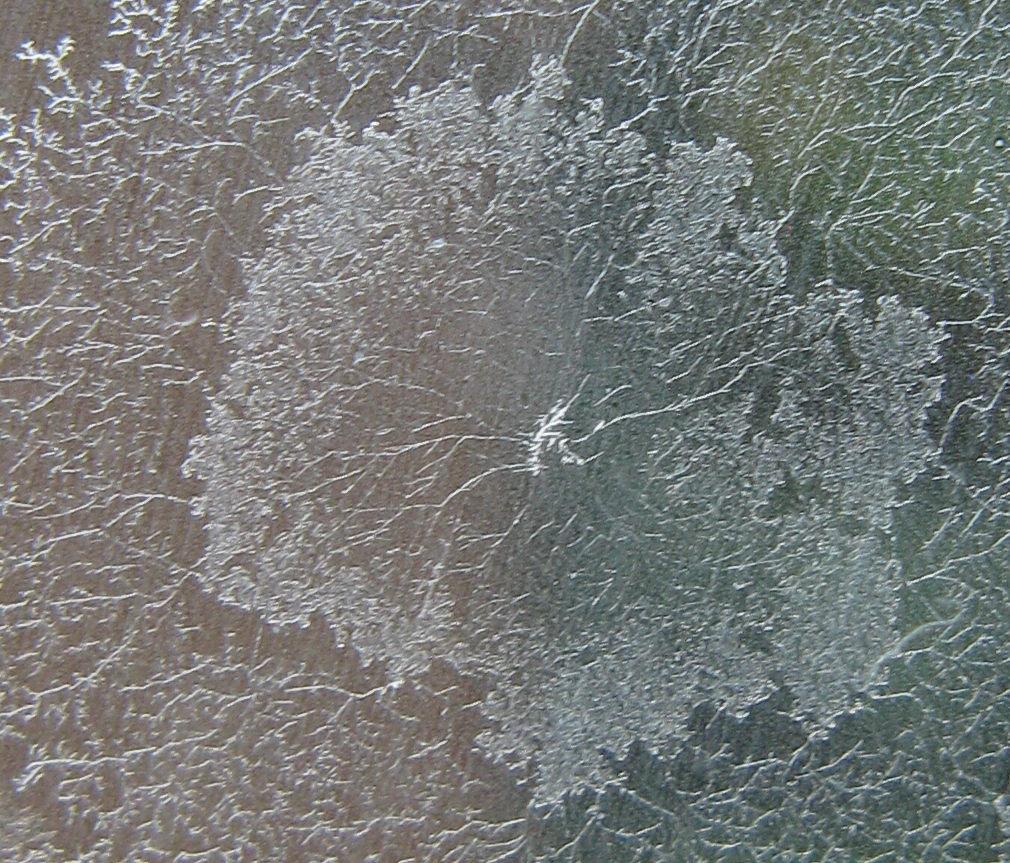
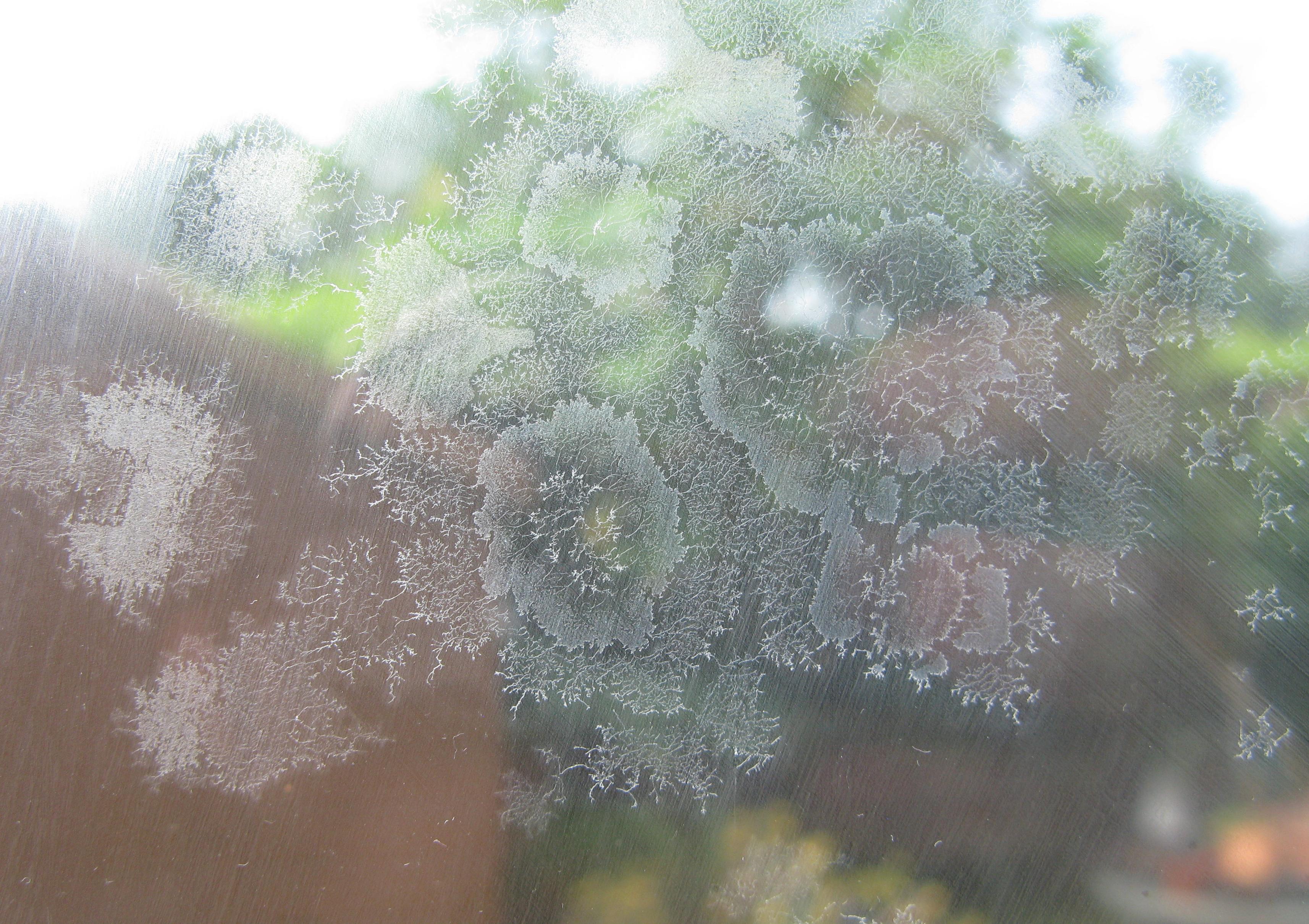
Something fun is growing inside a double-glazing panel near our washing machine; I guess it's loving being kept warm a lot of the time (and probably a bit damp). Couldn't say if it's fungal or bacterial or what but it certainly looks very fractal.
 @arXiv_mathST_bot@mastoxiv.page
Single-graph inference for fractal Gaussian networks
Chunhao Cai
https://arxiv.org/abs/2610.11597 https://arxiv.org/pdf/2610.11597 https://arxiv.org/html/2610.11597
arXiv:2610.11597v1 Announce Type: new
Abstract: We study inference on the strength of Gaussian multiplicative chaos from one geometric graph with unobserved vertex positions. In the planar model, the edge-count statistic has a piecewise deterministic limit with a transition at $\gamma=1$, whereas degree quantiles consistently estimate $\nu=\gamma^2/2$ throughout the subcritical range. Fractional moments give uniform finite-sample risk bounds. At finite resolution, common graph envelopes calibrate tests over continuous parameter boxes with unknown Poisson intensity. They give simultaneous coverage under adaptive refinement for a fixed statistic, and conditional coverage for an independently piloted size--degree residual on a fixed partition. For the exact periodic FFT--pixel approximation, we prove explicit total-variation rates for the annealed spatial Cox law and the observed graph law, uniformly on every compact subcritical range $0\le\gamma\le\Gamma<2$. The rates allow intensity to grow with resolution and imply uniform asymptotic coverage after recalibration at each resolution. Numerical studies examine parameter refinement, residual calibration, and multiresolution stability.
toXiv_bot_toot
 @stefan@gardenstate.social
How to Survive the Death of the Internet by Fractal Philosophy
#ai
 @seeingwithsound@mas.to
Topographic reorganization of EEG complexity during visual mental imagery: Insights from Lempel-Ziv complexity in high-density EEG https://link.springer.com/article/10.1007/s10548-026-01238-y "Visual mental imagery is the process of reconstructing perceptual experience…
 @arXiv_nlincd_bot@mastoxiv.page
On a cross coupling of Rulkov neural maps
Stefano Disca
https://arxiv.org/abs/2607.22318 https://arxiv.org/pdf/2607.22318 https://arxiv.org/html/2607.22318
arXiv:2607.22318v1 Announce Type: new
Abstract: We introduce a novel coupling of Rulkov neural maps, proposing a heuristic biological interpretation for the transition to non-small values of the perturbations acting on the slow variables. We analytically prove that the coupling preserves boundedness of motion and the existence of a snap-back repeller (leading to Devaney chaos by the Marotto theorem), if they are associated to the original system. For the coupling of two standard chaotic Rulkov maps, we present numerical simulations for the orbits of the system showing the arising of a global strange attractor, whose fractal structure is strongly suggested by the computation of a non-integer Kaplan-Yorke dimension. Furthermore, we perform standard numerical studies concerning time series, Lyapunov exponents spectra, bifurcation diagrams and basins of attraction. Finally, we briefly propose a generalization of the coupling to an arbitrary number of neurons.
toXiv_bot_toot
 @arXiv_nlinCG_bot@mastoxiv.page
Crosslisted article(s) found for nlin.CG. https://arxiv.org/list/nlin.CG/new
[1/1]:
- From Exponential to Gaussian Tails: Fractal Wavefront Scaling and the $\kappa$-Weibull Distributi...
O. V. Pavlovsky, M. Yu. Satleikin
https://arxiv.org/abs/2607.28172 https://mastoxiv.page/@arXiv_condmatstatmech_bot/117013599255005812
- Hash Chemistry: Minimal Models for Evolutionary Growth of Complexity
Ilya Horiguchi, Hiroki Sayama
https://arxiv.org/abs/2607.28219 https://mastoxiv.page/@arXiv_qbioPE_bot/117013558979151019
toXiv_bot_toot