Tootfinder

Opt-in global Mastodon full text search. Join the index!

@netzschleuder@social.skewed.de
2026-01-17 12:00:05

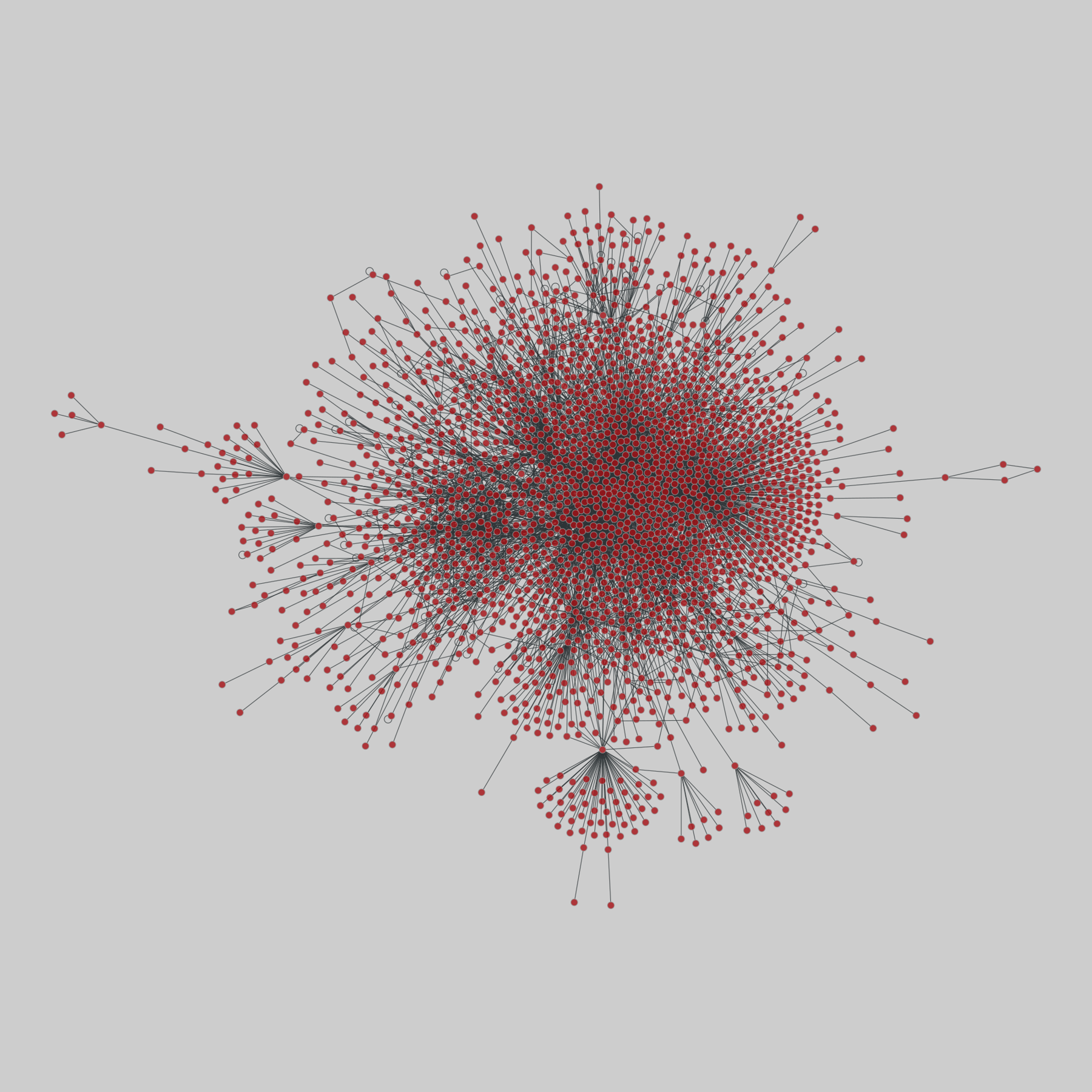
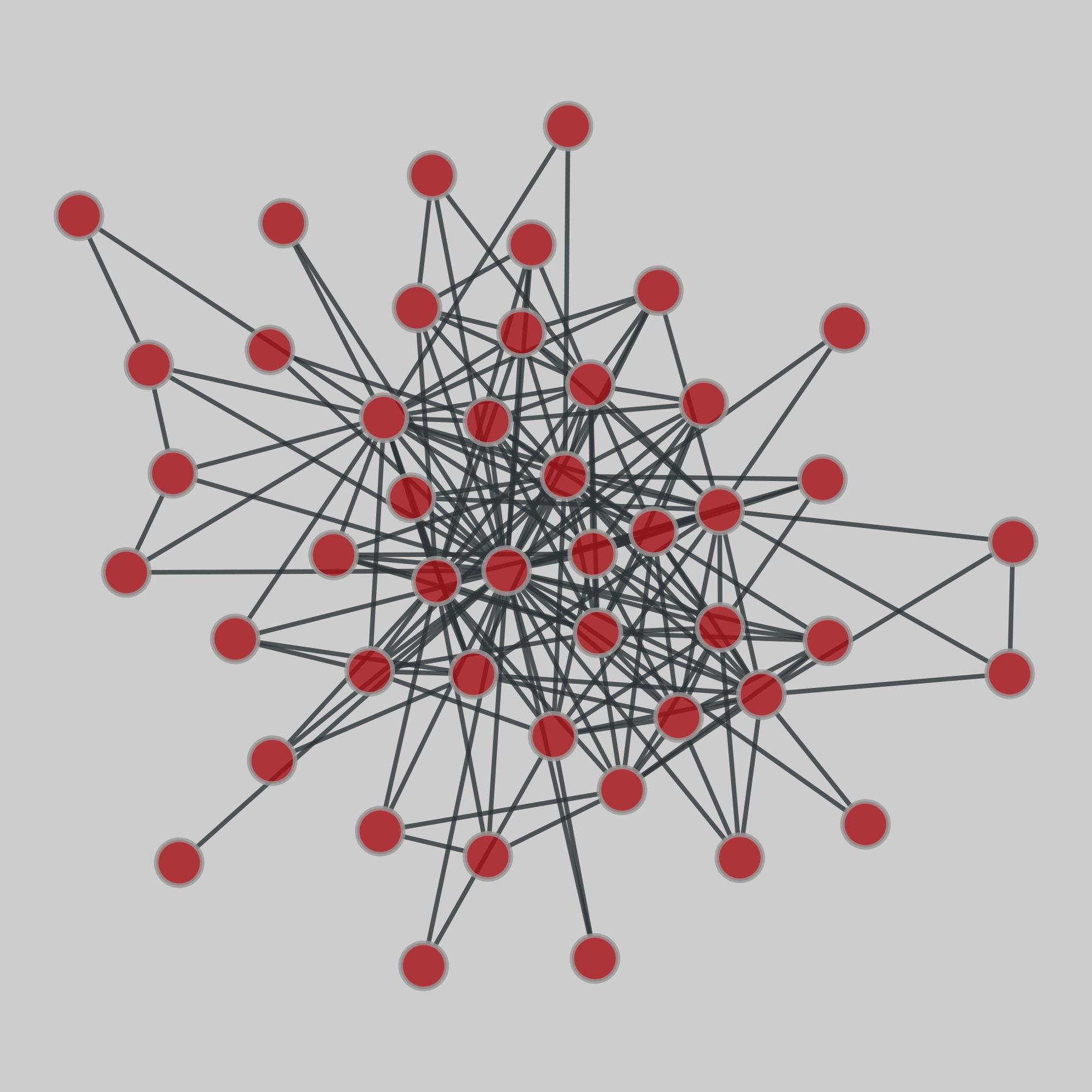
webkb: WebKB graphs (1998)
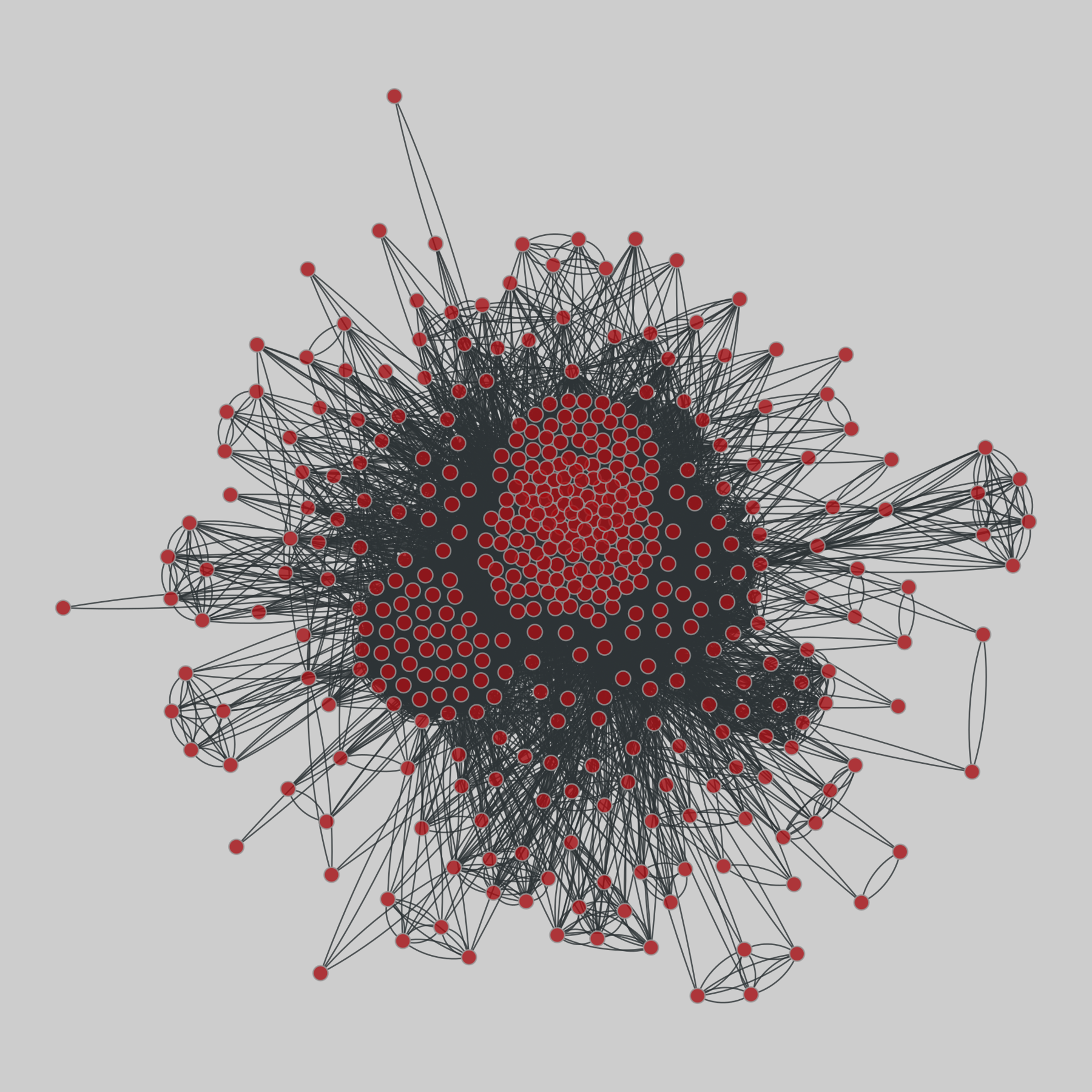
Web graphs crawled from four Computer Science departments in 1998, with each page manually classified into one of 7 categories: course, department, faculty, project, staff, student, or other. All graphs included in a single .zip; also included are 'co-citation' graphs, which links i and j if they both point to some k. Edge weights count the number of links from i to j.
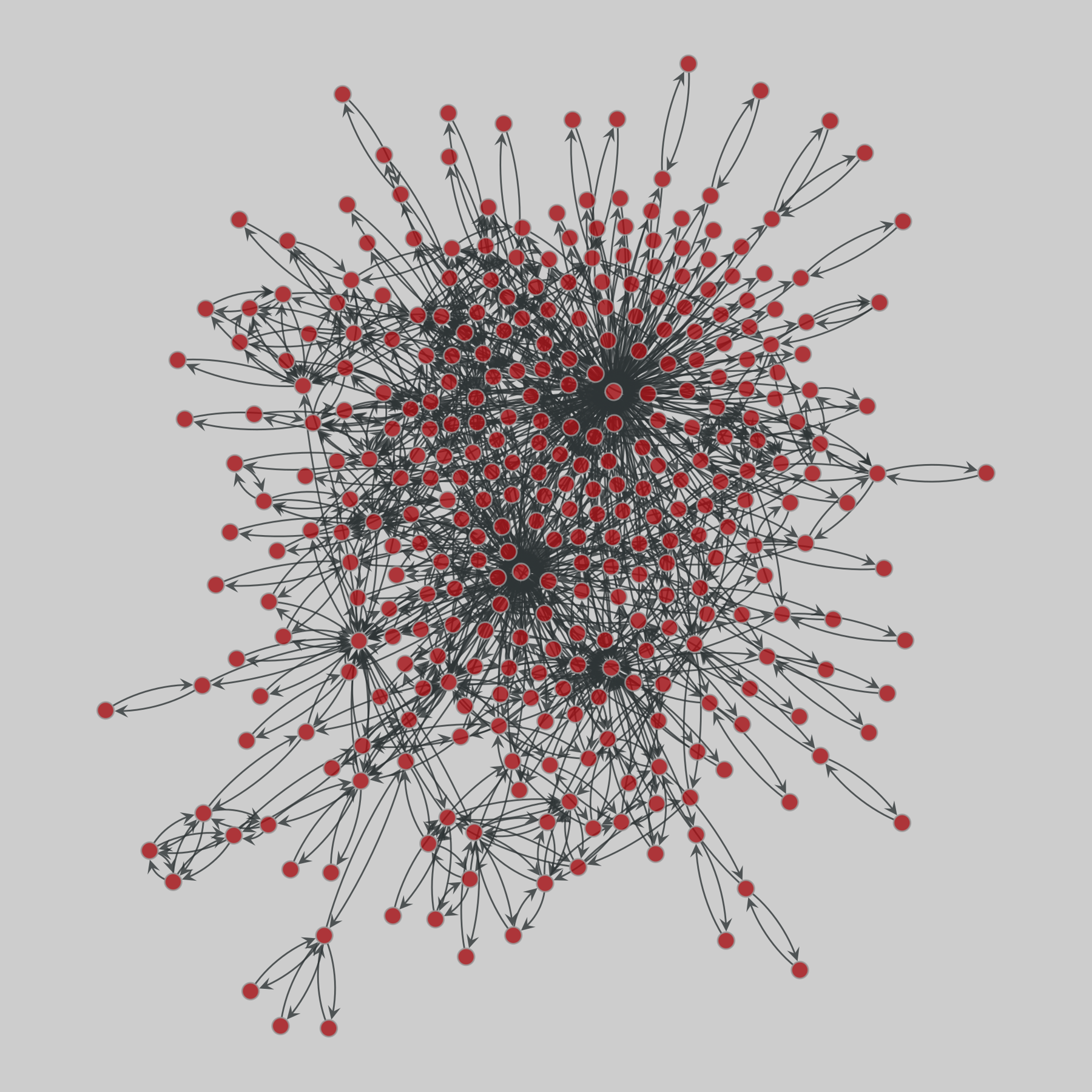
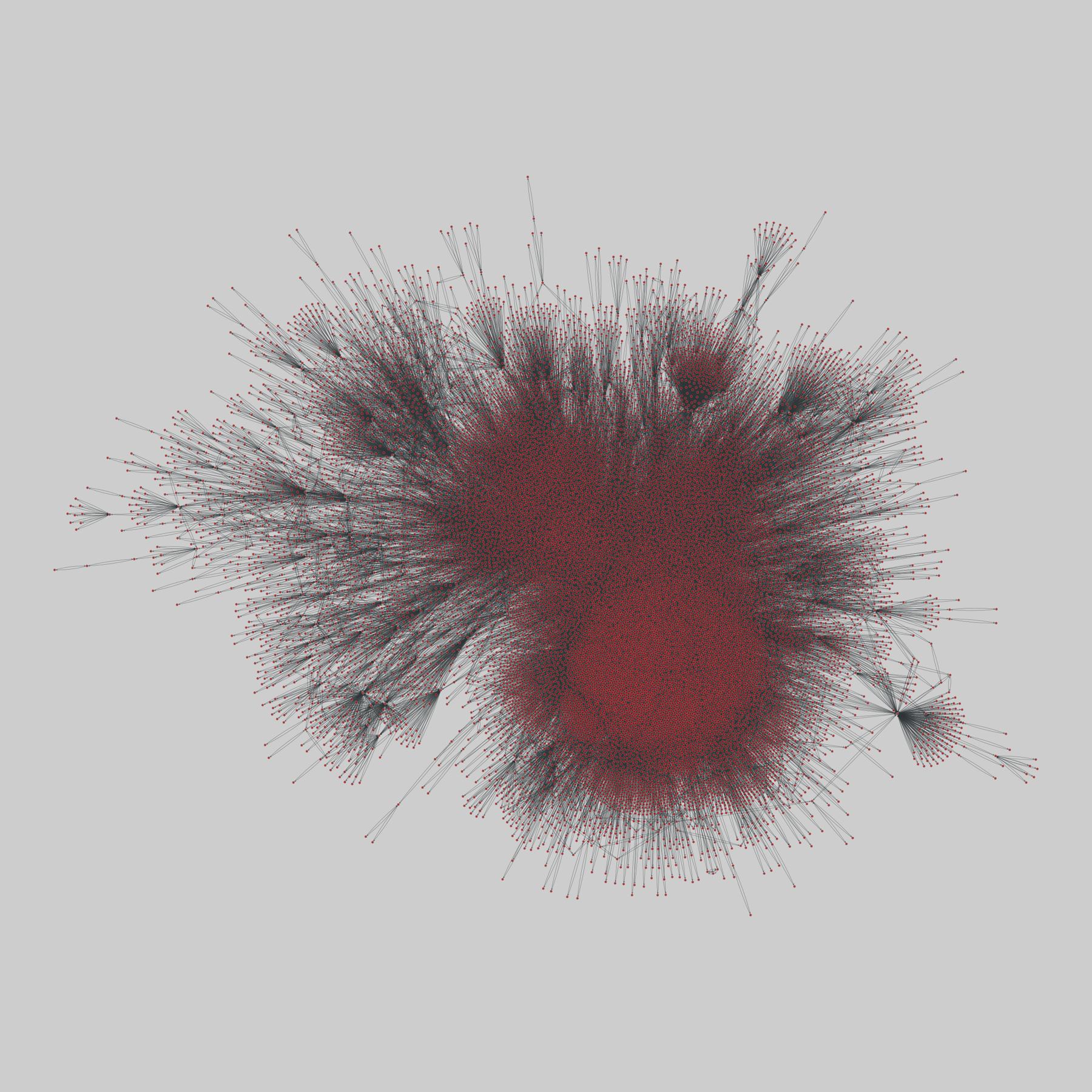
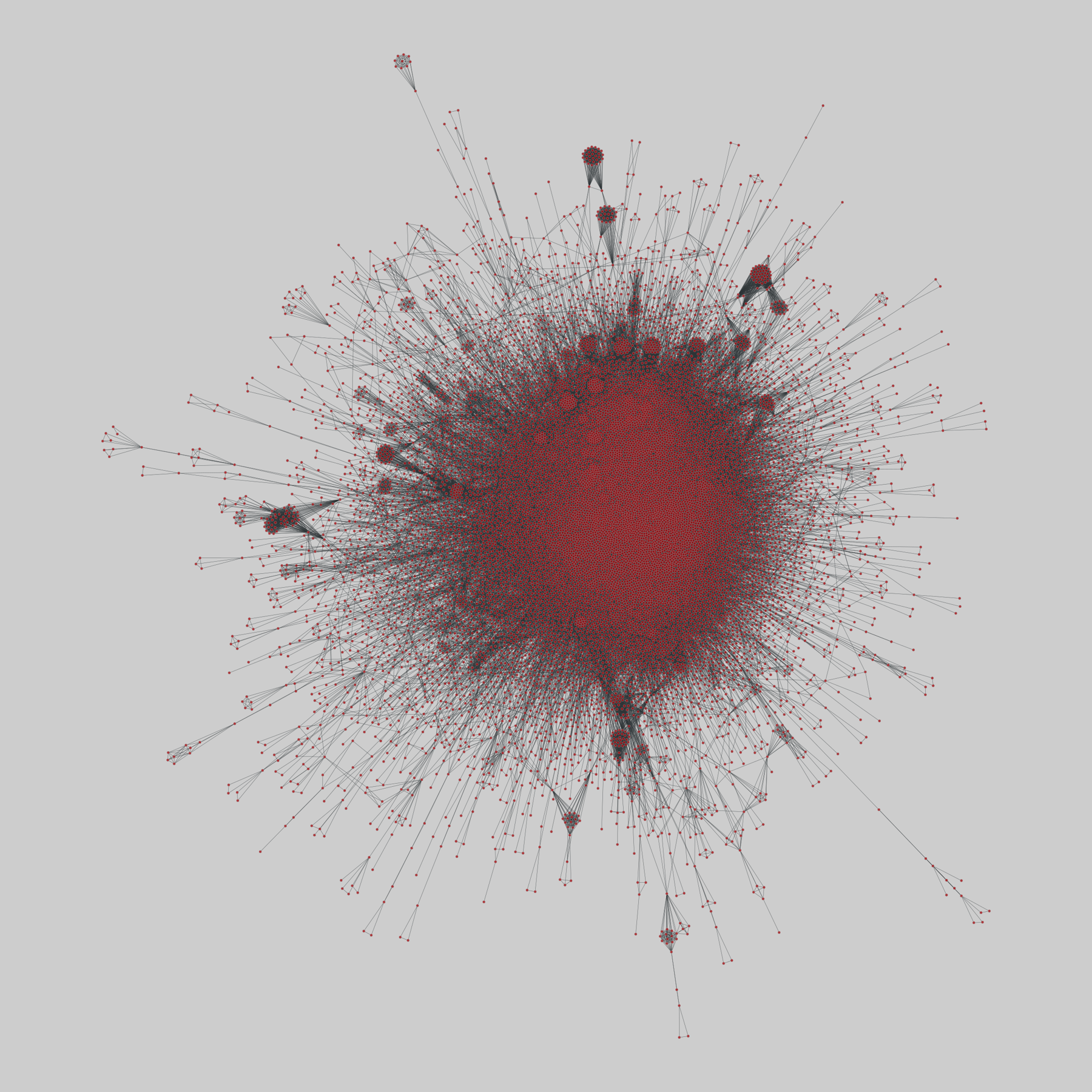
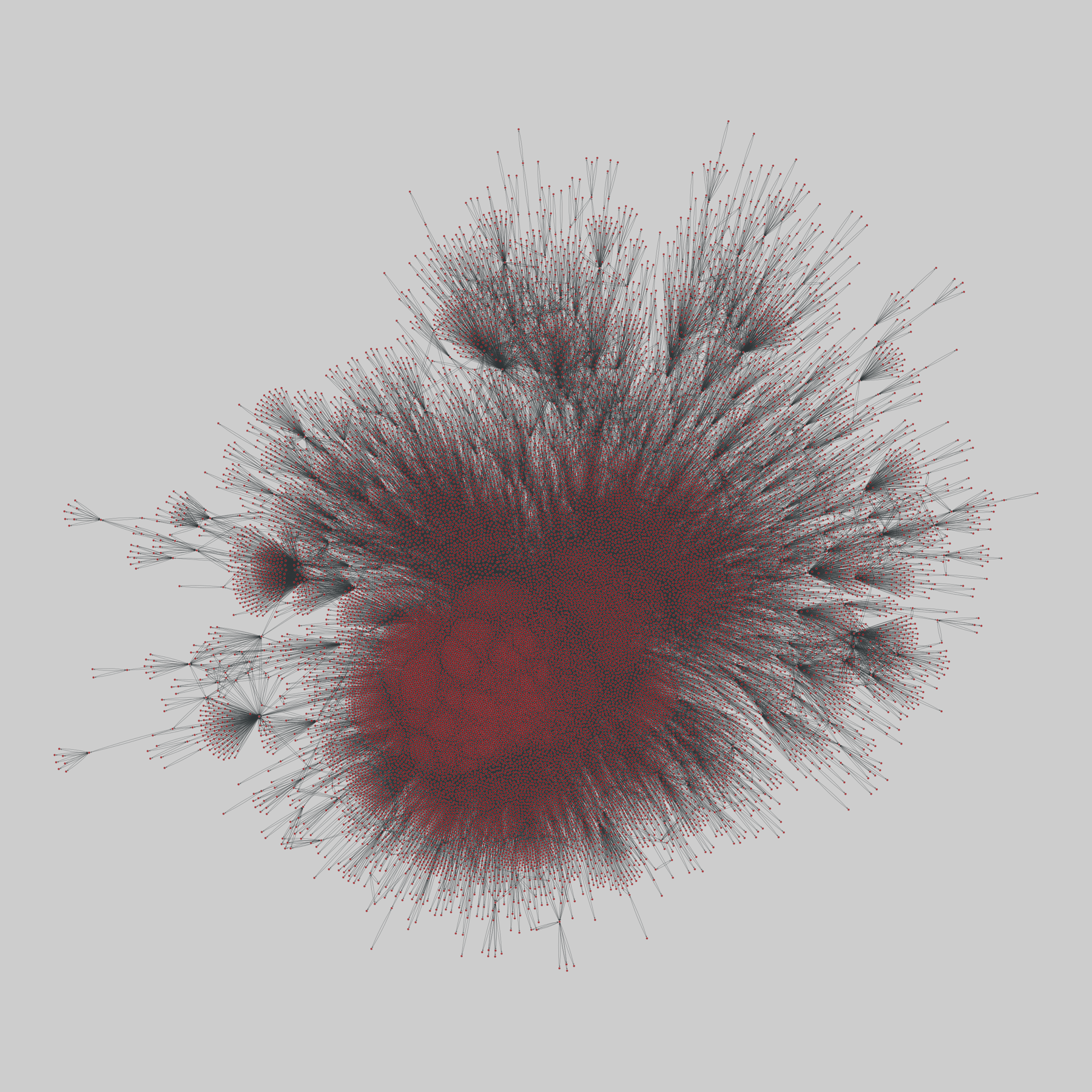
This network has 334 nodes and 32988 edges.
Tags: Informational, Web gr…

webkb: WebKB graphs (1998). 334 nodes, 32988 edges. https://networks.skewed.de/net/webkb#webkb_texas_cocite
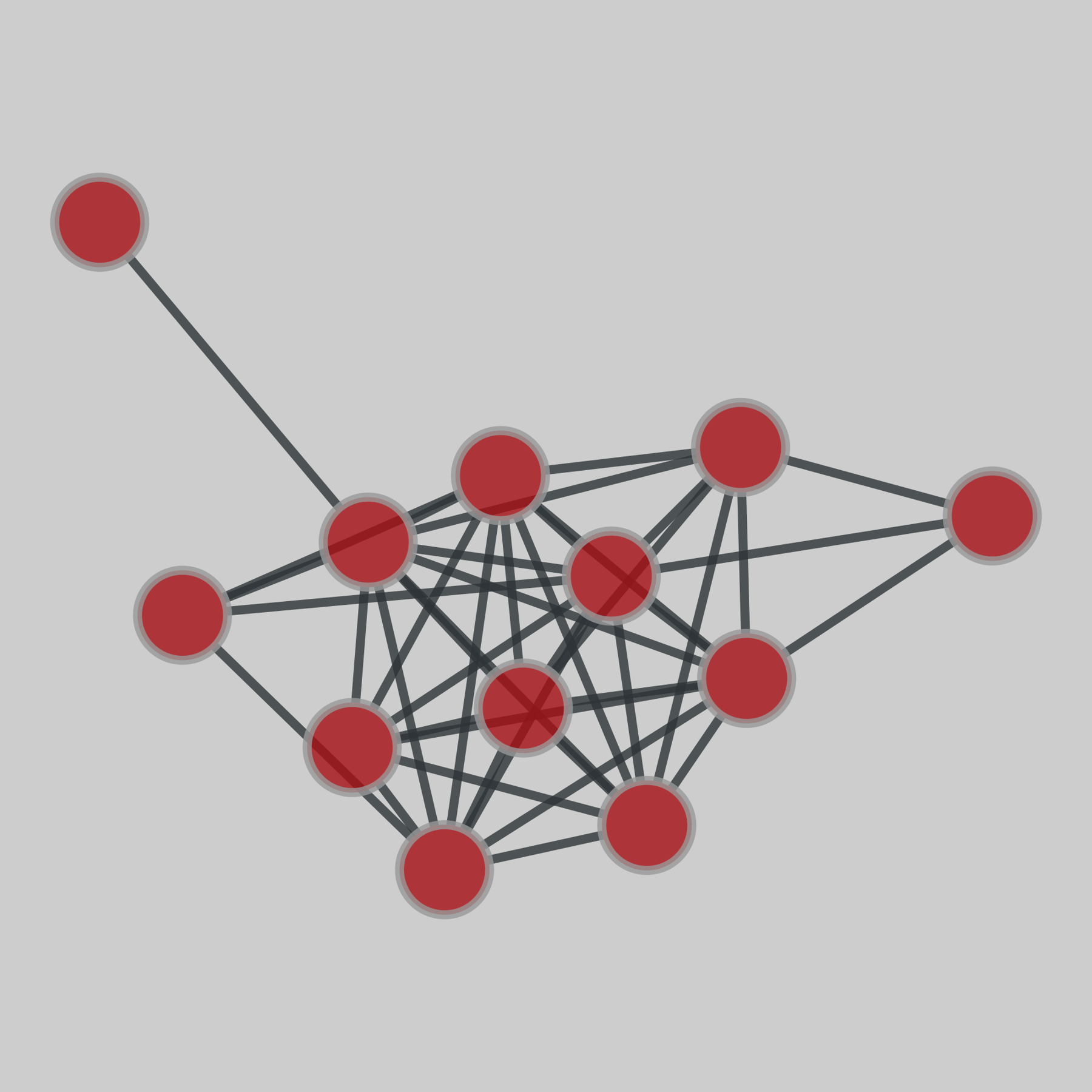
@netzschleuder@social.skewed.de
2025-11-18 03:00:04

webkb: WebKB graphs (1998)
Web graphs crawled from four Computer Science departments in 1998, with each page manually classified into one of 7 categories: course, department, faculty, project, staff, student, or other. All graphs included in a single .zip; also included are 'co-citation' graphs, which links i and j if they both point to some k. Edge weights count the number of links from i to j.
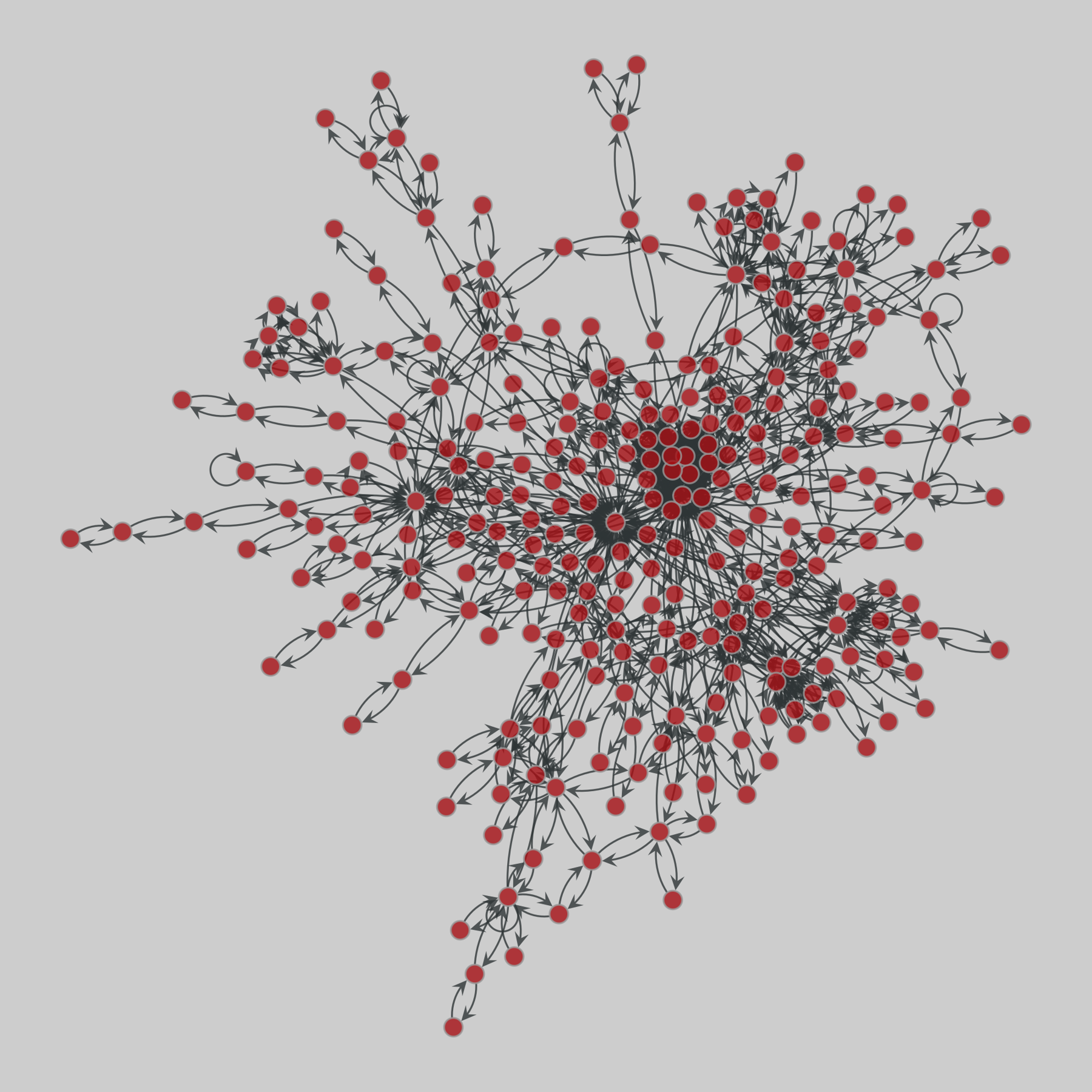
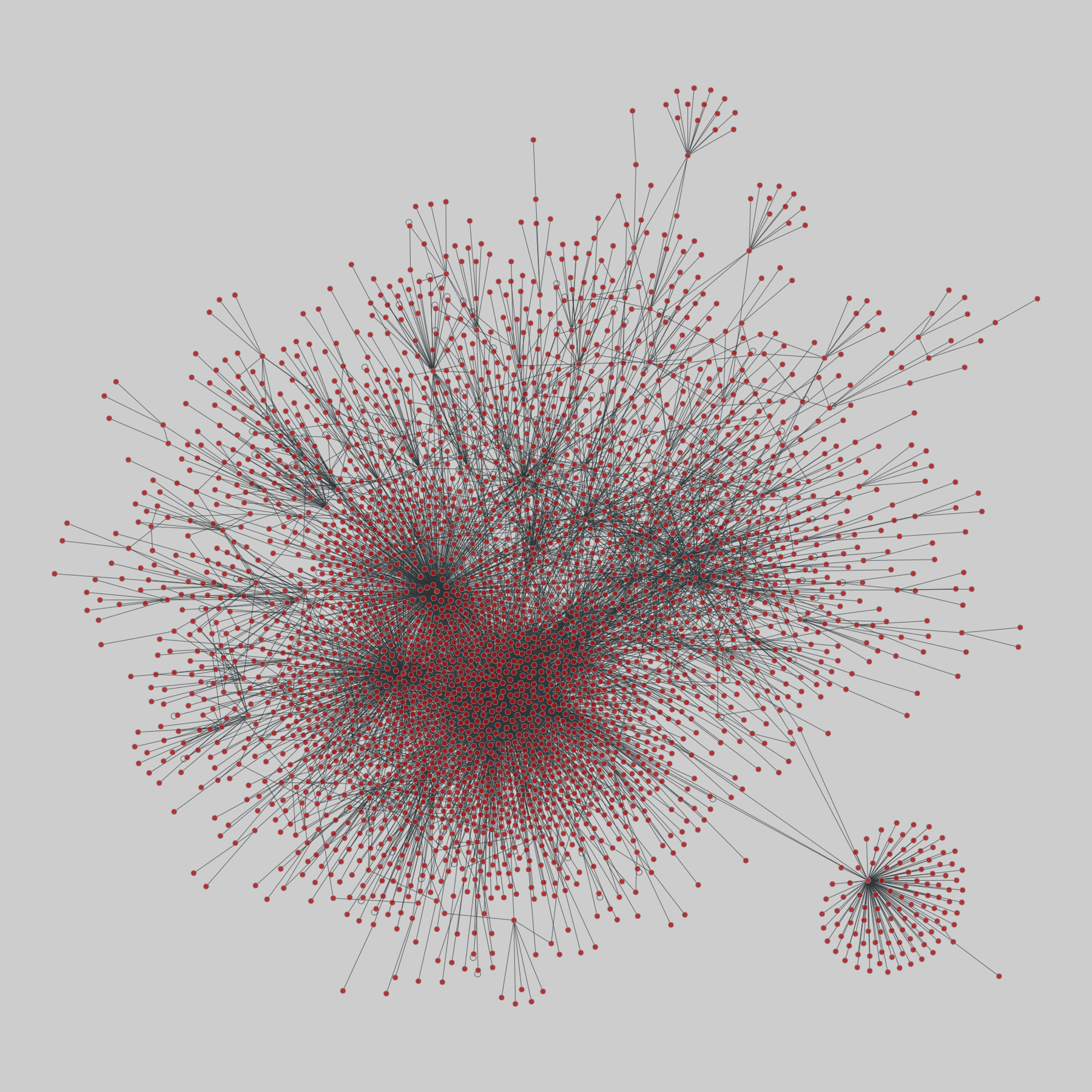
This network has 433 nodes and 1941 edges.
Tags: Informational, Web gra…

webkb: WebKB graphs (1998). 433 nodes, 1941 edges. https://networks.skewed.de/net/webkb#webkb_washington_link1
@penguin42@mastodon.org.uk
2025-12-17 16:30:17

'graphviz' is a suite of programs for drawing graphs (In the nodes/edges senses, rather than upwards and to the right sense) - and it uses a file format called 'dot'. Lots of things generate dot output (such as systemd-analyze I mentioned) and it's really easy to generate from scripts and things. 'dotty' is probably the most common program in the suite.
There are some newer formats and programs - but this one is probably the most universal.

@EarthOrgUK@mastodon.energy
2026-02-18 03:23:04

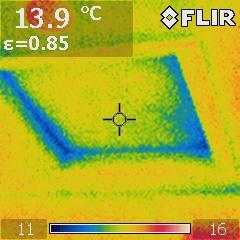
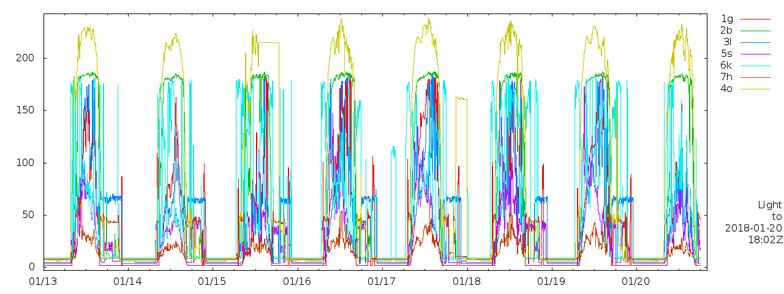
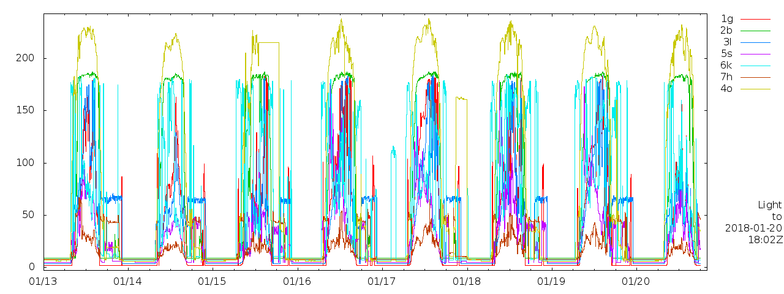
On 16WW Data Collections and Graphs - Open for research home #dataset - m.earth.org.uk/note-on-data.ht

@thomasfuchs@hachyderm.io
2026-02-17 02:23:18

When I was in my early twenties I read The Visual Display of Quantitative Information from Tufte and agonized over making charts great for users.
These days, Microsoft releases graphs like this

@azonenberg@ioc.exchange
2026-02-17 16:36:43

The outcome of a bunch of shader tuning last night: the upsample filter (4x sin(x/x) from 20M to 80M points in this test) went from 6.55 ms to 1.5 ms.
Original: 8% of peak DRAM read BW, 31% write, 14% L2$ hit rate.
New (just changed memory access patterns to be more coalesce/cache friendly): 9% read, 37% write, 73% L2$ hit
A similar memory ordering optimization cut the PAM edge detector from about 14 to 10 ms but my SM occupancy is still crap (around 12% of warp slots used)…

NSight Systems profiler screenshot showing a whole bunch of graphs of various GPU performance metrics
@pre@boing.world
2025-12-18 09:22:01

Added a zoom level to the Category page on the Exocortex-Log app. Can make the graphs look a lot cleaner now.
Looking back over the last 100 months here, we can see in general my social life is quite seasonal -- Festivals are a lot of social all weekend long and a couple of them in a month really bumps up the hours from my usual habit of sitting alone in a dark room pressing buttons.
The peak in 2019 is a summer filled with Glasto and Noisily and another festival or camping trip I don’t seem to have recorded the name of.
Then clearly visible is the drop-off in social activity as the COVID pandemic hit. Virtual-Social (IE zoom meetings and the like) picked up quite a bit around there but had died back to almost nothing way before the hours spent with actual people started to tick up.
Annoyingly, I have my biggest gap in data right on top of the pandemic there, where I failed to back up for months and then data became corrupted.
When the data-hole is over we see social life still not really returning until the middle of 2021 and not really getting back into stride until summer 2022.
It remains much lower now on average with lower peaks than before the pandemic too. Multiple reasons.
Work is pretty constant all the way though other than the data-hole. Dipping when I take time off for social mostly.
That data-hole is annoying. Back up your data kids.
#lifeLog #app #exocortexLog

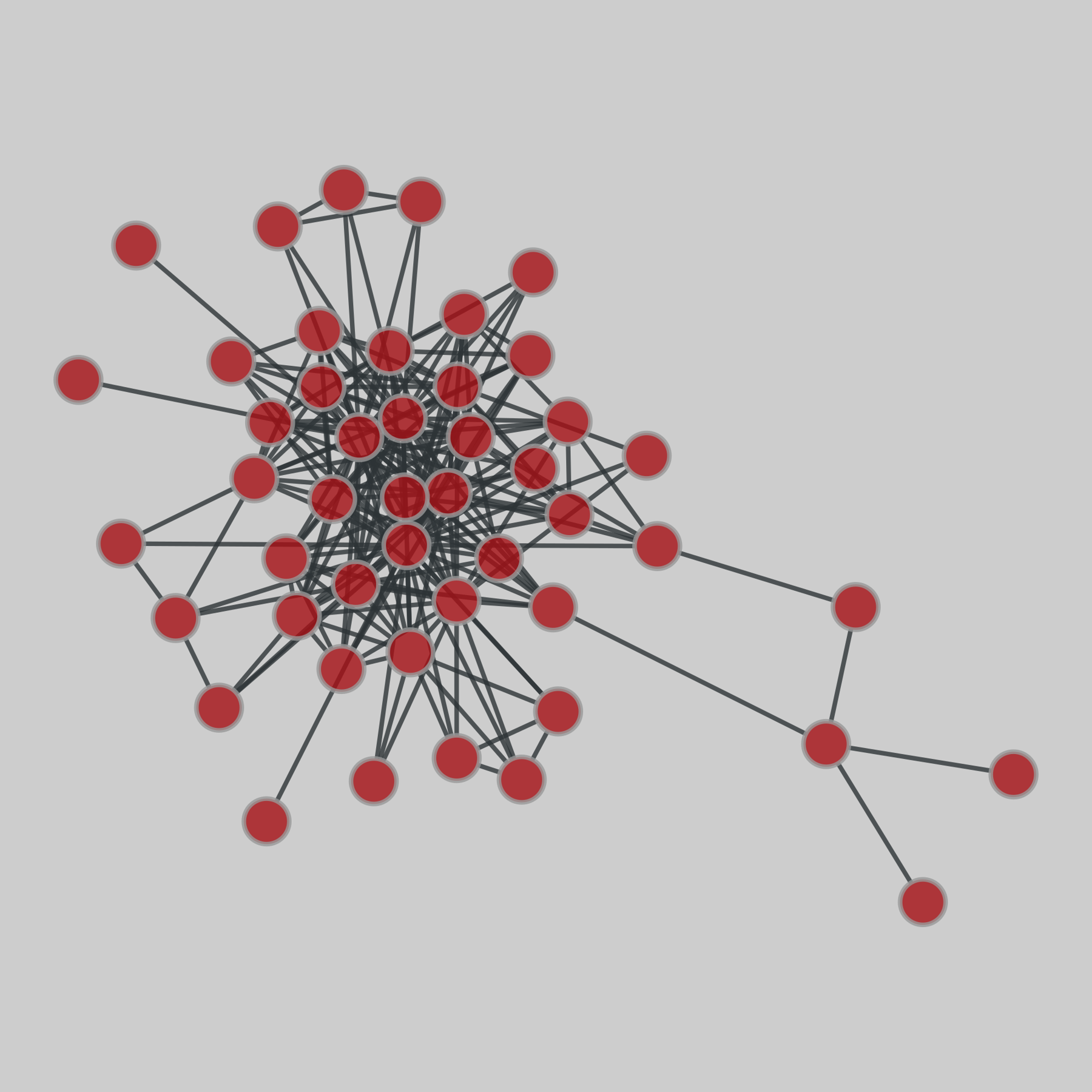
@netzschleuder@social.skewed.de
2026-02-16 06:00:05

webkb: WebKB graphs (1998)
Web graphs crawled from four Computer Science departments in 1998, with each page manually classified into one of 7 categories: course, department, faculty, project, staff, student, or other. All graphs included in a single .zip; also included are 'co-citation' graphs, which links i and j if they both point to some k. Edge weights count the number of links from i to j.
This network has 434 nodes and 30462 edges.
Tags: Informational, Web gr…

webkb: WebKB graphs (1998). 434 nodes, 30462 edges. https://networks.skewed.de/net/webkb#webkb_washington_cocite
@arXiv_mathCO_bot@mastoxiv.page
2026-01-16 08:17:56

Directed strongly regular graphs and divisible design graphs from Tatra association schemes
Mikhail Muzychuk, Grigory Ryabov
arxiv.org/abs/2601.09955

@netzschleuder@social.skewed.de
2026-01-14 15:00:04

webkb: WebKB graphs (1998)
Web graphs crawled from four Computer Science departments in 1998, with each page manually classified into one of 7 categories: course, department, faculty, project, staff, student, or other. All graphs included in a single .zip; also included are 'co-citation' graphs, which links i and j if they both point to some k. Edge weights count the number of links from i to j.
This network has 300 nodes and 1155 edges.
Tags: Informational, Web gra…

webkb: WebKB graphs (1998). 300 nodes, 1155 edges. https://networks.skewed.de/net/webkb#webkb_wisconsin_link1
@arXiv_csDS_bot@mastoxiv.page
2026-02-10 09:06:51

Local Computation Algorithms for (Minimum) Spanning Trees on Expander Graphs
Pan Peng, Yuyang Wang
arxiv.org/abs/2602.07394 arxiv.org/pdf/2602.07394 arxiv.org/html/2602.07394
arXiv:2602.07394v1 Announce Type: new
Abstract: We study \emph{local computation algorithms (LCAs)} for constructing spanning trees. In this setting, the goal is to locally determine, for each edge $ e \in E $, whether it belongs to a spanning tree $ T $ of the input graph $ G $, where $ T $ is defined implicitly by $ G $ and the randomness of the algorithm. It is known that LCAs for spanning trees do not exist in general graphs, even for simple graph families. We identify a natural and well-studied class of graphs -- \emph{expander graphs} -- that do admit \emph{sublinear-time} LCAs for spanning trees. This is perhaps surprising, as previous work on expanders only succeeded in designing LCAs for \emph{sparse spanning subgraphs}, rather than full spanning trees. We design an LCA with probe complexity $ O\left(\sqrt{n}\left(\frac{\log^2 n}{\phi^2} d\right)\right)$ for graphs with conductance at least $ \phi $ and maximum degree at most $ d $ (not necessarily constant), which is nearly optimal when $\phi$ and $d$ are constants, since $\Omega(\sqrt{n})$ probes are necessary even for expanders. Next, we show that for the natural class of \emph{\ER graphs} $ G(n, p) $ with $ np = n^{\delta} $ for any constant $ \delta > 0 $ (which are expanders with high probability), the $ \sqrt{n} $ lower bound can be bypassed. Specifically, we give an \emph{average-case} LCA for such graphs with probe complexity $ \tilde{O}(\sqrt{n^{1 - \delta}})$.
Finally, we extend our techniques to design LCAs for the \emph{minimum spanning tree (MST)} problem on weighted expander graphs. Specifically, given a $d$-regular unweighted graph $\bar{G}$ with sufficiently strong expansion, we consider the weighted graph $G$ obtained by assigning to each edge an independent and uniform random weight from $\{1,\ldots,W\}$, where $W = O(d)$. We show that there exists an LCA that is consistent with an exact MST of $G$, with probe complexity $\tilde{O}(\sqrt{n}d^2)$.
toXiv_bot_toot

@netzschleuder@social.skewed.de
2025-11-18 13:00:03

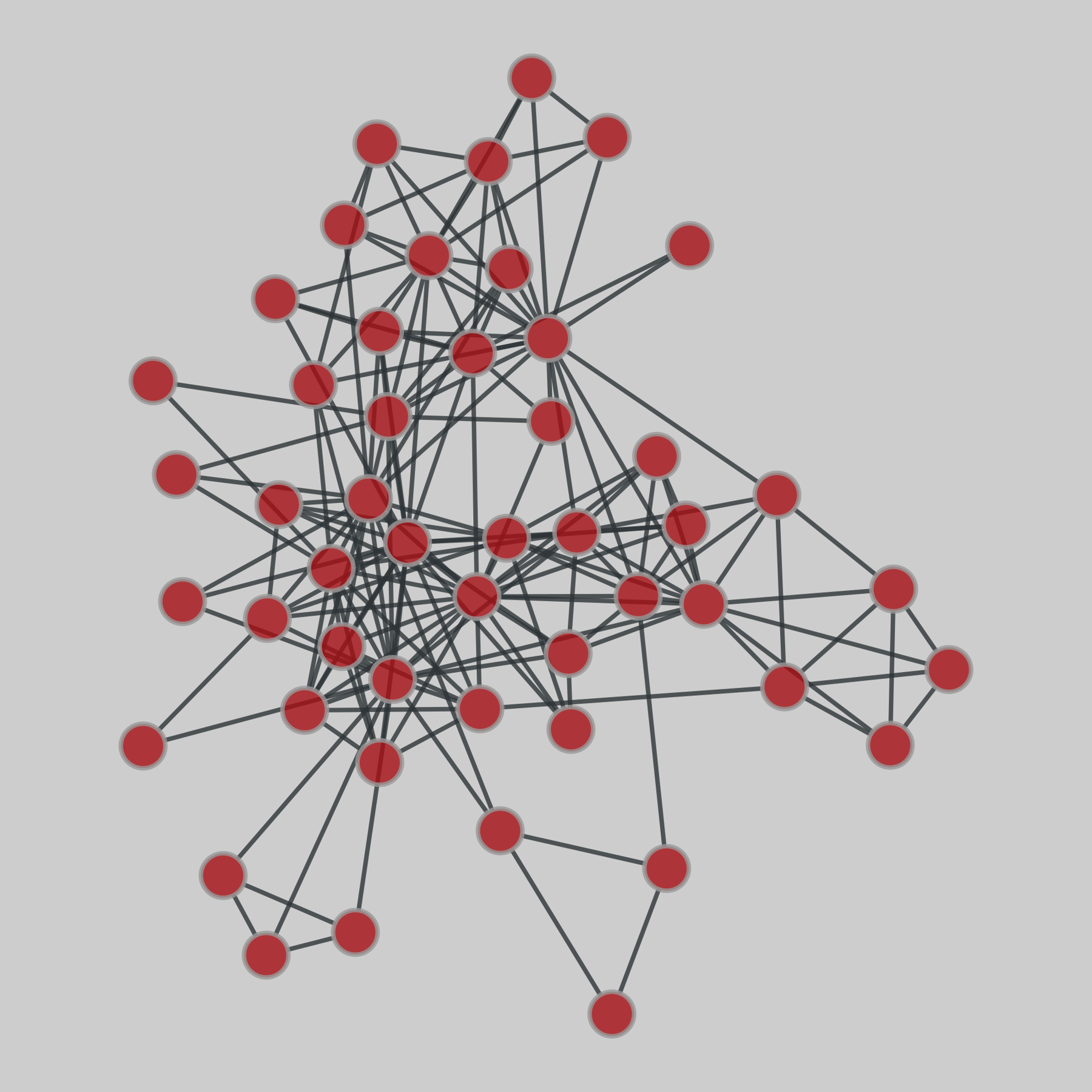
moviegalaxies: Moviegalaxies, movies 410-466 (2018)
Social graphs for over 700 movies from the moviegalaxies.com website. Each node represents a character in a movie and each edge is a same-scene appearance between two characters in that movie. The weight gives the number of same-scene appearances. Networks are extracted from movie scripts automatically.
This network has 15 nodes and 50 edges.
Tags: Social, Fictional, Weighted
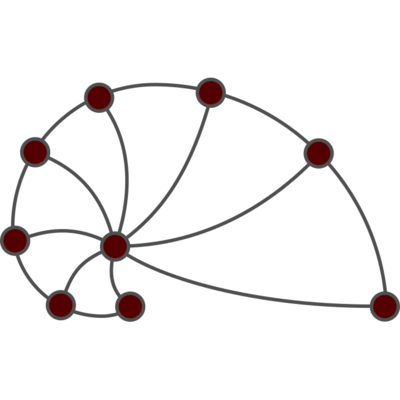
moviegalaxies: Moviegalaxies, movies 410-466 (2018). 15 nodes, 50 edges. https://networks.skewed.de/net/moviegalaxies#99
@datascience@genomic.social
2026-01-10 11:00:00

Friends Don't Let Friends Make Bad Graphs! Do you agree with the examples of bad graphs and the alternatives Chenxin Li (@chenxinli2.bsky.social) lists at #RStats

@Sustainable2050@mastodon.energy
2026-02-12 20:07:46

Now the US has chosen an admirer of Putin as president, who subsequently halted aid to Ukraine, Europe stepped up, filling most of the gap.
kielinstitut.de/publications/n

Bar graphs showing that, while US and Europe each provided about 50% of military and financial aid in 2024, US support collapsed to near zero on 2025. Europe almost filled that gap.
@netzschleuder@social.skewed.de
2025-12-16 22:00:03

moviegalaxies: Moviegalaxies, movies 410-466 (2018)
Social graphs for over 700 movies from the moviegalaxies.com website. Each node represents a character in a movie and each edge is a same-scene appearance between two characters in that movie. The weight gives the number of same-scene appearances. Networks are extracted from movie scripts automatically.
This network has 20 nodes and 30 edges.
Tags: Social, Fictional, Weighted

moviegalaxies: Moviegalaxies, movies 410-466 (2018). 20 nodes, 30 edges. https://networks.skewed.de/net/moviegalaxies#374
@netzschleuder@social.skewed.de
2025-12-15 23:00:04

arxiv_collab: Scientific collaborations in physics (1995-2005)
Collaboration graphs for scientists, extracted from the Los Alamos e-Print arXiv (physics), for 1995-1999 for three categories, and additionally for 1995-2003 and 1995-2005 for one category. For copyright reasons, the MEDLINE (biomedical research) and NCSTRL (computer science) collaboration graphs from this paper are not publicly available.
This network has 8361 nodes and 15751 edges.
Tags: Social, Collaboration…

arxiv_collab: Scientific collaborations in physics (1995-2005). 8361 nodes, 15751 edges. https://networks.skewed.de/net/arxiv_collab#hep-th-1999
@arXiv_mathCO_bot@mastoxiv.page
2026-01-16 09:09:25

On 3-Connected Planar Graphs with Unique Orientable Circuit Double Covers
Meike Wei{\ss}, Reymond Akpanya, Alice C. Niemeyer
arxiv.org/abs/2601.10171

@arXiv_csDS_bot@mastoxiv.page
2026-02-10 09:00:08

Online Algorithm for Fractional Matchings with Edge Arrivals in Graphs of Maximum Degree Three
Kanstantsin Pashkovich, Thomas Snow
arxiv.org/abs/2602.07355 arxiv.org/pdf/2602.07355 arxiv.org/html/2602.07355
arXiv:2602.07355v1 Announce Type: new
Abstract: We study online algorithms for maximum cardinality matchings with edge arrivals in graphs of low degree. Buchbinder, Segev, and Tkach showed that no online algorithm for maximum cardinality fractional matchings can achieve a competitive ratio larger than $4/(9-\sqrt 5)\approx 0.5914$ even for graphs of maximum degree three. The negative result of Buchbinder et al. holds even when the graph is bipartite and edges are revealed according to vertex arrivals, i.e. once a vertex arrives, all edges are revealed that include the newly arrived vertex and one of the previously arrived vertices. In this work, we complement the negative result of Buchbinder et al. by providing an online algorithm for maximum cardinality fractional matchings with a competitive ratio at least $4/(9-\sqrt 5)\approx 0.5914$ for graphs of maximum degree three. We also demonstrate that no online algorithm for maximum cardinality integral matchings can have the competitive guarantee $0.5807$, establishing a gap between integral and fractional matchings for graphs of maximum degree three. Note that the work of Buchbinder et al. shows that for graphs of maximum degree two, there is no such gap between fractional and integral matchings, because for both of them the best achievable competitive ratio is $2/3$. Also, our results demonstrate that for graphs of maximum degree three best possible competitive ratios for fractional matchings are the same in the vertex arrival and in the edge arrival models.
toXiv_bot_toot

@arXiv_mathPR_bot@mastoxiv.page
2026-01-15 08:24:06

Optimal factor matchings for point processes on non-amenable unimodular graphs
Yinon Spinka, Oren Yakir
arxiv.org/abs/2601.08983 arxiv.org/…

@losttourist@social.chatty.monster
2025-12-11 09:02:32

We added some extra capacity to one of our Kafka clusters at work and switched on a rebalancing job to move all the data around.
Don't worry if this means nothing to you, it's basically a fancy-arsed version of the good old Windows defrag.
Anyway, it did exactly what we wanted to do but looking at the resulting graphs of how the data moved around I think we've ended up creating the worst tube map ever.

@arXiv_mathAC_bot@mastoxiv.page
2026-02-09 08:09:47

Characterization of Some Graphs Realizing Regularity Bounds for Binomial Edge Ideals
Nursel Erey, Muhammed Ergen, Takayuki Hibi
arxiv.org/abs/2602.06524 arxiv.org/pdf/2602.06524 arxiv.org/html/2602.06524
arXiv:2602.06524v1 Announce Type: new
Abstract: In this paper, we characterize all graphs $G$ satisfying \[\operatorname{reg}(S/J_G)=\ell(G)=c(G)\] where $\ell(G)$ is the sum of the lengths of the longest induced paths in each connected component of $G$ and $c(G)$ is the number of the maximal cliques of $G$. We also characterize all connected graphs $G$ that satisfy \[\operatorname{reg}(S/J_G)=\ell(G)=|V(G)|-\omega(G) 1\] where $\omega(G)$ is the clique number of $G$. Moreover, we investigate the possible values of the regularity of $S/J_G$ within the intervals $[\ell(G), c(G)]$ and $[\ell(G), |V(G)|-\omega(G) 1]$.
toXiv_bot_toot

@burger_jaap@mastodon.social
2025-12-03 08:53:09

Managed charging of EVs (called 'smart charging' in Europe) could save California $5 - 18 billion on distribution grid upgrades by 2040. Increased electrification (transport, buildings) offsets increased infrastructure costs by -0.2-4.5¢/kWh for all.

Graphs show load profiles throughout the day. The text states that in a managed EV charging behaviour scenario, 50% of light-duty and 20% of medium and heavy-duty EVs participate.
Various graphs showing the distribution upgrade costs for 2025-2040 for the three utilities plus combined for different scenarios. The difference in 2040 between the highest scenario and the lowest scenario (managed charging) is approximately 18 billion.
@arXiv_mathCO_bot@mastoxiv.page
2026-01-16 09:35:16

The inducibility of Tur\'an graphs
Xizhi Liu, Jie Ma, Tianming Zhu
arxiv.org/abs/2601.10548 arxiv.org/pdf/2601.10548

@EarthOrgUK@mastodon.energy
2026-02-08 03:23:03

On 16WW Data Collections and Graphs - Open for research home #dataset - m.earth.org.uk/note-on-data.ht

@tiago@social.skewed.de
2025-12-04 21:14:41

I wrote a blog post about the often stated but never explained assumption that communities in graphs should always be connected.
This “connected cluster axiom” is inconsistent with statistical significance and null models that underlie the most widely employed methods.
skewed.de/lab/posts/connected-

@azonenberg@ioc.exchange
2026-02-12 08:04:48

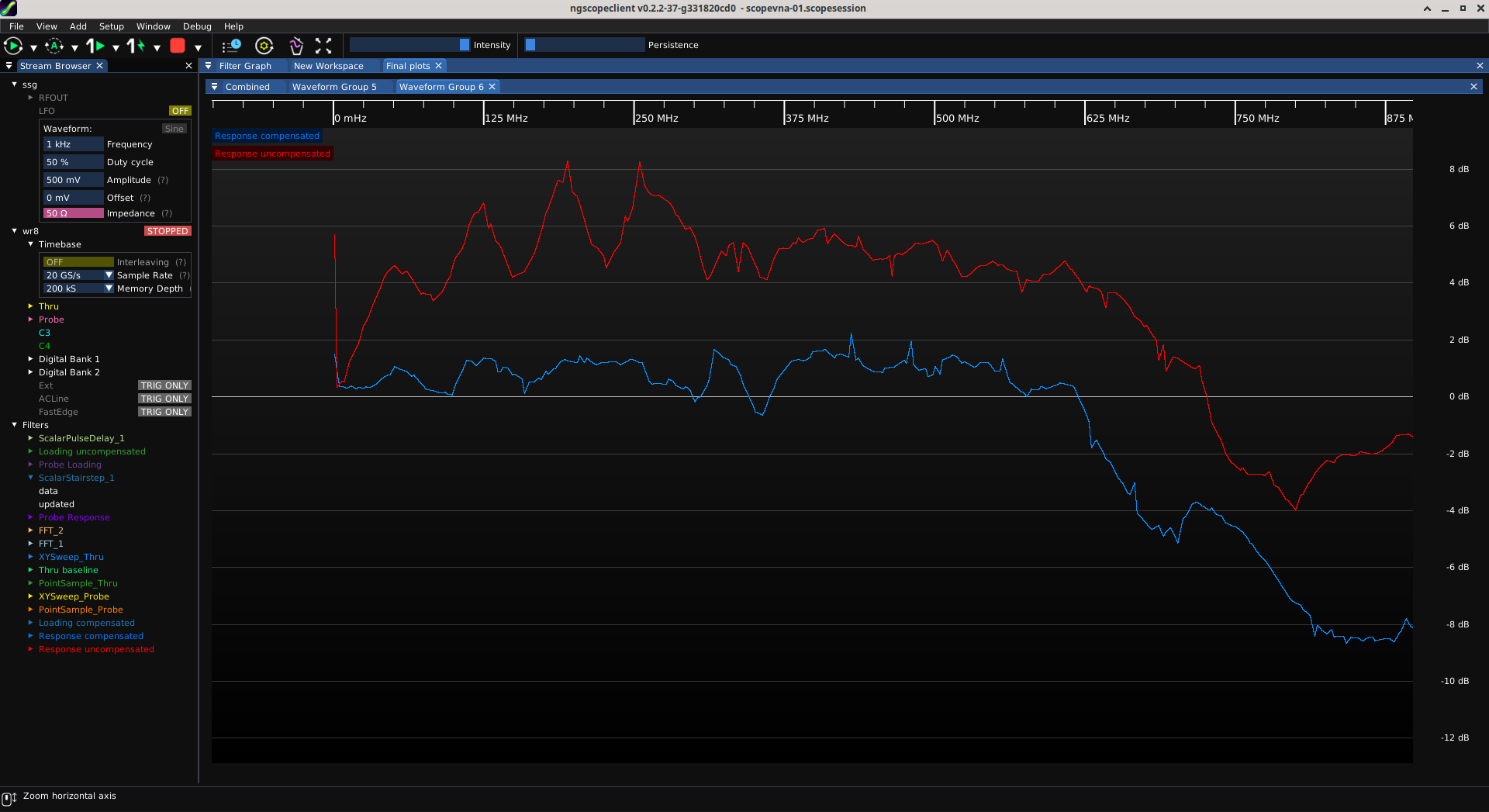
Started collecting some performance data on ngscopeclient filters as I go through and optimize/refactor.
This is nowhere near the entire filter suite, and a few rows are missing data right now.
8B/10B is still running on the CPU, as you can probably guess from the abysmal throughput, but I had it in one of my test filter graphs so I included the data.

Bar graph of filter names and throughputs in megasamples per second. Speeds range from 256 Msps for 8B/10B to 41 Gsps for threshold.
@netzschleuder@social.skewed.de
2025-12-17 08:00:03

moviegalaxies: Moviegalaxies, movies 410-466 (2018)
Social graphs for over 700 movies from the moviegalaxies.com website. Each node represents a character in a movie and each edge is a same-scene appearance between two characters in that movie. The weight gives the number of same-scene appearances. Networks are extracted from movie scripts automatically.
This network has 28 nodes and 75 edges.
Tags: Social, Fictional, Weighted

moviegalaxies: Moviegalaxies, movies 410-466 (2018). 28 nodes, 75 edges. https://networks.skewed.de/net/moviegalaxies#295
@arXiv_mathCO_bot@mastoxiv.page
2026-01-16 09:40:36

(a,b)-Fibonacci-Legendre Cordial Graphs and k-Pisano-Legendre Primes
J. D. Andoyo
arxiv.org/abs/2601.10561 arxiv.org/pdf/2601.10561<…

@datascience@genomic.social
2026-01-05 11:00:00

Visualize dependencies between functions: #rstats

@netzschleuder@social.skewed.de
2026-02-15 16:00:06

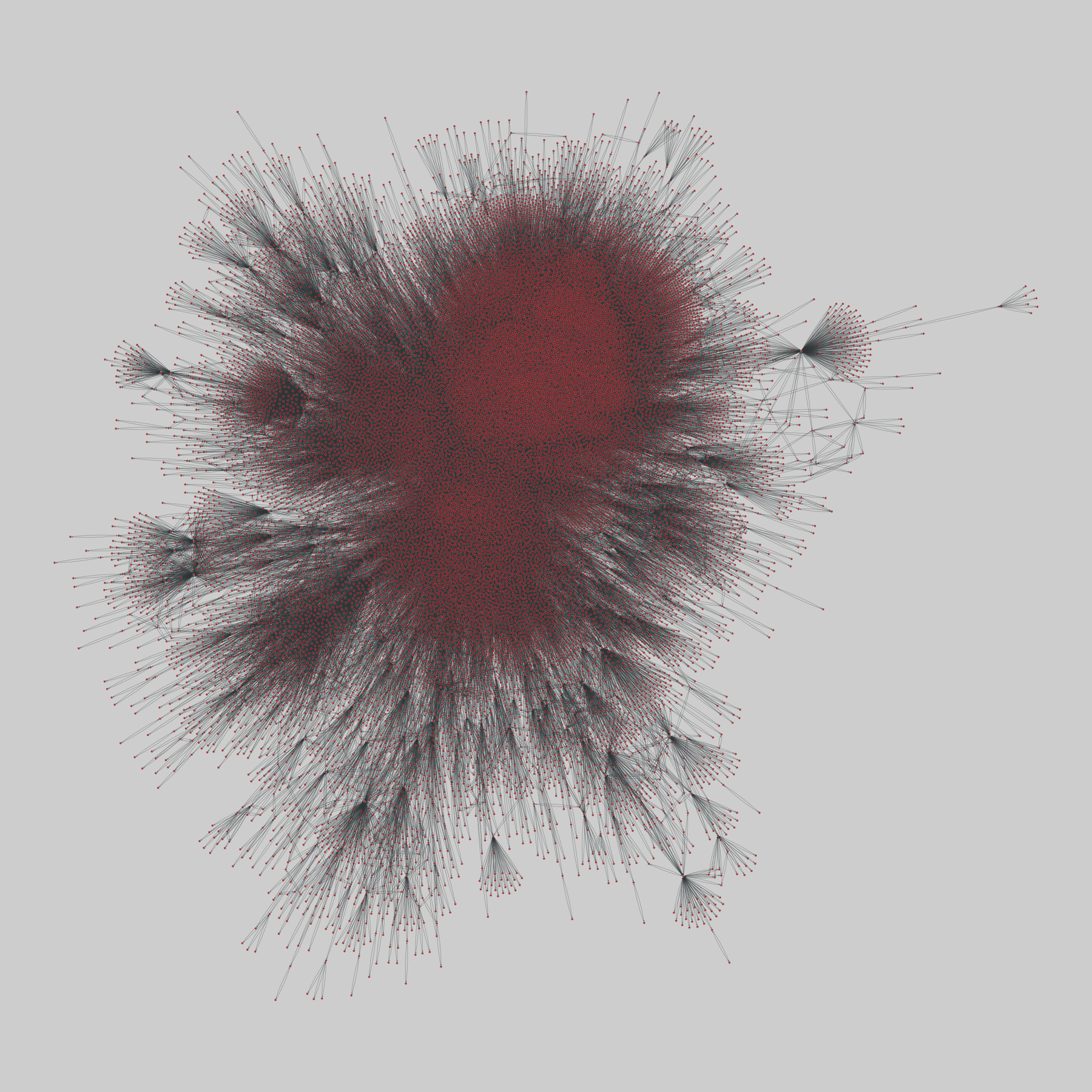
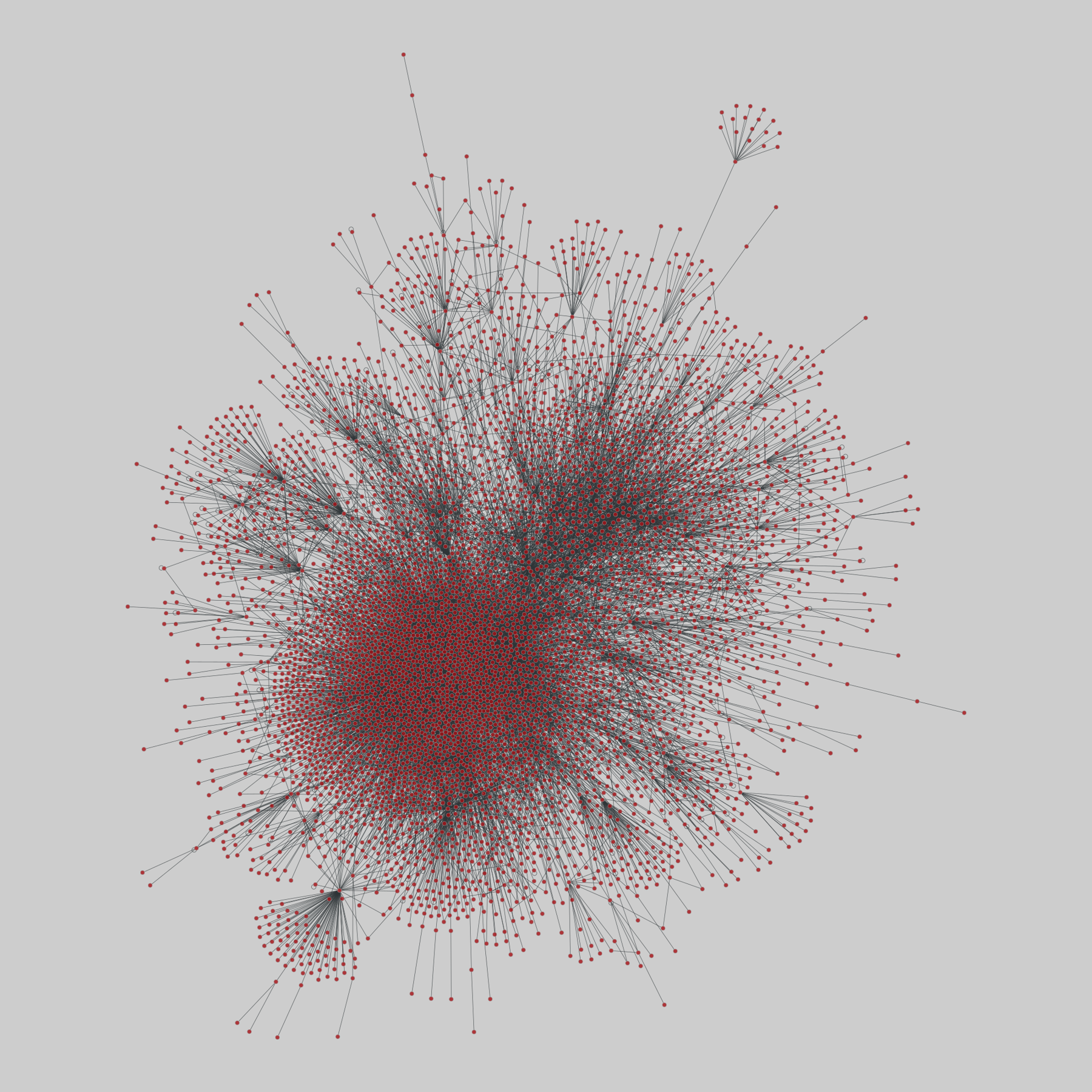
caida_as: CAIDA AS graphs (2004-2007)
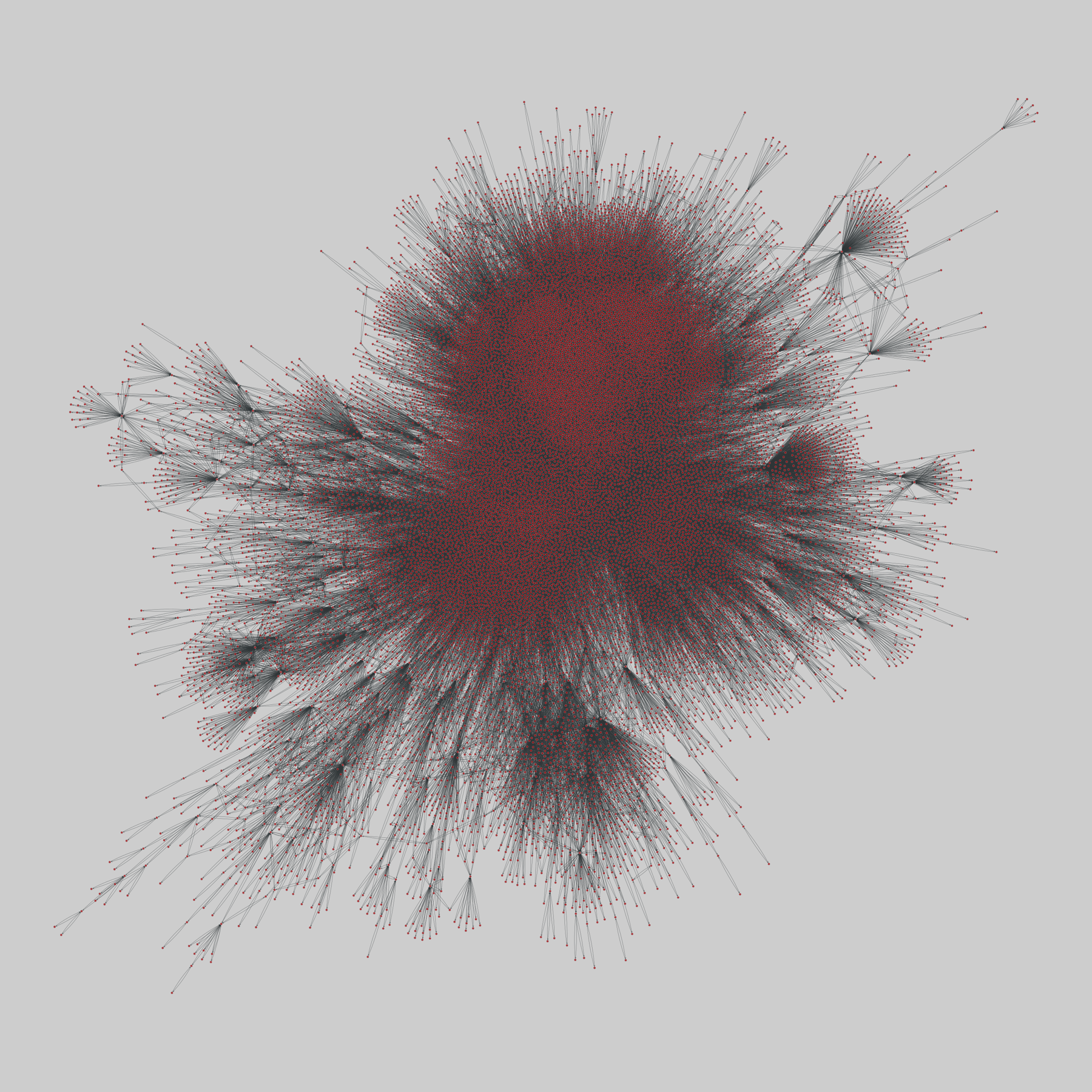
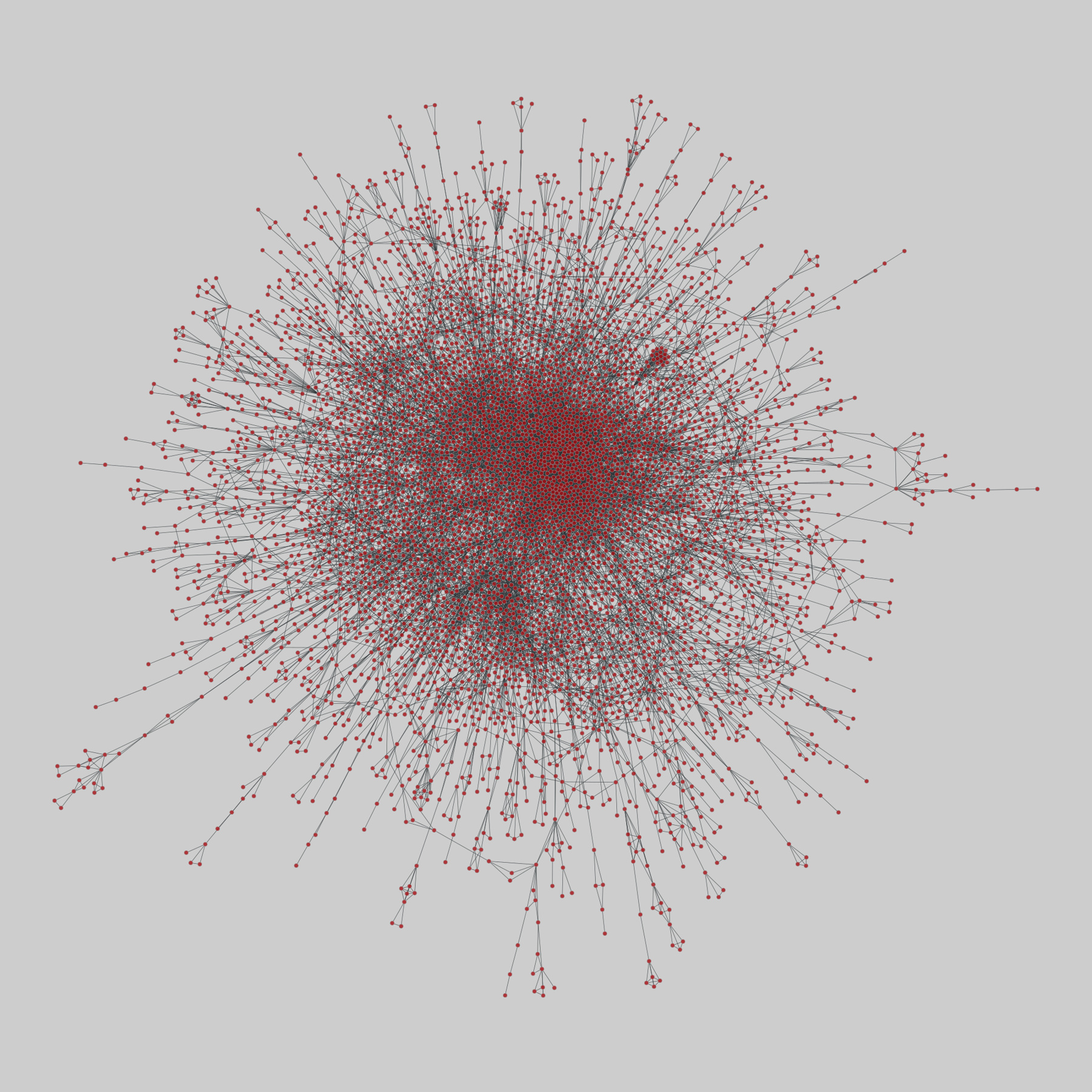
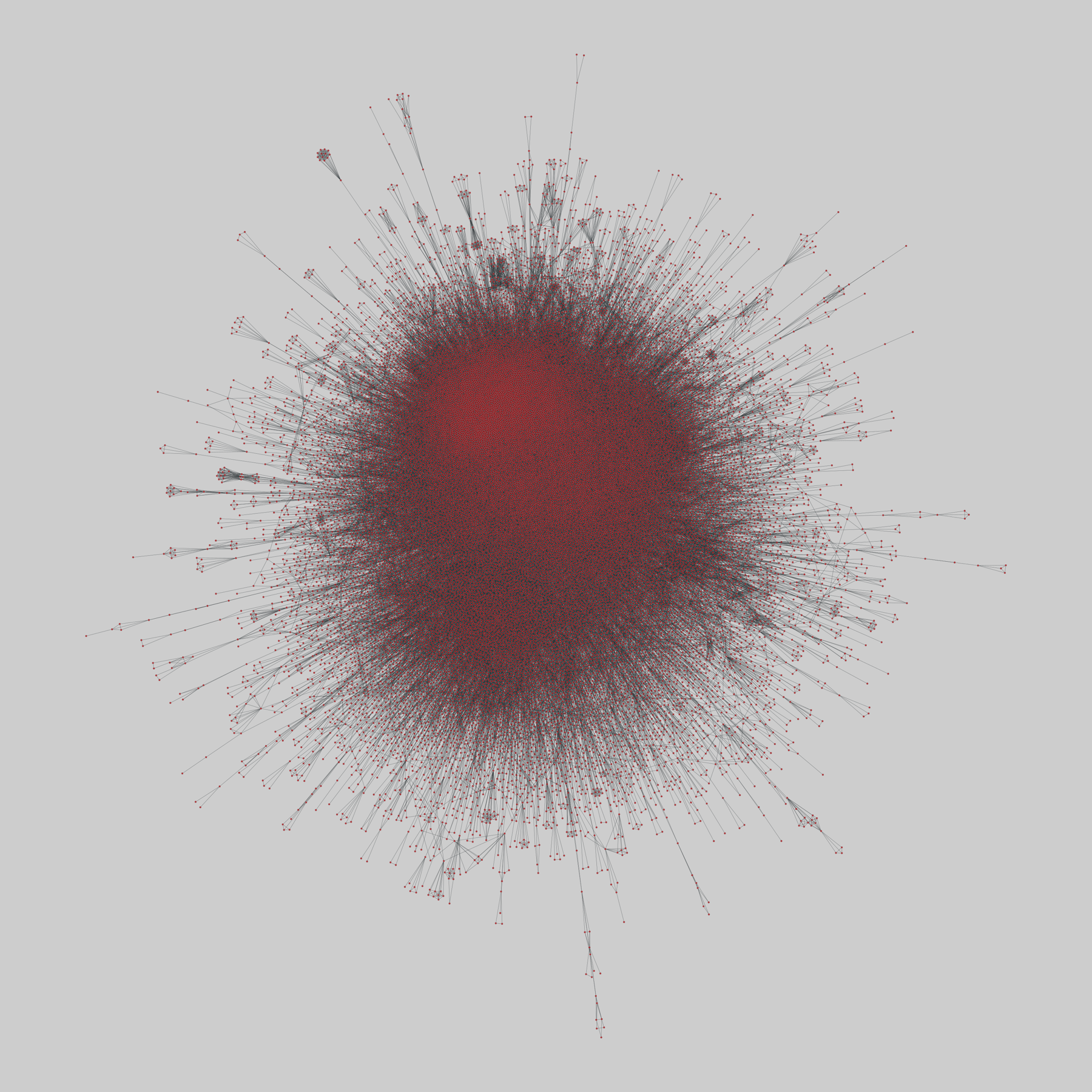
A sequence of 122 network snapshots denoting Autonomous System (AS) relationships on the Internet, from 2004-2007, inferred using the Serial-1 method from RouteViews BGP table snapshots and a set of heuristics.
This network has 25158 nodes and 102468 edges.
Tags: Technological, Communication, Unweighted, Temporal

caida_as: CAIDA AS graphs (2004-2007). 25158 nodes, 102468 edges. https://networks.skewed.de/net/caida_as#20070528
@penguin42@mastodon.org.uk
2025-12-12 16:41:31

'nut' is a UPS monitor program; you can configure your host to switch off when your UPS is running low and change settings on the UPS and monitor charge. The 'N' stands for Network - so you can do a lot of things remotely, for example making a bunch of machines speak to one host monitoring the UPS and get them all to shut down.
I also use some of my own scripts to feed it into some graphing stuff with Grafana and get pretty line voltage graphs;

A graph of line voltage and output voltage from my UPS; showing a rollercoaster of a graph going from about 230 upto about 240v
@netzschleuder@social.skewed.de
2026-02-15 05:00:05

route_views: Route Views AS graphs (1997-1998)
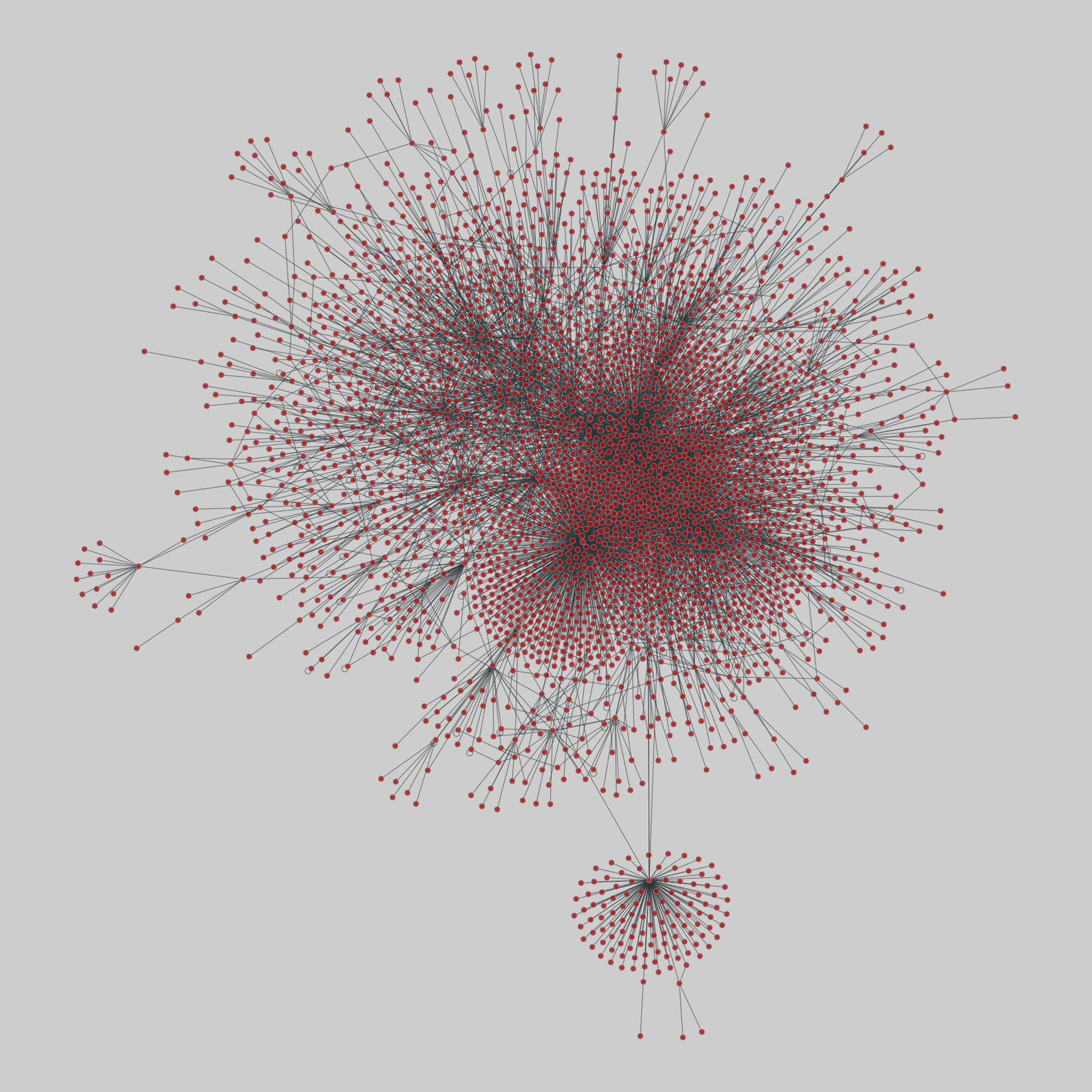
733 daily network snapshots denoting BGP traffic among autonomous systems (ASs) on the Internet, from the Oregon Route Views Project, spanning 8 November 1997 to 2 January 2000. Data collected by NLANR/MOAT.
This network has 3630 nodes and 7200 edges.
Tags: Technological, Communication, Unweighted, Temporal

route_views: Route Views AS graphs (1997-1998). 3630 nodes, 7200 edges. https://networks.skewed.de/net/route_views#19980506
@arXiv_mathCO_bot@mastoxiv.page
2026-01-16 09:30:45

On the characterization of geometric distance-regular graphs
Chenhui Lv, Jack H. Koolen
arxiv.org/abs/2601.10330 arxiv.org/pdf/2601.10330

@netzschleuder@social.skewed.de
2025-12-15 10:00:05

route_views: Route Views AS graphs (1997-1998)
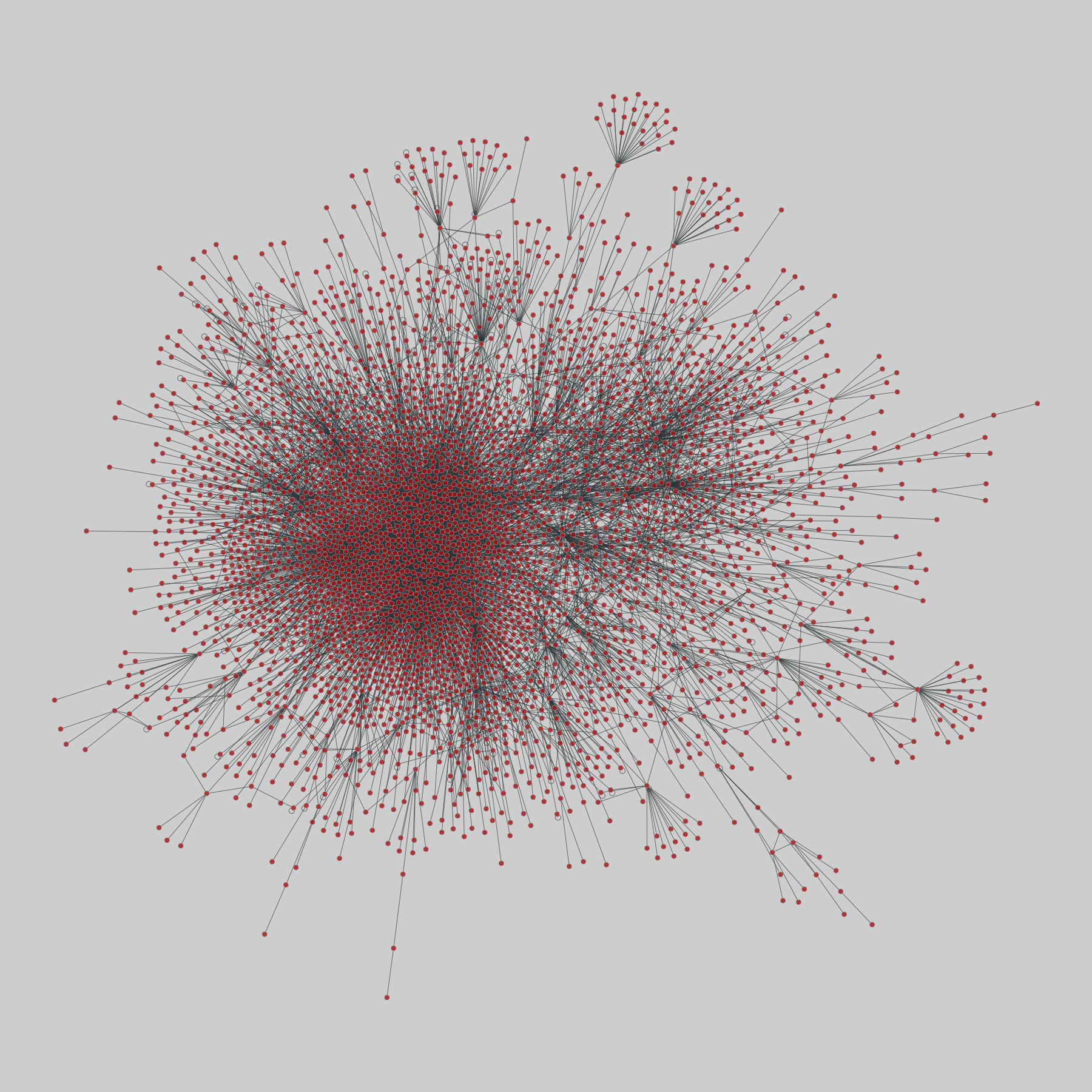
733 daily network snapshots denoting BGP traffic among autonomous systems (ASs) on the Internet, from the Oregon Route Views Project, spanning 8 November 1997 to 2 January 2000. Data collected by NLANR/MOAT.
This network has 3271 nodes and 6246 edges.
Tags: Technological, Communication, Unweighted, Temporal

route_views: Route Views AS graphs (1997-1998). 3271 nodes, 6246 edges. https://networks.skewed.de/net/route_views#19980121
@arXiv_csDS_bot@mastoxiv.page
2026-02-10 10:45:35

Incremental (k, z)-Clustering on Graphs
Emilio Cruciani, Sebastian Forster, Antonis Skarlatos
arxiv.org/abs/2602.08542 arxiv.org/pdf/2602.08542 arxiv.org/html/2602.08542
arXiv:2602.08542v1 Announce Type: new
Abstract: Given a weighted undirected graph, a number of clusters $k$, and an exponent $z$, the goal in the $(k, z)$-clustering problem on graphs is to select $k$ vertices as centers that minimize the sum of the distances raised to the power $z$ of each vertex to its closest center. In the dynamic setting, the graph is subject to adversarial edge updates, and the goal is to maintain explicitly an exact $(k, z)$-clustering solution in the induced shortest-path metric.
While efficient dynamic $k$-center approximation algorithms on graphs exist [Cruciani et al. SODA 2024], to the best of our knowledge, no prior work provides similar results for the dynamic $(k,z)$-clustering problem. As the main result of this paper, we develop a randomized incremental $(k, z)$-clustering algorithm that maintains with high probability a constant-factor approximation in a graph undergoing edge insertions with a total update time of $\tilde O(k m^{1 o(1)} k^{1 \frac{1}{\lambda}} m)$, where $\lambda \geq 1$ is an arbitrary fixed constant. Our incremental algorithm consists of two stages. In the first stage, we maintain a constant-factor bicriteria approximate solution of size $\tilde{O}(k)$ with a total update time of $m^{1 o(1)}$ over all adversarial edge insertions. This first stage is an intricate adaptation of the bicriteria approximation algorithm by Mettu and Plaxton [Machine Learning 2004] to incremental graphs. One of our key technical results is that the radii in their algorithm can be assumed to be non-decreasing while the approximation ratio remains constant, a property that may be of independent interest.
In the second stage, we maintain a constant-factor approximate $(k,z)$-clustering solution on a dynamic weighted instance induced by the bicriteria approximate solution. For this subproblem, we employ a dynamic spanner algorithm together with a static $(k,z)$-clustering algorithm.
toXiv_bot_toot

@zachleat@zachleat.com
2025-11-21 18:50:45

Pretty wild that GitHub Contribution Graphs don’t count responding to or closing issues as Activity (though *opening* issues counts 🥸)

@arXiv_mathCO_bot@mastoxiv.page
2026-01-16 09:05:06

Advances on two spectral conjectures regarding booksize of graphs
Mingqing Zhai, Rui Li, Zhenzhen Lou
arxiv.org/abs/2601.10163 arxiv.org/pd…

@azonenberg@ioc.exchange
2026-02-11 16:14:41

Thinking about future release plans for ngscopeclient.
There have been massive performance improvements and some significant bug fixes since v0.1.1 and the ThunderScope dev edition units are going to manufacture so we'll be getting a lot of additional users in ~2 months.
But there's also a lot of ongoing backend refactoring and changes to filter graph blocks that won't be strictly backwards compatible (old filter graphs will need updating) and while I freely break sof…

@netzschleuder@social.skewed.de
2026-01-07 21:00:04

webkb: WebKB graphs (1998)
Web graphs crawled from four Computer Science departments in 1998, with each page manually classified into one of 7 categories: course, department, faculty, project, staff, student, or other. All graphs included in a single .zip; also included are 'co-citation' graphs, which links i and j if they both point to some k. Edge weights count the number of links from i to j.
This network has 348 nodes and 33250 edges.
Tags: Informational, Web gr…

webkb: WebKB graphs (1998). 348 nodes, 33250 edges. https://networks.skewed.de/net/webkb#webkb_wisconsin_cocite
@datascience@genomic.social
2025-12-09 11:00:01

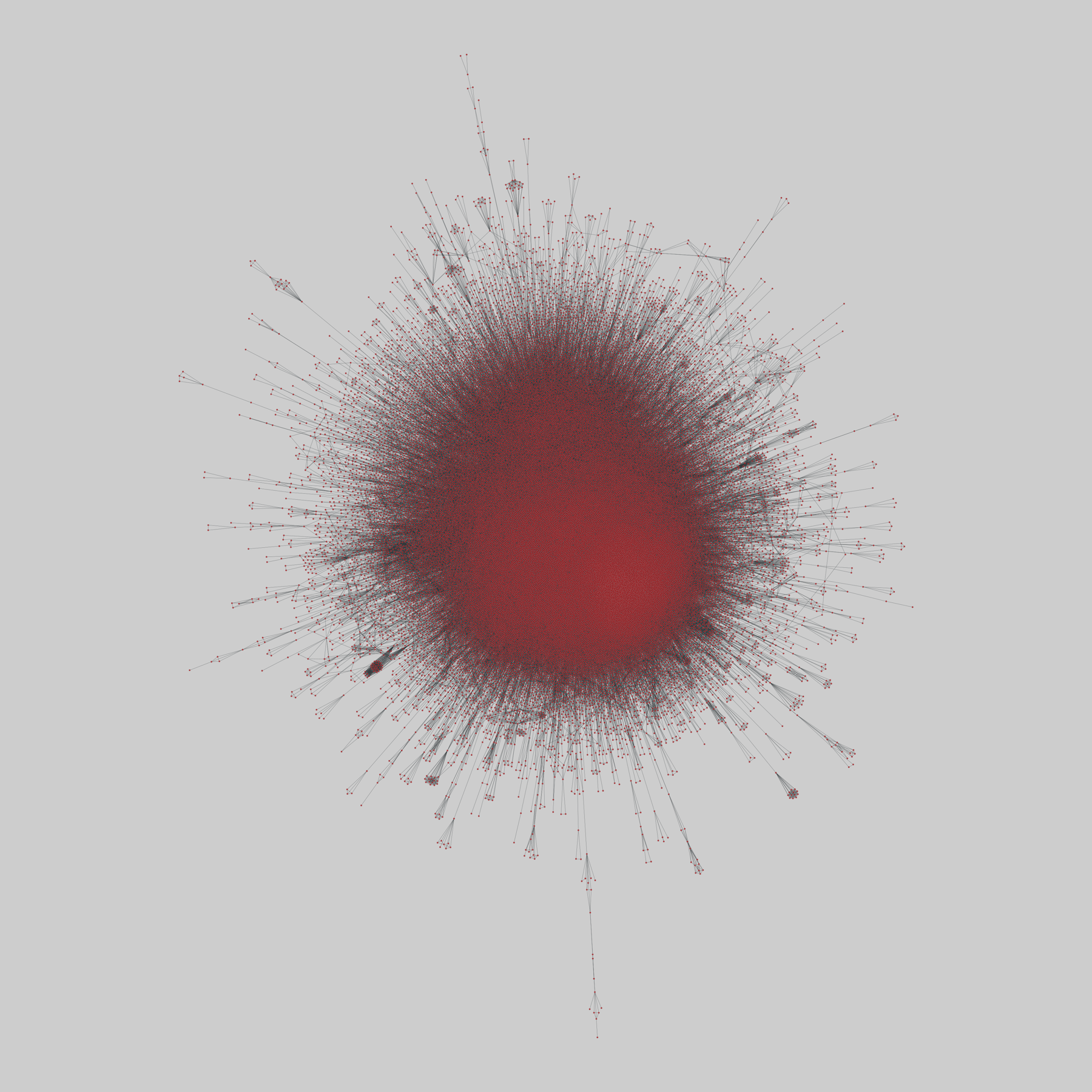
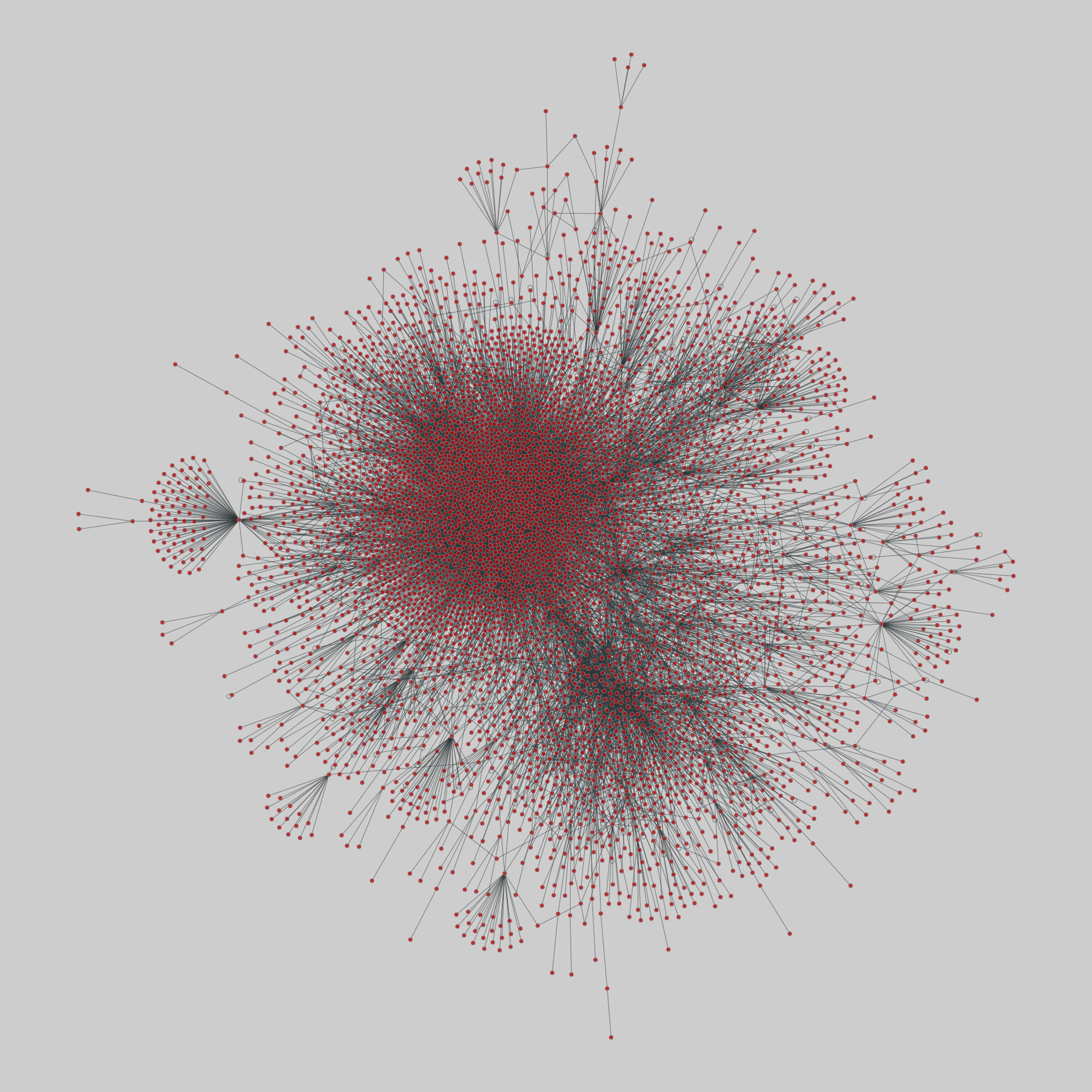
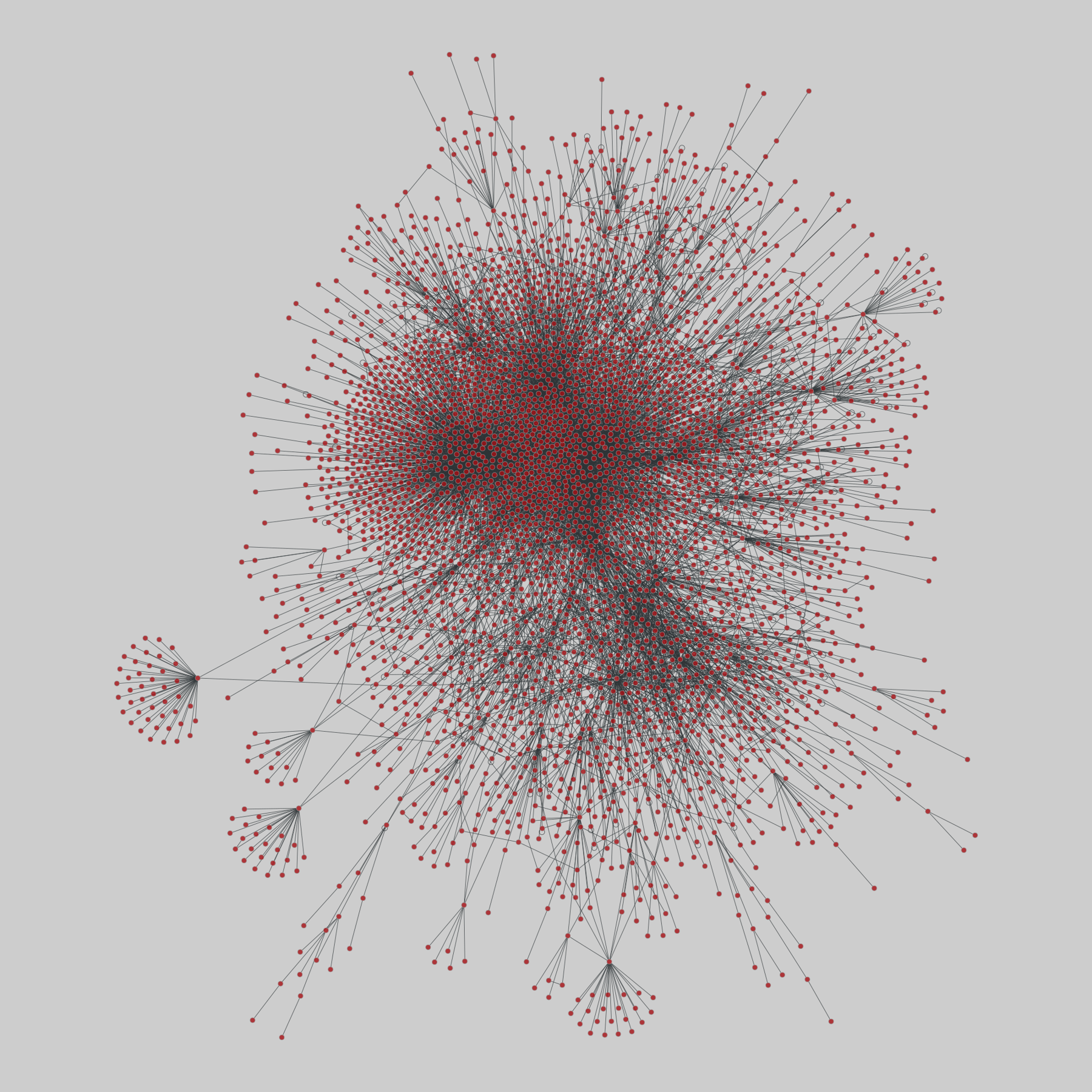
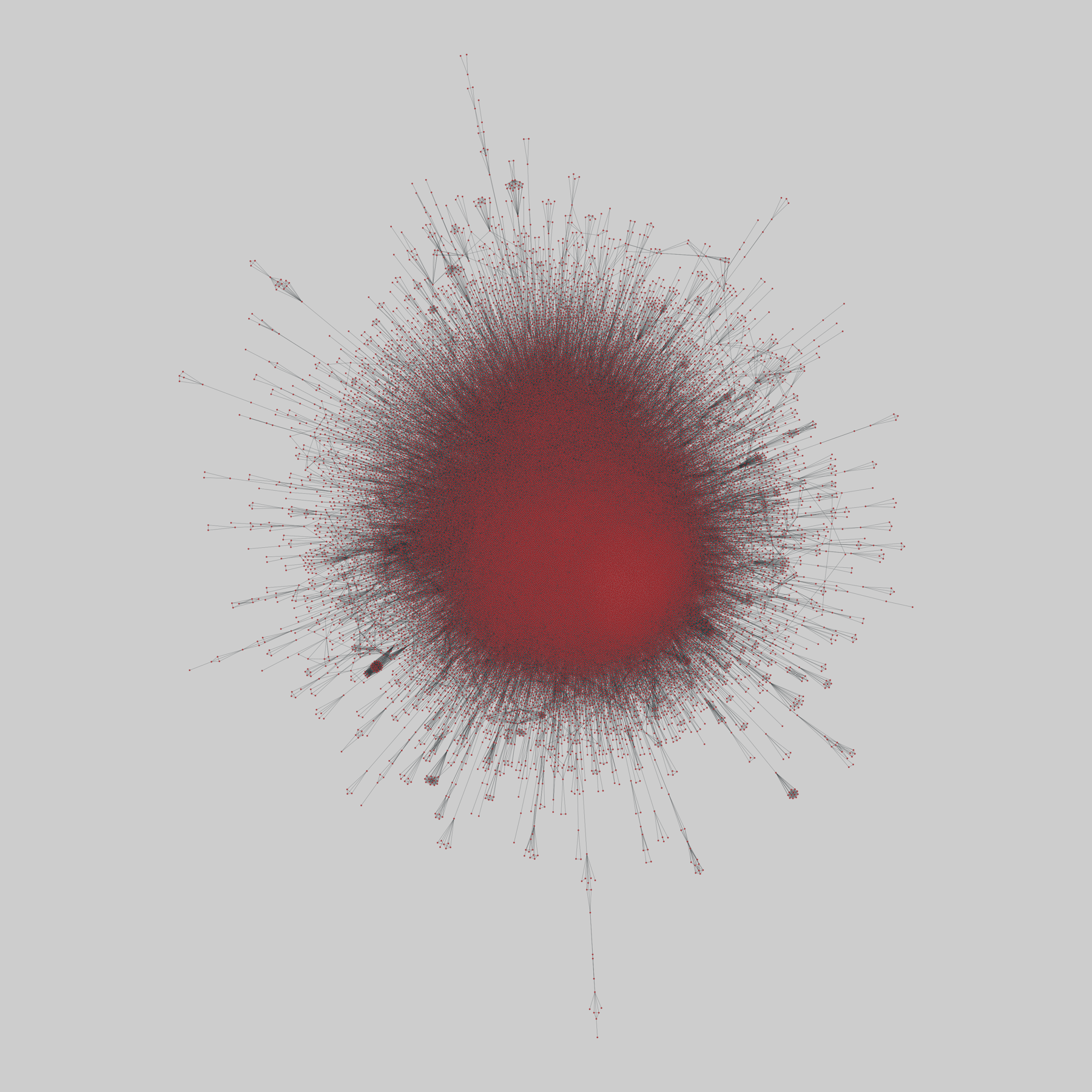
Using fonts in R graphics can be tricky at times. {showtext} aims to make it easier: #rstats

@netzschleuder@social.skewed.de
2026-01-14 03:00:05

caida_as: CAIDA AS graphs (2004-2007)
A sequence of 122 network snapshots denoting Autonomous System (AS) relationships on the Internet, from 2004-2007, inferred using the Serial-1 method from RouteViews BGP table snapshots and a set of heuristics.
This network has 23390 nodes and 92190 edges.
Tags: Technological, Communication, Unweighted, Temporal

caida_as: CAIDA AS graphs (2004-2007). 23390 nodes, 92190 edges. https://networks.skewed.de/net/caida_as#20061106
@arXiv_csDS_bot@mastoxiv.page
2026-02-10 10:36:46

Boltzmann sampling and optimal exact-size sampling for directed acyclic graphs
Wojciech Gabryelski, Zbigniew Go{\l}\c{e}biewski, Martin P\'epin
arxiv.org/abs/2602.08471 arxiv.org/pdf/2602.08471 arxiv.org/html/2602.08471
arXiv:2602.08471v1 Announce Type: new
Abstract: We propose two efficient algorithms for generating uniform random directed acyclic graphs, including an asymptotically optimal exact-size sampler that performs $\frac{n^2}{2} o(n^2)$ operations and requests to a random generator. This was achieved by extending the Boltzmann model for graphical generating functions and by using various decompositions of directed acyclic graphs. The presented samplers improve upon the state-of-the-art algorithms in terms of theoretical complexity and offer a significant speed-up in practice.
toXiv_bot_toot

@EarthOrgUK@mastodon.energy
2025-12-30 09:51:03

On 16WW Data Collections and Graphs - Open for research #dataset - earth.org.uk/note-on-data.html

@netzschleuder@social.skewed.de
2026-02-10 02:00:04

webkb: WebKB graphs (1998)
Web graphs crawled from four Computer Science departments in 1998, with each page manually classified into one of 7 categories: course, department, faculty, project, staff, student, or other. All graphs included in a single .zip; also included are 'co-citation' graphs, which links i and j if they both point to some k. Edge weights count the number of links from i to j.
This network has 286 nodes and 1002 edges.
Tags: Informational, Web gra…

webkb: WebKB graphs (1998). 286 nodes, 1002 edges. https://networks.skewed.de/net/webkb#webkb_texas_link1
@netzschleuder@social.skewed.de
2026-02-13 14:00:05

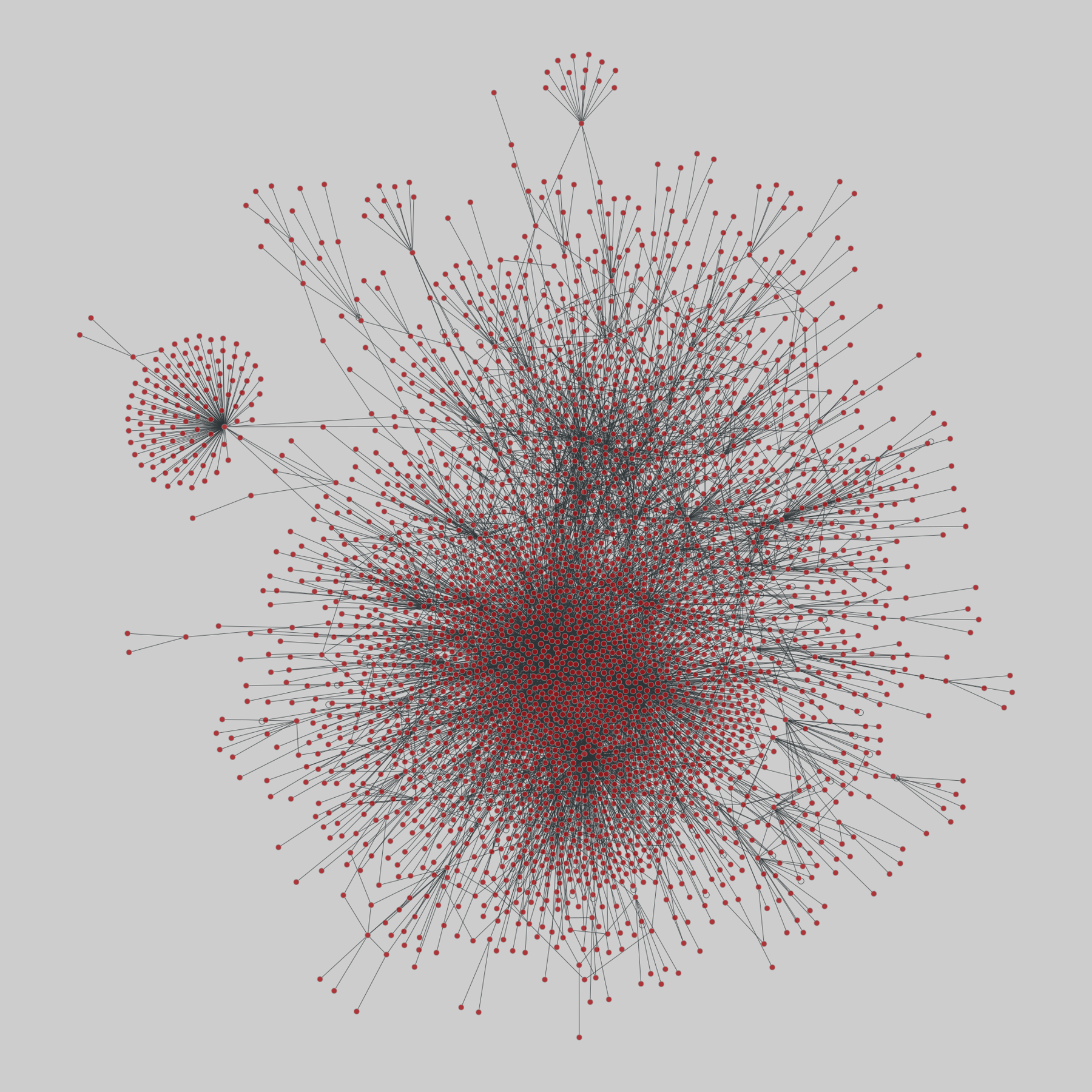
route_views: Route Views AS graphs (1997-1998)
733 daily network snapshots denoting BGP traffic among autonomous systems (ASs) on the Internet, from the Oregon Route Views Project, spanning 8 November 1997 to 2 January 2000. Data collected by NLANR/MOAT.
This network has 4407 nodes and 8932 edges.
Tags: Technological, Communication, Unweighted, Temporal

route_views: Route Views AS graphs (1997-1998). 4407 nodes, 8932 edges. https://networks.skewed.de/net/route_views#19981209
@arXiv_csDS_bot@mastoxiv.page
2026-02-10 10:15:16

Neighborhood-Aware Graph Labeling Problem
Mohammad Shahverdikondori, Sepehr Elahi, Patrick Thiran, Negar Kiyavash
arxiv.org/abs/2602.08098 arxiv.org/pdf/2602.08098 arxiv.org/html/2602.08098
arXiv:2602.08098v1 Announce Type: new
Abstract: Motivated by optimization oracles in bandits with network interference, we study the Neighborhood-Aware Graph Labeling (NAGL) problem. Given a graph $G = (V,E)$, a label set of size $L$, and local reward functions $f_v$ accessed via evaluation oracles, the objective is to assign labels to maximize $\sum_{v \in V} f_v(x_{N[v]})$, where each term depends on the closed neighborhood of $v$. Two vertices co-occur in some neighborhood term exactly when their distance in $G$ is at most $2$, so the dependency graph is the squared graph $G^2$ and $\mathrm{tw}(G^2)$ governs exact algorithms and matching fine-grained lower bounds. Accordingly, we show that this dependence is inherent: NAGL is NP-hard even on star graphs with binary labels and, assuming SETH, admits no $(L-\varepsilon)^{\mathrm{tw}(G^2)}\cdot n^{O(1)}$-time algorithm for any $\varepsilon>0$. We match this with an exact dynamic program on a tree decomposition of $G^2$ running in $O\!\left(n\cdot \mathrm{tw}(G^2)\cdot L^{\mathrm{tw}(G^2) 1}\right)$ time. For approximation, unless $\mathsf{P}=\mathsf{NP}$, for every $\varepsilon>0$ there is no polynomial-time $n^{1-\varepsilon}$-approximation on general graphs even under the promise $\mathrm{OPT}>0$; without the promise $\mathrm{OPT}>0$, no finite multiplicative approximation ratio is possible. In the nonnegative-reward regime, we give polynomial-time approximation algorithms for NAGL in two settings: (i) given a proper $q$-coloring of $G^2$, we obtain a $1/q$-approximation; and (ii) on planar graphs of bounded maximum degree, we develop a Baker-type polynomial-time approximation scheme (PTAS), which becomes an efficient PTAS (EPTAS) when $L$ is constant.
toXiv_bot_toot

@EarthOrgUK@mastodon.energy
2026-01-29 03:23:03

On 16WW Data Collections and Graphs - Open for research home #dataset - m.earth.org.uk/note-on-data.ht

@netzschleuder@social.skewed.de
2026-02-14 00:00:04

moviegalaxies: Moviegalaxies, movies 410-466 (2018)
Social graphs for over 700 movies from the moviegalaxies.com website. Each node represents a character in a movie and each edge is a same-scene appearance between two characters in that movie. The weight gives the number of same-scene appearances. Networks are extracted from movie scripts automatically.
This network has 35 nodes and 75 edges.
Tags: Social, Fictional, Weighted

moviegalaxies: Moviegalaxies, movies 410-466 (2018). 35 nodes, 75 edges. https://networks.skewed.de/net/moviegalaxies#792
@azonenberg@ioc.exchange
2026-02-04 08:29:44

Just fixed an interesting and subtle shader performance bug.
Here I'm trying to recover a clock from a PAM-3 signal which consists of two consecutive filter blocks: the PAM edge detector (find level crossings and interpolate, accounting for the fact that the threshold changes depending on start/end symbol), and then the CDR PLL proper.
If you're not familiar with NSight Systems especially on complex multithreaded applications, there's a lot going on here even though I…

Very complicated profiler view with a lot of graphs, described in main post text
@netzschleuder@social.skewed.de
2025-11-29 16:00:03

webkb: WebKB graphs (1998)
Web graphs crawled from four Computer Science departments in 1998, with each page manually classified into one of 7 categories: course, department, faculty, project, staff, student, or other. All graphs included in a single .zip; also included are 'co-citation' graphs, which links i and j if they both point to some k. Edge weights count the number of links from i to j.
This network has 346 nodes and 26832 edges.
Tags: Informational, Web gr…

webkb: WebKB graphs (1998). 346 nodes, 26832 edges. https://networks.skewed.de/net/webkb#webkb_cornell_cocite
@arXiv_mathDG_bot@mastoxiv.page
2026-01-22 11:04:17

Crosslisted article(s) found for math.DG. arxiv.org/list/math.DG/new
[1/1]:
- Random infinite ideal angled graphs and ideal hyperbolic polyhedra
Huabin Ge, Yangxiang Lu, Chuwen Wang, Tian Zhou

@netzschleuder@social.skewed.de
2025-12-26 22:00:03

webkb: WebKB graphs (1998)
Web graphs crawled from four Computer Science departments in 1998, with each page manually classified into one of 7 categories: course, department, faculty, project, staff, student, or other. All graphs included in a single .zip; also included are 'co-citation' graphs, which links i and j if they both point to some k. Edge weights count the number of links from i to j.
This network has 286 nodes and 1002 edges.
Tags: Informational, Web gra…

webkb: WebKB graphs (1998). 286 nodes, 1002 edges. https://networks.skewed.de/net/webkb#webkb_texas_link1
@arXiv_csDS_bot@mastoxiv.page
2026-02-10 09:36:57

A Faster Directed Single-Source Shortest Path Algorithm
Ran Duan, Xiao Mao, Xinkai Shu, Longhui Yin
arxiv.org/abs/2602.07868 arxiv.org/pdf/2602.07868 arxiv.org/html/2602.07868
arXiv:2602.07868v1 Announce Type: new
Abstract: This paper presents a new deterministic algorithm for single-source shortest paths (SSSP) on real non-negative edge-weighted directed graphs, with running time $O(m\sqrt{\log n} \sqrt{mn\log n\log \log n})$, which is $O(m\sqrt{\log n\log \log n})$ for sparse graphs. This improves the recent breakthrough result of $O(m\log^{2/3} n)$ time for directed SSSP algorithm [Duan, Mao, Mao, Shu, Yin 2025].
toXiv_bot_toot

@netzschleuder@social.skewed.de
2025-12-27 14:00:04

webkb: WebKB graphs (1998)
Web graphs crawled from four Computer Science departments in 1998, with each page manually classified into one of 7 categories: course, department, faculty, project, staff, student, or other. All graphs included in a single .zip; also included are 'co-citation' graphs, which links i and j if they both point to some k. Edge weights count the number of links from i to j.
This network has 433 nodes and 1941 edges.
Tags: Informational, Web gra…

webkb: WebKB graphs (1998). 433 nodes, 1941 edges. https://networks.skewed.de/net/webkb#webkb_washington_link1
@EarthOrgUK@mastodon.energy
2026-01-21 03:23:04

On 16WW Data Collections and Graphs - Open for research home #dataset - m.earth.org.uk/note-on-data.ht

@midtsveen@social.linux.pizza
2025-12-03 19:56:51

Merry Christmas, and welcome to December! 🎄 ⛄ 🎅
#Christmas #December #Santa #Advent <…

A sad-looking wojak, wearing a green hoodie and a red Santa hat, sits at a computer desk at night. He has a cigarette in his mouth and stares tiredly at a monitor displaying charts and graphs. Colorful string lights hang above the window behind him, and a smartphone lies face-up on the desk. The room is dim, with city buildings visible through the window.
@arXiv_csDS_bot@mastoxiv.page
2026-02-10 09:45:25

Space Complexity Dichotomies for Subgraph Finding Problems in the Streaming Model
Yu-Sheng Shih, Meng-Tsung Tsai, Yen-Chu Tsai, Ying-Sian Wu
arxiv.org/abs/2602.08002 arxiv.org/pdf/2602.08002 arxiv.org/html/2602.08002
arXiv:2602.08002v1 Announce Type: new
Abstract: We study the space complexity of four variants of the standard subgraph finding problem in the streaming model. Specifically, given an $n$-vertex input graph and a fixed-size pattern graph, we consider two settings: undirected simple graphs, denoted by $G$ and $H$, and oriented graphs, denoted by $\vec{G}$ and $\vec{H}$. Depending on the setting, the task is to decide whether $G$ contains $H$ as a subgraph or as an induced subgraph, or whether $\vec{G}$ contains $\vec{H}$ as a subgraph or as an induced subgraph. Let Sub$(H)$, IndSub$(H)$, Sub$(\vec{H})$, and IndSub$(\vec{H})$ denote these four variants, respectively.
An oriented graph is well-oriented if it admits a bipartition in which every arc is oriented from one part to the other, and a vertex is non-well-oriented if both its in-degree and out-degree are non-zero. For each variant, we obtain a complete dichotomy theorem, briefly summarized as follows.
(1) Sub$(H)$ can be solved by an $\tilde{O}(1)$-pass $n^{2-\Omega(1)}$-space algorithm if and only if $H$ is bipartite.
(2) IndSub$(H)$ can be solved by an $\tilde{O}(1)$-pass $n^{2-\Omega(1)}$-space algorithm if and only if $H \in \{P_3, P_4, co\mbox{-}P_3\}$.
(3) Sub$(\vec{H})$ can be solved by a single-pass $n^{2-\Omega(1)}$-space algorithm if and only if every connected component of $\vec H$ is either a well-oriented bipartite graph or a tree containing at most one non-well-oriented vertex.
(4) IndSub$(\vec{H})$ can be solved by an $\tilde{O}(1)$-pass $n^{2-\Omega(1)}$-space algorithm if and only if the underlying undirected simple graph $H$ is a $co\mbox{-}P_3$.
toXiv_bot_toot

@netzschleuder@social.skewed.de
2025-11-23 19:00:04

webkb: WebKB graphs (1998)
Web graphs crawled from four Computer Science departments in 1998, with each page manually classified into one of 7 categories: course, department, faculty, project, staff, student, or other. All graphs included in a single .zip; also included are 'co-citation' graphs, which links i and j if they both point to some k. Edge weights count the number of links from i to j.
This network has 433 nodes and 1941 edges.
Tags: Informational, Web gra…

webkb: WebKB graphs (1998). 433 nodes, 1941 edges. https://networks.skewed.de/net/webkb#webkb_washington_link1
@EarthOrgUK@mastodon.energy
2025-12-21 03:23:03

On 16WW Data Collections and Graphs - Open for research #dataset - m.earth.org.uk/note-on-data.ht

@netzschleuder@social.skewed.de
2026-01-07 15:00:05

arxiv_collab: Scientific collaborations in physics (1995-2005)
Collaboration graphs for scientists, extracted from the Los Alamos e-Print arXiv (physics), for 1995-1999 for three categories, and additionally for 1995-2003 and 1995-2005 for one category. For copyright reasons, the MEDLINE (biomedical research) and NCSTRL (computer science) collaboration graphs from this paper are not publicly available.
This network has 31163 nodes and 120029 edges.
Tags: Social, Collaborati…

arxiv_collab: Scientific collaborations in physics (1995-2005). 31163 nodes, 120029 edges. https://networks.skewed.de/net/arxiv_collab#cond-mat-2003
@penguin42@mastodon.org.uk
2026-01-18 18:13:34

Continuing in the process of measuring the speed of my turntable in the oddest way; here is the FFT before and after oiling & replacing it's belt. Hmm, it's clearly a bit fast before and a bit slow after; it's not got any speed adjustment mechanism, it's a belt on an AC driven motor.
This FFT and plot was done using #labplot using the waveforms gathered by

A set of 4 graphs, labelled Pre oil 1, Pre oil2, Post Oil1, Post oil2, with a horizontal axis of frequency, peaking at about 35Hz, a marker line at 35.55 Hz shows the pre are just faster, and the post a bit slower.
@netzschleuder@social.skewed.de
2025-12-12 15:00:03

moviegalaxies: Moviegalaxies, movies 410-466 (2018)
Social graphs for over 700 movies from the moviegalaxies.com website. Each node represents a character in a movie and each edge is a same-scene appearance between two characters in that movie. The weight gives the number of same-scene appearances. Networks are extracted from movie scripts automatically.
This network has 67 nodes and 186 edges.
Tags: Social, Fictional, Weighted

moviegalaxies: Moviegalaxies, movies 410-466 (2018). 67 nodes, 186 edges. https://networks.skewed.de/net/moviegalaxies#530
@arXiv_csLG_bot@mastoxiv.page
2025-12-22 13:54:35

Replaced article(s) found for cs.LG. arxiv.org/list/cs.LG/new
[2/5]:
- The Diffusion Duality
Sahoo, Deschenaux, Gokaslan, Wang, Chiu, Kuleshov
arxiv.org/abs/2506.10892 mastoxiv.page/@arXiv_csLG_bot/
- Multimodal Representation Learning and Fusion
Jin, Ge, Xie, Luo, Song, Bi, Liang, Guan, Yeong, Song, Hao
arxiv.org/abs/2506.20494 mastoxiv.page/@arXiv_csLG_bot/
- The kernel of graph indices for vector search
Mariano Tepper, Ted Willke
arxiv.org/abs/2506.20584 mastoxiv.page/@arXiv_csLG_bot/
- OptScale: Probabilistic Optimality for Inference-time Scaling
Youkang Wang, Jian Wang, Rubing Chen, Xiao-Yong Wei
arxiv.org/abs/2506.22376 mastoxiv.page/@arXiv_csLG_bot/
- Boosting Revisited: Benchmarking and Advancing LP-Based Ensemble Methods
Fabian Akkerman, Julien Ferry, Christian Artigues, Emmanuel Hebrard, Thibaut Vidal
arxiv.org/abs/2507.18242 mastoxiv.page/@arXiv_csLG_bot/
- MolMark: Safeguarding Molecular Structures through Learnable Atom-Level Watermarking
Runwen Hu, Peilin Chen, Keyan Ding, Shiqi Wang
arxiv.org/abs/2508.17702 mastoxiv.page/@arXiv_csLG_bot/
- Dual-Distilled Heterogeneous Federated Learning with Adaptive Margins for Trainable Global Protot...
Fatema Siddika, Md Anwar Hossen, Wensheng Zhang, Anuj Sharma, Juan Pablo Mu\~noz, Ali Jannesari
arxiv.org/abs/2508.19009 mastoxiv.page/@arXiv_csLG_bot/
- STDiff: A State Transition Diffusion Framework for Time Series Imputation in Industrial Systems
Gary Simethy, Daniel Ortiz-Arroyo, Petar Durdevic
arxiv.org/abs/2508.19011 mastoxiv.page/@arXiv_csLG_bot/
- EEGDM: Learning EEG Representation with Latent Diffusion Model
Shaocong Wang, Tong Liu, Yihan Li, Ming Li, Kairui Wen, Pei Yang, Wenqi Ji, Minjing Yu, Yong-Jin Liu
arxiv.org/abs/2508.20705 mastoxiv.page/@arXiv_csLG_bot/
- Data-Free Continual Learning of Server Models in Model-Heterogeneous Cloud-Device Collaboration
Xiao Zhang, Zengzhe Chen, Yuan Yuan, Yifei Zou, Fuzhen Zhuang, Wenyu Jiao, Yuke Wang, Dongxiao Yu
arxiv.org/abs/2509.25977 mastoxiv.page/@arXiv_csLG_bot/
- Fine-Tuning Masked Diffusion for Provable Self-Correction
Jaeyeon Kim, Seunggeun Kim, Taekyun Lee, David Z. Pan, Hyeji Kim, Sham Kakade, Sitan Chen
arxiv.org/abs/2510.01384 mastoxiv.page/@arXiv_csLG_bot/
- A Generic Machine Learning Framework for Radio Frequency Fingerprinting
Alex Hiles, Bashar I. Ahmad
arxiv.org/abs/2510.09775 mastoxiv.page/@arXiv_csLG_bot/
- ASecond-Order SpikingSSM for Wearables
Kartikay Agrawal, Abhijeet Vikram, Vedant Sharma, Vaishnavi Nagabhushana, Ayon Borthakur
arxiv.org/abs/2510.14386 mastoxiv.page/@arXiv_csLG_bot/
- Utility-Diversity Aware Online Batch Selection for LLM Supervised Fine-tuning
Heming Zou, Yixiu Mao, Yun Qu, Qi Wang, Xiangyang Ji
arxiv.org/abs/2510.16882 mastoxiv.page/@arXiv_csLG_bot/
- Seeing Structural Failure Before it Happens: An Image-Based Physics-Informed Neural Network (PINN...
Omer Jauhar Khan, Sudais Khan, Hafeez Anwar, Shahzeb Khan, Shams Ul Arifeen
arxiv.org/abs/2510.23117 mastoxiv.page/@arXiv_csLG_bot/
- Training Deep Physics-Informed Kolmogorov-Arnold Networks
Spyros Rigas, Fotios Anagnostopoulos, Michalis Papachristou, Georgios Alexandridis
arxiv.org/abs/2510.23501 mastoxiv.page/@arXiv_csLG_bot/
- Semi-Supervised Preference Optimization with Limited Feedback
Seonggyun Lee, Sungjun Lim, Seojin Park, Soeun Cheon, Kyungwoo Song
arxiv.org/abs/2511.00040 mastoxiv.page/@arXiv_csLG_bot/
- Towards Causal Market Simulators
Dennis Thumm, Luis Ontaneda Mijares
arxiv.org/abs/2511.04469 mastoxiv.page/@arXiv_csLG_bot/
- Incremental Generation is Necessary and Sufficient for Universality in Flow-Based Modelling
Hossein Rouhvarzi, Anastasis Kratsios
arxiv.org/abs/2511.09902 mastoxiv.page/@arXiv_csLG_bot/
- Optimizing Mixture of Block Attention
Guangxuan Xiao, Junxian Guo, Kasra Mazaheri, Song Han
arxiv.org/abs/2511.11571 mastoxiv.page/@arXiv_csLG_bot/
- Assessing Automated Fact-Checking for Medical LLM Responses with Knowledge Graphs
Shasha Zhou, Mingyu Huang, Jack Cole, Charles Britton, Ming Yin, Jan Wolber, Ke Li
arxiv.org/abs/2511.12817 mastoxiv.page/@arXiv_csLG_bot/
toXiv_bot_toot

@arXiv_csDS_bot@mastoxiv.page
2026-02-09 13:14:28

Replaced article(s) found for cs.DS. arxiv.org/list/cs.DS/new
[1/1]:
- Language Generation in the Limit: Noise, Loss, and Feedback
Yannan Bai, Debmalya Panigrahi, Ian Zhang
arxiv.org/abs/2507.15319 mastoxiv.page/@arXiv_csDS_bot/
- Online Firefighting on Cactus Graphs
Max Hugen, Bob Krekelberg, Alison Hsiang-Hsuan Liu
arxiv.org/abs/2509.22277 mastoxiv.page/@arXiv_csDS_bot/
- Improved Extended Regular Expression Matching
Philip Bille, Inge Li G{\o}rtz, Rikke Schjeldrup Jessen
arxiv.org/abs/2510.09311 mastoxiv.page/@arXiv_csDS_bot/
- Robust Algorithms for Finding Cliques in Random Intersection Graphs via Sum-of-Squares
Andreas G\"obel, Janosch Ruff, Leon Schiller
arxiv.org/abs/2511.20376 mastoxiv.page/@arXiv_csDS_bot/
- Analysis of Shuffling Beyond Pure Local Differential Privacy
Shun Takagi, Seng Pei Liew
arxiv.org/abs/2601.19154 mastoxiv.page/@arXiv_csDS_bot/
- Exact (n 2) Comparison Complexity for the N-Repeated Element Problem
Andrew Au
arxiv.org/abs/2601.21202 mastoxiv.page/@arXiv_csDS_bot/
- A Multi-Token Coordinate Descent Method for Semi-Decentralized Vertical Federated Learning
Pedro Valdeira, Yuejie Chi, Cl\'audia Soares, Jo\~ao Xavier
arxiv.org/abs/2309.09977
- Optimal Sequential Flows
Hugo Gimbert, Corto Mascle, Patrick Totzke
arxiv.org/abs/2511.13806 mastoxiv.page/@arXiv_mathOC_bo
toXiv_bot_toot

@netzschleuder@social.skewed.de
2025-12-21 16:00:04

webkb: WebKB graphs (1998)
Web graphs crawled from four Computer Science departments in 1998, with each page manually classified into one of 7 categories: course, department, faculty, project, staff, student, or other. All graphs included in a single .zip; also included are 'co-citation' graphs, which links i and j if they both point to some k. Edge weights count the number of links from i to j.
This network has 346 nodes and 26832 edges.
Tags: Informational, Web gr…

webkb: WebKB graphs (1998). 346 nodes, 26832 edges. https://networks.skewed.de/net/webkb#webkb_cornell_cocite
@netzschleuder@social.skewed.de
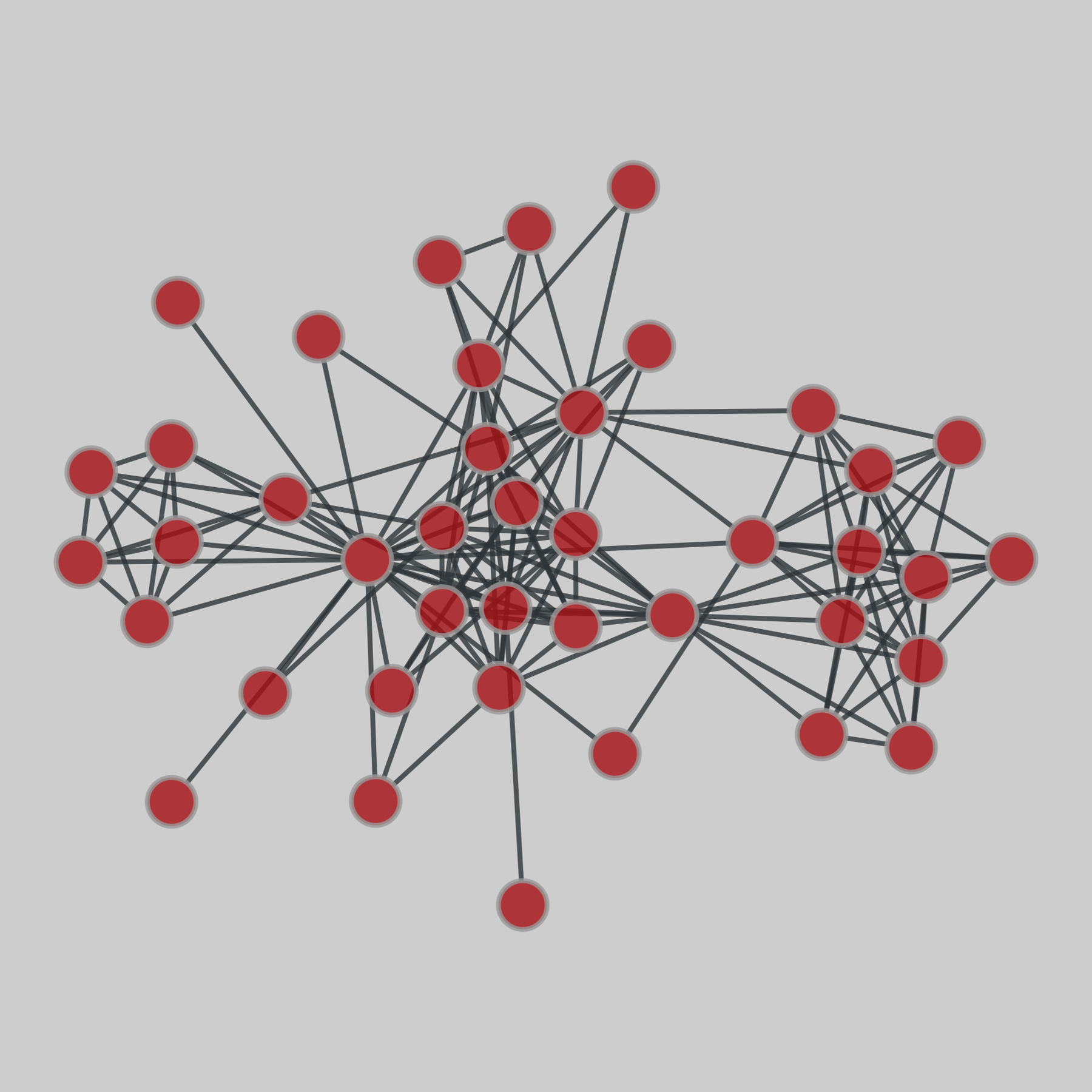
2026-01-08 01:00:04

route_views: Route Views AS graphs (1997-1998)
733 daily network snapshots denoting BGP traffic among autonomous systems (ASs) on the Internet, from the Oregon Route Views Project, spanning 8 November 1997 to 2 January 2000. Data collected by NLANR/MOAT.
This network has 3836 nodes and 7574 edges.
Tags: Technological, Communication, Unweighted, Temporal

route_views: Route Views AS graphs (1997-1998). 3836 nodes, 7574 edges. https://networks.skewed.de/net/route_views#19980720
@arXiv_csDS_bot@mastoxiv.page
2026-02-03 07:46:26

Fanciful Figurines flip Free Flood-It -- Polynomial-Time Miniature Painting on Co-gem-free Graphs
Christian Rosenke, Mark Scheibner
arxiv.org/abs/2602.00690 arxiv.org/pdf/2602.00690 arxiv.org/html/2602.00690
arXiv:2602.00690v1 Announce Type: new
Abstract: Inspired by the eponymous hobby, we introduce Miniature Painting as the computational problem to paint a given graph $G=(V,E)$ according to a prescribed template $t \colon V \rightarrow C$, which assigns colors $C$ to the vertices of $G$. In this setting, the goal is to realize the template using a shortest possible sequence of brush strokes, where each stroke overwrites a connected vertex subset with a color in $C$. We show that this problem is equivalent to a reversal of the well-studied Free Flood-It game, in which a colored graph is decolored into a single color using as few moves as possible. This equivalence allows known complexity results for Free Flood-It to be transferred directly to Miniature Painting, including NP-hardness under severe structural restrictions, such as when $G$ is a grid, a tree, or a split graph. Our main contribution is a polynomial-time algorithm for Miniature Painting on graphs that are free of induced co-gems, a graph class that strictly generalizes cographs. As a direct consequence, Free Flood-It is also polynomial-time solvable on co-gem-free graphs, independent of the initial coloring.
toXiv_bot_toot

@arXiv_csDS_bot@mastoxiv.page
2026-02-03 07:42:35

Hardness and Tractability of T_{h 1}-Free Edge Deletion
Ajinkya Gaikwad, Soumen Maity, Leeja R
arxiv.org/abs/2602.00644 arxiv.org/pdf/2602.00644 arxiv.org/html/2602.00644
arXiv:2602.00644v1 Announce Type: new
Abstract: We study the parameterized complexity of the T(h 1)-Free Edge Deletion problem. Given a graph G and integers k and h, the task is to delete at most k edges so that every connected component of the resulting graph has size at most h. The problem is NP-complete for every fixed h at least 3, while it is solvable in polynomial time for h at most 2.
Recent work showed strong hardness barriers: the problem is W[1]-hard when parameterized by the solution size together with the size of a feedback edge set, ruling out fixed-parameter tractability for many classical structural parameters. We significantly strengthen these negative results by proving W[1]-hardness when parameterized by the vertex deletion distance to a disjoint union of paths, the vertex deletion distance to a disjoint union of stars, or the twin cover number. These results unify and extend known hardness results for treewidth, pathwidth, and feedback vertex set, and show that several restrictive parameters, including treedepth, cluster vertex deletion number, and modular width, do not yield fixed-parameter tractability when h is unbounded.
On the positive side, we identify parameterizations that restore tractability. We show that the problem is fixed-parameter tractable when parameterized by cluster vertex deletion together with h, and also when parameterized by neighborhood diversity together with h via an integer linear programming formulation. We further present a fixed-parameter tractable bicriteria approximation algorithm parameterized by k. Finally, we show that the problem admits fixed-parameter tractable algorithms on split graphs and interval graphs, and we establish hardness for a directed generalization even on directed acyclic graphs.
toXiv_bot_toot

@netzschleuder@social.skewed.de

2026-02-05 09:00:05

route_views: Route Views AS graphs (1997-1998)
733 daily network snapshots denoting BGP traffic among autonomous systems (ASs) on the Internet, from the Oregon Route Views Project, spanning 8 November 1997 to 2 January 2000. Data collected by NLANR/MOAT.
This network has 4951 nodes and 10416 edges.
Tags: Technological, Communication, Unweighted, Temporal

route_views: Route Views AS graphs (1997-1998). 4951 nodes, 10416 edges. https://networks.skewed.de/net/route_views#19990421
@netzschleuder@social.skewed.de

2025-12-09 10:00:03

moviegalaxies: Moviegalaxies, movies 410-466 (2018)
Social graphs for over 700 movies from the moviegalaxies.com website. Each node represents a character in a movie and each edge is a same-scene appearance between two characters in that movie. The weight gives the number of same-scene appearances. Networks are extracted from movie scripts automatically.
This network has 26 nodes and 45 edges.
Tags: Social, Fictional, Weighted

moviegalaxies: Moviegalaxies, movies 410-466 (2018). 26 nodes, 45 edges. https://networks.skewed.de/net/moviegalaxies#562
@arXiv_csDS_bot@mastoxiv.page
2026-02-10 10:09:16

Prune, Don't Rebuild: Efficiently Tuning $\alpha$-Reachable Graphs for Nearest Neighbor Search
Tian Zhang, Ashwin Padaki, Jiaming Liang, Zack Ives, Erik Waingarten
arxiv.org/abs/2602.08097 arxiv.org/pdf/2602.08097 arxiv.org/html/2602.08097
arXiv:2602.08097v1 Announce Type: new
Abstract: Vector similarity search is an essential primitive in modern AI and ML applications. Most vector databases adopt graph-based approximate nearest neighbor (ANN) search algorithms, such as DiskANN (Subramanya et al., 2019), which have demonstrated state-of-the-art empirical performance. DiskANN's graph construction is governed by a reachability parameter $\alpha$, which gives a trade-off between construction time, query time, and accuracy. However, adaptively tuning this trade-off typically requires rebuilding the index for different $\alpha$ values, which is prohibitive at scale. In this work, we propose RP-Tuning, an efficient post-hoc routine, based on DiskANN's pruning step, to adjust the $\alpha$ parameter without reconstructing the full index. Within the $\alpha$-reachability framework of prior theoretical works (Indyk and Xu, 2023; Gollapudi et al., 2025), we prove that pruning an initially $\alpha$-reachable graph with RP-Tuning preserves worst-case reachability guarantees in general metrics and improved guarantees in Euclidean metrics. Empirically, we show that RP-Tuning accelerates DiskANN tuning on four public datasets by up to $43\times$ with negligible overhead.
toXiv_bot_toot

@netzschleuder@social.skewed.de
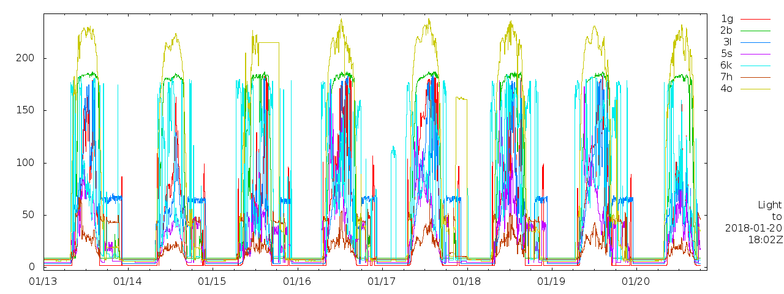
2025-11-30 11:00:04

caida_as: CAIDA AS graphs (2004-2007)
A sequence of 122 network snapshots denoting Autonomous System (AS) relationships on the Internet, from 2004-2007, inferred using the Serial-1 method from RouteViews BGP table snapshots and a set of heuristics.
This network has 22735 nodes and 92334 edges.
Tags: Technological, Communication, Unweighted, Temporal

caida_as: CAIDA AS graphs (2004-2007). 22735 nodes, 92334 edges. https://networks.skewed.de/net/caida_as#20060814
@netzschleuder@social.skewed.de
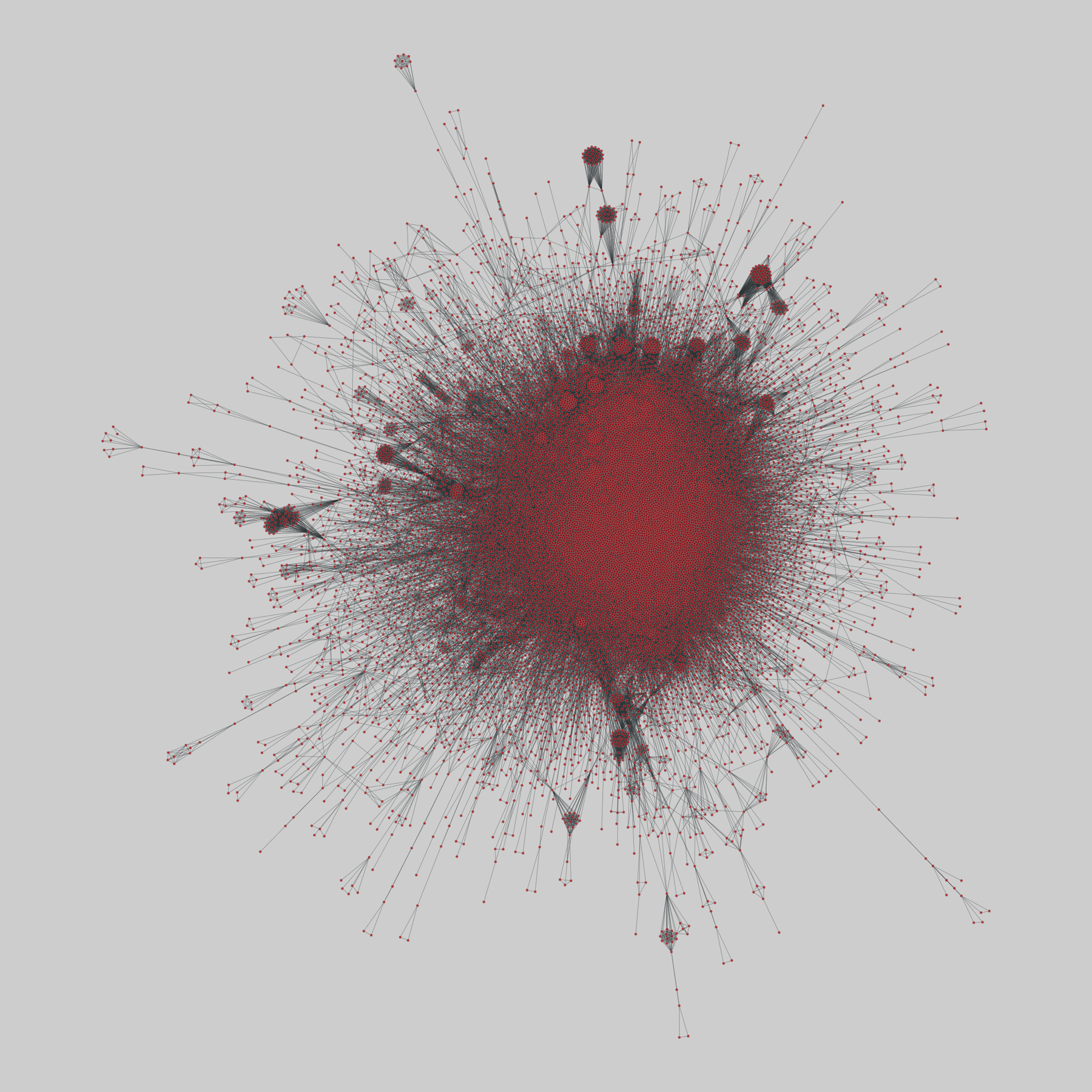
2025-12-27 06:00:04

arxiv_collab: Scientific collaborations in physics (1995-2005)
Collaboration graphs for scientists, extracted from the Los Alamos e-Print arXiv (physics), for 1995-1999 for three categories, and additionally for 1995-2003 and 1995-2005 for one category. For copyright reasons, the MEDLINE (biomedical research) and NCSTRL (computer science) collaboration graphs from this paper are not publicly available.
This network has 16706 nodes and 121251 edges.
Tags: Social, Collaborati…

arxiv_collab: Scientific collaborations in physics (1995-2005). 16706 nodes, 121251 edges. https://networks.skewed.de/net/arxiv_collab#astro-ph-1999
@netzschleuder@social.skewed.de

2026-01-25 20:00:05

arxiv_collab: Scientific collaborations in physics (1995-2005)
Collaboration graphs for scientists, extracted from the Los Alamos e-Print arXiv (physics), for 1995-1999 for three categories, and additionally for 1995-2003 and 1995-2005 for one category. For copyright reasons, the MEDLINE (biomedical research) and NCSTRL (computer science) collaboration graphs from this paper are not publicly available.
This network has 16726 nodes and 47594 edges.
Tags: Social, Collaboratio…

arxiv_collab: Scientific collaborations in physics (1995-2005). 16726 nodes, 47594 edges. https://networks.skewed.de/net/arxiv_collab#cond-mat-1999
@arXiv_csDS_bot@mastoxiv.page
2026-02-10 08:51:22

Unsplittable Transshipments
Srinwanti Debgupta, Sarah Morell, Martin Skutella
arxiv.org/abs/2602.07230 arxiv.org/pdf/2602.07230 arxiv.org/html/2602.07230
arXiv:2602.07230v1 Announce Type: new
Abstract: We introduce the Unsplittable Transshipment Problem in directed graphs with multiple sources and sinks. An unsplittable transshipment routes given supplies and demands using at most one path for each source-sink pair. Although they are a natural generalization of single source unsplittable flows, unsplittable transshipments raise interesting new challenges and require novel algorithmic techniques. As our main contribution, we give a nontrivial generalization of a seminal result of Dinitz, Garg, and Goemans (1999) by showing how to efficiently turn a given transshipment $x$ into an unsplittable transshipment $y$ with $y_a<x_a d_{\max}$ for all arcs $a$, where $d_{\max}$ is the maximum demand (or supply) value. Further results include bounds on the number of rounds required to satisfy all demands, where each round consists of an unsplittable transshipment that routes a subset of the demands while respecting arc capacity constraints.
toXiv_bot_toot

@netzschleuder@social.skewed.de

2026-01-30 10:00:05

caida_as: CAIDA AS graphs (2004-2007)
A sequence of 122 network snapshots denoting Autonomous System (AS) relationships on the Internet, from 2004-2007, inferred using the Serial-1 method from RouteViews BGP table snapshots and a set of heuristics.
This network has 22270 nodes and 90820 edges.
Tags: Technological, Communication, Unweighted, Temporal

caida_as: CAIDA AS graphs (2004-2007). 22270 nodes, 90820 edges. https://networks.skewed.de/net/caida_as#20060612
@netzschleuder@social.skewed.de

2025-12-29 14:29:08

caida_as: CAIDA AS graphs (2004-2007)
A sequence of 122 network snapshots denoting Autonomous System (AS) relationships on the Internet, from 2004-2007, inferred using the Serial-1 method from RouteViews BGP table snapshots and a set of heuristics.
This network has 24801 nodes and 101762 edges.
Tags: Technological, Communication, Unweighted, Temporal

caida_as: CAIDA AS graphs (2004-2007). 24801 nodes, 101762 edges. https://networks.skewed.de/net/caida_as#20070416
@arXiv_mathCO_bot@mastoxiv.page
2026-01-19 08:55:12

Cubic factor-invariant graphs of bialternating cycle quotient type
Primo\v{z} \v{S}parl
arxiv.org/abs/2601.11067 arxiv.org/pdf/2601.11067

@arXiv_csDS_bot@mastoxiv.page
2026-02-10 21:08:46

Replaced article(s) found for cs.DS. arxiv.org/list/cs.DS/new
[1/1]:
- Fully Dynamic Adversarially Robust Correlation Clustering in Polylogarithmic Update Time
Vladimir Braverman, Prathamesh Dharangutte, Shreyas Pai, Vihan Shah, Chen Wang
arxiv.org/abs/2411.09979 mastoxiv.page/@arXiv_csDS_bot/
- A Simple and Combinatorial Approach to Proving Chernoff Bounds and Their Generalizations
William Kuszmaul
arxiv.org/abs/2501.03488 mastoxiv.page/@arXiv_csDS_bot/
- The Structural Complexity of Matrix-Vector Multiplication
Emile Anand, Jan van den Brand, Rose McCarty
arxiv.org/abs/2502.21240 mastoxiv.page/@arXiv_csDS_bot/
- Clustering under Constraints: Efficient Parameterized Approximation Schemes
Sujoy Bhore, Ameet Gadekar, Tanmay Inamdar
arxiv.org/abs/2504.06980 mastoxiv.page/@arXiv_csDS_bot/
- Minimizing Envy and Maximizing Happiness in Graphical House Allocation
Anubhav Dhar, Ashlesha Hota, Palash Dey, Sudeshna Kolay
arxiv.org/abs/2505.00296 mastoxiv.page/@arXiv_csDS_bot/
- Fast and Simple Densest Subgraph with Predictions
Thai Bui, Luan Nguyen, Hoa T. Vu
arxiv.org/abs/2505.12600 mastoxiv.page/@arXiv_csDS_bot/
- Compressing Suffix Trees by Path Decompositions
Becker, Cenzato, Gagie, Kim, Koerkamp, Manzini, Prezza
arxiv.org/abs/2506.14734 mastoxiv.page/@arXiv_csDS_bot/
- Improved sampling algorithms and functional inequalities for non-log-concave distributions
Yuchen He, Zhehan Lei, Jianan Shao, Chihao Zhang
arxiv.org/abs/2507.11236 mastoxiv.page/@arXiv_csDS_bot/
- Deterministic Lower Bounds for $k$-Edge Connectivity in the Distributed Sketching Model
Peter Robinson, Ming Ming Tan
arxiv.org/abs/2507.11257 mastoxiv.page/@arXiv_csDS_bot/
- Optimally detecting uniformly-distributed $\ell_2$ heavy hitters in data streams
Santhoshini Velusamy, Huacheng Yu
arxiv.org/abs/2509.07286 mastoxiv.page/@arXiv_csDS_bot/
- Uncrossed Multiflows and Applications to Disjoint Paths
Chandra Chekuri, Guyslain Naves, Joseph Poremba, F. Bruce Shepherd
arxiv.org/abs/2511.00254 mastoxiv.page/@arXiv_csDS_bot/
- Dynamic Matroids: Base Packing and Covering
Tijn de Vos, Mara Grilnberger
arxiv.org/abs/2511.15460 mastoxiv.page/@arXiv_csDS_bot/
- Branch-width of connectivity functions is fixed-parameter tractable
Tuukka Korhonen, Sang-il Oum
arxiv.org/abs/2601.04756 mastoxiv.page/@arXiv_csDS_bot/
- CoinPress: Practical Private Mean and Covariance Estimation
Sourav Biswas, Yihe Dong, Gautam Kamath, Jonathan Ullman
arxiv.org/abs/2006.06618
- The Ideal Membership Problem and Abelian Groups
Andrei A. Bulatov, Akbar Rafiey
arxiv.org/abs/2201.05218
- Bridging Classical and Quantum: Group-Theoretic Approach to Quantum Circuit Simulation
Daksh Shami
arxiv.org/abs/2407.19575 mastoxiv.page/@arXiv_quantph_b
- Young domination on Hamming rectangles
Janko Gravner, Matja\v{z} Krnc, Martin Milani\v{c}, Jean-Florent Raymond
arxiv.org/abs/2501.03788 mastoxiv.page/@arXiv_mathCO_bo
- On the Space Complexity of Online Convolution
Joel Daniel Andersson, Amir Yehudayoff
arxiv.org/abs/2505.00181 mastoxiv.page/@arXiv_csCC_bot/
- Universal Solvability for Robot Motion Planning on Graphs
Anubhav Dhar, Pranav Nyati, Tanishq Prasad, Ashlesha Hota, Sudeshna Kolay
arxiv.org/abs/2506.18755 mastoxiv.page/@arXiv_csCC_bot/
- Colorful Minors
Evangelos Protopapas, Dimitrios M. Thilikos, Sebastian Wiederrecht
arxiv.org/abs/2507.10467
- Learning fermionic linear optics with Heisenberg scaling and physical operations
Aria Christensen, Andrew Zhao
arxiv.org/abs/2602.05058
toXiv_bot_toot

@netzschleuder@social.skewed.de
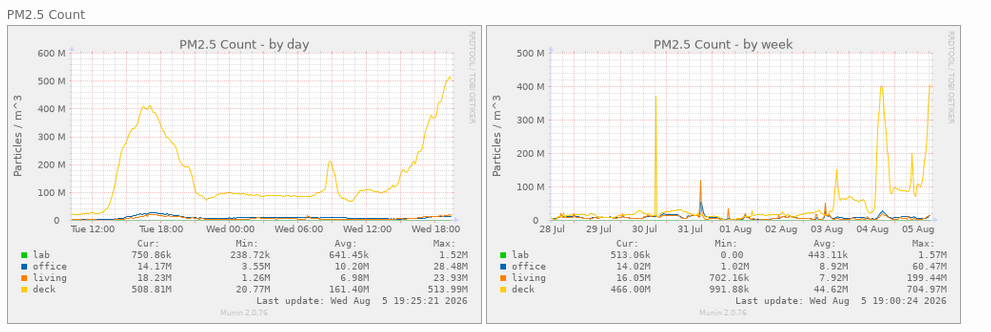
2026-01-21 04:00:05

arxiv_collab: Scientific collaborations in physics (1995-2005)
Collaboration graphs for scientists, extracted from the Los Alamos e-Print arXiv (physics), for 1995-1999 for three categories, and additionally for 1995-2003 and 1995-2005 for one category. For copyright reasons, the MEDLINE (biomedical research) and NCSTRL (computer science) collaboration graphs from this paper are not publicly available.
This network has 40421 nodes and 175692 edges.
Tags: Social, Collaborati…

arxiv_collab: Scientific collaborations in physics (1995-2005). 40421 nodes, 175692 edges. https://networks.skewed.de/net/arxiv_collab#cond-mat-2005
@arXiv_mathCO_bot@mastoxiv.page
2026-01-19 09:26:02

Highly regular vertex-transitive graphs are globally rigid
Angelo El Saliby
arxiv.org/abs/2601.11240 arxiv.org/pdf/2601.11240

@arXiv_csDS_bot@mastoxiv.page
2026-02-10 16:11:59

Crosslisted article(s) found for cs.DS. arxiv.org/list/cs.DS/new
[1/1]:
- Graph-Based Nearest-Neighbor Search without the Spread
Jeff Giliberti, Sariel Har-Peled, Jonas Sauer, Ali Vakilian
arxiv.org/abs/2602.06633 mastoxiv.page/@arXiv_csCG_bot/
- Tensor Hinted Mv Conjectures
Zhao Song
arxiv.org/abs/2602.07242 mastoxiv.page/@arXiv_csCC_bot/
- Compact Conformal Subgraphs
Sreenivas Gollapudi, Kostas Kollias, Kamesh Munagala, Aravindan Vijayaraghavan
arxiv.org/abs/2602.07530 mastoxiv.page/@arXiv_csLG_bot/
- The Parameterized Complexity of Independent Set and More when Excluding a Half-Graph, Co-Matching...
Jan Dreier, Nikolas M\"ahlmann, Sebastian Siebertz
arxiv.org/abs/2602.07606 mastoxiv.page/@arXiv_csCC_bot/
- A Two-Layer Framework for Joint Online Configuration Selection and Admission Control
Owen Shen, Haoran Xu, Yinyu Ye, Peter Glynn, Patrick Jaillet
arxiv.org/abs/2602.07663 mastoxiv.page/@arXiv_mathOC_bo
- Efficient Adaptive Data Analysis over Dense Distributions
Joon Suk Huh
arxiv.org/abs/2602.07732 mastoxiv.page/@arXiv_csLG_bot/
- Wheeler Bisimulations
Nicola Cotumaccio
arxiv.org/abs/2602.07964 mastoxiv.page/@arXiv_csFL_bot/
- Trellis codes with a good distance profile constructed from expander graphs
Yubin Zhu, Zitan Chen
arxiv.org/abs/2602.08718 mastoxiv.page/@arXiv_csIT_bot/
- Near-optimal Swap Regret Minimization for Convex Losses
Lunjia Hu, Jon Schneider, Yifan Wu
arxiv.org/abs/2602.08862 mastoxiv.page/@arXiv_csLG_bot/
- Distortion of Metric Voting with Bounded Randomness
Ziyi Cai, D. D. Gao, Prasanna Ramakrishnan, Kangning Wang
arxiv.org/abs/2602.08871 mastoxiv.page/@arXiv_csGT_bot/
toXiv_bot_toot

@netzschleuder@social.skewed.de

2025-12-24 18:00:05

caida_as: CAIDA AS graphs (2004-2007)
A sequence of 122 network snapshots denoting Autonomous System (AS) relationships on the Internet, from 2004-2007, inferred using the Serial-1 method from RouteViews BGP table snapshots and a set of heuristics.
This network has 26242 nodes and 106348 edges.
Tags: Technological, Communication, Unweighted, Temporal

caida_as: CAIDA AS graphs (2004-2007). 26242 nodes, 106348 edges. https://networks.skewed.de/net/caida_as#20071008
@netzschleuder@social.skewed.de
2026-01-25 14:00:04

route_views: Route Views AS graphs (1997-1998)
733 daily network snapshots denoting BGP traffic among autonomous systems (ASs) on the Internet, from the Oregon Route Views Project, spanning 8 November 1997 to 2 January 2000. Data collected by NLANR/MOAT.
This network has 5138 nodes and 10825 edges.
Tags: Technological, Communication, Unweighted, Temporal

route_views: Route Views AS graphs (1997-1998). 5138 nodes, 10825 edges. https://networks.skewed.de/net/route_views#19990525
@netzschleuder@social.skewed.de
2026-01-24 07:00:04

route_views: Route Views AS graphs (1997-1998)
733 daily network snapshots denoting BGP traffic among autonomous systems (ASs) on the Internet, from the Oregon Route Views Project, spanning 8 November 1997 to 2 January 2000. Data collected by NLANR/MOAT.
This network has 4897 nodes and 10307 edges.
Tags: Technological, Communication, Unweighted, Temporal

route_views: Route Views AS graphs (1997-1998). 4897 nodes, 10307 edges. https://networks.skewed.de/net/route_views#19990407
@netzschleuder@social.skewed.de

2025-12-23 09:00:04

route_views: Route Views AS graphs (1997-1998)
733 daily network snapshots denoting BGP traffic among autonomous systems (ASs) on the Internet, from the Oregon Route Views Project, spanning 8 November 1997 to 2 January 2000. Data collected by NLANR/MOAT.
This network has 4409 nodes and 8938 edges.
Tags: Technological, Communication, Unweighted, Temporal

route_views: Route Views AS graphs (1997-1998). 4409 nodes, 8938 edges. https://networks.skewed.de/net/route_views#19981214
@arXiv_csDS_bot@mastoxiv.page
2026-02-03 09:22:28

A polynomial-time algorithm for recognizing high-bandwidth graphs
Luis M. B. Varona
arxiv.org/abs/2602.01755 arxiv.org/pdf/2602.01755 arxiv.org/html/2602.01755
arXiv:2602.01755v1 Announce Type: new
Abstract: An unweighted, undirected graph $G$ on $n$ nodes is said to have \emph{bandwidth} at most $k$ if its nodes can be labelled from $0$ to $n - 1$ such that no two adjacent nodes have labels that differ by more than $k$. It is known that one can decide whether the bandwidth of $G$ is at most $k$ in $O(n^k)$ time and $O(n^k)$ space using dynamic programming techniques. For small $k$ close to $0$, this approach is effectively polynomial, but as $k$ scales with $n$, it becomes superexponential, requiring up to $O(n^{n - 1})$ time (where $n - 1$ is the maximum possible bandwidth). In this paper, we reformulate the problem in terms of bipartite matching for sufficiently large $k \ge \lfloor (n - 1)/2 \rfloor$, allowing us to use Hall's marriage theorem to develop an algorithm that runs in $O(n^{n - k 1})$ time and $O(n)$ auxiliary space (beyond storage of the input graph). This yields polynomial complexity for large $k$ close to $n - 1$, demonstrating that the bandwidth recognition problem is solvable in polynomial time whenever either $k$ or $n - k$ remains small.
toXiv_bot_toot

@netzschleuder@social.skewed.de
2025-12-30 20:00:03

moviegalaxies: Moviegalaxies, movies 410-466 (2018)
Social graphs for over 700 movies from the moviegalaxies.com website. Each node represents a character in a movie and each edge is a same-scene appearance between two characters in that movie. The weight gives the number of same-scene appearances. Networks are extracted from movie scripts automatically.
This network has 23 nodes and 68 edges.
Tags: Social, Fictional, Weighted

moviegalaxies: Moviegalaxies, movies 410-466 (2018). 23 nodes, 68 edges. https://networks.skewed.de/net/moviegalaxies#80
@netzschleuder@social.skewed.de
2025-12-21 00:00:05

caida_as: CAIDA AS graphs (2004-2007)
A sequence of 122 network snapshots denoting Autonomous System (AS) relationships on the Internet, from 2004-2007, inferred using the Serial-1 method from RouteViews BGP table snapshots and a set of heuristics.
This network has 24078 nodes and 98112 edges.
Tags: Technological, Communication, Unweighted, Temporal

caida_as: CAIDA AS graphs (2004-2007). 24078 nodes, 98112 edges. https://networks.skewed.de/net/caida_as#20070122
@netzschleuder@social.skewed.de

2025-12-29 05:00:04

moviegalaxies: Moviegalaxies, movies 410-466 (2018)
Social graphs for over 700 movies from the moviegalaxies.com website. Each node represents a character in a movie and each edge is a same-scene appearance between two characters in that movie. The weight gives the number of same-scene appearances. Networks are extracted from movie scripts automatically.
This network has 56 nodes and 160 edges.
Tags: Social, Fictional, Weighted

moviegalaxies: Moviegalaxies, movies 410-466 (2018). 56 nodes, 160 edges. https://networks.skewed.de/net/moviegalaxies#321
@arXiv_csDS_bot@mastoxiv.page
2026-02-03 17:43:04

Crosslisted article(s) found for cs.DS. arxiv.org/list/cs.DS/new
[1/1]:
- A Fault-Tolerant Version of Safra's Termination Detection Algorithm
Wan Fokkink, Georgios Karlos, Andy Tatman
arxiv.org/abs/2602.00272 mastoxiv.page/@arXiv_csDC_bot/
- Non-Clashing Teaching in Graphs: Algorithms, Complexity, and Bounds
Sujoy Bhore, Liana Khazaliya, Fionn Mc Inerney
arxiv.org/abs/2602.00657 mastoxiv.page/@arXiv_csCC_bot/
- Sublinear Time Quantum Algorithm for Attention Approximation
Zhao Song, Jianfei Xue, Jiahao Zhang, Lichen Zhang
arxiv.org/abs/2602.00874 mastoxiv.page/@arXiv_quantph_b
- Hallucination is a Consequence of Space-Optimality: A Rate-Distortion Theorem for Membership Testing
Anxin Guo, Jingwei Li
arxiv.org/abs/2602.00906 mastoxiv.page/@arXiv_csLG_bot/
- Counting Unit Circular Arc Intersections
Haitao Wang
arxiv.org/abs/2602.01074 mastoxiv.page/@arXiv_csCG_bot/
- Profit Maximization in Closed Social Networks
Poonam Sharma, Suman Banerjee
arxiv.org/abs/2602.01232 mastoxiv.page/@arXiv_csSI_bot/
- Totally $\Delta$-Modular Tree Decompositions of Graphic Matrices for Integer Programming
Caleb McFarland
arxiv.org/abs/2602.01499 mastoxiv.page/@arXiv_mathCO_bo
- Finite and Corruption-Robust Regret Bounds in Online Inverse Linear Optimization under M-Convex A...
Taihei Oki, Shinsaku Sakaue
arxiv.org/abs/2602.01682 mastoxiv.page/@arXiv_csLG_bot/
- Stable Matching with Predictions: Robustness and Efficiency under Pruned Preferences
Samuel McCauley, Benjamin Moseley, Helia Niaparast, Shikha Singh
arxiv.org/abs/2602.02254 mastoxiv.page/@arXiv_csGT_bot/
- Deciding Reachability and the Covering Problem with Diagnostics for Sound Acyclic Free-Choice Wor...
Thomas M. Prinz, Christopher T. Schwanen, Wil M. P. van der Aalst
arxiv.org/abs/2602.02447 mastoxiv.page/@arXiv_csFL_bot/
toXiv_bot_toot

@netzschleuder@social.skewed.de
2026-01-23 16:00:04

moviegalaxies: Moviegalaxies, movies 410-466 (2018)
Social graphs for over 700 movies from the moviegalaxies.com website. Each node represents a character in a movie and each edge is a same-scene appearance between two characters in that movie. The weight gives the number of same-scene appearances. Networks are extracted from movie scripts automatically.
This network has 31 nodes and 98 edges.
Tags: Social, Fictional, Weighted

moviegalaxies: Moviegalaxies, movies 410-466 (2018). 31 nodes, 98 edges. https://networks.skewed.de/net/moviegalaxies#811
@arXiv_csDS_bot@mastoxiv.page
2026-02-04 01:36:45

Replaced article(s) found for cs.DS. arxiv.org/list/cs.DS/new
[1/1]:
- Optimal Hardness of Online Algorithms for Large Independent Sets
David Gamarnik, Eren C. K{\i}z{\i}lda\u{g}, Lutz Warnke
arxiv.org/abs/2504.11450 mastoxiv.page/@arXiv_csDS_bot/
- An Approximation Algorithm for Monotone Submodular Cost Allocation
Ryuhei Mizutani
arxiv.org/abs/2511.00470 mastoxiv.page/@arXiv_csDS_bot/
- Expected Cost of Greedy Online Facility Assignment on Regular Polygons (v3)
Md. Rawha Siddiqi Riad, Md. Tanzeem Rahat, Md. Manzurul Hasan
arxiv.org/abs/2512.00506 mastoxiv.page/@arXiv_csDS_bot/
- Nested and outlier embeddings into trees
Shuchi Chawla, Kristin Sheridan
arxiv.org/abs/2601.15470 mastoxiv.page/@arXiv_csDS_bot/
- Bankrupting DoS Attackers
Trisha Chakraborty, Abir Islam, Valerie King, Daniel Rayborn, Jared Saia, Maxwell Young
arxiv.org/abs/2205.08287
- An Algorithm for Fast and Correct Computation of Reeb Spaces for PL Bivariate Fields
Amit Chattopadhyay, Yashwanth Ramamurthi, Osamu Saeki
arxiv.org/abs/2403.06564 mastoxiv.page/@arXiv_csCG_bot/
- On Densest $k$-Subgraph Mining and Diagonal Loading: Optimization Landscape and Finite-Step Exact...
Qiheng Lu, Nicholas D. Sidiropoulos, Aritra Konar
arxiv.org/abs/2410.07388 mastoxiv.page/@arXiv_csSI_bot/
- A New Quantum Linear System Algorithm Beyond the Condition Number and Its Application to Solving ...
Jianqiang Li
arxiv.org/abs/2510.05588 mastoxiv.page/@arXiv_quantph_b
- On Purely Private Covariance Estimation
Tommaso d'Orsi, Gleb Novikov
arxiv.org/abs/2510.26717 mastoxiv.page/@arXiv_csLG_bot/
- The Query Complexity of Local Search in Rounds on General Graphs
Simina Br\^anzei, Ioannis Panageas, Dimitris Paparas
arxiv.org/abs/2601.13266 mastoxiv.page/@arXiv_csCC_bot/
toXiv_bot_toot

@netzschleuder@social.skewed.de

2025-12-21 08:00:04

moviegalaxies: Moviegalaxies, movies 410-466 (2018)
Social graphs for over 700 movies from the moviegalaxies.com website. Each node represents a character in a movie and each edge is a same-scene appearance between two characters in that movie. The weight gives the number of same-scene appearances. Networks are extracted from movie scripts automatically.
This network has 27 nodes and 58 edges.
Tags: Social, Fictional, Weighted

moviegalaxies: Moviegalaxies, movies 410-466 (2018). 27 nodes, 58 edges. https://networks.skewed.de/net/moviegalaxies#341
@netzschleuder@social.skewed.de
2026-01-19 11:00:04

moviegalaxies: Moviegalaxies, movies 410-466 (2018)
Social graphs for over 700 movies from the moviegalaxies.com website. Each node represents a character in a movie and each edge is a same-scene appearance between two characters in that movie. The weight gives the number of same-scene appearances. Networks are extracted from movie scripts automatically.
This network has 34 nodes and 171 edges.
Tags: Social, Fictional, Weighted

moviegalaxies: Moviegalaxies, movies 410-466 (2018). 34 nodes, 171 edges. https://networks.skewed.de/net/moviegalaxies#257
@netzschleuder@social.skewed.de

2025-12-19 08:00:03

moviegalaxies: Moviegalaxies, movies 410-466 (2018)
Social graphs for over 700 movies from the moviegalaxies.com website. Each node represents a character in a movie and each edge is a same-scene appearance between two characters in that movie. The weight gives the number of same-scene appearances. Networks are extracted from movie scripts automatically.
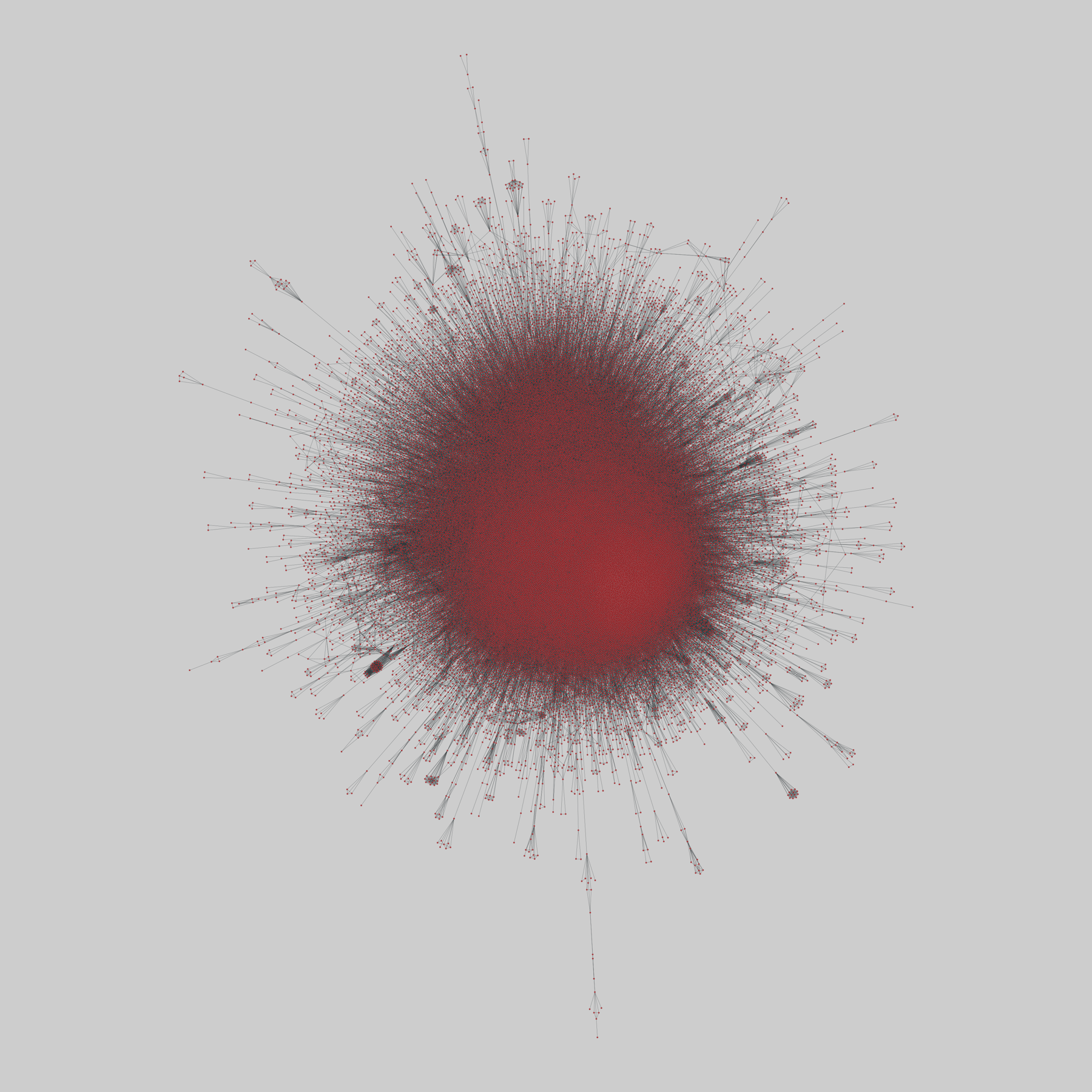
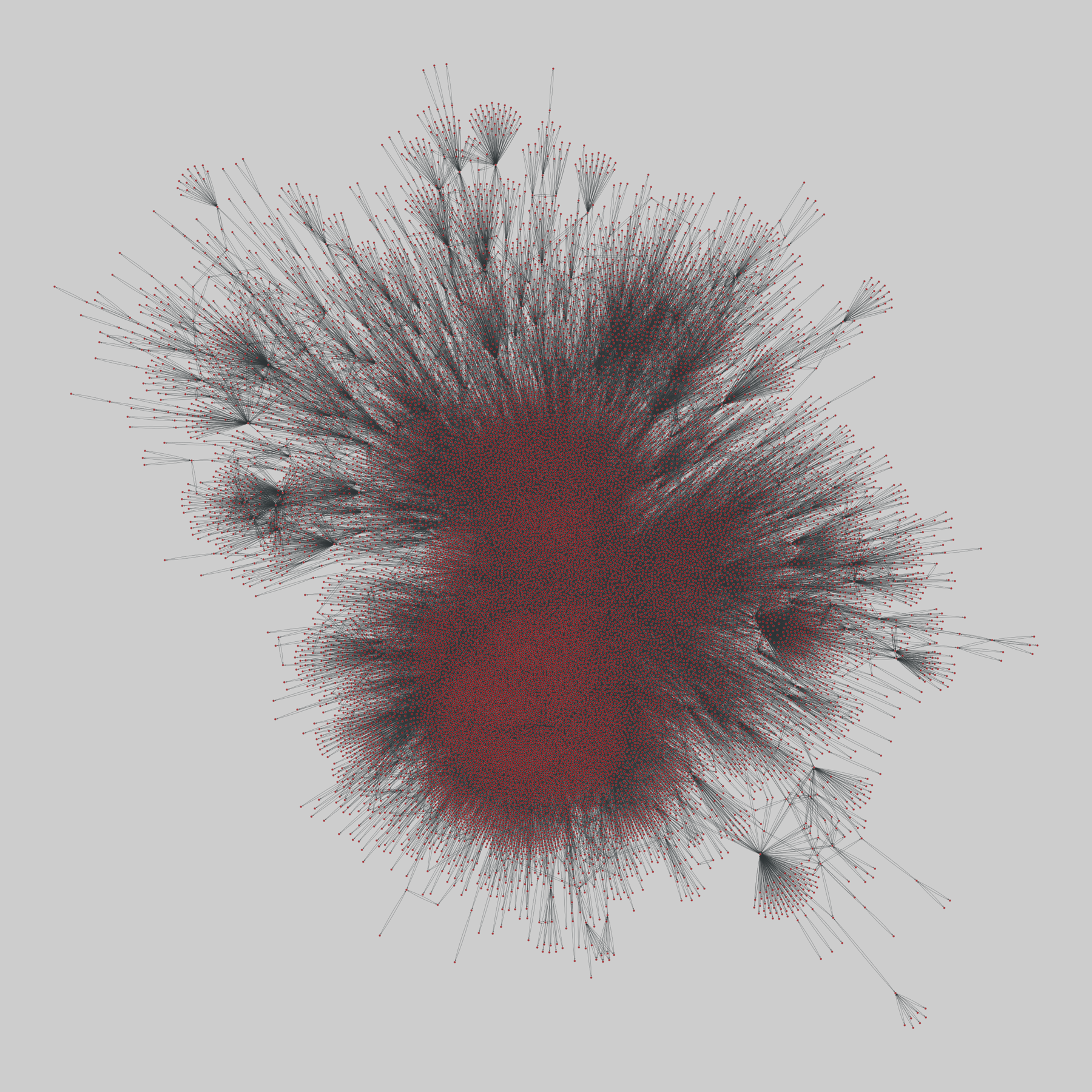
This network has 40 nodes and 100 edges.
Tags: Social, Fictional, Weighted

moviegalaxies: Moviegalaxies, movies 410-466 (2018). 40 nodes, 100 edges. https://networks.skewed.de/net/moviegalaxies#195