 @tinoeberl@mastodon.online
2026-09-16 12:14:12
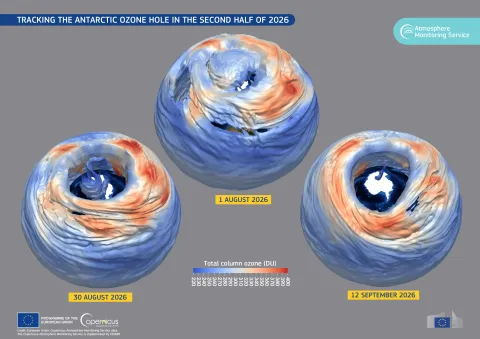
Das #Ozonloch über der #Antarktis ist 2026 ungewöhnlich groß.
Am 12. September erreichte es rund 25 Millionen Quadratkilometer und lag damit etwa fünf Millionen Quadratkilometer über dem Durchschnitt für diese Jahreszeit. Prognosen des
 @cdarwin@c.im
2026-07-03 02:38:53
Nearly 39,000 Acres of Land Returned to California Tribes
The California Natural Resources Agency,
in partnership with the CAL FIRE and the Ocean Protection Council
awarded $107.7 million to fund 33 projects
and support the return of approximately 38,950 acres of land to California Native American tribes
through the Tribal Nature-Based Solutions grant program.
Funding will support the return of ancestral lands to tribal ownership and stewardship,
pla…

 @seav@en.osm.town
2026-08-05 04:19:48
Yet another example of how the real world refuses to comply with the human need to classify and label things.
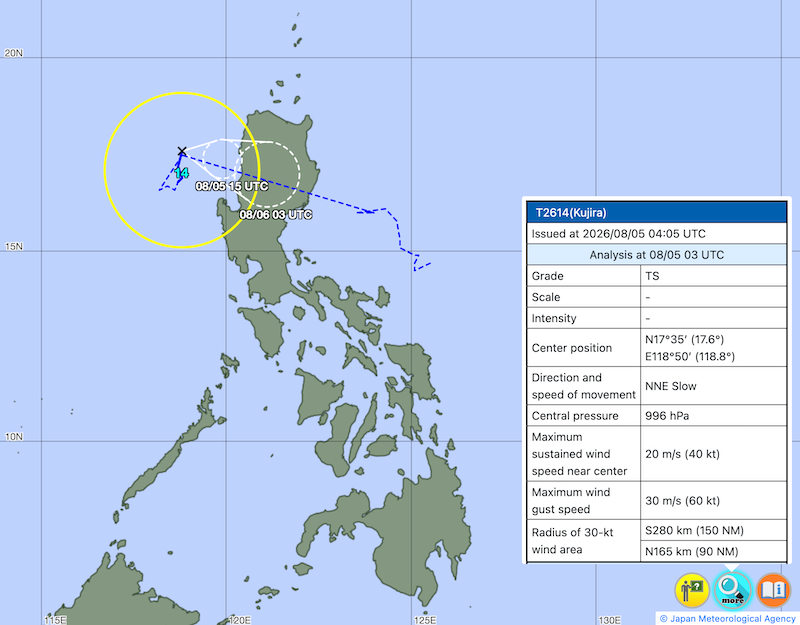
The Japan Meteorological Agency (JMA) is tracking an ongoing storm named Kujira that had passed over northern Luzon island and is expected to pass over it again.
The Philippines’ weather agency, PAGASA, considers this system to be two, named Luis from July 29 to August 3, and Maymay from August 4. It considers Luis to have dissipated when it passed over Luzon.
 @fanf@mendeddrum.org
2026-08-02 08:42:04
from my link log —
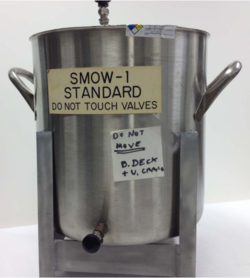
Vienna Standard Mean Ocean Water for metrology.
https://signoregalilei.com/2026/07/26/the-most-official-water-costs-120000-a-gallon/
saved 2026-08-01
 @primonatura@mstdn.social
2026-08-13 14:00:37
 @sean@scoat.es
2026-08-24 03:10:18
Assuming this information is accurate (I haven't personally vetted it):
I can't tell if these people are complete morons, or if this was simply engineered to fail.
(Both Occam and Hanlon suggest…) https://yac.grumpy-learning.com/@grmpyprogra…

 @arXiv_physicsappph_bot@mastoxiv.page
2026-07-22 07:58:10
Ambient Pressure-Driven Actuators and Shape-Morphing Metamaterials
Benjamin Holdstock, Robert Trowbridge, Alexander W. Powell, Julian Monsalve Londono
https://arxiv.org/abs/2607.18982 https://arxiv.org/pdf/2607.18982 https://arxiv.org/html/2607.18982
arXiv:2607.18982v1 Announce Type: new
Abstract: Actuators which change shape in response to ambient pressure have great potential for use in extreme environments, from space to the deep ocean. Bi-layer actuators have so far not been explored to this end, despite their lightness and mechanical simplicity (there is no requirement for a separate power source or pump, for example) making them ideal for applications where transport and maintenance are difficult. In this paper, foam-based bilayer actuators powered by ambient pressure change have been constructed, modelled mathematically, characterised in terms of their actuating force, and built into deployable devices and metamaterial structures to showcase properties such as negative pressure expansivity. Actuators such as these are ideally suited for a range of applications, from deploying solar panels and sensors in space and extra-terrestrial atmospheres, to under-sea expandable structures and sensing.
toXiv_bot_toot
@seav@en.osm.town2026-07-20 07:16:48

 @arXiv_physicsgeoph_bot@mastoxiv.page
2026-07-03 07:55:20
Joint elastic full waveform inversion of multi-component geophone and distributed acoustic sensing data
Hoang Anh Nguyen, Ali Tura
https://arxiv.org/abs/2607.01649 https://arxiv.org/pdf/2607.01649 https://arxiv.org/html/2607.01649
arXiv:2607.01649v1 Announce Type: new
Abstract: Joint full waveform inversion (FWI) of distributed acoustic sensing (DAS) and ocean-bottom node (OBN) data typically requires converting measured strain to particle velocity, introducing numerical noise and spectral distortion. To eliminate this, we present an elastic multi-parameter FWI framework using a velocity-stress-strain (VSS) formulation that directly models pressure, particle velocity, and gauge-length-averaged DAS strain from a single forward simulation. Data residuals are injected additively into a single backward simulation, making computational cost independent of the active sensor subsets. We benchmark individual and combined datasets on cross-talk and elastic Marmousi models. Our results show that joint inversion recovers elastic parameters more accurately than single deployments when the sensors offer complementary information. Specifically, pairing two-component geophones with a deviated borehole DAS cable yields the most accurate parameter recovery and mitigates inter-parameter cross-talk by providing a distinct physical observable and complementary depth aperture. We release our implementation as xFWI, an open-source, Devito-based Python package for scalable, multi-deployment inversions.
toXiv_bot_toot