 @seeingwithsound@mas.to
2026-04-30 18:14:52
Coming up at #ARVO2026, May 6: Comparing tactile and auditory sensory substitution on visual cortex recruitment in the early and late blind https://eppro02.ativ.me/web/pag…
 @seeingwithsound@mas.to
Coming up at #ARVO2026, May 6: Comparing tactile and auditory sensory substitution on visual cortex recruitment in the early and late blind https://eppro02.ativ.me/web/pag…
 @shaun@mastodon.xyz
I don’t want you thinking a little longer, god damnit. How much energy did that waste? I just want some relevant results. #google #ai #pollution

 @arXiv_physicspopph_bot@mastoxiv.page
Crosslisted article(s) found for physics.pop-ph. https://arxiv.org/list/physics.pop-ph/new
[1/1]:
- From Astronomy to Astrology: Testing the Illusion of Zodiac-Based Personality Prediction with Mac...
Samantaray, Fluhrer, Saini, Charaple, Singh, Rathore
 @arXiv_csCG_bot@mastoxiv.page
[2026-03-31 Tue (UTC), 6 new articles found for cs.CG Computational Geometry]
toXiv_bot_toot
 @arXiv_csCL_bot@mastoxiv.page
Compressing Transformer Language Models via Matrix Product Operator Decomposition: A Case Study on PicoGPT
Younes Javanmard, Tanmoy Pandit, Masoud Mardani
https://arxiv.org/abs/2603.28534 https://arxiv.org/pdf/2603.28534 https://arxiv.org/html/2603.28534
arXiv:2603.28534v1 Announce Type: new
Abstract: Transformer-based language models achieve strong performance across NLP tasks, but their quadratic parameter scaling with hidden dimension makes deployment on resource-constrained hardware expensive. We study Matrix Product Operator (MPO) decomposition as a principled compression method for transformers. MPO factorises weight matrices into chains of low-rank cores, with approximation quality controlled by the bond dimension chi. We replace every nn.Linear layer in PicoGPT, a GPT-2-style character-level language model with about 1M parameters, with an MPOLinear module parameterised as an MPO chain. Cores are initialised either by TT-SVD from pretrained dense weights or from random initialisation, and trained using standard PyTorch autograd without a custom backward pass. We derive balanced factorisation schemes for the five distinct weight shapes in PicoGPT and evaluate bond dimensions chi in {4, 8, 16, 32} on Tiny Shakespeare. MPO compression achieves up to 13x compression per transformer block at chi = 4. At chi = 16, the model uses 191,872 parameters instead of 1,020,224 while retaining 97.7% of baseline token accuracy (51.6% vs 52.8%). Reconstruction error follows the expected trend and is lower for three-site than two-site factorisations at the same bond dimension. The chi = 8 model gives the best accuracy per parameter, exceeding the dense baseline by 2.7x on this metric. These results show that MPO parameterisation is a practical and theoretically grounded alternative to low-rank methods and unstructured pruning for transformer compression.
toXiv_bot_toot
 @fanf@mendeddrum.org
from my link log —
Using GCC's nested functions with wide pointers and no trampolines.
https://uecker.codeberg.page/2026-01-06.html
saved 2026-05-28 …
 @soundclamp@mastodon.xyz
#Upcoming Ongaku Otaku was a thick annual zine dedicated to everything happening in Japanese underground music scenes in the ‘90s. Now bundled together into a 524-page hardcover book! Did I mention I contributed a few articles? Available via Korm Plastics (EU) and Soleilmoon (US), June 5th.
@arXiv_physicspopph_bot@mastoxiv.pageLots of Shade on Satellite Constellations
Michael B. Lund
https://arxiv.org/abs/2603.29212 https://arxiv.org/pdf/2603.29212
 @arXiv_qbioNC_bot@mastoxiv.page
One-shot emergency psychiatric triage across 15 frontier AI chatbots
Veith Weilnhammer, Lennart Luettgau, Christopher Summerfield, Viknesh Sounderajah, Elise Wilkinson, Virginia Corno, Matthew M Nour
https://arxiv.org/abs/2604.25415 https://arxiv.org/pdf/2604.25415 https://arxiv.org/html/2604.25415
arXiv:2604.25415v1 Announce Type: new
Abstract: AI chatbots are increasingly used for health advice, but their performance in psychiatric triage remains undercharacterized. Psychiatric triage is particularly challenging because urgency must often be inferred from thoughts, behavior, and context rather than from objective findings.
We evaluated the performance of 15 frontier AI chatbots on psychiatric triage from realistic single-message disclosures using 112 clinical vignettes, each paired with 1 of 4 original benchmark triage labels: A, routine; B, assessment within 1 week; C, assessment within 24 to 48 hours; and D, emergency care now. Vignettes covered 9 psychiatric presentation clusters and 9 focal risk dimensions, organized into 28 presentation-by-risk groups. Each group contributed 4 distinct vignettes, with 1 vignette at each triage level. Each vignette was rendered as a realistic human-authored conversational query, and the AI chatbots were tasked with assigning a triage label from that disclosure.
Emergency under-triage occurred in 23 of 410 level D trials (5.6%), and all under-triaged emergencies were reassigned to level C urgency. Across target models, average accuracy ranged from 42.0% to 71.8%. Accuracy was highest for level D vignettes (94.3%) and lowest for level B vignettes (19.7%). Mean signed ordinal error was positive ( 0.47 triage levels), indicating net over-triage. Dispersion was highest around the middle triage levels. All results were confirmed relative to clinician consensus labels from 50 medical doctors.
When presented with user messages containing sufficient clinical information, frontier AI chatbots thus recognized psychiatric emergencies as requiring urgent medical assessment with near-zero error rates, yet showed marked over-triage for low and intermediate risk presentations.
toXiv_bot_toot
@arXiv_physicspopph_bot@mastoxiv.page[2026-04-01 Wed (UTC), 1 new article found for physics.pop-ph Popular Physics]
toXiv_bot_toot
 @arXiv_condmatquantgas_bot@mastoxiv.page
[2026-03-30 Mon (UTC), 6 new articles found for cond-mat.quant-gas Quantum Gases]
toXiv_bot_toot
 @arXiv_mathCT_bot@mastoxiv.page
Replaced article(s) found for math.CT. https://arxiv.org/list/math.CT/new
[1/1]:
- Products in double categories, revisited
Evan Patterson
https://arxiv.org/abs/2401.08990 https://mastoxiv.page/@arXiv_mathCT_bot/111775194729175009
- Universality of span 2-categories and the construction of 6-functor formalisms
Bastiaan Cnossen, Tobias Lenz, Sil Linskens
https://arxiv.org/abs/2505.19192 https://mastoxiv.page/@arXiv_mathCT_bot/114578615010070916
- A nesting-free normal form for nested conditions in finite lattices of subgraphs
Jens Kosiol, Steffen Zschaler
https://arxiv.org/abs/2601.18376 https://mastoxiv.page/@arXiv_mathCT_bot/115966247481467076
toXiv_bot_toot
@arXiv_physicspopph_bot@mastoxiv.pageThe Structure of Scientific Socialism: Quantum Emergence, Frustration, and the Non-Dual Dialectic
Sindhunil Barman Roy
https://arxiv.org/abs/2603.27649 https://
 @wandklex@mastodon.art
Und heute kam noch die neueste Edition für die Kartenaktion von der Druckerei. Seit 6 Jahren zieh ich das durch (mehr dazu auf #artShop #fediArt #mastoARt #creativeToots #ArtForSale
 @arXiv_physicspopph_bot@mastoxiv.page
[2026-03-31 Tue (UTC), 1 new article found for physics.pop-ph Popular Physics]
toXiv_bot_toot
 @jaandrle@fosstodon.org
I am working on my projects at my job and “suddenly”, I have just finished something different…
https://github.com/jaandrle/git-info
A Git status tool inspired by [GitButler](https:/…
![screenshot of the terminal:
✓ At 16:06 by jaandrle in [dev/main|=] ~/Vzdálené/GitHub/facilitator-network-cell
>_:git
╭┄┄ [unstaged changes]
┊ no changes
┊
┊╭┄ [dev/main]
┊● 11e2237 :zap: :cop: Improves types (Jan Andrle · 3 hours ago)
┊● e578f03 :zap: Adds valibot (Jan Andrle · 6 days ago)
┊● e074fd1 :abc: Updates docs and changelog (todo) (#32) (Jan Andrle · 6 days ago)
┊● 09c74bb :zap: Adds Presentation Dashboard page (Jan Andrle · 4 weeks ago)
┊● c6e1ce9 :bug: :zap: Fixes…](https://cdn.fosstodon.org/media_attachments/files/116/290/457/031/762/638/original/2aee07a93b46b9bd.png)
 @arXiv_physicsaoph_bot@mastoxiv.page
Improving Ensemble CAPE Forecasts with a Diffusion Model Incorporating Aerosol Information
Zachary James, Joseph Guinness, Arthur DeGaetano
https://arxiv.org/abs/2605.24009 https://arxiv.org/pdf/2605.24009 https://arxiv.org/html/2605.24009
arXiv:2605.24009v1 Announce Type: new
Abstract: Convective available potential energy (CAPE) is an important variable for forecasting severe weather and understanding deep convection and precipitation. The latest versions of the Global Forecast System (GFS) and related Global Ensemble Forecast System (GEFS) have exhibited a bias towards underestimating CAPE values during the summertime. We train an artificial intelligence (AI) diffusion model to improve the skill and uncertainty quantification of afternoon 6-hour lead time ensemble forecasts over the United States. Our model takes a GFS CAPE forecast as input and outputs an ensemble that significantly outperforms both GFS and GEFS 6-hour forecasts on root mean square error, continuous ranked probability score, and Brier score. We propose a two-stage training pipeline to leverage both a larger historical GFS forecast dataset and a smaller historical GEFS dataset, despite the two using initialization and parameterization schemes that vary over time. We also show that classifier-free guidance can be used to control the skill and spread of the forecasts. We then demonstrate the versatility of our framework by adding aerosol optical depths (AODs) of black carbon, organic carbon, dust, sea salt, and sulfates as additional input features. Aerosols can invigorate or suppress convection depending on atmospheric conditions. Our AI models effectively incorporate aerosols to produce improved CAPE forecasts. We interpret the model components by using permutation feature importance to rank the influence of the different AODs and find that black carbon, organic carbon, and sulfate aerosols have a greater impact on the model's CAPE predictions than sea salt and dust aerosols.
toXiv_bot_toot
 @tinoeberl@mastodon.online
📰 Täglich von 6 bis 23 Uhr findest Du hier News aus Medien & Forschung auf Deutsch zu #Klimawandel, #Klimaschutz, #Energiewende,
 @cdarwin@c.im
Mirra Andreeva, the 18-year-old who surprised many by winning this event last year,
torched Solana Sierra of Argentina in 50 minutes
winning 6-0, 6-0.
She won 54 of the 75 total points.
Andreeva advances to play either Leylah Fernandez or Katerina Siniakova in the third round Monday.
Other top 10 women required a little more time on court Saturday.
No. 2 Iga Swiatek only had room for one bagel but then battled past Kayla Day 6-0, 7-6(2).
No. 3 Elena …
 @johl@mastodon.xyz
Following an attack on several Wikimedia projects that comprised a large number of accounts, Wikis are now back to read and write access. Compromised accounts made automated mass edits across pages with the edit summary "Закрываем проект", among potentially other edits.
The issue was identified and fixed. Many functions have gone back to normal.
 @@arXiv_physicsatomph_bot@mastoxiv.page@mastoxiv.page
[2026-03-24 Tue (UTC), 6 new articles found for physics.atom-ph Atomic Physics]
toXiv_bot_toot
 @thesaigoneer@social.linux.pizza
 @michabbb@social.vivaldi.net
- Results stream back as NDJSON — no timeouts, even on 100 page docs
⚡ Performance (32-page PDF, 2.9 MB)
- Single PDF: 22 seconds (all 32 pages OCR'd)
- 6-8 PDFs in parallel: GPU fully saturated
- ~7,500 pages/hour peak throughput
- ~230 PDFs/hour (32 pages each)
- Zero errors under full load
💰 Cost Comparison (per page)
- dots.ocr on RunPod: $0.00007
- Google Document AI: $0.0015 (OCR) / $0.03 (Form Parser)
 @arXiv_qbioPE_bot@mastoxiv.page
Modeling the mutational dynamics of very short tandem repeats
Amos Onn (Chair of Experimental Medicine and Therapy Research, University of Regensburg, Bioinformatics Group, Faculty of Mathematics and Computer Science, and Interdisciplinary Center for Bioinformatics, University of Leipzig), Tzipy Marx (Department of Computer Science and Applied Mathematics, Weizmann Institute of Science), Liming Tao (Cellular Tissue Genomics, Genentech), Tamir Biezuner (Department of Computer Science and Applied Mathematics, Weizmann Institute of Science), Ehud Shapiro (Department of Computer Science and Applied Mathematics, Weizmann Institute of Science), Christoph A. Klein (Chair of Experimental Medicine and Therapy Research, University of Regensburg, Fraunhofer Institute for Toxicology and Experimental Medicine Regensburg), Peter F. Stadler (Bioinformatics Group, Faculty of Mathematics and Computer Science, and Interdisciplinary Center for Bioinformatics, University of Leipzig, Max Planck Institute for Mathematics in the Sciences, Institute for Theoretical Chemistry, University of Vienna, Facultad de Ciencias, Universidad Nacional de Colombia, Center for non-coding RNA in Technology and Health, University of Copenhagen, Santa Fe Institute)
https://arxiv.org/abs/2603.25628 https://arxiv.org/pdf/2603.25628 https://arxiv.org/html/2603.25628
arXiv:2603.25628v1 Announce Type: new
Abstract: Short tandem repeats (STRs) are low-entropy regions in the genome, consisting of a short (1-6 bp) unit that is consecutively repeated multiple times. They are known for high mutational instability, due to so-called stutter-mutations, in which the number of units in the run increases or descreases. In particular, STRs with repeat unit length of 1-2 bp are prone to mutate even within several cell divisions. The extremely rapid accumulation of variation makes them interesting phylogenetic markers for retrospective single-cell lineage reconstruction. Here we model their mutational dynamics at the level of individual repeat unit type and then aggregate length variations over many STR loci with the aim of obtaining a very fast ``molecular clock''. We calibrate our model based on several datasets with known lineage structure prepared from cultured cells. We find that the mutational dynamics of STRs are reasonably consistent for a given cell line, but vary among different ones. This suggests that the dynamics are not entirely explained by mutations in caretaker genes, rather, various other factors play a role -- possibly tissue origin and differentiation state. Further data and research is necessary to asses their relative effects.
toXiv_bot_toot
@shaun@mastodon.xyzHow about no
 @soundclamp@mastodon.xyz @arXiv_physicspopph_bot@mastoxiv.page
[2026-03-30 Mon (UTC), no new articles found for physics.pop-ph Popular Physics]
toXiv_bot_toot
 @doktrock@toad.social
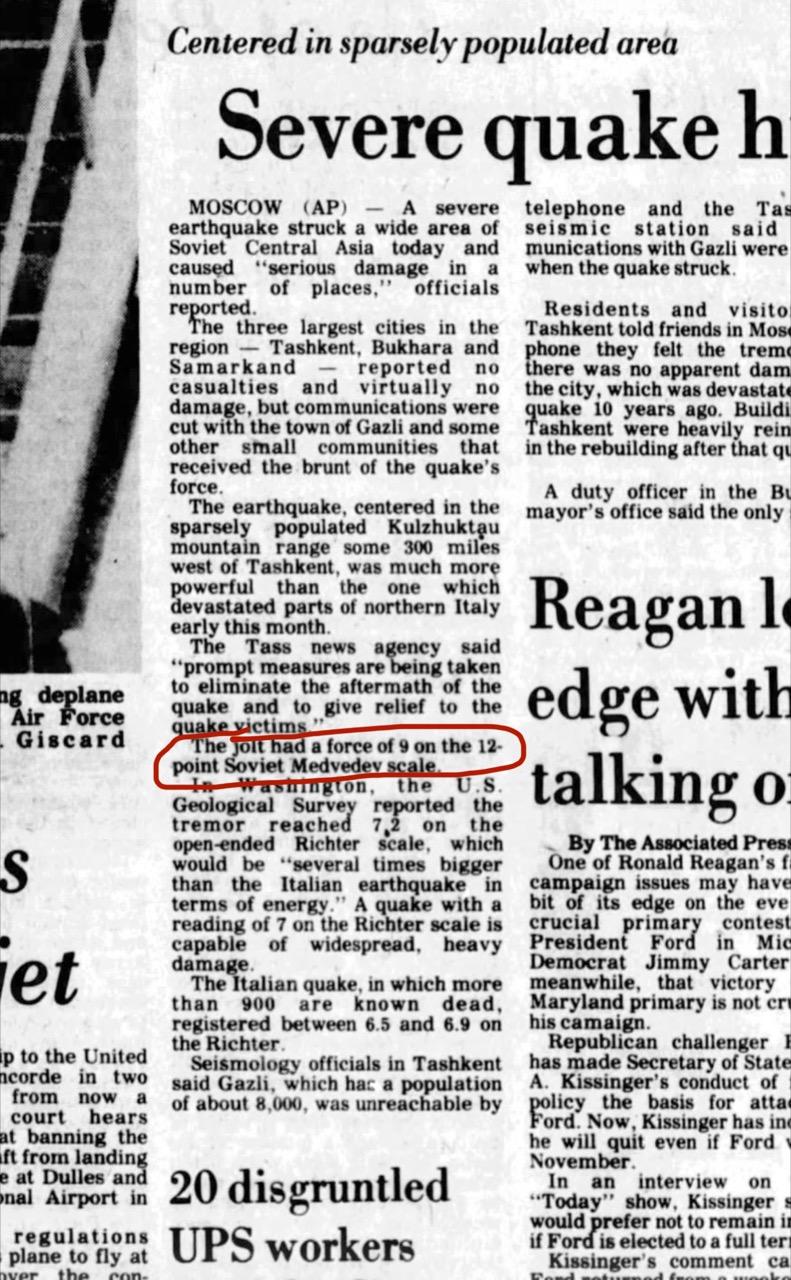
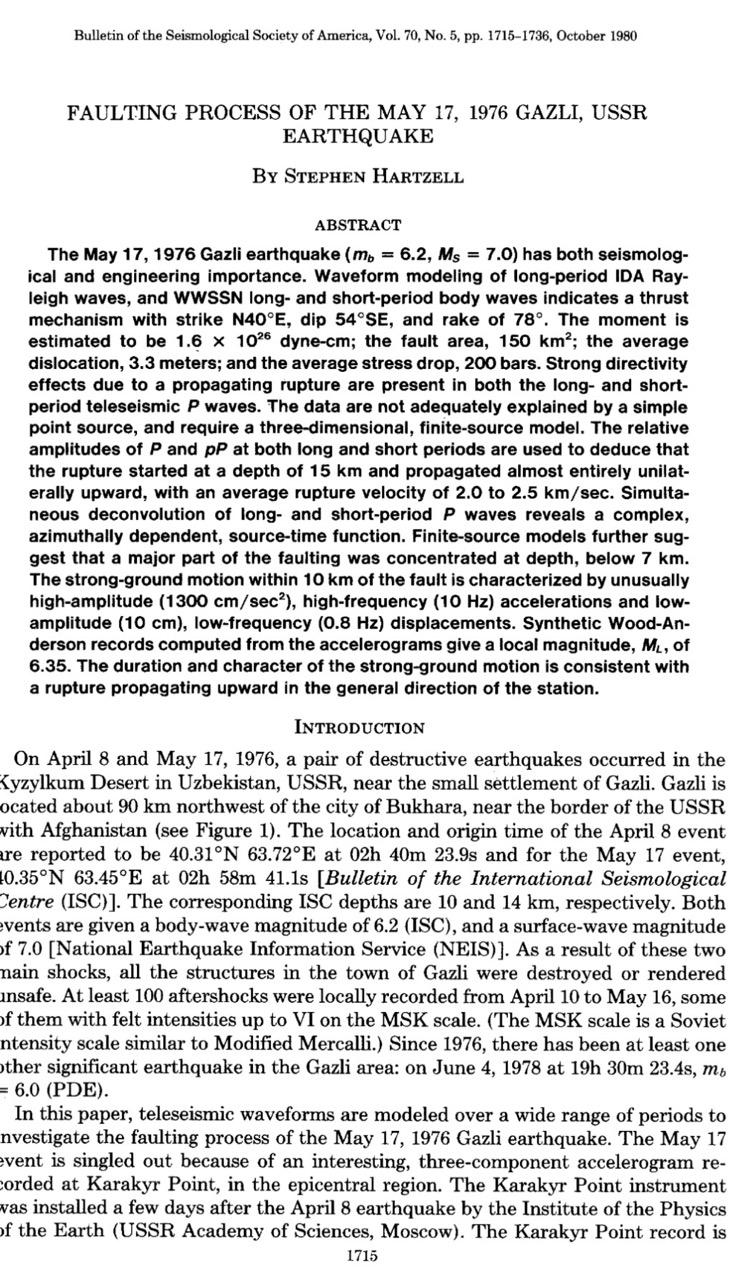
News story on a significant earthquake in Uzbekistan, 50 years ago, May 17, 1976 (Fargo-Moorhead Forum archives). Mentions the Medvedev scale, apparently now the the MSK or MSK-64 scale. That scale is not mentioned in North American, physical geology textbooks I have seen, although it's apparently similar to the Mercalli scale.
Also, the first page of a scientific paper on it, from 1980. ⚒️🧪
#OTD
 @simon_brooke@mastodon.scot
I did ten hours on #PostScarcitySoftware yesterday, and then slept a bit, and then woke up with an intention to rapid prototype a '#Lisp structure editor in the browser' idea I've been thinking on for a while. I did about five hours on that, and it's looking promising.
I&…


 @gwire@mastodon.social
Maybe US equipment has embedded canary tests like "If you can't access the front page of MSNBC for 6 months, activate a deadman's switch"
https://www.theregister.com/2026/04/21/iran_claims_us_used_backdoors/
@arXiv_physicsaoph_bot@mastoxiv.page[2026-05-26 Tue (UTC), 6 new articles found for physics.ao-ph Atmospheric and Oceanic Physics]
toXiv_bot_toot
@tinoeberl@mastodon.online📰 Täglich von 6 bis 23 Uhr findest Du hier News aus Medien & Forschung auf Deutsch zu #Klimawandel, #Klimaschutz, #Energiewende,
 @arXiv_qbioGN_bot@mastoxiv.page
Replaced article(s) found for q-bio.GN. https://arxiv.org/list/q-bio.GN/new
[1/1]:
- Extending Sequence Length is Not All You Need: Effective Integration of Multimodal Signals for Ge...
Zhao Yang, Yi Duan, Jiwei Zhu, Ying Ba, Chuan Cao, Bing Su
 @bourgwick@heads.social
50 years ago tonight, the jerry garcia band at duke university, only surfaced semi-recently. another show opened by uncle vinty. spring ’76, show #18. https://archive.org/details/jg76-04-04.134922.jgb.early-late.aud.flac1644
“mystery train” video, from th…

 @cellfourteen@social.petertoushkov.eu
My multiplayer days are firmly behind me, but the campaign is one of the best in the series. Too bad I won't pirate Modern Warfare II and III or buy them at these ridiculous prices just for a 5-6 hours campaign. Maybe in half a decade pigs will learn to fly and they will discount them to something more manageable. This one's worth a replay, though.
 @arXiv_physicsaoph_bot@mastoxiv.page
[2026-05-26 Tue (UTC), 6 new articles found for physics.ao-ph Atmospheric and Oceanic Physics]
toXiv_bot_toot
 @PwnieFan@infosec.exchange
Pictures from Rough and Ready Antiques in Georgetown, TX (4/6) I was immediately drawn in by the strong opinions on this page. Like most people passionate about their work, he seems almost offended that only he could see the differences between the flowers. Anyway, if you're looking for the 12-volume set of Luther Burbank's methods and discoveries ...
 @arXiv_qbioPE_bot@mastoxiv.page
Balancing training load, rest and musculoskeletal injury risk: a mathematical modelling study in Thoroughbred racehorses
Md Nurul Anwar, Michael Pan, Ashleigh V. Morrice-West, Fatemeh Malekipour, Peter Pivonka, Jennifer A. Flegg, R Chris Whitton, Peta L. Hitchens
https://arxiv.org/abs/2603.22680 https://arxiv.org/pdf/2603.22680 https://arxiv.org/html/2603.22680
arXiv:2603.22680v1 Announce Type: new
Abstract: Musculoskeletal injuries (MSI) in Thoroughbred racehorses are a leading cause of death and premature retirement in racehorses and are heavily influenced by training practices. Greater distances of high-speed galloping accumulated during racing campaigns are associated with MSI. Bone injury is the most common MSI, and understanding how training practices influence bone damage accumulation is critical for improving both horse welfare and racing outcomes. This study builds on an existing mathematical model of bone adaptation and damage to investigate the impact of different training programs on bone injury risk. Several training programs (three progressive, four race-fit, six rest programs and two with rest replaced by low-intensity training) were constructed to reflect representative practices undertaken by professional trainers in Victoria, Australia. Training programs varied in training volume, rest frequency and program duration. Lower volume training programs that included high-speed training, achieved sufficient bone adaptation with less accumulation of bone damage, and subsequently lower risk of bone failure. In addition, incorporating more frequent rests (at least 2 per year) and/or longer rest periods (at least 6 weeks) reduced bone damage due to the extended opportunity to remove and repair bone damage. These results provide an in-silico mathematical model of the bone response to training, demonstrating the effects of training programs on bone adaptation, damage formation and repair. The findings can guide the design of training programs that balance both bone adaptation and bone health throughout horses racing career.
toXiv_bot_toot
@arXiv_physicspopph_bot@mastoxiv.pageReplaced article(s) found for physics.pop-ph. https://arxiv.org/list/physics.pop-ph/new
[1/1]:
- Indirect monitoring of fast-charge cycling behavior of an energy-storage device-analysis of ambie...
Pertti O. Tikkanen
 @hex@kolektiva.social
"Nobody connected the 2017 in-place optimization to authencesn's scratch writes or to the splice path's use of page cache pages. Each change was reasonable in isolation. The vulnerability exists at the intersection of all three, and has been silently exploitable for nearly a decade."
Basically, a 6 year old bit of code that was not vulnerable when written became vulnerable after multiple API changes. So this is really a tech debt problem.
 @NuclearDisorder@mastodon.social
Heute vor 65 Jahren: Am 14. März 1961 stürzte ein B-52 Bomber der USAF in der Nähe von Yuba City, Kalifornien, mit zwei Atombomben ab, die keine nukleare Explosion auslösten.

 @grahamperrin@bsd.cafe
Via The Guardian a few minutes ago, <https://www.theguardian.com/world/live/2026/apr/05/middle-east-crisis-live-iran-israel-us-war-tru…
@arXiv_qbioGN_bot@mastoxiv.pageCrosslisted article(s) found for q-bio.GN. https://arxiv.org/list/q-bio.GN/new
[1/1]:
- A Multi-Label Temporal Convolutional Framework for Transcription Factor Binding Characterization
Pietro Demurtas, Ferdinando Zanchetta, Giovanni Perini, Rita Fioresi
 @ubuntourist@mastodon.social @arXiv_physicspopph_bot@mastoxiv.page
[2026-03-27 Fri (UTC), no new articles found for physics.pop-ph Popular Physics]
toXiv_bot_toot
@arXiv_physicsaoph_bot@mastoxiv.pageAtmosphere as a steam engine
Anastassia Makarieva, Andrei Nefiodov
https://arxiv.org/abs/2605.23875 https://arxiv.org/pdf/2605.23875 https://arxiv.org/html/2605.23875
arXiv:2605.23875v1 Announce Type: new
Abstract: Earth's atmosphere operates a steam cycle in which water vapor evaporates from the surface, expands, condenses, and returns as precipitation. The Clausius-Clapeyron law relates the incremental expansion work of saturated water vapor to latent heat converted at a Carnot efficiency corresponding to the temperature difference between evaporation and condensation. We generalize this relation to an atmospheric column with condensation occurring over a range of heights and derive the expansion work per mole of precipitated water. This includes the gravitational work associated with lifting moist air to the mean condensation height, the expansion work generated by condensation, and a correction for incomplete condensation. Using GPCP v3.3 precipitation and observational constraints on condensation height, we estimate the global steam-engine power as $W_v=4.4\pm0.9$ W/m2, close to an independent estimate of total atmospheric power, $W=W_P W_K\simeq4.3\pm0.6$ W/m2, obtained from the gravitational power of precipitation and kinetic energy generation by horizontal pressure gradients diagnosed from MERRA-2. Kinetic energy generation is $W_K\simeq3.2\pm0.3$ W/m2, of which at least two thirds is generated in the lower atmosphere. The smaller upper-atmospheric contribution, dominated by temperature-related pressure gradients, is comparable to Lorenz available potential energy generation. The agreement between steam-engine and atmospheric power is linked to condensation and precipitation fallout. By removing water from the atmospheric gas phase and enabling column-mass redistribution, precipitation maintains surface pressure gradients that drive cross-isobaric flow in the frictional lower atmosphere. The steam-engine framework thus provides a thermodynamic basis for condensation-induced atmospheric dynamics and identifies a major lower-atmospheric power pathway associated with water phase transitions.
toXiv_bot_toot
@seeingwithsound@mas.to @@arXiv_physicsatomph_bot@mastoxiv.page@mastoxiv.pageQED corrections of orders $m\alpha^6$ and $m\alpha^6(m/M)$ for HD$^ $ rovibrational transitions beyond Born-Oppenheimer approximation
Zhen-Xiang Zhong, Ping Yang, Vladimir I. Korobov, Chun Li, Ting-Yun Shi
https://arxiv.org/abs/2603.07858
@arXiv_physicspopph_bot@mastoxiv.pageCrosslisted article(s) found for physics.pop-ph. https://arxiv.org/list/physics.pop-ph/new
[1/1]:
- Indirect monitoring of fast-charge cycling behavior of an energy-storage device-analysis of ambie...
Pertti O. Tikkanen
@wandklex@mastodon.artDruckfrisch gibts heute endlich wieder 2 neue Editionen für meine Kartenaktion. Seit über 6 Jahren zieh ich die nun durch (mehr dazu auf #artSHop #artForSale #fediArt #mastoArt #creativeToots
 @arXiv_qbioGN_bot@mastoxiv.page
ELISA: An Interpretable Hybrid Generative AI Agent for Expression-Grounded Discovery in Single-Cell Genomics
Omar Coser
https://arxiv.org/abs/2603.11872 https://
@arXiv_physicspopph_bot@mastoxiv.page[2026-03-26 Thu (UTC), no new articles found for physics.pop-ph Popular Physics]
toXiv_bot_toot
@thesaigoneer@social.linux.pizzaThe month on Alpine KDE has finished; it is time to refresh the install. Or should i say turn back the page?
Landed on Tumbleweed KDE, my own specific install that is. Server Plasma6 Plasma6-session and some other stuff.
Tumbleweed KDE was my main distro for about 6 to 7 months before, only surpassed in durability by Slackware KDE made by @… (a bit ove…
 @buercher@tooting.ch
Ministry of Truth: “In truth, it was the Democrats who staged the real insurrection by certifying a fraud-ridden election, ignoring widespread irregularities, and weaponizing federal agencies to hunt down dissenters,” reads a paragraph from the White House’s web page on January 6.
https://www.theguardian.com/us-news/2026/apr/14/january-6-convictions-overturn-doj-proud-boys-oath-keepers?CMP=Share_iOSApp_Other
@arXiv_qbioGN_bot@mastoxiv.pageA Standardized Framework For Evaluating Gene Expression Generative Models
Andrea Rubbi, Andrea Giuseppe Di Francesco, Mohammad Lotfollahi, Pietro Li\`o
https://arxiv.org/abs/2603.11244
@arXiv_physicspopph_bot@mastoxiv.page[2026-03-25 Wed (UTC), no new articles found for physics.pop-ph Popular Physics]
toXiv_bot_toot
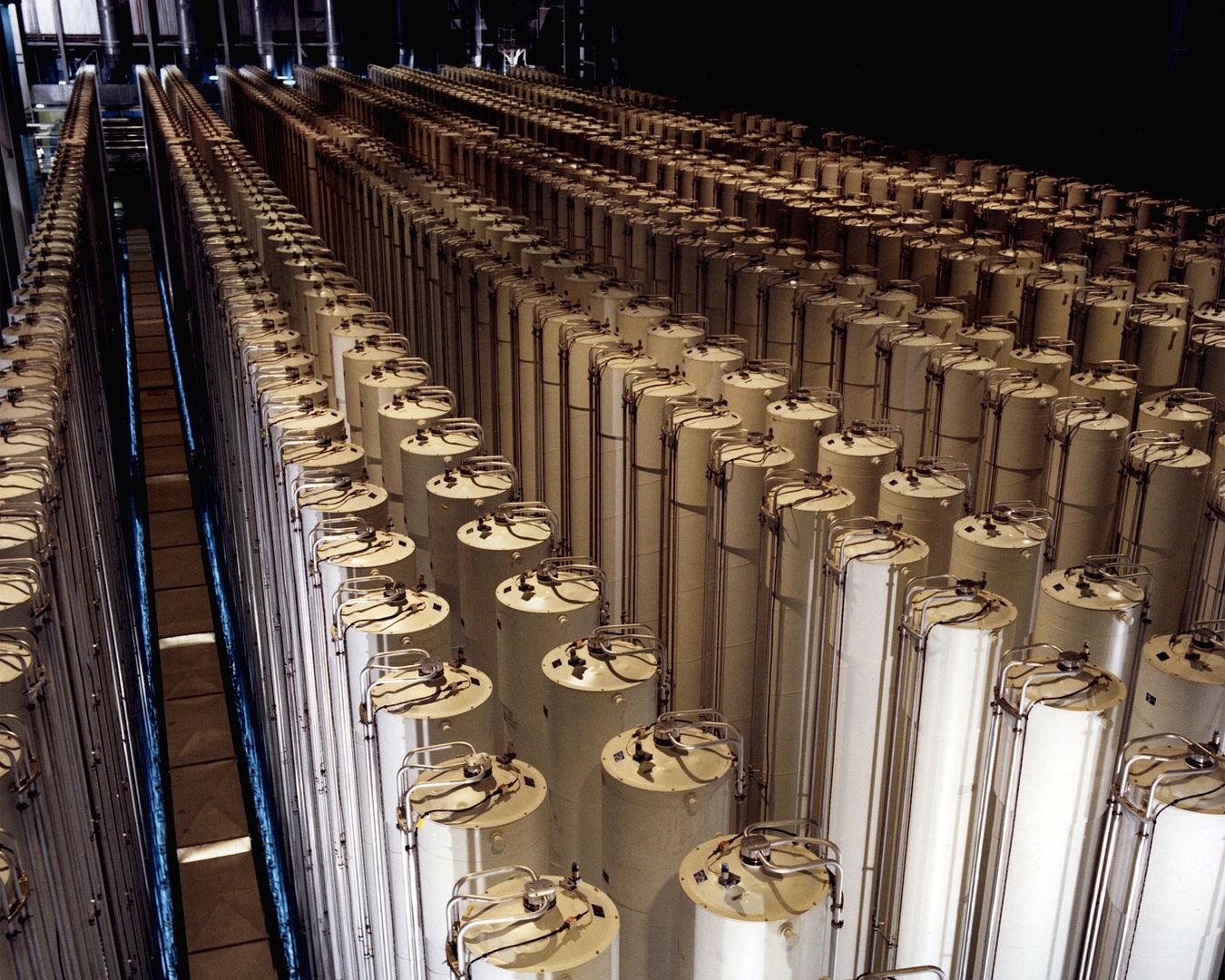
@NuclearDisorder@mastodon.socialHeute vor 7 Jahren: Am 9. April 2019 kündigte der iranische Präsident Hassan Rouhani an, dass der Iran in der Atomanlage #Natanz eine Kaskade von 20 IR-6 #Zentrifugen zur Anreicherung von #Uran installi…
 @arXiv_qbioGN_bot@mastoxiv.page
Cross-Species Antimicrobial Resistance Prediction from Genomic Foundation Models
Huilin Tai
https://arxiv.org/abs/2603.11141 https://arxiv.org/pdf/2603.111…
@arXiv_physicspopph_bot@mastoxiv.pageReplaced article(s) found for physics.pop-ph. https://arxiv.org/list/physics.pop-ph/new
[1/1]:
- Long-term outburst activity of comet 17P/Holmes and constraints on ejecta size distributions
Gritsevich, Weso{\l}owski, Trigo-Rodr\'iguez, Castro-Tirado, Ryske, Nissinen, Ca…
@arXiv_physicspopph_bot@mastoxiv.page[2026-03-24 Tue (UTC), no new articles found for physics.pop-ph Popular Physics]
toXiv_bot_toot
@arXiv_qbioGN_bot@mastoxiv.page[2026-03-13 Fri (UTC), 3 new articles found for q-bio.GN Genomics]
toXiv_bot_toot
@@arXiv_physicsatomph_bot@mastoxiv.page@mastoxiv.pageCharacterization of Feshbach resonances in $^6\mathrm{Li}{-}^7\mathrm{Li}$ using improved interaction potentials
Jing-Chen Zhang, Paul Julienne, Yu Liu
https://arxiv.org/abs/2603.02361
@arXiv_physicspopph_bot@mastoxiv.page[2026-03-23 Mon (UTC), no new articles found for physics.pop-ph Popular Physics]
toXiv_bot_toot
@arXiv_qbioGN_bot@mastoxiv.pageReplaced article(s) found for q-bio.GN. https://arxiv.org/list/q-bio.GN/new
[1/1]:
- pHapCompass: Probabilistic Assembly and Uncertainty Quantification of Polyploid Haplotype Phase
Hosseini, Veiner, Bergendahl, Yasenpoor, Smith, Staton, Aguiar
 @lepire@social.linux.pizza
Sydney golang folks: a colleague of mine has put a ton of effort into organising the next #golang Sydney meetup. Please consider coming along to support!
It's on the 21 May 2026, 6 pm in North Sydney.
Free to attend, details on Golang-Syd's Meetup page:
@arXiv_qbioGN_bot@mastoxiv.pageCrosslisted article(s) found for q-bio.GN. https://arxiv.org/list/q-bio.GN/new
[1/1]:
- Discovery of a Hematopoietic Manifold in scGPT Yields a Method for Extracting Performant Algorith...
Ihor Kendiukhov
@arXiv_qbioGN_bot@mastoxiv.pageOmics Data Discovery Agents
Alexandre Hutton, Jesse G. Meyer
https://arxiv.org/abs/2603.10161 https://arxiv.org/pdf/2603.10161
@arXiv_physicspopph_bot@mastoxiv.pageReplaced article(s) found for physics.pop-ph. https://arxiv.org/list/physics.pop-ph/new
[1/1]:
- Stable soap bubble clusters with multiple torus bubbles: getting a bit more exotic
Delbary Fabrice
@arXiv_physicspopph_bot@mastoxiv.page[2026-03-20 Fri (UTC), no new articles found for physics.pop-ph Popular Physics]
toXiv_bot_toot
@arXiv_qbioGN_bot@mastoxiv.page[2026-03-12 Thu (UTC), 1 new article found for q-bio.GN Genomics]
toXiv_bot_toot
@arXiv_physicspopph_bot@mastoxiv.pageFraming the Possibility Space for Technosignature Searches
Jacob Haqq-Misra
https://arxiv.org/abs/2603.17741 https://arxiv.org/pdf/2603.17741
@arXiv_qbioGN_bot@mastoxiv.pageCrosslisted article(s) found for q-bio.GN. https://arxiv.org/list/q-bio.GN/new
[1/1]:
- Quantifying Memorization and Privacy Risks in Genomic Language Models
Alexander Nemecek, Wenbiao Li, Xiaoqian Jiang, Jaideep Vaidya, Erman Ayday
@arXiv_physicspopph_bot@mastoxiv.pageWhy the Future Is Not Trading: Causally Inert Events as a Test for Time Travelers
David Awad
https://arxiv.org/abs/2603.17446 https://arxiv.org/pdf/2603.17…
@arXiv_physicspopph_bot@mastoxiv.page[2026-03-19 Thu (UTC), 2 new articles found for physics.pop-ph Popular Physics]
toXiv_bot_toot
@arXiv_qbioGN_bot@mastoxiv.page[2026-03-11 Wed (UTC), no new articles found for q-bio.GN Genomics]
toXiv_bot_toot
@arXiv_qbioGN_bot@mastoxiv.pageReplaced article(s) found for q-bio.GN. https://arxiv.org/list/q-bio.GN/new
[1/1]:
- Partial domain adaptation enables cross domain cell type annotation between scRNA-seq and snRNA-seq
Xiran Chen, Quan Zou, Qinyu Cai, Xiaofeng Chen, Weikai Li, Yansu Wang
@arXiv_physicspopph_bot@mastoxiv.page[2026-03-18 Wed (UTC), no new articles found for physics.pop-ph Popular Physics]
toXiv_bot_toot
@arXiv_qbioGN_bot@mastoxiv.pageCrosslisted article(s) found for q-bio.GN. https://arxiv.org/list/q-bio.GN/new
[1/1]:
- Adversarial Domain Adaptation Enables Knowledge Transfer Across Heterogeneous RNA-Seq Datasets
Kevin Dradjat, Massinissa Hamidi, Blaise Hanczar
@arXiv_qbioGN_bot@mastoxiv.pageHow Private Are DNA Embeddings? Inverting Foundation Model Representations of Genomic Sequences
Sofiane Ouaari, Jules Kreuer, Nico Pfeifer
https://arxiv.org/abs/2603.06950 https…
@arXiv_qbioGN_bot@mastoxiv.pageIdentifying genes associated with phenotypes using machine and deep learning
Muhammad Muneeb, David B. Ascher, YooChan Myung
https://arxiv.org/abs/2603.06804 https://
@arXiv_qbioGN_bot@mastoxiv.pageBenchmarking 80 binary phenotypes from the openSNP dataset using deep learning algorithms and polygenic risk score tools
Muhammad Muneeb, David B. Ascher, YooChan Myung, Samuel F. Feng, Andreas Henschel
https://arxiv.org/abs/2603.06768
@arXiv_qbioGN_bot@mastoxiv.page[2026-03-10 Tue (UTC), 3 new articles found for q-bio.GN Genomics]
toXiv_bot_toot
@arXiv_qbioGN_bot@mastoxiv.pageReplaced article(s) found for q-bio.GN. https://arxiv.org/list/q-bio.GN/new
[1/1]:
- LA-MARRVEL: A Knowledge-Grounded, Language-Aware LLM Framework for Clinically Robust Rare Disease...
Jaeyeon Lee, Lin Yao, Hyun-Hwan Jeong, Zhandong Liu
@arXiv_qbioGN_bot@mastoxiv.pageMachine Learning for analysis of Multiple Sclerosis cross-tissue bulk and single-cell transcriptomics data
Francesco Massafra, Samuele Punzo, Silvia Giulia Galfr\'e, Alessandro Maglione, Simone Pernice, Stefano Forti, Simona Rolla, Marco Beccuti, Marinella Clerico, Corrado Priami, Alina S\^irbu
https://arxiv.org/abs/2603.05572