 @newsie@darktundra.xyz
2026-10-13 14:51:14
Tesla's 'Security Protocols' Stopped DHS From Installing a Tracking Device https://www.404media.co/teslas-security-protocols-stopped-dhs-from-installing-a-tracking-device/
@newsie@darktundra.xyzTesla's 'Security Protocols' Stopped DHS From Installing a Tracking Device https://www.404media.co/teslas-security-protocols-stopped-dhs-from-installing-a-tracking-device/
 @Techmeme@techhub.social
A theoretical computer scientist, citing sources, says AI labs have quietly started probing whether their models can break important cryptographic protocols (Scott Aaronson/Shtetl-Optimized)
https://scottaaronson.blog/?p=10169
 @seeingwithsound@mas.to
Blue magnetophosphene perception under subthreshold magnetic stimulation in a human retinal degeneration model https://www.frontiersin.org/journals/neuroscience/articles/10.3389/fnins.2026.1893022/full "Extremely low-frequency magnetic fie…

 @stefan@gardenstate.social
This is a great list of apps and services on the fediverse
#fediforum
 @arXiv_csAR_bot@mastoxiv.page
Dryas: A Reprogrammable Engine for High-Speed Interconnect Tracing and Analysis
Manuel Br\"ochin, Tom Kuchler, Michael Giardino, David Cock, Timothy Roscoe
https://arxiv.org/abs/2608.12934 https://arxiv.org/pdf/2608.12934 https://arxiv.org/html/2608.12934
arXiv:2608.12934v1 Announce Type: new
Abstract: The proliferation of heterogeneous components in modern computing systems has been accompanied by new higher bandwidth and lower latency interconnects. These interfaces and protocols are enormously complex and the process of developing, debugging, and analyzing FPGA-based implementations requires significant engineering work. Moreover, once a functional implementation is completed, optimization of the controller and associated software requires processing potentially hundreds of gigabytes of trace data.
In this paper, we present Dryas, an open source tool for analyzing such an interconnect. We developed our tool, using minimal hardware resources, alongside an FPGA implementation of a very high speed, low latency (30~GiB/s, 200~ns) interconnect. With our run-time reprogrammable overlay engine we can inspect this interconnect to find rare, complex, or transient events even at full operation. This filtering engine is based on non-deterministic finite automata (NFAs), efficiently implemented using state transition elements (STEs), allowing us to trace events at a cache-line granularity. Moreover we can change the filters in less than a second, without reprogramming the FPGA or interfering with the running application. This data enables not only debugging the implementation of the interconnect itself, but analyzing the behavior of accelerated applications.
We examine the mathematical basis for using NFAs and describe their implementation on a real coherent CPU-FPGA research platform. We then evaluate the scalability of Dryas for various size NFAs, followed by two different use cases: debugging FPGA implementation of the interconnect and analyzing cache behavior.
toXiv_bot_toot
 @heiseonline@social.heise.de
AGNTCon MCPCon: Agentische KI wird erwachsen
Auf einer eigenen Konferenz diskutiert die Community über die Zukunft des Model Context Protocols: Wie wird agentische KI sicher, überwachbar und skalierbar?
https://www.
 @arXiv_csHC_bot@mastoxiv.page
ProtoGIB-Workload: Learning Workload-Specific Neural Topology Prototypes across Subjects
Yuzhe Zhang, Yixi Zhang, Shengdian Jiang, Chengxi Xie, Jihong Wang, Huan Liu, Man Yao, Minnan Luo, Chao Shen
https://arxiv.org/abs/2608.10647 https://arxiv.org/pdf/2608.10647 https://arxiv.org/html/2608.10647
arXiv:2608.10647v1 Announce Type: new
Abstract: Reliable electroencephalography (EEG)-based mental workload recognition is crucial for adaptive human-centered systems, yet practical deployment requires models to generalize to users unseen during training. Although functional connectivity graphs are widely adopted to capture workload-related neural interactions, they inherently entangle task-relevant structures with subject-specific physiological traits and sample-level noise. This entanglement often leads models to learn structural shortcuts, severely degrading cross-subject generalization. To address this, we propose ProtoGIB-Workload, a novel framework that explicitly regularizes and aligns graph structures for subject-independent workload recognition. Our approach introduces a Stochastic Graph Information Bottleneck (SGIB) to compress dense correlation priors into compact, task-relevant subgraphs, filtering out input-related redundancy. Crucially, to prevent the retention of subject-specific spurious edges, we propose a Class-Conditional Topology Stabilizer (CTS). Leveraging the fixed electrode coordinates of EEG data, CTS operates directly on graph-generation probabilities to encourage consistent edge-generation statistics across different subjects sharing the same workload class. Extensive experiments on two public EEG workload datasets and one in-house EEG cognitive load dataset of air traffic controllers under strict leave-one-subject-out (LOSO) protocols demonstrate that ProtoGIB-Workload significantly outperforms state-of-the-art temporal and graph-based baselines, improving the cross-subject Macro-F1 score by an average of 5.15% (up to 6.34%). Further analyses confirm that our method successfully extracts stable, cross-subject consistent neural connectivity patterns.
toXiv_bot_toot
@seeingwithsound@mas.toThe optimization of neuroprosthetic interfaces relying on biophysical and surrogate digital twins https://www.nature.com/articles/s44385-026-00076-8 "the need to ensure computational feasibility has driven the adoption of substantial simplifications in the level of detail used t…
 @arXiv_hepth_bot@mastoxiv.page
Isomorphic Emergence of Lorentz and Gauge Symmetries--A Constructive Interpretation Based on Continuum Mechanics
Ke-Xia Jiang
https://arxiv.org/abs/2608.06244 https://arxiv.org/pdf/2608.06244 https://arxiv.org/html/2608.06244
arXiv:2608.06244v1 Announce Type: new
Abstract: Lorentz symmetry and gauge symmetry constitute the mathematical cornerstones of modern physics, yet their ultimate physical origins remain elusive. From the standpoint of a constructive interpretation, this paper demonstrates that both symmetry structures can emerge isomorphically from a unified classical source: dynamical constraints on wave-packet excitations in a continuous elastic substrate medium (SM). Neither symmetry is posited as fundamental, nor does their emergence rely on quantization. Three core results are established. First, taking the transverse wave speed of a homogeneous, isotropic SM as the benchmark under a conventionalist synchronization scheme, Minkowski-type spacetime arises isomorphically, with Lorentz transformations as effective coordinate transformations between inertial frames. This reinterprets the Michelson--Morley null result: observers are composite wave-packet excitations, and medium-induced kinematic corrections are encoded in their measurement frameworks. Second, for wave packets endowed with $SU(N)$ intrinsic symmetry, the requirement of identity invariance drives the SM to spontaneously generate gauge fields. This requires invariant equivalence classes of intrinsic states under propagation, yielding gauge structures isomorphic to Yang-Mills theory. The gauge group $SU(N)$ is uniquely determined by the number of stable normal modes supported by the medium. Third, through the same conventionalist measurement protocols, inhomogeneous distributions of the SM emerge isomorphically as curved spacetime geometry, governed by Einstein-type field equations from variational extremization of the medium's deformation free energy. This paper advances a unified interpretive account of the physical origin underlying the mathematical structures of both Relativity and the Standard Model.
toXiv_bot_toot
 @ripienaar@devco.social
Released a huge release of my Fisk AI Harness https://github.com/choria-io/fisk-ai/releases/tag/v0.0.5
* Slack
* Durable Jobs
* Remote agents in sandboxes etc
* PII detection
* MCP Client
Huge, and still all focused on privacy, safety, control ov…
 @NFL@darktundra.xyz
Eagles drive spoiled: Jalen Hurts sent to medical tent, backup Andy Dalton throws end-zone pick https://www.nytimes.com/athletic/7641938/2026/09/28/jalen-hurts-eagles-andy-dalton-interception/
@Techmeme@techhub.socialSources: OpenAI repeatedly dismissed internal warnings about inadequate monitoring of testing, prioritizing fast releases without additional security protocols (New York Times)
https://www.nytimes.com/2026/09/29/technology/openai-warnings-security.html
 @neverpanic@chaos.social
My team is looking for a US-based person to work on making #PQC #SmartCards work with open source software. Says Raleigh, but remote will be considered when nobody can be found locally, which is likely:
 @@arXiv_physicsatomph_bot@mastoxiv.page@mastoxiv.page
Protocols of coherent motion control for an interaction-driven Rydberg gate
Valentin Magro, Wojciech Adamczyk, Sylvain de L\'es\'eleuc
https://arxiv.org/abs/2607.23090 h…
 @fazalmajid@vivaldi.net
@… GSM networks (and thus their 4G and 5G descendants) have had that capability since the mid-nineties, when the use case was that you had a honking big phone in your car, and a smaller mobile phone with worse reception. At most they will need some sort of provisioning logic speaking Apple protocols since handoff does not rely on paired SIM cards li…
 @arXiv_csCR_bot@mastoxiv.page
Enhancing Attack Detection Capabilities in BACnet/IP Networks Using Machine-Learning Models
Derek Manzella, John D. Hastings
https://arxiv.org/abs/2607.20686 https://arxiv.org/pdf/2607.20686 https://arxiv.org/html/2607.20686
arXiv:2607.20686v1 Announce Type: new
Abstract: Building Automation Systems (BAS) manage critical building functions using protocols such as BACnet/IP, yet defenders have limited tooling and few labeled datasets for detecting BACnet-specific attacks. This work addresses these gaps through three contributions. First, CISA's Zeek BACnet parser is modified to produce a unified per-packet log, simplifying feature engineering for machine-learning (ML) pipelines. Second, a simulated BACnet/IP testbed is developed using bacpypes3 to model a small commercial HVAC system with physics-based device behavior, schedule-aware controller logic, and per-packet attack labeling. Third, five unsupervised anomaly detection models are evaluated using baseline traffic and six BACnet attack types, including denial of service, reconnaissance, property tampering, and false data injection. Results show that One-Class SVM achieved the strongest overall performance, with an average F1 score of 0.864 across all attacks and F1 scores above 0.99 for high-volume denial-of-service and reconnaissance attacks. Detection is much stronger for high-volume attacks, such as DoS attacks and reconnaissance, than stealthier techniques such as tampering and false data injection, which scored around 77%.
toXiv_bot_toot
 @aka_pugs@mastodon.social
SunLink was the product family for all the non-TCP/IP/Ethernet protocols. This was hugely important to get in to accounts who had not yet realized where things were heading.
The 80s was the wild west of protocols. The survivors were open and had communities dedicated to interoperability.
2/6
 @danyork@mastodon.social
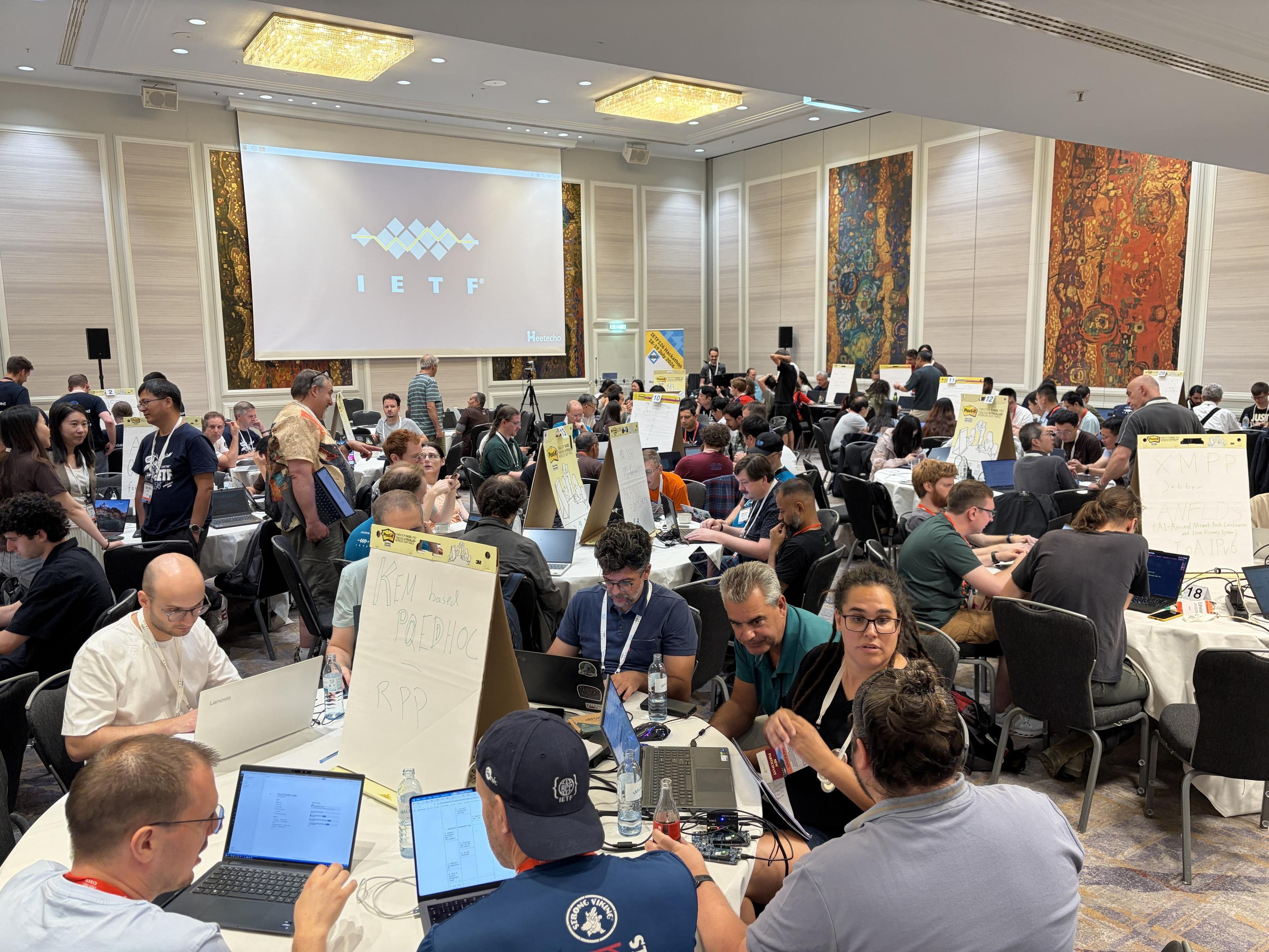
Another day at the very busy #IETF126 #Hackathon in Vienna!
#ietf126 #hackathon
 @arXiv_csCR_bot@mastoxiv.page
Evaluating Large Language Models for Symbolic Security Protocol Analysis
Paolo Modesti, Syed Ahmed, Ioannis Sfyrakis, Derek Enodolomwanyi
https://arxiv.org/abs/2607.20712 https://arxiv.org/pdf/2607.20712 https://arxiv.org/html/2607.20712
arXiv:2607.20712v1 Announce Type: new
Abstract: Security protocol verification relies on formal tools such as ProVerif and OFMC. This study evaluates whether Large Language Models (LLMs) can perform comparable analysis. We test GPT and DeepSeek in chat and reasoning modes over three runs on 130 obfuscated AnB/AnBx protocols covering 388 security goals, scored against ProVerif and OFMC. Chat models reach 69 to 81% recall at precision below 31%. Reasoning models reverse this trade-off, reaching 66.5% precision for GPT and 45.4% for DeepSeek, but detect just over half the attacks. DeepSeek's two modes share one underlying model, so the comparison isolates reasoning itself, which raises precision from 27.2% to 45.4%. The GPT contrast spans a model-version change and is only suggestive. All models perform worst on authentication goals: reasoning models detect well under half of injective and non-injective agreement attacks, whereas chat models over-flag them at low precision. Confidentiality is the exception, with F1 up to 95.7% in reasoning mode. Verdicts are unstable across runs, identical on 89.7% of goals for GPT but 74.0% for DeepSeek. Self-reported confidence is uniformly high yet shows no meaningful correlation with correctness. On this benchmark LLMs do not match formal verification, but may serve, at best, as pre-screening filters.
toXiv_bot_toot
 @arXiv_csOH_bot@mastoxiv.page
Collaborative System Failure Prognostics via Federated Longitudinal-Survival Modeling
Fan Yang, Madelyn Weller, Dimuthu Fernando, Hila Livneh, Yuxin Wen
https://arxiv.org/abs/2607.26038 https://arxiv.org/pdf/2607.26038 https://arxiv.org/html/2607.26038
arXiv:2607.26038v1 Announce Type: new
Abstract: Time-to-event modeling provides a systematic framework for estimating time-dependent failure risk, reliability, and remaining useful life (RUL) from longitudinal condition monitoring data. However, applying these models to distributed prognostics remains challenging because sensor trajectories and failure-time records are often stored across organizations or operational sites and cannot be centrally pooled due to privacy or proprietary constraints. Moreover, the classical Cox proportional hazards model relies on a nonseparable partial likelihood involving global risk sets, making direct optimization difficult under standard federated learning protocols. This paper presents a federated longitudinal-survival modeling framework for collaborative system failure prognostics. The proposed framework combines longitudinal sensor representation learning with a client-separable discrete-time hazard objective, enabling multiple clients to collaboratively train a prognostic model without sharing raw sensor measurements or individual failure records. Time-dependent representations extracted from multivariate sensor histories are used to estimate interval-specific failure hazards, reliability curves, and system RUL. Experiments on the four C-MAPSS turbofan engine degradation subsets under simulated decentralized settings demonstrate that the proposed framework consistently improves prognostic performance over isolated local training while maintaining performance comparable to centralized training across heterogeneous operating conditions and failure modes. These results demonstrate the potential of federated longitudinal-survival modeling for collaborative, data-aware condition monitoring and system failure prognostics.
toXiv_bot_toot
 @jtk@infosec.exchange
Weekend Reads
* China-controlled US Internet threats
https://k3xec.com/tags/pigeon/
* Super-app and Russia's MAX dangers
https://arxiv.org/abs/2609.11814
#pigeon/" target="_blank" rel="nofollow noopener" translate="no">https://k3xec.com/tags/pigeon/
* Super-app and Russia's MAX dangers
https://arxiv.org/abs/2609.11814
#DNS #IPv6 #OFDM #SDR #Russia
 @arXiv_physicsfludyn_bot@mastoxiv.page
Hard Guarantees at a Measured Price: Entropy-Stable Learned Finite Volumes for Compressible Flow
Denis Gueyffier (ONERA -- Institut Polytechnique de Paris)
https://arxiv.org/abs/2607.20171 https://arxiv.org/pdf/2607.20171 https://arxiv.org/html/2607.20171
arXiv:2607.20171v1 Announce Type: new
Abstract: Learned solvers for compressible flow are usually compared to classical methods at equal mesh resolution rather than at equal computational cost, and they typically offer no guarantee that their solutions remain physically admissible. We present a learned finite volume scheme for the two-dimensional Euler equations on unstructured meshes, admissible by construction and with an entropy-stable interior flux. We evaluate it under protocols fixed before any computation: frozen thresholds, falsification clauses, negative controls, a factor decomposition of the learned components, and an iso-cost comparison against the refined classical baseline. The decomposition produced the central result: the guarantee machinery alone, with both learned heads switched off (the unlearned skeleton), is the strongest scheme at equal mesh on every periodic case. At equal wall-clock cost the picture inverts into a map. Learning pays robustly only on the wall case whose boundary-condition type it never saw (10.8%). Its periodic gains flip sign with the evaluation draw ( 10% on one held-out case, -12% on the hardest). The skeleton is the only method whose iso-cost gain never changes sign, at a measured overhead of 1.74x per step. The guaranteed variant completes 36 of 36 rollouts, Mach extrapolation and unseen wall included, with zero negativity events. We fix the guaranteed scheme's one remaining out-of-distribution weakness, Mach extrapolation, at inference time: with scale-invariant network inputs, a specific-entropy floor, and no retraining, the corrected arm overtakes the unconstrained arm on one Mach case, cuts its deficit on the other by a third, passes the skeleton on the unseen wall, and keeps the guarantee. A spatial gate closes the loop: activating the heads only near the walls beats both the skeleton and the corrected arm, and transfers unchanged to a second wall geometry.
toXiv_bot_toot
 @arXiv_physicsmedph_bot@mastoxiv.page
Portable surrogate-free 4D MRI from standard fast multi-slice 2D MRI via implicit neural representations
Muheng Li, Xinyang Wu, Xia Li, Orso Pusterla, Philippe C. Cattin, Sairos Safai, Antony J. Lomax, Ye Zhang
https://arxiv.org/abs/2607.17906 https://arxiv.org/pdf/2607.17906 https://arxiv.org/html/2607.17906
arXiv:2607.17906v1 Announce Type: new
Abstract: Four-dimensional MRI (4D MRI) characterizes respiratory organ motion, yet existing reconstruction pipelines are tightly coupled to specific acquisition platforms (e.g., non-Cartesian trajectories with self-gating, vendor-specific navigators, or external respiratory hardware), limiting broad adoption across diverse clinical and research settings, including low-field, open-bore, and non-supine imaging. We present SIMPLE-4D (Surrogate-free, IMplicit, PortabLE 4D MRI), a software-first portable workflow that operates entirely on reconstructed slices from standard fast multi-slice 2D MRI and requires no pulse-sequence modification, no non-Cartesian trajectory, no navigator, and no external hardware. SIMPLE-4D combines an acquisition-agnostic front end consuming standard 2D protocols, a surrogate-free variational motion encoder that extracts a compact motion code directly from each 2D slice, and a physics-aware continuous spatio-temporal reconstruction based on a hash-encoded implicit neural representation (INR) with a SIREN deformation network producing bidirectional cycle-consistent DVFs and motion-dependent Gauss-Legendre thick-slice quadrature. Bidirectionality yields a complete inter-frame motion model by composition, supporting downstream tasks such as dose accumulation without retraining. We validate the identical pipeline on two contrasting datasets: a 1.5 T clinical bSSFP dataset (5 volunteers, 3 sessions each) and a 0.5 T open-bore HASTE dataset (5 volunteers, supine and upright). To our knowledge, this is the first per-frame 4D volumetric respiratory MRI reconstruction on a weight-bearing upright open-bore low-field scanner from reconstructed 2D Cartesian slices alone. On low-field data the INR template additionally acts as an implicit denoiser, yielding 132% SNR. Systematic ablations isolate each component's contribution.
toXiv_bot_toot
@arXiv_csCR_bot@mastoxiv.pageCrosslisted article(s) found for cs.CR. https://arxiv.org/list/cs.CR/new
[1/1]:
- TopoGuard: Graph Theory Based Defenses Against Split-Knowledge Attacks on RAG
Chahana Dahal, Zuobin Xiong
https://arxiv.org/abs/2607.20437 https://mastoxiv.page/@arXiv_csCL_bot/116973867316185089
- Isolating LLM Alignment from Regex: Zero Coverage and Metric-Dependent Divergence Under Adversari...
Alexandre Cristov\~ao Maiorano
https://arxiv.org/abs/2607.20494 https://mastoxiv.page/@arXiv_csAI_bot/116973970735647184
- Edit-Neighboring Data Streams and Privacy under Continual Observation
Joel Daniel Andersson, Anamay Chaturvedi, Monika Henzinger, Roodabeh Safavi
https://arxiv.org/abs/2607.20727 https://mastoxiv.page/@arXiv_csDS_bot/116973794572869732
- Beyond Heavy Log Curation: Perplexity-Based APT Detection via Unsupervised, Context-Augmented Lan...
Shoya Otsu, Kei Suzuki, Toshiaki Koike-Akino, Jing Liu, Ye Wang
https://arxiv.org/abs/2607.20832 https://mastoxiv.page/@arXiv_csLG_bot/116973999245670512
- The Consensus Number of Untraceable Cryptocurrencies
Christian Cachin, David Lehnherr, Juan Villacis, Fran\c{c}ois-Xavier Wicht
https://arxiv.org/abs/2607.20929 https://mastoxiv.page/@arXiv_csDC_bot/116973788672146161
- Weak Private Information Retrieval for Graph-based Storage
Shodasakshari Vidya, Chandan Anand, Prasad Krishnan
https://arxiv.org/abs/2607.21014 https://mastoxiv.page/@arXiv_csIT_bot/116973843557672147
- Risk-Limiting Audits for Parliamentary Majorities
Jack Freestone, Dennis Leung, Damjan Vukcevic
https://arxiv.org/abs/2607.21082 https://mastoxiv.page/@arXiv_statAP_bot/116973845690486258
- Agree on the Model, Verify the Inference: GKR Protocols for HND-Based Transformer Inference
Xiaolong Liang, Juanjuan Li, Rui Qin, Yisheng Lv
https://arxiv.org/abs/2607.21162 https://mastoxiv.page/@arXiv_csLG_bot/116974022251021755
- Advances in STV Margin Computation
Michelle Blom, Alexander Ek, Peter J. Stuckey, Vanessa Teague, Damjan Vukcevic
https://arxiv.org/abs/2607.21178 https://mastoxiv.page/@arXiv_csGT_bot/116973834510813731
- Unconditional Unclonable Encryption
Prabhanjan Ananth, Amit Sahai
https://arxiv.org/abs/2607.21551 https://mastoxiv.page/@arXiv_quantph_bot/116974006325118063
toXiv_bot_toot
@aka_pugs@mastodon.socialThis card was for *synchronous* serial protocols, which you should be thankful don't exist anymore - BiSync, SDLC, HDLC, and upper layers like X.25, SNA, and weird terminal emulation
3/6
@aka_pugs@mastodon.socialBut you didn't need the SCP card unless you were running multiple links.
The Sun-2, Sun-3, and early Sun-4s could run all those protocols on the CPU serial ports!
Sun-3 could run 56Kb WAN links all day without breaking a sweat.
4/6