@… When it comes to reform, I would do *plenty*. But if I did nothing else, it would be to remove all of the bogus "emergency" powers from the hands of the president. The framers were right to include separation of powers and checks and balances into the system, and those should be restored... no matter who is in the White House.
Effect of Weak Non-Conservative Dynamics on Pattern Formation in Scalar Active Matter
Sameer Kumar
https://arxiv.org/abs/2608.11851 https://arxiv.org/pdf/2608.11851 https://arxiv.org/html/2608.11851
arXiv:2608.11851v1 Announce Type: new
Abstract: Biological systems such as bacteria and cells undergo growth or degradation, resulting in weak violations of mass conservation. We investigate how such weak non-conservative dynamics affect phase separation in scalar active matter by incorporating a reaction term into a minimal continuum model. Through numerical simulations and linear stability analysis, we show that even weak non-conservative reactions arrest coarsening and stabilize nonequilibrium microphase-separated states. With increasing activity, the system undergoes a morphological transition from interconnected labyrinthine patterns to worm-like structures and eventually to isolated droplets. Quantitative analysis of the correlation function and static structure factor reveals a well-defined steady-state characteristic length. Qualitative analysis of the resulting phases shows that the non-conservative reaction primarily promotes microphase separation and enhances local hexagonal ordering, while activity predominantly controls the domain morphology. Our results demonstrate that weak violations of mass conservation fundamentally alter the nonlinear coarsening dynamics of active phase separation and provide a minimal framework for understanding pattern formation in related systems.
toXiv_bot_toot
The Impact of Circumgalactic Rotation on Ly$\alpha$ Radiative Transfer
Hee-Gyeong Kym, Seok-Jun Chang, Max Gronke, Kwang-Il Seon
https://arxiv.org/abs/2609.08396 https://arxiv.org/pdf/2609.08396 https://arxiv.org/html/2609.08396
arXiv:2609.08396v1 Announce Type: new
Abstract: Hydrogen Lyman-alpha (Ly$\alpha$) is a prominent emission line from the circumgalactic medium (CGM). Due to its resonant nature, Ly$\alpha$ carries imprints of the physical properties and kinematics of the cold CGM. In particular, CGM rotation can modify the Ly$\alpha$ peak separation, which is often interpreted as a tracer of H I column density. We present 3D Monte Carlo Ly$\alpha$ radiative-transfer simulations in a CGM-like rotating medium and examine how the emergent spectra depend on rotational velocity ($V_{\rm rot}$), H I column density ($N_{\rm HI}$), viewing angle, clumpiness, and intrinsic source width. We find that rotation broadens the integrated spectra and increases the peak separation, with the strongest viewing-angle dependence when rotational Doppler shifts dominate over frequency diffusion. At high $N_{\rm HI}$, numerous scatterings reduce the sensitivity of integrated spectra to rotation, producing a degeneracy between $V_{\rm rot}$ and $N_{\rm HI}$. Consequently, Ly$\alpha$ peak separation alone can overestimate $N_{\rm HI}$ in a rotating medium. Spatially resolved halo spectra provide a clearer diagnostic: opposite sides of the rotating medium show systematic redshifted and blueshifted asymmetries associated with the line-of-sight velocity of the last-scattering gas. Such rotation-driven signatures can also contribute to velocity-map patterns often interpreted in terms of inflow or outflow, highlighting the need to consider rotation in spatially resolved Ly$\alpha$ observations. We further show that the main signatures persist in simple clumpy media, while the halo signatures are largely insensitive to the intrinsic source width. Our results demonstrate that spatially resolved Ly$\alpha$ observation is essential for disentangling CGM rotation from radiative-transfer effects.
toXiv_bot_toot
Trump’s second term has revealed many weaknesses in America’s political system.
This is one of them:
It turns out that the government can function (or malfunction) based just on orders of the president and the Supreme Court’s rulings on those orders.
Congress is largely irrelevant, if it wants to be.
As the court returns for a new term this week, we are due for another round of debate about the separation of powers
— the fight between the executive and the cou…
The Ex-Files: The Divorce And Separation Podcast
An Australian podcast designed to help you navigate divorce, separation, parenting arrangements, property settlements and other family law issues with confidence...
Great Australian Pods Podcast Directory: https://www.greataustralianpods.com/the-ex
Sources: Tesla execs were told to prepare for a separation of its China unit ahead of a potential SpaceX merger; advisers weighed a sale, spinoff, or closure (Wall Street Journal)
https://www.wsj.com/busines…
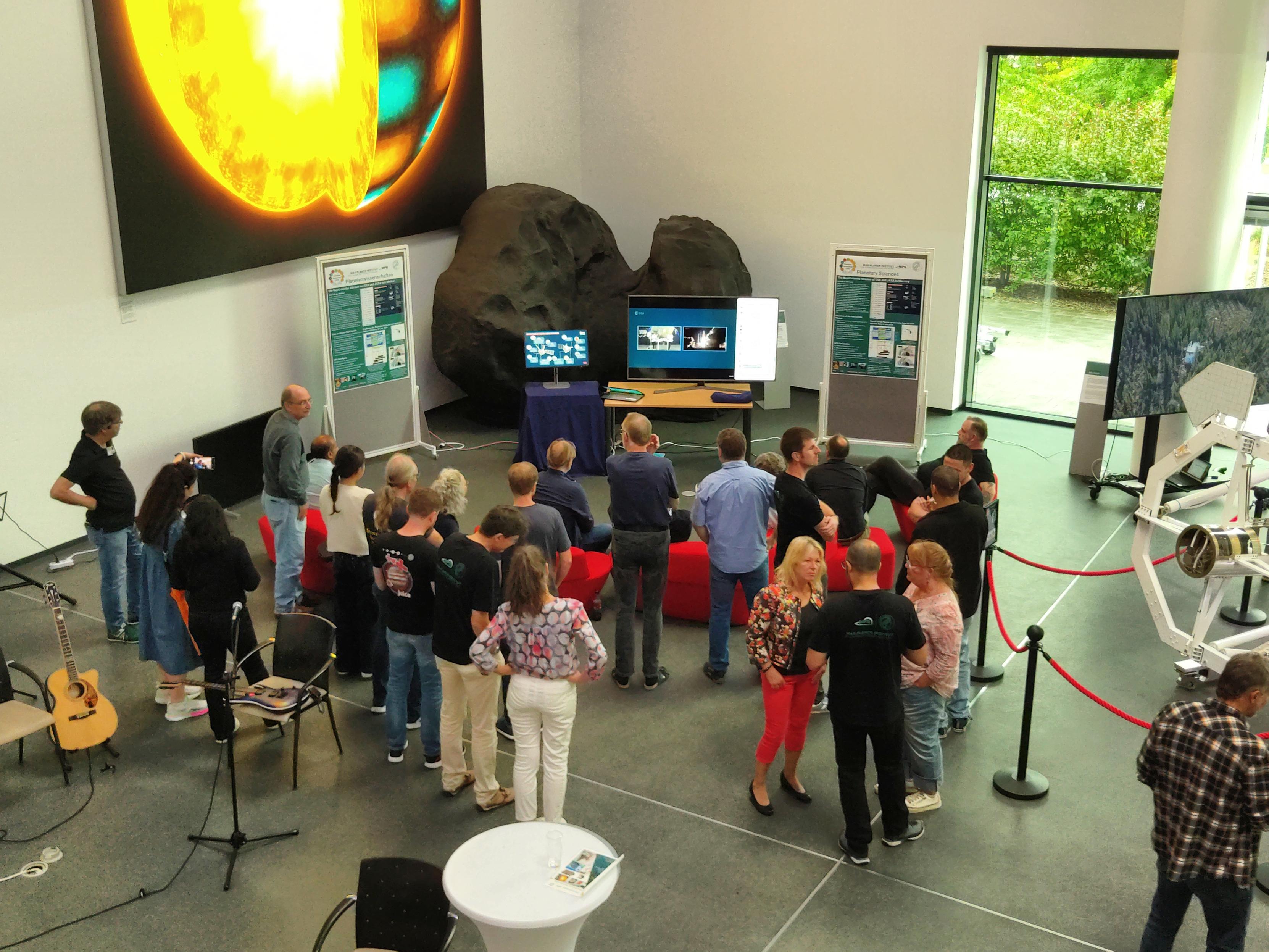
Everything set up to follow the ESA live stream on the Mercury Transfer Module (MTM) separation: The BepiColombo team at MPS Göttingen and colleagues are glued to the screen and are eagerly awaiting to see the outcome of the maneuver! Join us watching live via https://www.esa…
""Starting with Red Hat Enterprise Linux (#RHEL) 10.2, #Firefox and #Thunderbird are delivered as Flatpaks by default. If you install RHEL with a graphical desktop, your browser and email client will now come from the
Replaced article(s) found for math.GN. https://arxiv.org/list/math.GN/new
[1/1]:
- Pairwise Separation and Compactness in Soft Bitopological Spaces via Soft Elements
Subhasis Ray, Titu Barik
https://arxiv.org/abs/2602.06372 https://mastoxiv.page/@arXiv_mathGN_bot/116039627488494962
toXiv_bot_toot
The 2026 State of CSS Survey results are out:
https://2026.stateofcss.com/
Unsurprised color features in CSS are most hated, despite last year’s survey’s odd focus on them.
CSS carousels also fitting given they encode WCAG violations, break Separation of Concerns.
In the coming weeks, the justices will decide whether to wade into Trump’s messy defamation brawl with magazine columnist E. Jean Carroll,
his mass cancellation of federal research grants,
whether the Department of Government Efficiency must provide records detailing its slashing of federal agencies last year,
and the administration’s ban on transgender Americans serving in the military.
Those and other cases could be added to a term that already includes an important…
Lipid Controlled Non-Monotonic Assembly and Rheology of an Egg Yolk Protein at Water-Soybean Oil Interface
Nancy Jaglan, Rumal Singh, Sajal K Ghosh
https://arxiv.org/abs/2608.11825 https://arxiv.org/pdf/2608.11825 https://arxiv.org/html/2608.11825
arXiv:2608.11825v1 Announce Type: new
Abstract: An essential component of food items like mayonnaise and salad dressing is hen egg yolk. Phosvitin (PVT) is a phosphoprotein, which exists in the granules of this hen egg yolk which stabilizes the food emulsion by preventing phase separation. To understand, how this protein is adsorbed at the interface of water and edible oil in the presence and absence of lipids is essential for improved control in food production. To monitor the kinetics of this adsorption, the dynamic interfacial tension has been determined in the current investigation. The drop in interfacial tension over time indicates the adsorption of protein at interface which is enhanced on increasing the concentration of protein in water phase. However, at higher concentration, the positive activation energy hinders the adsorption process resulting a saturated interfacial tension. The dilation rheology of the macromolecular film at this oil-water interface shows the elastic nature of the film to be greater than the viscous nature, indicating the formation of a soft gel film. At low concentration, the zwitterionic lipid, 1-palmitoyl-2-oleoyl-sn-glycero 3-phosphocholine (POPC), promotes this protein adsorption at the interface. Interestingly, at high concentration, the lipid overtakes the interface removing the protein from there. The lipid-protein composite film again shows the nature of a soft gel. The non-monotonic effects of lipids on assembly of protein at the water-edible oil interface is an important observation to optimize the composition of relevant food products.
toXiv_bot_toot
Unreasonably excited about finally landing UI and Agent separation by network in my AI Harness and multiple concurrent input channels
Each talking to unique, isolated contexts, durable, relocatable and able to recover from crash without redoing any work.
Durable jobs, TUI, Slack, Discord app talking to hyper focussed private, local-first LLMs backed by knowledge and easy (very!) to write tools.
Sharp Orlicz Endpoints for Spatial-Temporal Ergodic Averaging
Jie Li
https://arxiv.org/abs/2608.03767 https://arxiv.org/pdf/2608.03767 https://arxiv.org/html/2608.03767
arXiv:2608.03767v1 Announce Type: new
Abstract: We study the composition of temporal ergodic averaging with spatial averaging over shrinking metric balls, and determine sharp Orlicz endpoints for the corresponding unrestricted joint limit. For consecutive Birkhoff averages normalized by $N\Lambda_q(N)$ ($q\ge 0$), the sharp Orlicz endpoint is $L\log_{q 1}L$. In particular, the ordinary case $q=0$ yields an $L\log L$ local joint convergence theorem under the Lebesgue differentiation property alone, while $L^1$ fails even on the Euclidean interval, answering two questions of Young. The same $L\log_{q 1}L$ endpoint holds for prime averages for every $q\ge 1$. For arbitrary time sequences, $L\log_qL$ always suffices at the same normalization $N\Lambda_q(N)$ ($q\ge 1$), and this endpoint is sharp in the Orlicz sense for fixed-base exponential sequences $k^n$ ($k\ge 2$) and for sequences with polynomial ratio separation, including $n!$.
The positive results rest on a local stability principle: under the ball Lebesgue differentiation property, pointwise temporal convergence lifts to the local joint limit whenever the associated temporal maximal function admits an $L^1$ majorant. The additional logarithm in the regular-time case comes from lifting restricted logarithmic maximal estimates from sets to general functions. The arbitrary-sequence theorem uses a dyadic decomposition instead. The lower bounds are local $\infty$-sweeping out constructions, obtained by weighted local sweeping out for polynomial-growth regular times, by residue constructions for polynomially ratio-separated sequences, and by digit constructions for fixed-base exponentials.
toXiv_bot_toot
Today is a very special episode of "dog with separation anxiety". Rigby howls, James *never* leaves the house this early. Something nefarious must be happening.
Yeah, Rigby. You're not that special. James has another dog family out west that plays fetch like you never do, and they're going on a tasting tour of the Tillamook cheese treats factory without you
Divorce, Parenting And Property – Legal Insights From Village Family Lawyers
Your go-to source for calm, clear guidance on separation, parenting arrangements, financial settlements, mediation, and more...
Great Australian Pods Podcast Directory: https://www.greataustralianpods.com/divorc
Elon Musk in recent years instructed Tesla executives to organize the company with a “laser” between its U.S. and China businesses, according to people familiar with the planning.
He wanted to ensure that in the event of geopolitical strife between the two countries, at least the U.S. half of Tesla would survive.
Now, some Tesla executives have been told to prepare for a separation of the China business ahead of a potential merger with SpaceX, a person familiar with those talks…
Efficient Separation of the Isomeric State $^{26\text{m}}\text{Al}$ from the Intense Ground State Background via Sequential Optical Pumping in Collinear Laser Spectroscopy
Hoon Yu, Jung Bog Kim, Cheolmin Ham, Sung Jong Park
https://arxiv.org/abs/2608.22825
Universal scaling of electrochemical information transfer at solid-liquid interfaces
Eikichi Kimura, Ashutosh Rathi, Saki Tsuchiya, El Mustapha Mansouri, Sara Mandi\'{c}, Kristi Kanya Saikia, Keisuke Oshimi, Masazumi Fujiwara, Keigo Arai
https://arxiv.org/abs/2607.22190 https://arxiv.org/pdf/2607.22190 https://arxiv.org/html/2607.22190
arXiv:2607.22190v1 Announce Type: new
Abstract: Electrochemical potentials at solid-liquid interfaces govern diverse chemical and energy conversion processes; however, the extent to which their electrochemical influence extends into the solid remains unclear. This study demonstrates that the maximally accessible electrochemical information is controlled by a single dimensionless factor $u$, defined as the ratio of the effective electrostatic separation between the liquid and probe locations to the electrostatic propagation length in the solid. The resulting universal inverse-square scaling is independent of the microscopic details of the probe. This attenuation law identifies electrostatic screening as a fundamental constraint on information transfer across solid-liquid interfaces, providing quantitative design principles for subsurface electrochemical sensing.
toXiv_bot_toot
Toward cryptographically verifiable authorization for autonomous AI agents: A security hypothesis, preliminary formal model, and proof-of-concept implementation
M. Llamb\'i-Morillas, D. Fern\'andez-Fern\'andez
https://arxiv.org/abs/2607.21325 https://arxiv.org/pdf/2607.21325 https://arxiv.org/html/2607.21325
arXiv:2607.21325v1 Announce Type: new
Abstract: Autonomous AI agents increasingly execute actions, invoke tools, and operate on protected resources with limited human oversight. Existing authentication and authorization mechanisms establish identity and delegate authority, but do not inherently provide cryptographic evidence that a concrete request issued by a specific agent satisfies the applicable policy in a specific execution context. This paper hypothesizes that agent authorization can be formalized as a cryptographically verifiable relation, denoted $R_{CVA}$, that jointly binds an agent principal, a concrete authorization request, an execution context, and the satisfaction of an applicable policy, while selectively preserving the confidentiality of private authorization attributes. We introduce a preliminary formal abstraction for Cryptographically Verifiable Agent Authorization (CVA), define a compact set of candidate security properties including authorization soundness, principal binding, request binding, policy binding, and replay resistance, and provide an executable zero-knowledge proof of concept that instantiates selected elements of the model over a Groth16 zk-SNARK construction. We further identify and formalize the structural separation among identity binding, authorization-request binding, and runtime execution binding as a central open problem in the design of secure agentic systems (a distinction {not explicitly addressed by} current agentic security frameworks) and present a falsifiable research agenda for its resolution.
toXiv_bot_toot
Replaced article(s) found for physics.ins-det. https://arxiv.org/list/physics.ins-det/new
[1/1]:
- A tunable photonic band gap resonator for axion dark matter searches
Lewis, Goulart, Barbosa, Jois, Leder, Sindhwad, Urdinaran, van Bibber
https://arxiv.org/abs/2408.03861 https://mastoxiv.page/@arXiv_physicsinsdet_bot/112925197817813337
- Optimization of Cryogenic Detector Test Station by Rejecting Electromagnetic Interference
Sangbaek Lee, Whitney Armstrong, Maximo DiPreta, Jacob Dulya, Valentine Novosad, Tomas Polakovic
https://arxiv.org/abs/2601.03158 https://mastoxiv.page/@arXiv_physicsinsdet_bot/115852984138241851
- Valley-peak modulation in phase space: a law-invariant VPM and its theta-function structure
Aaron J. Hendrickson, David P. Haefner
https://arxiv.org/abs/2603.01199 https://mastoxiv.page/@arXiv_physicsinsdet_bot/116164317738741185
- Pushing the Limits of Pulse Shape Discrimination in a Large Liquid Xenon Detector
D. S. Akerib, et al.
https://arxiv.org/abs/2603.26877 https://mastoxiv.page/@arXiv_physicsinsdet_bot/116322766877175621
- Cherenkov and scintillation light separation in BGO and BSO crystals coupled to SiPMs for dual-re...
M. Alviggi, et al.
https://arxiv.org/abs/2604.09918 https://mastoxiv.page/@arXiv_physicsinsdet_bot/116402026414652810
- Small but Tubby: A Magnetic Loop Antenna Made from 100 mm Copper Tubing
Peter M\"arki, Markus Niese
https://arxiv.org/abs/2607.10828 https://mastoxiv.page/@arXiv_physicsinsdet_bot/116917273903663314
toXiv_bot_toot
So far so good: as seen in the clip #BepiColombo was at 12:11 UTC, just at the time of the planned MTM separation plus signal time.
Sharp proper estimation of fixed-component Gaussian location mixtures in polynomial time
Hengzhi He, Guang Cheng
https://arxiv.org/abs/2608.12701 https://arxiv.org/pdf/2608.12701 https://arxiv.org/html/2608.12701
arXiv:2608.12701v1 Announce Type: new
Abstract: We consider a mixture of at most $k$ unit-covariance Gaussians in $\mathbb{R}^d$ whose means belong to a fixed-radius ball, with no separation or minimum-weight condition. Doss, Wu, Yang and Zhou (2023) proved that the minimax Hellinger risk is of order $\sqrt{d/n}\wedge 1$ and constructed a proper polynomial-time estimator with the slower general bound $(d/n)^{1/4}$; obtaining the sharp rate in polynomial time for fixed $k\geq 3$ was left open. We resolve this question. The key device is a moment-fiber range finder. A second-moment subspace controls the energy missed by projection. We then estimate finitely many one-free-index Hermite contractions. These vector-valued contractions recover every tensor component containing exactly one missed direction at the sharp $\sqrt{d/n}$ scale. Every remaining term contains at least two missed factors and is therefore controlled by the residual second-moment energy. The resulting subspace has dimension depending only on $k$. Exhaustive moment fitting in this constant-dimensional space produces a proper mixture and, together with the dimension-free moment characterization of Gaussian mixtures, achieves the optimal Hellinger rate in polynomial arithmetic time for every fixed $k$.
toXiv_bot_toot
The DoJ civil rights division has seen dramatic changes since Trump came back into office last year and installed Harmeet Dhillon, a former Republican Party operative in California, to lead it.
Dhillon has fired employees in droves,
pushed out others through separation incentives tied to pressure campaigns,
reassigned staff
and rewritten the mission statements for each section in the division.
She has vastly reshaped the types of cases the office pursues
…
Stephen Miller, White House deputy chief of staff, is making his dreams come true:
accelerating the arrest and removal of thousands of unaccompanied immigrant kids.
The man behind family separation in the first Trump term
who once boasted that policy would “prove to be a migration deterrent”
has now teamed up with another deadly threat,
Robert F. Kennedy Jr.,
to attack the most vulnerable kids in our country:
-- those here on their own.
By law…
Crosslisted article(s) found for physics.ins-det. https://arxiv.org/list/physics.ins-det/new
[1/1]:
- Radiation damage to the Hubble Space Telescope has been several years out of phase with the Solar...
Gavin Leroy, et al.
https://arxiv.org/abs/2608.18214 https://mastoxiv.page/@arXiv_astrophIM_bot/117126723538465290
- Beam-Tracing-Based Quantitative Reconstruction of Density Fluctuations in QUEST Using Doppler Bac...
Kinoshita, Tokuzawa, Hall-Chen, Tan, Ido, Idei, Ikezoe, Hanada, Hasegawa, Onchi, Peng
https://arxiv.org/abs/2608.18444 https://mastoxiv.page/@arXiv_physicsplasmph_bot/117126778820753320
- Exact time-correlated coincidence modeling with reset boundaries
Jinjing Li
https://arxiv.org/abs/2608.18728 https://mastoxiv.page/@arXiv_hepex_bot/117126770332511706
- Technical Proposal for the Atom Interferometer CERN Experiment (AICE) Facility
Gianluigi Arduini, et al.
https://arxiv.org/abs/2608.18743 https://mastoxiv.page/@arXiv_hepex_bot/117126797695022116
- Exploring the limits of high-energy proton-pion separation in granular calorimeters
Andrea De Vita, Abhishek, Tommaso Dorigo, Pietro Vischia
https://arxiv.org/abs/2608.19064 https://mastoxiv.page/@arXiv_hepex_bot/117126803167045763
toXiv_bot_toot
A Splitting Architecture for Exact Reduced Coulomb Friction
Hongcheng Song, Ye Fan, Uri M. Ascher, Dinesh K. Pai
https://arxiv.org/abs/2607.19599 https://arxiv.org/pdf/2607.19599 https://arxiv.org/html/2607.19599
arXiv:2607.19599v1 Announce Type: new
Abstract: Existing approaches to frictional contact dynamics typically either modify the Coulomb law to improve numerical robustness or solve the exact law in a fully coupled monolithic form. However, in its reduced form, exact Coulomb friction can be written as a cone complementarity problem with an augmented velocity, which reveals a natural split between a cone-constrained linear response and a scalar non-associated coupling induced by tangential velocity. We exploit this structure in the solver design. Our method uses an outer iteration to update the non-associated coupling explicitly, and an inner solve for a strongly convex cone-constrained quadratic program. This separation also makes the inner solver modular, so different numerical schemes can be used without changing the outer iteration. We evaluate the method on rigid-body benchmarks with stick-slip transitions and frictional stacking, and show that it reproduces exact Coulomb complementarity without smoothing or relaxing the friction law.
toXiv_bot_toot
A formal log(Re)-cost framework for the engineering turbulence problem
Jiaqi Li, Robert F. Kunz, George Huang, Xiang I. A. Yang
https://arxiv.org/abs/2607.20199 https://arxiv.org/pdf/2607.20199 https://arxiv.org/html/2607.20199
arXiv:2607.20199v1 Announce Type: new
Abstract: In fluid engineering, the turbulence problem is the longstanding challenge of obtaining accurate predictions of engineering quantities at affordable computational cost. Viewed through computational complexity, a practical algorithm requires cost growth no worse than $O(N)$, where $N$ denotes problem size. For turbulent flows, the problem size may be approximated by the number of dynamically relevant scales and hence by the Reynolds number $Re$. We propose a multi-fidelity, physics-constrained, data-driven framework designed to meet this criterion under stated assumptions. We augment the Spalart--Allmaras model through field inversion and machine learning using a constrained formulation that preserves the law of the wall. The model is trained at a low Reynolds number, where high-fidelity data are affordable, and deployed at higher Reynolds numbers. For a mean-flow-aligned grid in a wall-bounded flow, fixed spanwise resolution, and steady-solver cost linear in grid-point count, the low-fidelity RANS prediction scales as $O(\log(Re))$. The high-fidelity calculation and learning stage each contribute $O(Re^0)$ relative to the target Reynolds number, giving an overall formal cost of $O(\log(Re))$. In plane channel flow, a model trained at $Re_\tau=1000$ corrects the wake-layer error of the baseline model and retains the improvement at $Re_\tau=5200$. In the periodic hill, a model trained at $Re_b=5600$ is tested at $Re_b=10595$, $19000$, and $37000$. The constrained formulation preserves separation and recovery behavior as Reynolds number increases, yields the lowest root-mean-square error across all tests, and exhibits nearly Reynolds-number-independent error, indicating robust extrapolation.
toXiv_bot_toot
A Measure-Theoretic Approach to Spontaneous Stochasticity
Wandrille Ruffenach, Eric Simonnet, Nicolas Valade
https://arxiv.org/abs/2607.16328 https://arxiv.org/pdf/2607.16328 https://arxiv.org/html/2607.16328
arXiv:2607.16328v1 Announce Type: new
Abstract: Spontaneous stochasticity (SpSt), originating in Richardson's picture of turbulent dispersion and Lorenz's Eulerian view of finite-time loss of predictability, was later formulated under this name by Gaw\k{e}dzki and collaborators and developed in shell models by Mailybaev and collaborators. Whether it occurs in fully developed turbulence remains a major open question.
Beyond a few specific classes of systems, however, SpSt has lacked a general mathematical definition. We introduce a measure-theoretic formalism in which it is understood as a measure-selection principle. Given an inviscid problem, a well-posed regularization, and an ambient measure, we study the pushforward of that measure by the regularized flow. Strong SpSt occurs when these pushforward measures converge to a non-Dirac probability law, replacing classical deterministic selection by statistical selection.
For finite-dimensional systems, we establish several structural results. Our central attainability theorem shows that, whenever the inviscid problem is nonunique, any probability measure supported on the set of inviscid states can be selected as the limiting law of a suitable regularization. We also identify singular sets in the inviscid dynamics, detected through Dini-type directional growth, as necessary obstructions underlying nonuniqueness. We analyze the relation between SpSt and sensitivity to initial data, clarifying the scope and limitations of turbulence-inspired finite-time separation criteria. Finally, we develop a renormalization-(semi)group viewpoint in which limiting statistics arise as statistical attractors. Explicit examples illustrate how ambient measures, inviscid singularities, regularization scales, and initial-data sensitivity interact in the emergence of SpSt.
toXiv_bot_toot
Rhetoric is ramping up on both sides of the debate with regards to the question on Alberta separation on the upcoming October referendum.
I've lived through the Quebec referendum, got out of the UK just before Brexit, and recently left Texas where a week didn't go by there without someone in Austin mentioning the word secession.
All of these arguments that I have heard in these are immensely myopic, completely ignorant of history, and heavily dependent on anti-immigrant rhetoric - in my humble opinion.
Keenable has made their SELECT product free for the month of September - so I tasked it at gathering data about the upcoming referendum in Alberta regarding the potential for separating from the rest of Canada.
So the question was:
Cross reference lost opportunity cost for economic growth in Alberta with the onset of the Alberta Separatist movement with a conservative estimate on the low end and extrapolate the maximum potential economic loss on the high end
This is an AI product - it is, in essence - AISlop, so ingest and consume with a grain of salt (and other preferred seasonings, as you do.)
There is the caveat that that links to original sources remain in place for those who want to dig deeper, for better or for worse.
Yes - the question was loaded, albeit with what some might consider wisdom and others would simply label as "the woke" (without being able to define what "woke" in this context actually means - but I digress)
Long story short:
#AlbertaSepartation #AlbertaRefererendum #AI #AISlop
""The Chief Executive directing his subordinates to exercise core Executive functions is a feature, not a bug, of our constitutional system," the filing said.
The DOJ went further, calling the idea of an independent Justice Department "antithetical to the constitutional separation of powers" — and "as a matter of historical analysis, it is a myth.""
DOJ lobs new seashell attack with jaw-dropping Trump boast: 'Feature, not a bug' - Raw Story
https://www.rawstory.com/doj-vindictive-prosecution-comey/
Axioms of Continuous Separation
Zhongqiang Yang, Nada Wu
https://arxiv.org/abs/2608.13086 https://arxiv.org/pdf/2608.13086 https://arxiv.org/html/2608.13086
arXiv:2608.13086v1 Announce Type: new
Abstract: For a $T_1$-space $X$, let $Cld(X)$ denote all its nonempty closed subsets and $T_4(X)=\{(F_1,F_2)\in Cld(X)^2:F_1\cap F_2=\emptyset\}$. In terms of closed sets, $X$ is $T_4$ iff for each $(F_1,F_2)\in T_4(X)$, there is a pair of closed sets $\phi_1(F_1,F_2)$ and $\phi_2(F_1,F_2)$ such that their union is $X$ and $F_j\cap \phi_j(F_1,F_2)=\emptyset$ for $j=1,2$. Thus, in this paper, for a topology $\tau$ on $Cld(X)$, we introduce the definition: A $T_1$-space $X$ is called $CT_4$ for the topology $\tau$ if the above maps $\phi_j:T_4(X)\to Cld(X)$ are continuous on $\tau$. Similarly, for $i=1,2,3$, we can define a $T_1$-space to be $CT_i$ for $\tau$. We only consider the Vietoris topology on $Cld(X)$ and show that every $CT_4$-space is countably compact, and every $CT_3$-space is a Fr\'{e}chet-Urysohn space, every separable subspace of a $CT_3$-space is metrizable. We give relevant examples. Any finite-dimensional cubes, the infinite-dimensional cube, any finite-dimensional spheres, and all 0-dimensional compact metrizable spaces are $CT_4$. All infinite discrete spaces, all finite-dimensional Euclidean spaces and all countable limit ordinal spaces are $CT_3$ but not $CT_4$. Also, each metrizable space with a unique non-isolated point is $CT_3$, and is $CT_4$ if it is compact. Moreover, the infinite sum of $CT_3$ spaces is $CT_3$ but not $CT_4$. Every countable space with a unique non-isolated point is $CT_2$, and it is $CT_3$ if and only if it is metrizable. All subfields of real numbers and their complement spaces are $CT_2$ but not $CT_4$; and their $CT_3$ status remains unclear. All uncountable ordinal spaces are not $CT_2$. The one-point compactification of any uncountable discrete space is not $CT_2$. $CT_1$ and $T_1$ are equivalent, hence all spaces above are $CT_1$. Open Problems: is there a non-metrizable $CT_3$ or $CT_4$ space? Is any compact $CT_2$ space $CT_3$ or $CT_4$?
toXiv_bot_toot
Substrate-Directed Wetting Layers in Bicontinuous Particle-Stabilised Emulsions
Jesse M. Steenhoff, Martin F. Haase
https://arxiv.org/abs/2608.13230 https://arxiv.org/pdf/2608.13230 https://arxiv.org/html/2608.13230
arXiv:2608.13230v1 Announce Type: new
Abstract: Bicontinuous interfacially jammed emulsion gels (bijels) facilitate efficient mass transport across multiple length scales due to their interwoven structure of particle-stabilised liquid channels. This unique morphology imparts considerable potential for applications in separation and catalysis, particularly when fabricated \textit{via} solvent-transfer-induced phase separation (STrIPS). STrIPS enables the continuous, large-scale production of nanostructured bijel films on solid substrates, yet the influence of the substrate properties on the formation dynamics and final morphology remains insufficiently understood. In this study, this relationship is elucidated by preparing STrIPS bijel films on silane-functionalised glass substrates with selectively controlled wettability and analysing the resulting structure with confocal microscopy. The results showed the presence of notable wetting layers at the bijel-substrate interface, whose thicknesses could be tuned through the nanoparticle weight fraction. In line with numerical simulations, increasing the substrate hydrophobicity drove a transition from a laminar, water-rich surface layer to a patch-like, progressively oil-rich structure. These findings provide crucial insight into the structure-directing role of substrates in supported bijel films, which aids their application as functional materials.
toXiv_bot_toot
 @SteveFoerster@social.vivaldi.net