 @hex@kolektiva.social
2025-10-15 20:50:35
I keep coming back to the mirror dualities of the oppressed and oppressor under authoritarianism.
The oppressed is portrayed as both weak and godlike. The stereotypes are always some variation on sloth and incompetence, but yet somehow also a menace capable of destroying the "pure" society. To use the most relevant current example, Antifa being both little femme soy boys who would always get beat up by "real men" while also being an international terrorist organization on the brink of overthrowing the US government, the unarmed presence of whom makes the heavily armed agents of ICE flee for their lives. Antifa is both having absolutely no impact on ICE, and also having such an impact on ICE that the military needs to come in to protect them. The contradiction is obvious but never seems to occur to those who hold both to be true at the same time.
But few talk about the duality of the oppressor. The sovereign throughout history has always been both a ruler above the law, sometimes even the representative or incarnation of a divine force. Yet, this same superhuman/god-man is also a baby who needs constant care. This is absolutely a through line from the very earliest records of sovereign cults to modern cult leaders, CEOs, and Trump today. Power, for these people, is expressed both as the ability to force others to enact their will and in the ability to compel others to care for them. Can any of these "men" cook? Can they fix anything themselves? They are driven everywhere, cooked for all the time, constantly protected from danger. Kings are still dressed, at least for rituals. I could dissect masculinity here, but that's a whole thing.
It is as though the drive to care for our children, who must be taught to behave within acceptable norms, is hijacked by "leaders" who demand our care and attention... even at the expense of our literal children. And recently we've seen some of those very CEOs, with LLMs and return to office demands, show that their judgment is also little better than children, making decisions while pretending to understand a subject.
The oppressed are portrayed as both god-like and impotent and are, in fact, neither. Meanwhile the rulers portray themselves only as invulnerable and are, in fact, childish in their ability to survive without constant support. Their greatest fear from the collapse of society is figuring out how to make sure people keep taking care of them.
It just keeps rattling around in my head.
#USPol
 @thomasfuchs@hachyderm.io
2025-11-16 15:52:34
So I've a medical thing that I need to buy once a month on Amazon and they cancelled my subscription delivery for it last time (but not the subscription itself), without telling me.
I tried to just order it for one time delivery, but the delivery date was a month out and they immediately cancelled my order.
My wife told me to use my developer brain—and yes, imagining a bug with some row in a database being in a fugue state, the exactly a month out delivery date being the biggest hint to something going into a default state when a calculation fails.
So I removed the subscription to the item (they make it hard to find where to do this).
Bingo: I can now order immediately for delivery in two days and for working subscrpition delivery.
 @castarco@hachyderm.io
2025-11-16 12:05:17
I have the distinct impression that we could use most American "sci-fi" TV series (which seem to have a kink for post-apocalyptical scenographies) as a diagnostic tool for the autism spectrum.
For a moment, let's leave aside the tons of right-wing propaganda "hidden" in plain sight, and their excessive reliance on boring & worn out tropes (religious & cultish bullshit, irrational lack of communication & excess of anti-social behaviour, all vs all, ultra-low-iq characters*, psychotic & irrationally treacherous characters*, ultra-inconsistent character development used to justify "unexpected" plot twists, rampant anti-intellectualism...).
What could be used as a diagnosis tool is the incredible amount of strong inconsistencies that we can find in them**. It throws me out of the story every single time; and I suspect that it takes a certain kind of "uncommon personality" to feel that way about it, because otherwise these series wouldn't be so popular without real widespread criticism beyond cliches like "too slow", "it loses steam towards the end of the season", etc.
Many of those plots start in a gold mine of potentially powerful ideas... yet they consistently provide us with dirt & clay instead, while side-lining the "good stuff" as if it was too complicated for the populace.
Do you feel strongly about it? Do you feel like you can't verbalize it without being criticised as "too negative", or "too picky", or an "unbearable snob"? Do you wonder why it seems like nobody around shares your discomfort with these stories?
* : I feel this is a bit like the chicken & egg problem. Has the media conditioned part of American society to behave like dumb psychopaths as if it was something "natural", or is the media reflecting what was already there? Also, could we use other societies as models for these stories... just for a change? Please?
** : Just a tiny example: a "brilliant" engineer who builds a bridge out of fence parts and who doesn't bother to perform the most basic tests before trying it in a real setting and suffer the consequences: the bridge failing and her falling into the void. Bonus points for anyone who knows what I'm talking about.
 @simon_brooke@mastodon.scot
2025-11-16 14:24:11
When it's observable that the very rich are steadily growing richer while the vast majority of people are growing poorer, it's obvious that the tax system is not neutral: it is actively redistributing wealth upwards. For the tax system to be neutral, it MUST tax the very rich much more. To do so is not redistributive, at least until it actively causes a net movement of wealth towards the poor: rather it is simply neutral.

 @burger_jaap@mastodon.social
2025-10-16 11:13:54
“By 2040, the Locational scenario could reduce the total system cost by 23 – 59 Bn. EUR annually. These savings are in the order of magnitude of those associated with the integration of European electricity markets.”
https://publications.jrc.ec.europa.eu/repository/handle/J…

 @markhburton@mstdn.social
2025-11-16 09:17:14
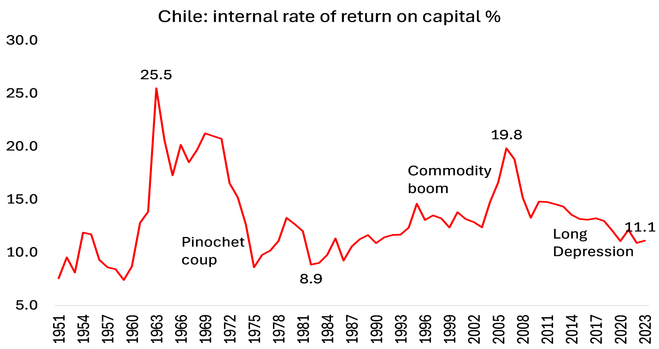
"Although the leftist alliance led by Jeannette Jara of the Communist Party, who served as Boric’s labor minister, is ahead in the opinion polls, she will not get an outright majority in the first round as Boric did. And a collection of right-wing parties is likely to combine their vote and get Kast into the presidential office in the second round in December."
 @Sustainable2050@mastodon.energy
2025-10-15 04:38:04
As climate change causes stronger storms and melts the permafrost, the Trump regime took away the funding to protect this low-income Alaska Native community against the effects.
https://www.
 @cdarwin@c.im
2025-11-15 06:18:20
A federal judge has blocked the Trump administration from withholding federal funding and threatening hefty fines against the University of California
amid the administration’s attempts to coerce elite US universities into adopting and promoting conservative ideals.
US district judge Rita Lin of San Francisco issued the preliminary injunction late Friday,
saying the government was not allowed to demand payments from the California school system over the administration’s cla…
@hex@kolektiva.social2025-10-15 11:10:50
Perhaps the most interesting thing about the Nacirema people is their insistence that they do not participate in practices of which they clearly do. Equally unusual is the fact that, unlike other sacrificial cultures who raid neighboring tribes for victims, both slaves and victims for human sacrifice are only taken from within the society. In fact, there is a very strong cultural taboo against sacrificing or enslaving those from other tribes.
They are aware of the rituals of human sacrifice in other tribes, but claim such rituals to be inconsistent with their society. Yet their human sacrifice rituals are some of the most elaborate in the world. These rituals are so important that there is a whole part of Nacirema society dedicated specifically to arguing about who should and should not be sacrificed, restraining and feeding the potential victims for the years during which these arguments take place, and ultimately preparing and administering the ritual poison.
This is strangely similar to their approach to slavery. Both human sacrifice and slavery were once a much larger part of Nacirema society. Their human sacrifice rituals now take far longer and happen far less often, but at no point have they ever recognized these ritual sacrifices as such. Meanwhile, the Nacirema do acknowledge that slavery was part of their culture once. During the time when they did recognize their practice of slavery, they did raid other tribes for slaves. Now they follow the same complex ritual for slavery as they do for human sacrifice.
It is strange that, by following this ritual and only choosing victims from within their society, they seem to become incapable of seeing their behavior for what it is.
 @tiotasram@kolektiva.social
2025-10-15 12:08:42
Day 22: Yuki Urushibara
I've got a few more mangaka left on my short list, and might very well get to at least one more, but Urushibara is the author of Mushishi and anyone who knows either the manga or anime understands immediately why she appears here.
Mushishi is a "seinen" anime, which means it's written for adults, not children or teenagers (although it's very accessible for all ages). It deals with a vast array of life's circumstances through the lens of a traveling mushi expert and the various whimsical supernatural creatures he is called on to deal with. He's not an exorcist though, instead understanding that humans must live in harmony with the mushi, and working like an ecologist to sort things out. As is probably obvious, Urushibara is an incredible world-builder; she's also a top-notch artist and above all, her stories are overflowing with kindness, humanity, and respect for the natural world.
Besides Mushishi, I've read "Suiiki", and it's one of the few manga I stumbled through in the original Japanese, which says a lot given my limited reading vocabulary (and the fact that it doesn't include rubi). It weaves the supernatural into a story of childhood innocence and curiosity in a lovely way.
Much like Shirahama who I mentioned earlier, Urushibara's stories are full of gentle wisdom for all ages, but Urushibara's work is quieter and less dramatic, with an adult main character confident in his expertise instead of a young-and-learning protagonist.
#30AuthorsNoMen