 @cdarwin@c.im
2026-02-12 17:21:02
Tesla will end production of its two flagship models, the Model S and Model X, which have long carried the company's prestige.
According to statements by Tesla CEO Elon Musk, the fundamental reason behind this decision is the company's desire to shift its resources and production infrastructure toward autonomous driving and robotics.
Planned to take effect from the next quarter, this production halt has generated significant reverberations throughout the automotive indus…

 @hanno@mastodon.social
2026-02-12 13:25:53
A Climate Success Story🎉 without a Happy End🙁?
This chart📉 shows something we would like to see more often: emissions are going down rapidly. Those are emissions of N₂O from the production of a chemical🧪—Caprolactam—used to make certain plastics&synthetic fibers.
N₂O is 273x as damaging as CO₂. However, N₂O emissions from chemical plants🏭 can be avoided with cheap🪙 technology. The curve is declining rapidly because Envalior(BE) and Fibrant(NL) have implemented N₂O abatement i…

 @Mediagazer@mstdn.social
2026-02-04 15:20:58
Email: Matt Murray says WaPo's organic search fell by 50% in three years, daily story output fell substantially, and "we often write from one perspective" (Max Tani/@maxwelltani)
https://x.com/maxwelltani/status/2019066214450954706

 @fanf@mendeddrum.org
2026-02-06 09:42:02
from my link log —
The Wendelstein 7-X fusion stellarator proves its efficiency.
https://www.ipp.mpg.de/5125328/05_21
saved 2021-08-17 https://dota…

 @cosmos4u@scicomm.xyz
2026-03-04 23:25:41
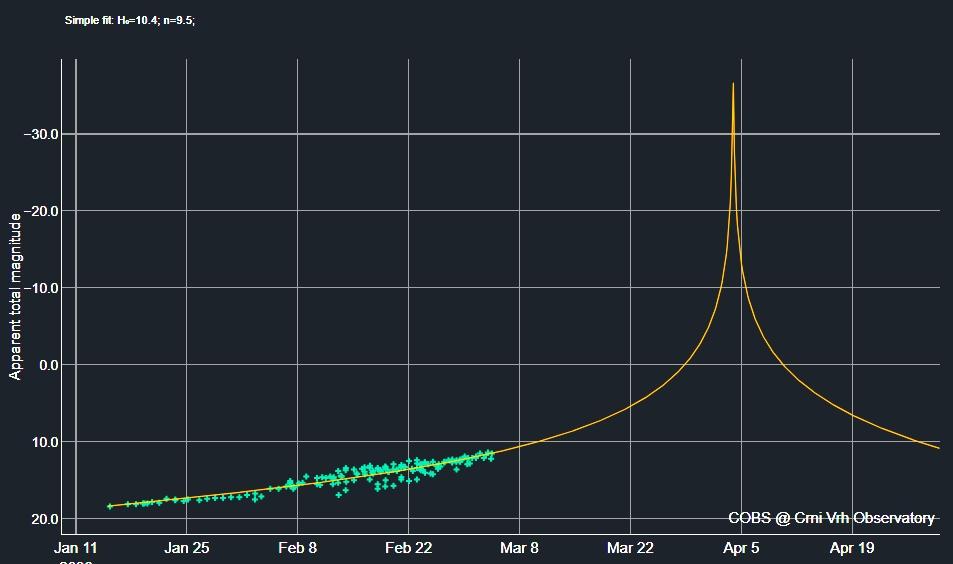
So the new #Kreutz #comet #MAPS is *still* following the constant rapid rise in brightness it has shown since discovery: a dumb extrapolation - https://cobs.si/analysis/?comet=2688&from_date=2026-01-15 00:00&to_date=2026-04-30 00:00&observation_type=V&observation_type=C&plot_x_value=1&plot_y_value=1&fit_option=1&exclude_faint=on&exclude_issue=on&observer=&association=&country=&compare_values=compare - has it get 10,000-times brighter than the Sun at its extremely close perihelion which makes so sense at all, of course, physically.
"It must therefore be assumed that this increase in activity will level off significantly in the near future," writes https://fg-kometen.vdsastro.de/koj_2026/c2026a1/26a1eaus.htm: "More likely are parameters m m0=12.0 mag / n=4 (or even lower), which would still result in a (very short-term) maximum brightness of about –9 mag (but this would probably still be significantly too bright) – always assuming that the comet survives its perihelion passage unscathed."
For other views see http://www.cbat.eps.harvard.edu/iau/cbet/005600/CBET005663.txt and https://arxiv.org/abs/2602.17626 and https://www.facebook.com/photo?fbid=10236580364221799 and https://cometografia.es/cometa-kreutz-2026-a1-maps-analisis/ - and the actual brightness is tracked at https://cobs.si/obs_list?id=2688 where it has reached ~11.5 mag. now.
 @burger_jaap@mastodon.social
2026-03-03 10:28:05

 @azonenberg@ioc.exchange
2026-02-17 16:36:43
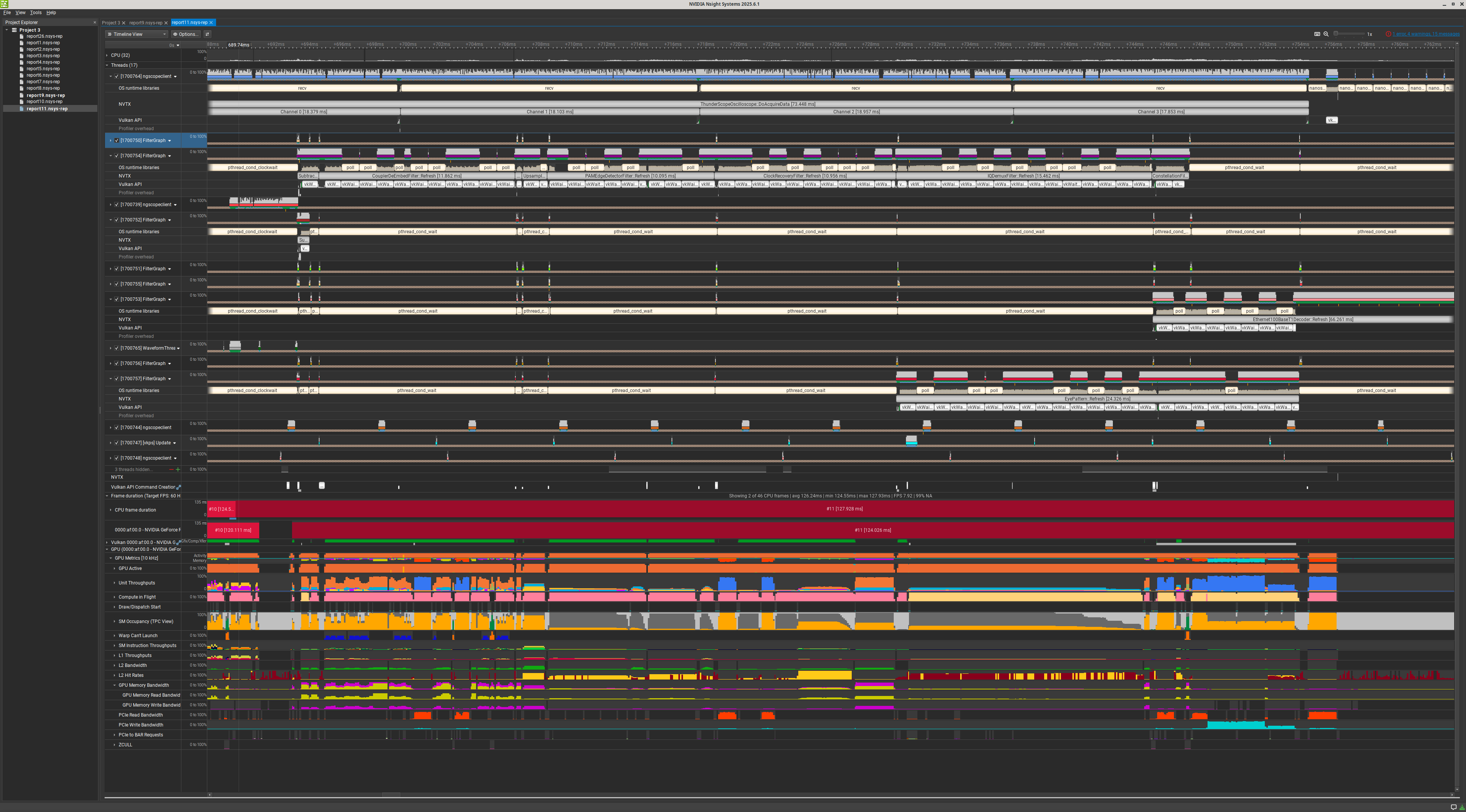
The outcome of a bunch of shader tuning last night: the upsample filter (4x sin(x/x) from 20M to 80M points in this test) went from 6.55 ms to 1.5 ms.
Original: 8% of peak DRAM read BW, 31% write, 14% L2$ hit rate.
New (just changed memory access patterns to be more coalesce/cache friendly): 9% read, 37% write, 73% L2$ hit
A similar memory ordering optimization cut the PAM edge detector from about 14 to 10 ms but my SM occupancy is still crap (around 12% of warp slots used)…
 @tiotasram@kolektiva.social
2026-04-07 11:23:25
In the interests of starting a more productive dialogue than yesterday's main character was interested in, let's make a #brainstorm thread about design changes to ActivityPub and/or client UI that could actually help address drive-by (often racist) harassment on the fediverse.
Feel free to discuss pros/cons but don't feel an idea needs to be perfect to suggest it. Also since this is a brainstorm don't worry about complexity/implementation cost. If you have a great-but-hard-to-implement idea someone else may think of a way to simplify it.
Note that the underlying problem *is* a social one, do there won't be a technological fix! But tech changes can make social remedies easier/harder.
I've got some to start:
1. Have a "protected mode" that users can voluntarily turn on. Some servers might turn it on by default. In protected mode, users whose accounts are less than D days old and/or who have fewer than F followers can't reply to or DM you. F and D could have different values for same-sever vs. different-server accounts, and could be customized by each user. Obviously a dedicated harasser can get around this, but it ups the activation energy for block evasion and pile-ons a bit. Would be interesting to review moderation records to estimate how helpful this might or might not be. Could also have a setting to require "follows-from-my-server" although that might be too limiting on private servers. Restriction would be turned off for people you mention within that thread and could be set to unlimit anyone you've ever mentioned. Would this lock new users out of engagement entirely? If everyone had it on via a default, you'd have you post your own stuff until someone followed you (assuming F=1). One could add "R non-moderated replies" and/or "F favorites" options to soften things; those experiencing more harassment could set higher limits. When muting/blocking/reporting someone who replied to your post, protected mode could be suggested with settings that would have filtered the post you're reporting.
2. Enable some form of public moderation info to be displayed when both moderator and local server opt-in. Obviously each server would be able to ignore federated public tags. I'm imagining "banned from X server for R reason (optional link to evidence)" appearing on someone's profile & an icon on their PFP in each post viewed by someone on server Y *if* the mods of server X decide it's appropriate *and* server Y opts in to displaying such tags from server X specifically. Alliances of servers with similar moderation preferences could then have moderation action on one server result in clear warning propagation to others without the other mods needing to decide whether to also take action immediately. In some cases different moderation preferences would mean you wouldn't take action yourself but would keep the notice up for your users to consider. Obviously the "Scarlet Letter" vibe ain't great, but in some cases it's deserved, and when there's disagreement between servers about that, mods on server Y could either disable a specific tag or disable federation of mod tags from that server in general. Even better shared moderation tools are of course possible.
3. Different people/groups have different norms around boosting. Currently we only have a locked/public binary. Without any big protocol changes, adding a "prefers boosts/doesn't" setting which would warn in the UI before a viewer chooses to boost if the preference is "doesn't" could help. This could be set per-post, but could also have defaults and could have different values for same-server or not, or for particular servers. For example, I could say "default to prefer boosts from users on my server but not from users on other servers" or "default to prefer boosting on all servers except mastodon.social." Last option might be harder to implement I guess.
#ActivityPub #Meta #Harassment
@fanf@mendeddrum.org2026-04-06 17:42:03
from my link log —
A tail-call interpreter in (nightly) Rust.
https://www.mattkeeter.com/blog/2026-04-05-tailcall/
saved 2026-04-05 https://
@cdarwin@c.im2026-02-27 11:33:24
Neanderthal DNA is largely missing from the human X chromosome.
“We found a pattern indicating a sex bias: gene flow occurred predominantly between Neanderthal males and anatomically modern human females,”
said Dr Alexander Platt, a senior research scientist at the University of Pennsylvania and first author of the research.
The ancestors of modern humans and the closest related species, the Neanderthals, diverged, forming two distinct groups, about 600,000 years ago.