 @tiotasram@kolektiva.social
2026-07-12 16:28:07
Since it was relevant to a discussion I just had on here and is something most people probably haven't thought about much (unless you've taken one of a handful of philosophy classes), I thought I'd try to lay out a key piece of Descartes' Meditations (#philosophy
 @Techmeme@techhub.social
2026-09-15 11:10:54
New York State Assemblyman Alex Bores launches Who Decides, a nonprofit that raised $10M and aims to raise another $20M in 2027 to shape Democratic AI policy (New York Times)
https://www.nytimes.com/2026/09/15/us/politics/ai-safety-2028-election-democrat…

 @Dragofix@veganism.social
2026-09-11 23:28:37
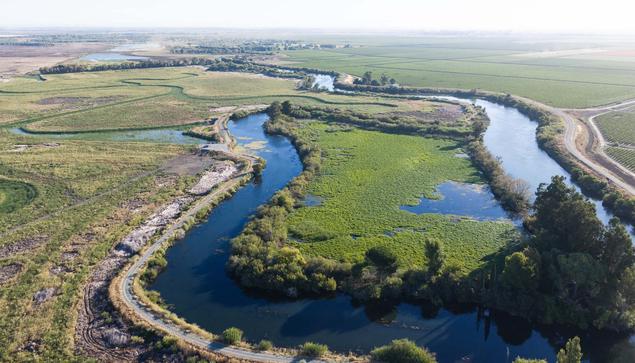
New digital tool shows exactly where California's water goes—and how climate change might disrupt it https://phys.org/news/2026-09-digital-tool-california-climate-disrupt.html
 @cdarwin@c.im
2026-06-29 17:33:48
In 2023, presidential candidate Donald Trump, seemingly out of nowhere, promised to hold a contest that would lead to the creation of 10 “freedom cities” on federal lands.
The trial balloon barely registered at the time, lost in the daily deluge of outrageous claims.
Since the new administration took office, however, would-be country starters have been on a lobbying blitz, determined to turn Trump’s pledge into reality.
“The energy in DC is absolutely electric,”
Tre…

 @bibbleco@infosec.exchange
2026-07-13 14:06:28
Just did very approximate calculations; with 10g of lithium per drone*, and assuming the Russian and Ukrainian drone efforts consume 5m units a year**, that'd be ~50 tons of lithium deposited into the environment per year, mostly within, let's say, 50km of the grey zone***. It's only about $20,000 / ton****, which means $1m of metal*****.
So to answer my own silly question: no, it won't be economically viable to scalp the top few inches of topsoil and extract the lithium from it.
* Roughly right for quadcopters / small FPV; larger and longer range ones will have more, so this is a bottom bound. (OTOH longer range UAVs will tend to use ICE kerosene rather than batteries
** Changing all the time as both sides try expanding production as fast as they can manage. Ua are scaling much faster at time of writing
*** Handwaving. Contact zone's hardly moved since early 2023; OTOH Ua are pushing range limits on small battery-powered form factor, saw a 60km claim for the Logistics Lockdown operation the other day
**** There was a big spike to the $70-8000 range in 2022; median price is closer to $10k than $20k
***** (IDK the chemistry but presumably it's in an exciting range of different compounds, depending on how many bits the battery was blown into, how hot / pressured the blast wave was a few tens of mm from the boom, what other stuff was in the vicinity that the lithium would combine with, etc etc.
@tiotasram@kolektiva.social2026-07-26 17:31:24
Semi-subtoot: there's a certain kind of anti-genocide narrative that draws comparisons between the Gaza genocide and the genocide of Jews, queer, and disabled people during WW2, with an incredulous overtone, the subtext of which is: if the good nations invaded Germany to stop the Nazis' evil in WW2, it's hypocritical for this nations not to take action to protect Gazan civilians now. There are a couple of problems with this line of reasoning, but the most obvious from an anarchist perspective (which sees "good nation" for the oxymoron it is) is that it's ahistorical. The reasons for the various allies' entrance into WW2 are varied, but they weren't about good and evil, and in fact the full depth of the evils of the Holocaust *was not known* in allied countries until after the war. Nations never really do things to "fight evil" like some humans might; they always act out of a kind of (imperfect) self-interest. The motivations for many of the allies were simply "we don't want Germany to conquer and destroy us" (and the imperfection in that motive is amply evident in the appeasement that preceded the war). America was of course not swayed by that motive, and it was the Japanese that (thinking the issue would have to come to a head eventually and that a surprise attack was worth speeding it up) put America in a situation where it joined for similar reasons.
Why is this extra relevant right now? Because neither the US nor any European country is existentially threatened by Israel (or threatened at all in fact, quite the opposite they're all benefiting economically from the situation in Gaza). The lesson of history isn't "brave, good nations will stand up to fight against anyone who commits genocide or other major evils", it's "nations act in their narrow and twisted and often mistaken self-interest (the interest of the national entity, which is often counter to the interest of it's citizens), and they always mythologize their actions after the fact as having been a fight against evil, which sometimes by luck is partially true."
To double down on this point: in the European theater the U.S. war actions were pretty good overall, defeating an evil opponent through military force and being a fairly gracious victor to the civilian populations there. In contrast, in the Pacific theater the U.S. was one of two evil empires duking it out for global dominance at the expense of civilians on both sides. The Japanese empire was a vile regime and perpetrated horrors in China, Korea, and across southeast Asia. The U.S. was barely better, between Japanese internment camps at home, and mass targeting of civilians on Japan, both with the firebombing of Tokyo and especially the nuclear bombs dropped on Hiroshima and Nagasaki.
So if your model of how we stop genocide is "convince the good guys to invade (or exert political pressure) and save the day", your model is wrong. That's not what happened in WW2. I'm not confident I know the perfect solution, but I do think it involves a mass of people making increasingly disruptive protest so that the cost *to rich companies and thus politicians* of falling to intervene is too high to stomach. That's a large part of what succeeded in South Africa, for example. Thankfully, there is already a vibrant protest movement to end the genocide in Gaza, and even though they haven't been fully successful yet, I'm optimistic that as things naturally (and through hard work) fall apart for various fascists politically, that movement will be able to succeed.
#gaza #genocide
 @hex@kolektiva.social
2026-07-22 11:37:14
Popular Front recently did a piece on the current conflicts in Ethiopia:
https://popularfront.substack.com/p/everything-you-didnt-know-about-the
It's a good primer for anyone who's unfamiliar, but is definitely lacking if you know any Ethiopian folks or pay attention to much news out of the Horn of Africa.
The interplay between authoritarian liberal nationalism, as represented by Abiy Ahmed and his government, and tribal federalism , represented by various tribal factions, reads to me very similarly to the liberalization of Europe (enclosure of the commons, a push to sacrifice ethnic identities for nationalist ones, etc). Like the liberalization of, say, France, it's a lot more complicated than "old thing bad, new thing good."
Liberalism was violent and authoritarian. It often sacrificed leftists. Liberalism's focus on borders and national identity led directly to pogroms and Nazism. Similarly, liberalization of Ethiopia has led to genocide and ethnic cleansing.
People think of "the terror" in France as a leftist thing, but it wasn't. It was a Liberal thing, centrist extremism, carried out against right and left.
I understand that tribal federalism is also not a good system, but I don't have a ton of depth so I'm not going to try to explain it. During the European Liberal revolutionary period of 1848, ethnic minorities would often side with some monarch or emperor against liberalism out of fear of liberal nationalism. It makes sense to support a system that's bad if your other option is a nationalism that erases your identity.
But even in Europe at that time, anarchism offered an alternative but that alternative often also drew from simply a different branch of liberalism that also suppressed culture and identity. Today the world is different. Democratic Confederalism offers a solution to *exactly* this problem, tested for more than a decade in Syria and developing now in Myanmar.
But the cross pollination between Syria and Myanmar in terms of fighters really made the ideological cross pollination possible. I don't think anything like that is happening now in Ethiopia.
Eurocentrism makes it easy to ignore what's happening now, but Addis Ababa is the seat of the African Union Commission. Ethiopia is a major military power in the region, so these developments carry a lot of weight. Especially as the US collapses and the world becomes more multipolar, the development of regional powers like Ethiopia will have a big impact on how that part of the continent develops.
If any folks are more familiar with Ethiopia than I am (which shouldn't be hard since I'm basically not), please correct me or add context if anything is missing or wrong.
@tiotasram@kolektiva.social2026-08-07 16:11:56
#ScribesAndMakers Aug 7: Is there a work of art that you didn't like at first but came to appreciate once you understood it better?
This is a hard one. There's tons of stuff I love now that I cab recognize I would have bounced off of completely when I was younger, but most of it I didn't actually have earlier encounters with.
I think jazz music as a genre counts for me though. Once I reached a certain level of my own musically and began to want more, I realized what Jazz was about and started to appreciate it.
There's also tons of stuff for me that's the converse: stuff I genuinely enjoyed when younger that I wouldn't enjoy now, from Harry Potter to League of Legends to Terry Goodkind.