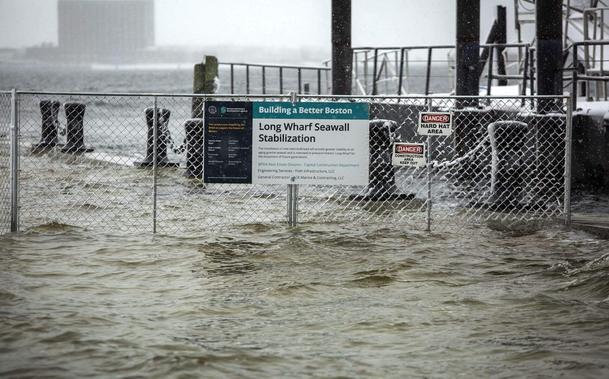
Eine neue Studie des Woods Hole Oceanographic Institution zeigt, dass der #Meeresspiegelanstieg entlang der US-Küste deutlich schneller voranschreitet als bislang von offiziellen Stellen dargestellt.
Demnach hat sich die Anstiegsrate seit 1900 mehr als verdoppelt. Die Analyse widerspricht einem Bericht des US-Energieministeriums, der keine Beschleunigung erkannte.
acceleration of nostalgia online
@… from the posts below, I assumed that whilst 6.9 does work for Intel Meteor Lake graphics, acceleration was an issue. Maybe I misunderstood.
<https://www.reddit.com/r/freebsd/co…
Non-Gravitational Acceleration in 3I ATLAS: Constraints on Exotic Volatile Outgassing in Interstellar Comets
Florian Neukart
https://arxiv.org/abs/2511.07450 https://arxiv.org/pdf/2511.07450 https://arxiv.org/html/2511.07450
arXiv:2511.07450v1 Announce Type: new
Abstract: The interstellar comet 3I/ATLAS exhibited a measurable nongravitational acceleration similar in form to that of 1I/'Oumuamua but of smaller magnitude. Using thermophysical and Monte Carlo models, we show that this acceleration can be fully explained by anisotropic outgassing of conventional volatiles, primarily CO and CO2, under realistic surface and rotational conditions. The model includes diurnal and obliquity-averaged energy balance, empirical vapor-pressure relations, and collimated jet emission from localized active regions. Mixed CO-CO2 compositions reproduce both the magnitude and direction of the observed acceleration with physically plausible active fractions below one percent for nucleus radii between 0.5 and 3 km. Less volatile species such as NH3 and CH4 underproduce thrust at equilibrium temperatures near 1 AU. These results eliminate the need for nonphysical or exotic explanations and define thermophysical limits for natural acceleration mechanisms in interstellar comets.
toXiv_bot_toot
Halpern Acceleration of the Inexact Proximal Point Method of Rockafellar
Liwei Zhang, Fanli Zhuang, Ning Zhang
https://arxiv.org/abs/2511.10372 https://arxiv.org/pdf/2511.10372 https://arxiv.org/html/2511.10372
arXiv:2511.10372v1 Announce Type: new
Abstract: This paper investigates a Halpern acceleration of the inexact proximal point method for solving maximal monotone inclusion problems in Hilbert spaces. The proposed Halpern inexact proximal point method (HiPPM) is shown to be globally convergent, and a unified framework is developed to analyze its worst-case convergence rate. Under mild summability conditions on the inexactness tolerances, HiPPM achieves an $\mathcal{O}(1/k^{2})$ rate in terms of the squared fixed-point residual. Furthermore, under additional mild condition, the method retains a fast linear convergence rate. Building upon this framework, we further extend the acceleration technique to constrained convex optimization through the augmented Lagrangian formulation. In analogy to Rockafellar's classical results, the resulting accelerated inexact augmented Lagrangian method inherits the convergence rate and complexity guarantees of HiPPM. The analysis thus provides a unified theoretical foundation for accelerated inexact proximal algorithms and their augmented Lagrangian extensions.
toXiv_bot_toot
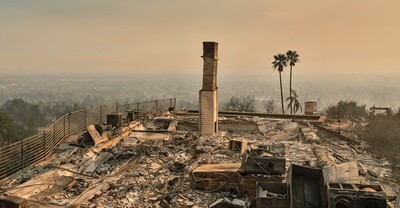
"But catastrophes also tend to reveal deficits in society, and the patterns of destruction and abandonment that followed the fire—which have roots in America’s past and its present—tell us something about the country’s future, too."
https://www.theatlantic.com/magazine/2025/
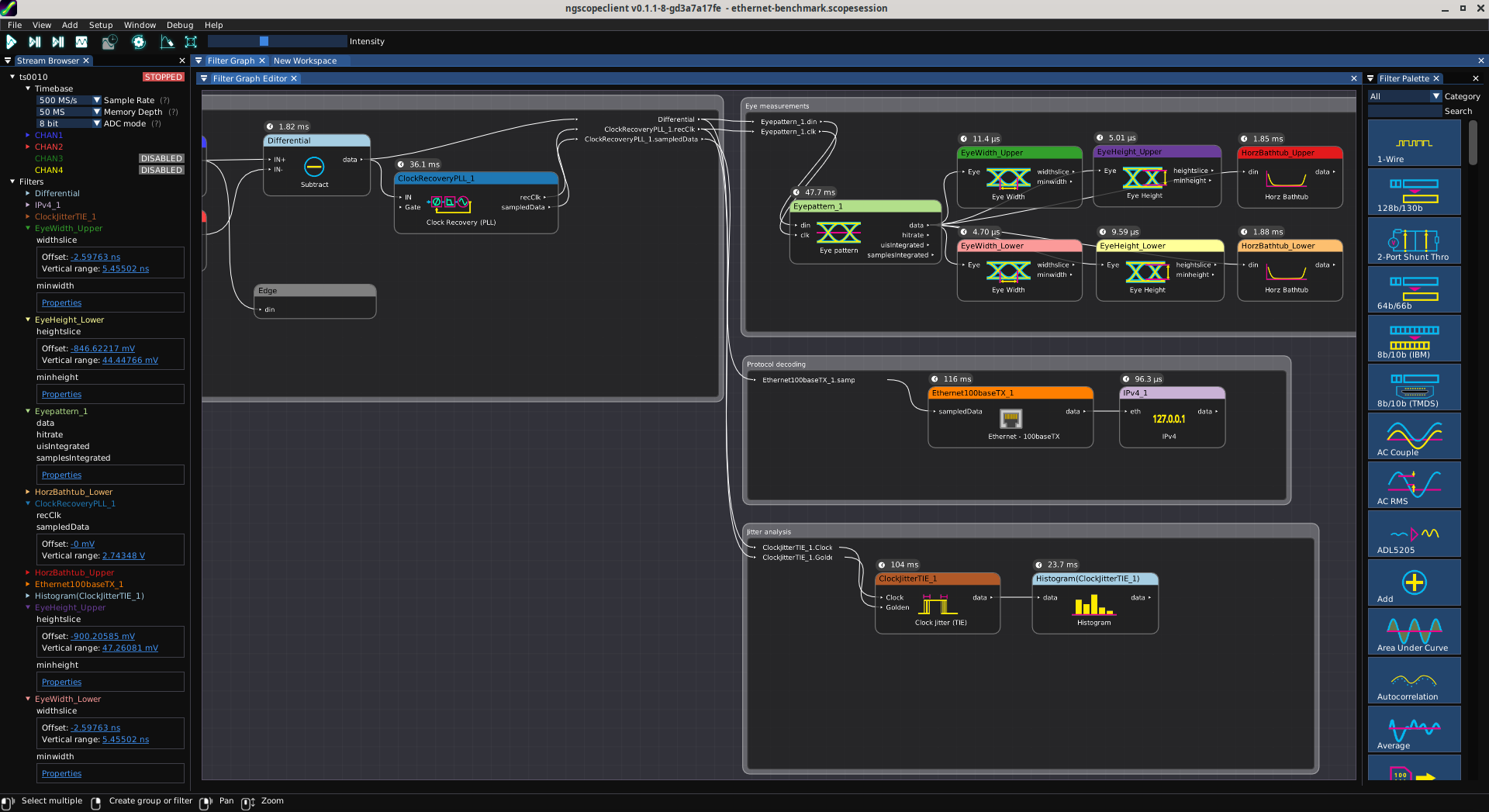
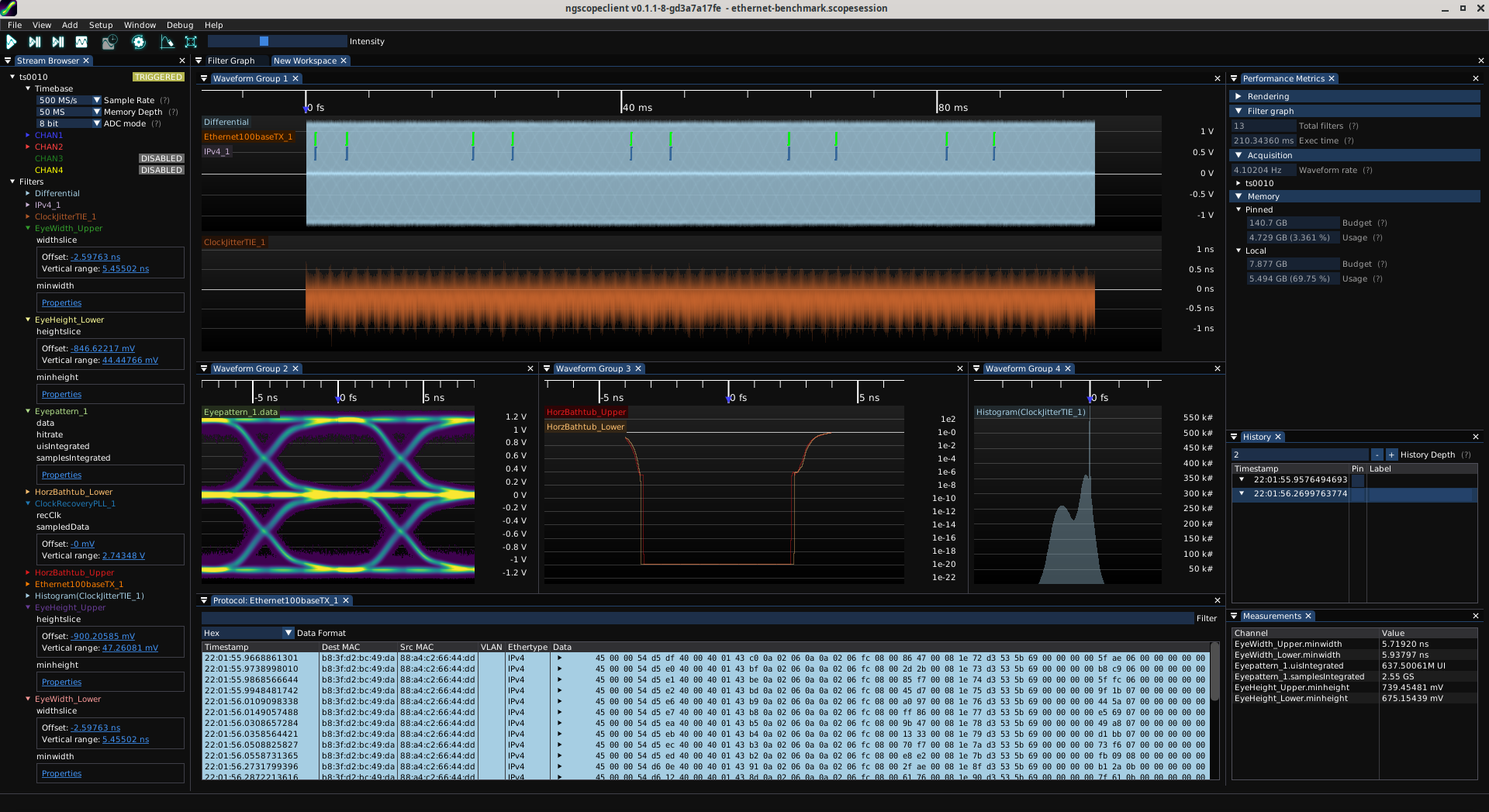
Now that I'm on a GPU acceleration kick in ngscopeclient again I'm spoiled. Every time I use a filter block even on a massive waveform I expect it to be instantaneous and get frustrated when it's not lol.
If this keeps up we'll have GPU i2c and spi decodes pretty soon.
After a three-and-a-half-month journey, NASA’s Interstellar Mapping and Acceleration Probe or #IMAP has finally reached its destination, a strategic location between the Sun and Earth where it will begin its groundbreaking mission to study the edge of our solar system and advance our knowledge of space weather on Feb. 1: https://www.jhuapl.edu/news/news-releases/260112-imap-arrives-l1
A profile of Substrate, which uses particle acceleration to handle lithography, claiming to solve one of tech's toughest problems, and aims to compete with ASML (Bloomberg)
https://www.bloomberg.com/news/articles/20
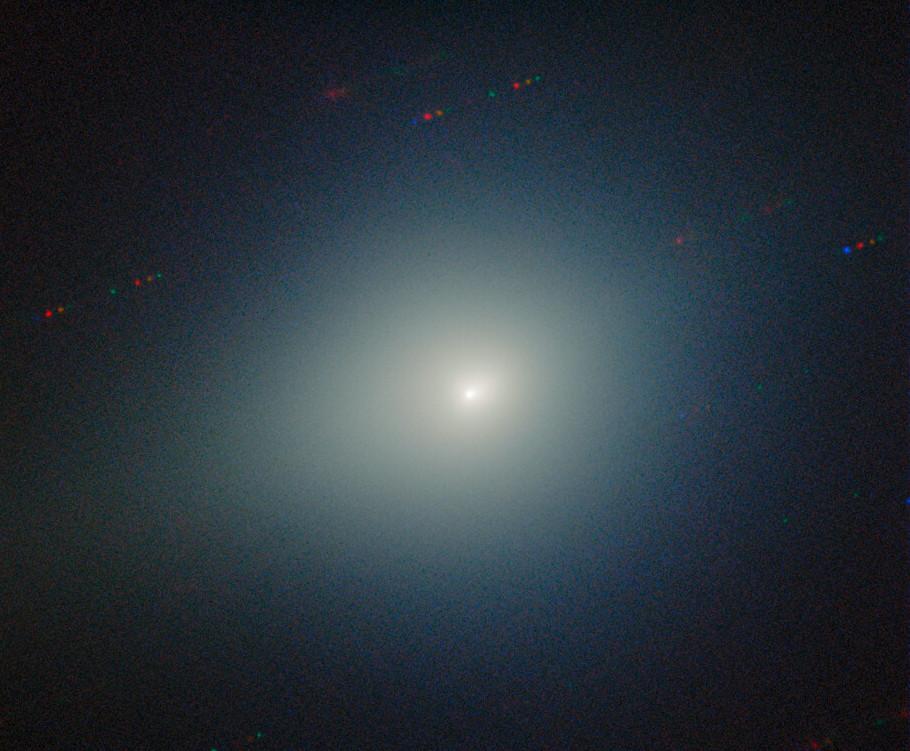
Finally an RGB image of comet #3IATLAS from images taken by #GeminiNorth during the 26 November #shadowTheScientists session: https://noirlab.edu/public/news/noirlab2532/ - the coma has become bluer due to more gas emission. Also published today: an X-ray image by XMM-Newton at https://www.esa.int/ESA_Multimedia/Images/2025/12/XMM-Newton_sees_comet_3I_ATLAS_in_X-ray_light with explanations in http://www.cbat.eps.harvard.edu/iau/cbet/005600/CBET005646.txt which also contains more 3I news.
Meanwhile the paper https://iopscience.iop.org/article/10.3847/2515-5172/ae2915 claims an upper limit for 3I's nucleus diameter of only some 750 meters from the measured non-gravitational acceleration (NGA) parameters: that would be waaay more stringent than the 5.6 km upper limit from early Hubble observations reported in https://iopscience.iop.org/article/10.3847/2041-8213/adf8d8 (where also a lower limit of 440 meters is stated).
Last evening of Christmas vacation before getting back to work for the new year.
Aiming to make it a good one. Working on GPU acceleration of the TIE filter and maybe the histogram block so I can do jitter analysis faster.
The peak at T=0 in the jitter histogram is related to use of the GPU CDR block and doesn't show up in the CPU implementation. It's likely caused by transients of some sort at thread block boundaries and I need to spend more time chasing it, I wouldn'…
EVs are surprisingly powerful. This is not an endorsement to drive badly, but here's a relevant anecdote.
Yesterday, I was moving along our local freeway just above the posted 110kph limit when I started to get boxed in by some silly drivers doing silly things and acting erractically.
In order to avoid any possibility of a bad situation, I moved into the passing lane and accelerated quickly to go around someone and separate myself from the crowd.
I stepped on the “gas” and easily went around the person in a few seconds… then I looked down and realized I was doing 150kph.
Whoa horsey!🐎
I pulled back into the travelling lane and slowed down to 115kph.
That kind of acceleration, especially at that already high cruising speed, just wasn’t possible in any other car I've ever owned.
EVs are great, but they are still vehicles that can reach dangerously high speeds.
Here's another anecdote: Last week my daughter was very nearly run over by a truck as she was walking in a crosswalk. She was halfway across the street when an (oversized) pickup truck turned left across her, completely on a red light. She is relatively small in stature, her head would have barely been above the hood of the truck.
She saw it at the last second and jumped back... the truck missed by inches. Another car at the intersection honked at the truck. It stopped in the crosswalk, the driver gave HER a dirty look, and zoomed off. The car driver who honked leaned out the window and kindly asked if she was ok. She was.
Driving is the most dangerous thing we do on a daily basis.. for ourselves, and everyone around us. Take care out there friends.
#Driving #Commuter #EVs #Transportation #PublicTransit #Pedestrians
https://flipboard.com/@insideevs/insideevs-diuanki5z/-/a-ngD5hVuiSdatWdkb-4BdLw:a:2577024118-/0
Has there ever been a scene of witches flying around on brooms in a movie that has realistic acceleration physics etc?
I'm picturing a pair of witches in tight formation at high altitude making a steep dive to pick up speed, then pull out at treetop height, a high G turn to line up for a low pass over a bunch of trick-or-treaters, then maybe getting a ping on their RWR when some grownups come into view.
The radial acceleration relation at the EDGE of galaxy formation - testing its universality in low-mass dwarf galaxies: #DarkMatter debate narrows thanks to dwarf galaxies: https://www.aip.de/en/news/dark-matter-debate-narrows/
The size of #3I/ATLAS from non-gravitational acceleration: https://arxiv.org/abs/2512.18341 -> "we find diameters between 820 meters and 1050 meters [...] reliable estimates of the mass loss rate at other stages of the comet's trajectory will substantially reduce the systematic uncertainty in this estimate."
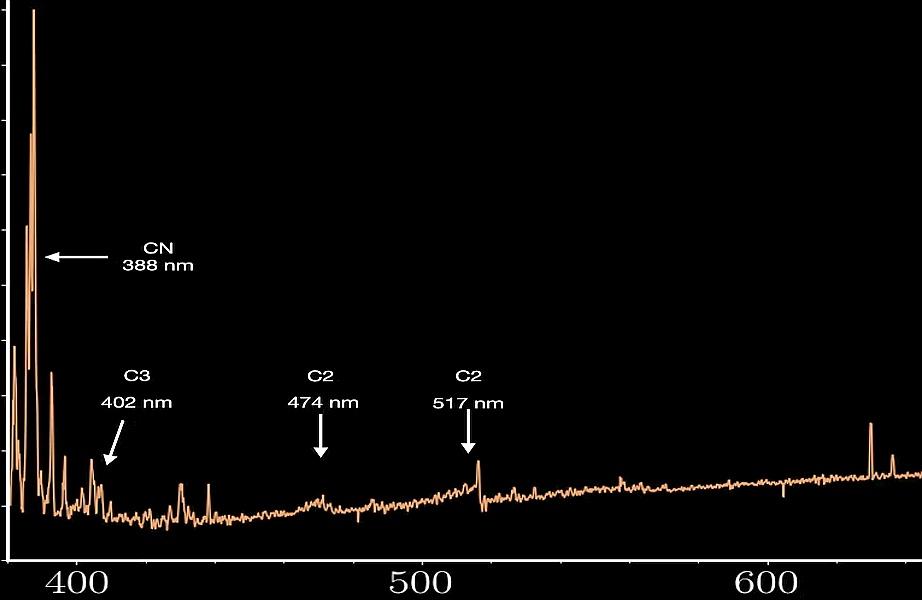
And here is now also a spectrum of #comet #3I/ATLAS taken during the #ShadowTheScientists session on 26 November, from https://www.astronomerstelegram.org/?read=17561 - CN (388 nm), C3 (402 nm) and C2 (474 nm/517 nm) are detected. Meanwhile the paper https://arxiv.org/abs/2512.18341 concludes from the non-gravitational acceleration that the diameter of the comet's nucleus is 820 to1050 m.
 @tinoeberl@mastodon.online