 @grumpybozo@toad.social
2025-06-14 17:42:05
After all, they called Joe Biden, the former Senator from CapitalOne and a devout Catholic, a socialist and communist.
One of the differences between the Right and Left in the USA is that the Right is dedicated to the idea of political tribal solidarity and social binaries, while the Left puts an overriding emphasis on its own diversity, that of the Right, and that of society.
It is part of how they manage to maintain themselves in power.
 @inthehands@hachyderm.io
2025-06-14 23:37:27
A gaudy stage with the US Army logo and Coinbase listed as its sponsor underneath.
I am pretty damned far from being one of those people who puts the armed services some kind of quasi-religious pedestal, and even to me this is deeply offensive, just incredibly gross.
EDIT to add: This is so hideous I’m having trouble believing it. Can anyone verify the photo?
EDIT 2: Yes, almost certainly real; see thread
https://fed.brid.gy/r/https://bsky.app/profile/did:plc:gvda6fem6r7selm4gzjjww4a/post/3lrm2rrrhms2y
 @tiotasram@kolektiva.social
2025-07-04 20:14:31
Long; central Massachusetts colonial history
Today on a whim I visited a site in Massachusetts marked as "Huguenot Fort Ruins" on OpenStreetMaps. I drove out with my 4-year-old through increasingly rural central Massachusetts forests & fields to end up on a narrow street near the top of a hill beside a small field. The neighboring houses had huge lawns, some with tractors.
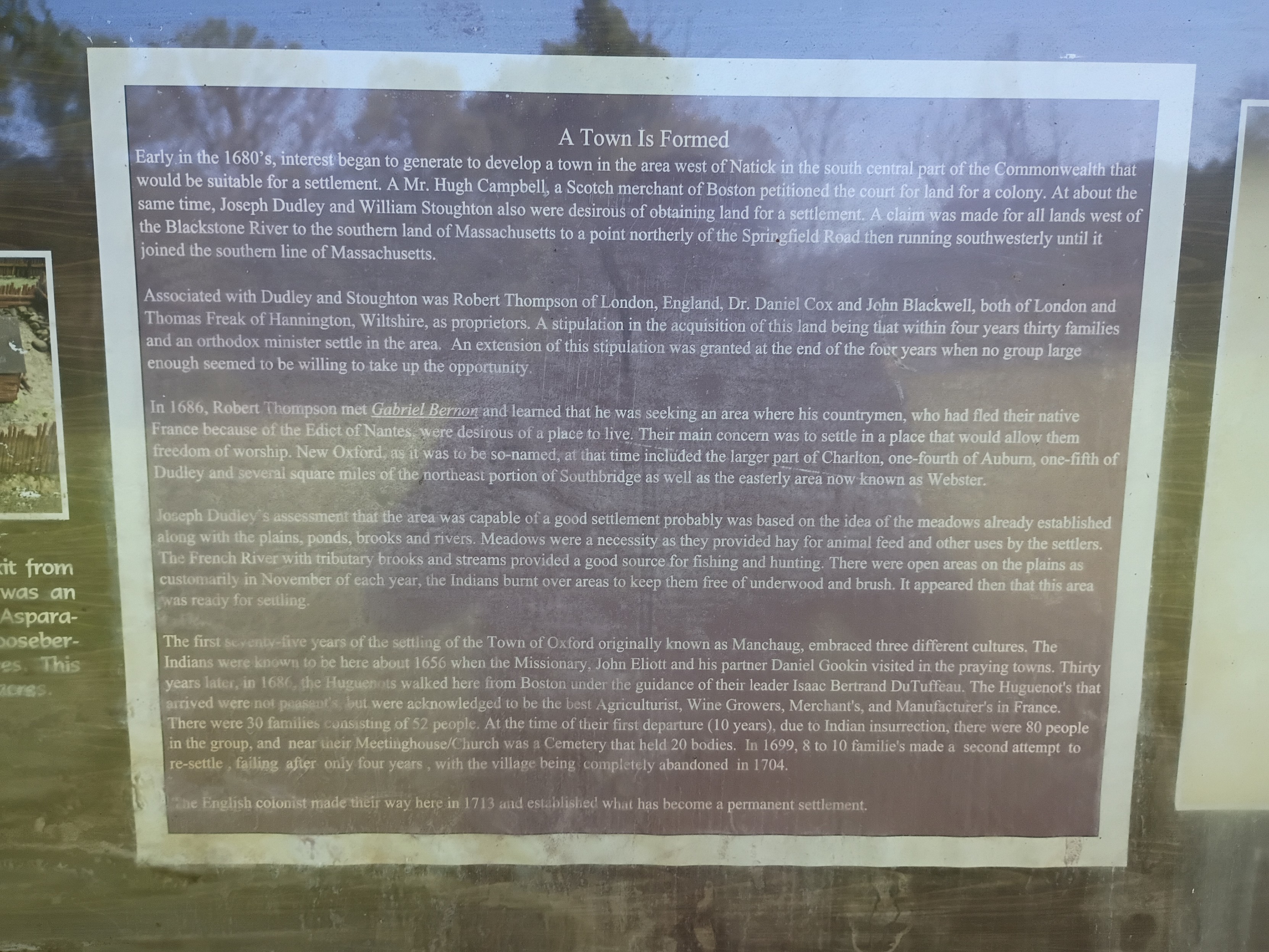
Appropriately for this day and this moment in history, the history of the site turns out to be a microcosm of America. Across the field beyond a cross-shaped stone memorial stood an info board with a few diagrams and some text. The text of the main sign (including typos/misspellings) read:
"""
Town Is Formed
Early in the 1680's, interest began to generate to develop a town in the area west of Natick in the south central part of the Commonwealth that would be suitable for a settlement. A Mr. Hugh Campbell, a Scotch merchant of Boston petitioned the court for land for a colony. At about the same time, Joseph Dudley and William Stoughton also were desirous of obtaining land for a settlement. A claim was made for all lands west of the Blackstone River to the southern land of Massachusetts to a point northerly of the Springfield Road then running southwesterly until it joined the southern line of Massachusetts.
Associated with Dudley and Stoughton was Robert Thompson of London, England, Dr. Daniel Cox and John Blackwell, both of London and Thomas Freak of Hannington, Wiltshire, as proprietors. A stipulation in the acquisition of this land being that within four years thirty families and an orthodox minister settle in the area. An extension of this stipulation was granted at the end of the four years when no group large enough seemed to be willing to take up the opportunity.
In 1686, Robert Thompson met Gabriel Bernor and learned that he was seeking an area where his countrymen, who had fled their native France because of the Edict of Nantes, were desirous of a place to live. Their main concern was to settle in a place that would allow them freedom of worship. New Oxford, as it was the so-named, at that time included the larger part of Charlton, one-fourth of Auburn, one-fifth of Dudley and several square miles of the northeast portion of Southbridge as well as the easterly ares now known as Webster.
Joseph Dudley's assessment that the area was capable of a good settlement probably was based on the idea of the meadows already established along with the plains, ponds, brooks and rivers. Meadows were a necessity as they provided hay for animal feed and other uses by the settlers. The French River tributary books and streams provided a good source for fishing and hunting. There were open areas on the plains as customarily in November of each year, the Indians burnt over areas to keep them free of underwood and brush. It appeared then that this area was ready for settling.
The first seventy-five years of the settling of the Town of Oxford originally known as Manchaug, embraced three different cultures. The Indians were known to be here about 1656 when the Missionary, John Eliott and his partner Daniel Gookin visited in the praying towns. Thirty years later, in 1686, the Huguenots walked here from Boston under the guidance of their leader Isaac Bertrand DuTuffeau. The Huguenot's that arrived were not peasants, but were acknowledged to be the best Agriculturist, Wine Growers, Merchant's, and Manufacter's in France. There were 30 families consisting of 52 people. At the time of their first departure (10 years), due to Indian insurrection, there were 80 people in the group, and near their Meetinghouse/Church was a Cemetery that held 20 bodies. In 1699, 8 to 10 familie's made a second attempt to re-settle, failing after only four years, with the village being completely abandoned in 1704.
The English colonist made their way here in 1713 and established what has become a permanent settlement.
"""
All that was left of the fort was a crumbling stone wall that would have been the base of a higher wooden wall according to a picture of a model (I didn't think to get a shot of that myself). Only trees and brush remain where the multi-story main wooden building was.
This story has so many echoes in the present:
- The rich colonialists from Boston & London agree to settle the land, buying/taking land "rights" from the colonial British court that claimed jurisdiction without actually having control of the land. Whether the sponsors ever actually visited the land themselves I don't know. They surely profited somehow, whether from selling on the land rights later or collecting taxes/rent or whatever, by they needed poor laborers to actually do the work of developing the land (& driving out the original inhabitants, who had no say in the machinations of the Boston court).
- The land deal was on condition that there capital-holders who stood to profit would find settlers to actually do the work of colonizing. The British crown wanted more territory to be controlled in practice not just in theory, but they weren't going to be the ones to do the hard work.
- The capital-holders actually failed to find enough poor suckers to do their dirty work for 4 years, until the Huguenots, fleeing religious persecution in France, were desperate enough to accept their terms.
- Of course, the land was only so ripe for settlement because of careful tending over centuries by the natives who were eventually driven off, and whose land management practices are abandoned today. Given the mention of praying towns (& dates), this was after King Phillip's war, which resulted in at least some forced resettlement of native tribes around the area, but the descendants of those "Indians" mentioned in this sign are still around. For example, this is the site of one local band of Nipmuck, whose namesake lake is about 5 miles south of the fort site: #LandBack.
 @grumpybozo@toad.social
2025-06-14 20:48:17
I know it is well-meaning, but extrapolating the total size of 2000 events from 320 reports is bogus unless one models the size distribution and how that influences whether an event has a report. I.e. big events get reported, smaller ones not so much.
Even with that, it would be very much open to debate.
 @leftsidestory@mstdn.social
2025-05-13 00:30:02





 @PwnieFan@infosec.exchange
2025-06-13 14:53:32
“…declared in an article based exclusively on LAPD sources. It’s an understandable decision on their part … As of Tuesday morning, the LA Press Club documented over 30 injuries to members of the press. Easier and safer to parrot police talking points than face down their guns.”
https://
 @karlauerbach@sfba.social
2025-06-10 00:46:43
I just took a look at the proposed text for these "trump accounts".
The language begins at page 741 in the linked-to .pdf file, below.
The language is rather vague. For example, it does not indicate the base date for measuring the age of the "beneficiary". Is it the conception date or the live-birth date?
And the text is filled with terribly vague phrases like "Rules similar to the rules of section" - There are big devils lurking in that hor…

 @hex@kolektiva.social
2025-06-12 07:31:28
The liberal obsession with optics serves the right and persuades no one. There is literally an active ethnic cleansing happening in the US right now, and the only thing that matters is making that as hard as possible to carry out.
Anarchists destroying intelligence assets saves lives. Every escooter thrown at a cop car is one less escort for a goon too afraid to kidnap random brown people without being flanked by a branch full of bad apples. Spray paint is not violence. Vandalism is not violence. Community self defense in all forms is legitimate.
Make no mistake, these raids are about changing demographics. Demographic trends have been shifting blue for a long time, and the right has, for a long time, been blaming "white replacement." Conspiracy theory aside, Democrats have also been relying on the growth of black and brown voters as a block. The nuances of whiteness as an identity are lost on the current administration and their supporters. They see that "white people will be a minority by 2050" and equate that with the "end of Western Civilization."
The only way to "save Western Civilization" is to change those demographics. Forced birth and forced removal are two sides of the same white nationalist objective. Of course they can't have due process, because they need to be able to kidnap anyone who they see as a threat to their demographic future.
They don't care about optics. The plan is to murder away any threat and flood everyone else with propaganda. There is no mythical middle. There's no one unconvinced. They know this, but they win when democrats buy that myth and save the police the work of policing the protests.
If your protest is 90% "peaceful," they'll take pictures of the 10% that isn't. If it's 99% peaceful, they'll shoot rubber bullets and teargas until someone throws a brick and take 100 pictures from a dozen angles. If its 100% "peaceful" and no one can be provoked, they'll generate pictures with AI or photoshop like they did during the George Floyd uprising and the pictures from the CHOP/CHAZ. Do you have literally no memory?
#USPol #FiftyFiftyOne #50501movenent #resistance #NoKingsDay #NoKingsDayOfAction
@leftsidestory@mstdn.social2025-05-13 00:30:02
@tiotasram@kolektiva.social2025-06-21 02:34:13
Why AI can't possibly make you more productive; long
#AI and "productivity", some thoughts:
Edit: fixed some typos.
Productivity is a concept that isn't entirely meaningless outside the context of capitalism, but it's a concept that is heavily inflected in a capitalist context. In many uses today it effectively means "how much you can satisfy and/or exceed your boss' expectations." This is not really what it should mean: even in an anarchist utopia, people would care about things like how many shirts they can produce in a week, although in an "I'd like to voluntarily help more people" way rather than an "I need to meet this quota to earn my survival" way. But let's roll with this definition for a second, because it's almost certainly what your boss means when they say "productivity", and understanding that word in a different (even if truer) sense is therefore inherently dangerous.
Accepting "productivity" to mean "satisfying your boss' expectations," I will now claim: the use of generative AI cannot increase your productivity.
Before I dive in, it's imperative to note that the big generative models which most people think of as constituting "AI" today are evil. They are 1: pouring fuel on our burning planet, 2: psychologically strip-mining a class of data laborers who are exploited for their precarity, 3: enclosing, exploiting, and polluting the digital commons, and 4: stealing labor from broad classes of people many of whom are otherwise glad to give that labor away for free provided they get a simple acknowledgement in return. Any of these four "ethical issues" should be enough *alone* to cause everyone to simply not use the technology. These ethical issues are the reason that I do not use generative AI right now, except for in extremely extenuating circumstances. These issues are also convincing for a wide range of people I talk to, from experts to those with no computer science background. So before I launch into a critique of the effectiveness of generative AI, I want to emphasize that such a critique should be entirely unnecessary.
But back to my thesis: generative AI cannot increase your productivity, where "productivity" has been defined as "how much you can satisfy and/or exceed your boss' expectations."
Why? In fact, what the fuck? Every AI booster I've met has claimed the opposite. They've given me personal examples of time saved by using generative AI. Some of them even truly believe this. Sometimes I even believe they saved time without horribly compromising on quality (and often, your boss doesn't care about quality anyways if the lack of quality is hard to measure of doesn't seem likely to impact short-term sales/feedback/revenue). So if generative AI genuinely lets you write more emails in a shorter period of time, or close more tickets, or something else along these lines, how can I say it isn't increasing your ability to meet your boss' expectations?
The problem is simple: your boss' expectations are not a fixed target. Never have been. In virtue of being someone who oversees and pays wages to others under capitalism, your boss' game has always been: pay you less than the worth of your labor, so that they can accumulate profit and thus more capital to remain in charge instead of being forced into working for a wage themselves. Sure, there are layers of management caught in between who aren't fully in this mode, but they are irrelevant to this analysis. It matters not how much you please your manager if your CEO thinks your work is not worth the wages you are being paid. And using AI actively lowers the value of your work relative to your wages.
Why do I say that? It's actually true in several ways. The most obvious: using generative AI lowers the quality of your work, because the work it produces is shot through with errors, and when your job is reduced to proofreading slop, you are bound to tire a bit, relax your diligence, and let some mistakes through. More than you would have if you are actually doing and taking pride in the work. Examples are innumerable and frequent, from journalists to lawyers to programmers, and we laugh at them "haha how stupid to not check whether the books the AI reviewed for you actually existed!" but on a deeper level if we're honest we know we'd eventually make the same mistake ourselves (bonus game: spot the swipe-typing typos I missed in this post; I'm sure there will be some).
But using generative AI also lowers the value of your work in another much more frightening way: in this era of hype, it demonstrates to your boss that you could be replaced by AI. The more you use it, and no matter how much you can see that your human skills are really necessary to correct its mistakes, the more it appears to your boss that they should hire the AI instead of you. Or perhaps retain 10% of the people in roles like yours to manage the AI doing the other 90% of the work. Paradoxically, the *more* you get done in terms of raw output using generative AI, the more it looks to your boss as if there's an opportunity to get enough work done with even fewer expensive humans. Of course, the decision to fire you and lean more heavily into AI isn't really a good one for long-term profits and success, but the modern boss did not get where they are by considering long-term profits. By using AI, you are merely demonstrating your redundancy, and the more you get done with it, the more redundant you seem.
In fact, there's even a third dimension to this: by using generative AI, you're also providing its purveyors with invaluable training data that allows them to make it better at replacing you. It's generally quite shitty right now, but the more use it gets by competent & clever people, the better it can become at the tasks those specific people use it for. Using the currently-popular algorithm family, there are limits to this; I'm not saying it will eventually transcend the mediocrity it's entwined with. But it can absolutely go from underwhelmingly mediocre to almost-reasonably mediocre with the right training data, and data from prompting sessions is both rarer and more useful than the base datasets it's built on.
For all of these reasons, using generative AI in your job is a mistake that will likely lead to your future unemployment. To reiterate, you should already not be using it because it is evil and causes specific and inexcusable harms, but in case like so many you just don't care about those harms, I've just explained to you why for entirely selfish reasons you should not use it.
If you're in a position where your boss is forcing you to use it, my condolences. I suggest leaning into its failures instead of trying to get the most out of it, and as much as possible, showing your boss very clearly how it wastes your time and makes things slower. Also, point out the dangers of legal liability for its mistakes, and make sure your boss is aware of the degree to which any of your AI-eager coworkers are producing low-quality work that harms organizational goals.
Also, if you've read this far and aren't yet of an anarchist mindset, I encourage you to think about the implications of firing 75% of (at least the white-collar) workforce in order to make more profit while fueling the climate crisis and in most cases also propping up dictatorial figureheads in government. When *either* the AI bubble bursts *or* if the techbros get to live out the beginnings of their worker-replacement fantasies, there are going to be an unimaginable number of economically desperate people living in increasingly expensive times. I'm the kind of optimist who thinks that the resulting social crucible, though perhaps through terrible violence, will lead to deep social changes that effectively unseat from power the ultra-rich that continue to drag us all down this destructive path, and I think its worth some thinking now about what you might want the succeeding stable social configuration to look like so you can advocate towards that during points of malleability.
As others have said more eloquently, generative AI *should* be a technology that makes human lives on average easier, and it would be were it developed & controlled by humanists. The only reason that it's not, is that it's developed and controlled by terrible greedy people who use their unfairly hoarded wealth to immiserate the rest of us in order to maintain their dominance. In the long run, for our very survival, we need to depose them, and I look forward to what the term "generative AI" will mean after that finally happens.