 @patrick_townsend@infosec.exchange
2026-08-16 18:13:09
Signal – Don’t forget to configure for privacy
In a business or non-profit environment, there is a good chance that your management team is using Signal. And why not? It brings security and privacy to messaging, file sharing, video and phone calls. Not only can you do one-to-one communications, you can create and manage groups. Sensitive business conversations can remain secret. What’s not to like about that?
Out-of-the-Box Signal needs attention to the configuration settings to get the best privacy. If you are a CISO or IT specialist, you can help your management team configure Signal for the best privacy.
After installing Signal on a mobil phone or desktop, review the configuration settings and adjust them as needed. Here is a free guide that will get you started:
#Security #Privacy #Signal
 @arXiv_csHC_bot@mastoxiv.page
2026-08-12 08:28:14
The Signal Rail: A Deterministic Motion Grammar for Communicating Conversational Agent State in Terminal Interfaces
Matteo Grella
https://arxiv.org/abs/2608.10689 https://arxiv.org/pdf/2608.10689 https://arxiv.org/html/2608.10689
arXiv:2608.10689v1 Announce Type: new
Abstract: Terminal interfaces to conversational agents report rich internal state (listening, thinking, executing tools, awaiting input, failing) almost entirely through text, while the motion channel beside it, the one peripheral vision monitors without reading, carries a single bit: alive. We present the Signal Rail, a one-row terminal status instrument that gives that channel a grammar. Four ideas govern it: spatial semantics (input, processing, and output zones, with direction as meaning), a motion grammar (one kinetic rule per state, never color alone), determinism (frames as a pure function of explicit inputs, golden-frame testable), and honesty (no invented progress or activity). We contribute a 45-section normative specification and a reference implementation inside a working full-duplex local voice agent driven by real signals.
toXiv_bot_toot
 @chris@mstdn.chrisalemany.ca
2026-08-17 04:59:23
Doing some #poolpond math as someone was asking about power usage/cost.
I have been running the pond pumps (Jebao 20000) at 50% normally. They show on the controller to be using around 63 Watts. So that’s 126 Watts total. The pumps run continuously, 24/7.
When we are in the pond, or if I am doing something that disturbs it and it needs a clean, I’ll put them up to 95% temporarily which is 160 W on the display. So 320W total.
I am thinking that in the winter when we are not swimming as much (lol!), and the demands are lower as there is less plant and other growth, I’ll reduce it to minimum which is 30%, which I believe is 15W. So that’s 30W total.
Ok, so now that we have those three modes we can talk about cost and comparison.
Cost: My power cost is based on time of day (cheaper overnight, normal in day, more expensive in evening), so we will keep it simple and say I pay an average of about 11c/kWh.
Comparison: for comparison, since I talk about my #EV a lot, let’s compare to my Kona EV. Which has a 64kWh battery.
Here comes the math:
Let’s say I never do anything but run it at 50%, 24hrs a day and 365 days a year. The math is easy.
63Wx2pumps = 126Wx24hr =3024Wh or 3.024kWh per day
3.0kWh x 365 = 1095kWh per year
1095x11 cents = 12,045/100= $120.45
Or
1095kWh / 64kWh = 17 “fills” of my Kona EV.
Realistically, I will be running these pumps in various configurations and power levels throughout the year. I might even only run one pump at times. I am not sure yet.
But at this point let’s break it down something like:
2% of the time at 95% (320W)
40% of the time at 50% (126W)
58% of the time at 30% (30W)
That works out to:
95% / 320W for 7.3 days = 56kWh = $6.16
50% / 126W for 146 days = 441kWh = $48.51
30% / 30W for 211 days = 151kWh = $16.61
Total: $71.28
If your question is “why is that so much less than running my hot tub like 20 times a year?”… it’s the “hot” part. There won’t be any heating in my poolpond. You swim in whatever temperature it chooses for YOU. 😂 🥶 🥵
Well. That was fun. 🧐
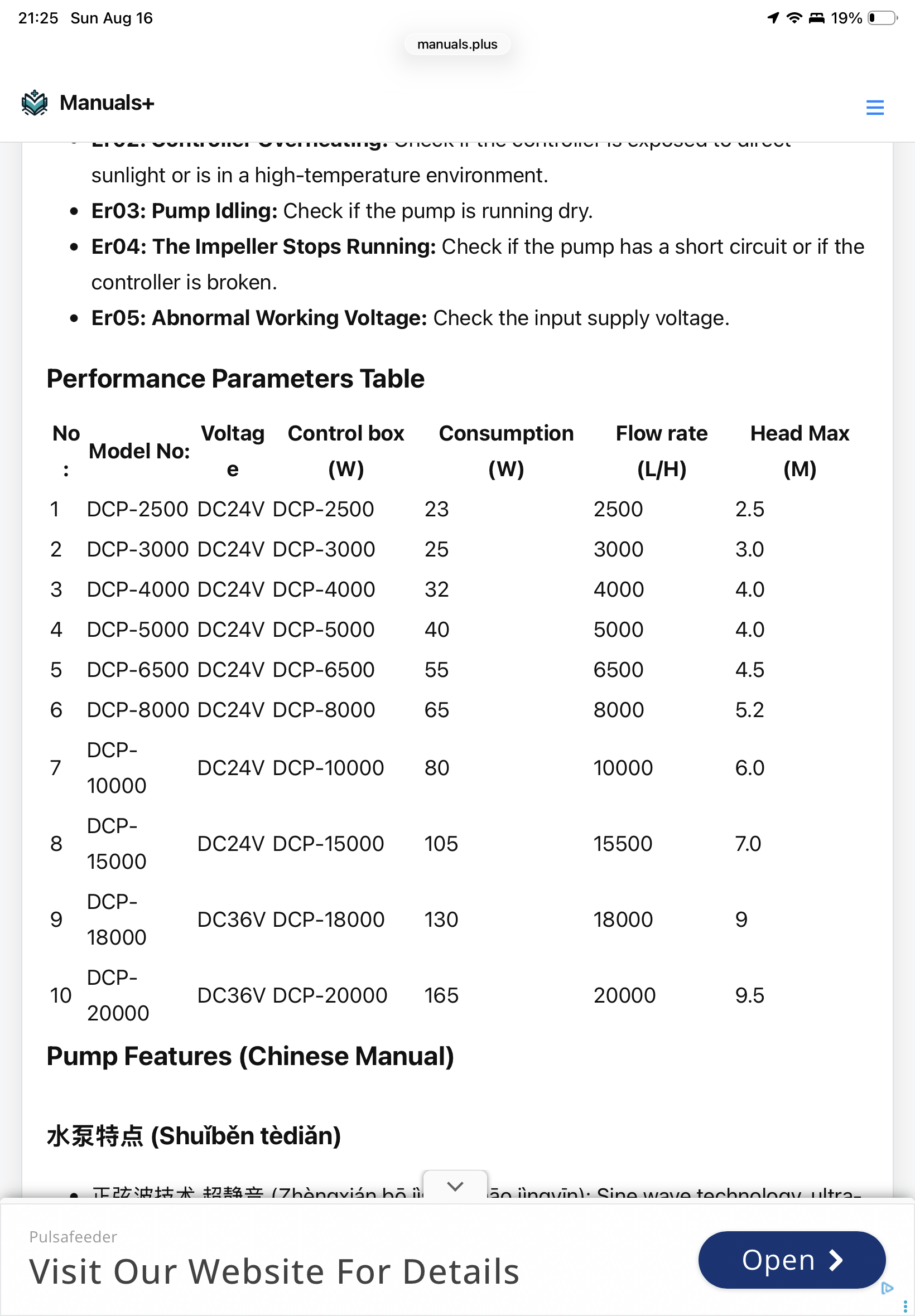
To complete the nerding, I have attached a snap of the user manual with the various pump ratings/specs. It is searchable online for Jebao pumps.
Now you too can have a poolpond!
#poolpond #backyardproject #diy #cost #electricity #power
 @hex@kolektiva.social
2026-08-26 18:34:02
RE: https://todon.eu/@CrimethInc/117162698930485347
There was a time, 4 or 5 years ago, when my partner and I had a conversation. We had already fought last time, and now we had kids. We had the ability to leave, so we decided that we would if things got bad enough. We had to make a decision about when that would be, about what the trigger would be. It was Roe being overturned. It had happened in the past. We left as soon as we could.
If you haven't left, or can't leave, you need to make another decision. You need to decide if you're going to fight or hide. I'll tell you now, your best chance is if you fight before it's too late. If you try to keep your head down the best outcome you can hope for is to survive in shame.
If you decide to fight, then you need to decide when. I don't know what your life looks like, so I can't tell you where that line is. But you need to know what it is, because not knowing is the same as hiding. You need to talk to other people and know when they'll fight, because your best chances are together. Everyone should have a breaking point. A lot of folks may have blown right past it and not noticed, because it's all too overwhelming, because life is already too much without adding more. I understand, but without thinking about it you're making a different choice.
This is an extremely common platform for leftists. I remember my old roommate and their autistici email address. I have an account with them for organizing I did in the past. If you've ever listed to anything on the Channel Zero network, you've probably run across someone reading out a noblogs domain. This is an explicit attack on the left, and specifically on anarchists. This provides the legal framework for mass arrests targeting anarchists.
Will they do that? I don't know. They know they're unpopular and they know anarchists are a big part of the fight. Will they use those warehouses? They'll do what they can get away with.
What will you do to stop them? What will you do when they escalate? Figure out your escalation plan. What would it take to get you in the street? What would it take to get you on the barricades? If you don't have a plan, if you haven't at least thought about it, and maybe even talked about it, then you're deciding to let them do whatever they want.
Fascism is like a dying star that gets bigger even as it consumes itself before exploding. It has to have an enemy, so it will make enemies to feed on. You may be used to being safe when the state cracks down like this, but you never really were. Your turn was just so far off it seemed impossible. But now we're at the end. No one will be safe until this is over. So at the very least, make plans for when they come after you.
 @tiotasram@kolektiva.social
2026-06-29 01:58:24
Thinking about some things that @… said in another thread, and as someone who advocates against AI hype and against the use of most generative AI in most circumstances, I feel it's important to say: many of the ethical issues with using generative AI mirror almost directly the ethical issues with living/working on land stolen by colonists, except that they're less harmful.
Arguments like "well we don't really know whose work it's ripping off this time" and "artists that post their art online know it's going to be looked at; this is the same thing" and "well it's inevitable and everyone's doing it so it's unreasonable to make a big deal about it" directly echo arguments like "well now we don't know whose land it was any more exactly" (yes, we do; you can literally go look up the website of their descendants), or "the natives weren't really using the land anyways", or "it's all in the past now, and it's unavoidable." That unavoidable one is actually somewhat true of using stolen land, at least compared to LLM usage.
If you can see through those lies in the case of AI hype but choose not to do so in the case of colonialism, that says something about your priorities and allegiances.
This is not at all a call for people to talk less about AI; rather it's a call for those who take opposing AI hype seriously to look around and make some noise about other injustices too (I realize many of you already do this).
#AI #LLMs #LandBack #GenAI
 @shriramk@mastodon.social
2026-09-05 15:32:30
I'm now on TTFA:
"How should we teach Programming Languages in the age of AI?
New TTFA episode! 🎙️
We sat down with [me] to talk about PL education, how LLMs are changing the way students learn programming, and what we should actually be teaching when AI can increasingly write the code for us.
We also dive into Racket, programming language design, and [my] decades of experience thinking about how we teach people to reason about programs.
A fascinating conversation!"
https://youtu.be/dS5e8z8S8Fc